
Lost World Bestiary — Hollow Earth & Lemuria
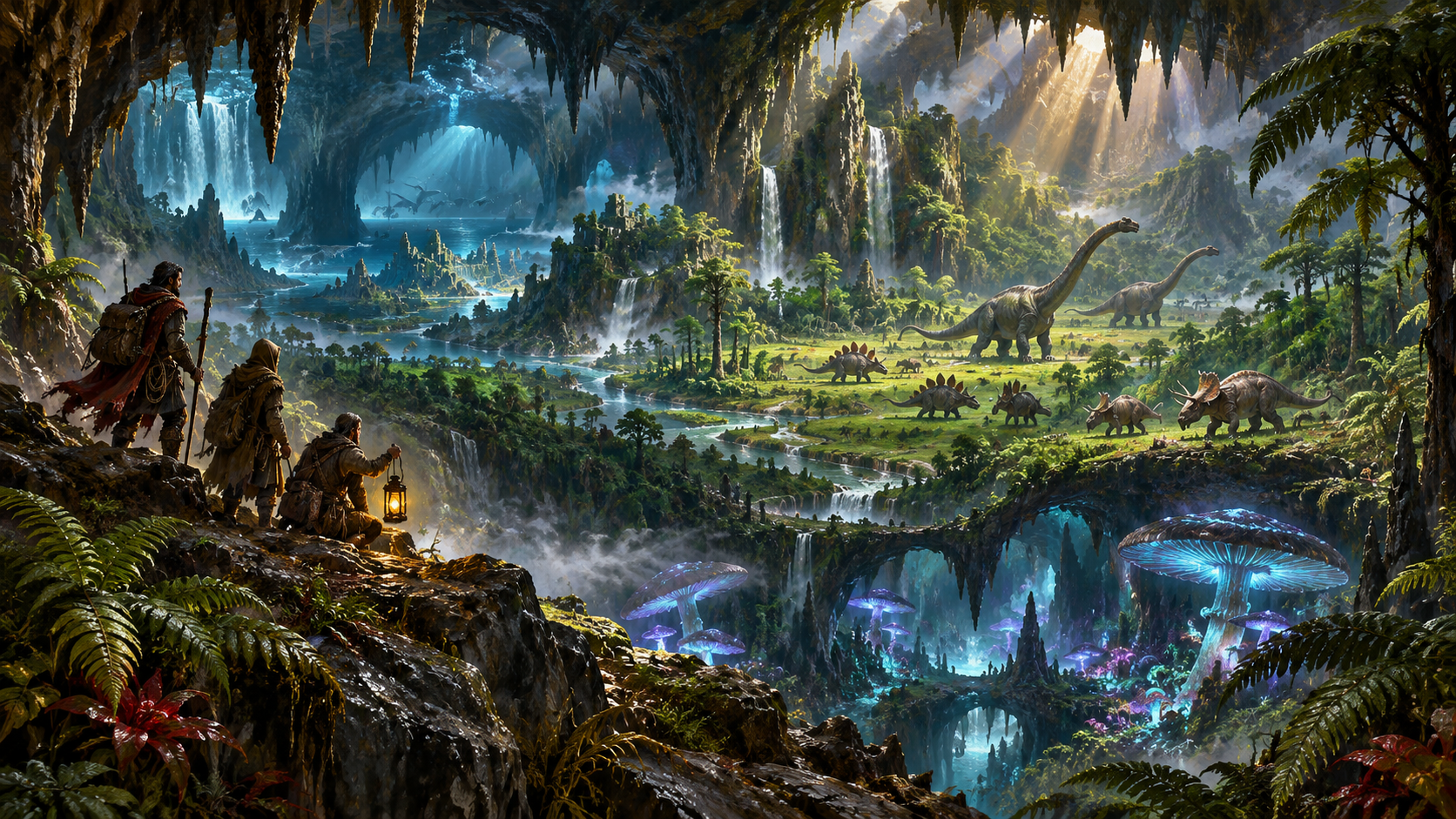
The Lost World Bestiary gathers prehistoric survivors, deep-cavern inhabitants and colossal creatures for expeditions through Hollow Earth, Lemuria and other hidden regions. Browse by environment: an inland sea, a sealed valley and a fungal cavern offer very different dangers.
Hollow Earth’s Old-Earth Wilds preserve different ages in separate refuges. Lemuria’s drowned ruins connect ancient communities, marine habitats and passages into deeper regions. The lists below lead to individual creatures and their rules; the complete Bestiary A–Z covers the wider world.
Choose an environment
Old-Earth Wilds
A basin’s inhabitants matter as much as its predators. Herds migrate between mineral-lit forests and river valleys; armoured herbivores close trails; giant hunters take advantage of the movement. Different basins preserve different periods of prehistory. The lists below separate genuine dinosaurs from earlier land animals and extinct mammals.
Dinosaurs A–L56 linked entries
True dinosaur lineages, from armoured browsers to giant theropods, listed alphabetically by name.
- Acanthopholis
- Acrocanthosaurus
- Allosaurus
- Amargasaurus
- Anatotitan
- Anchisaurus
- Ankylosaurus
- Archaeoceratops
- Argentinosaurus
- Avaceratops
- Avimimus
- Bambiraptor
- Baryonyx
- Beipiaosaurus
- Bellusaurus
- Brachiosaurus
- Brontosaurus
- Buitreraptor
- Camarasaurus
- Camptosaurus
- Carcharodontosaurus
- Carnotaurus
- Centrosaurus
- Ceratosaurus
- Cetiosaurus
- Charonosaurus
- Coelophysis
- Coelurus
- Compsognathus
- Compsognathus Swarm
- Dacentrurus
- Daspletosaurus
- Deinonychus
- Dilophosaurus
- Diplodocus
- Edmontosaurus
- Eoraptor
- Epanterias
- Epidexipteryx
- Eshanosaurus
- Eustreptospondylus
- Gallimimus
- Gasosaurus
- Giganotosaurus
- Gigantoraptor
- Giraffatitan
- Gorgosaurus
- Halticosaurus
- Herrerasaurus
- Huayangosaurus
- Hypsilophodon
- Iguanodon
- Kentrosaurus
- Lambeosaurus
- Leptoceratops
- Lexovisaurus
Dinosaurs M–Z66 linked entries
The remaining linked dinosaur genera. Pterosaurs and marine reptiles are listed separately.
- Maiasaura
- Mamenchisaurus
- Mapusaurus
- Masiakasaurus
- Massopondylus
- Megalosaurus
- Megaraptor
- Micropachycephalosaurus
- Microraptor
- Microvenator
- Monoclonius
- Mononykus
- Nodosaurs
- Notoceratops
- Ornitholestes
- Ornithomimus
- Ouranosaurus
- Oviraptor
- Pachycephalosaurus
- Pachyrhinosaurus
- Paleocinthus
- Panoplosaurus
- Parasaurolophus
- Pawpawsaurus
- Pentaceratops
- Piatnitzkysaurus
- Pinacosaurus
- Plateosaurus
- Prenocephale
- Prosaurolophus
- Protoceratops
- Psittacosaurus
- Rugops primus
- Saltasaurus
- Saurolophus
- Sauroposeidon
- Scelidosaurus
- Scutellosaurus
- Segnosaurus
- Seismosaurus
- Shantungosaurus
- Shunosaurus
- Shuvuuia
- Sinocalliopteryx
- Sinornithosaurus
- Sinraptor
- Spinosaurus
- Stegosaurus
- Stokesosaurus
- Struthiomimus
- Struthiosaurus
- Styracosaurus
- Suchomimus
- Therizinosaurus
- Torosaurus
- Torvosaurus
- Triceratops
- Tsintaosaurus
- Tuojiangosaurus
- Tyrannosaurus
- Utahraptor
- Velociraptor
- Vulcanodon
- Xiaosaurus
- Yangchuanosaurus
- Zuniceratops
Pterosaurs and early flyers6 linked entries
Flying reptiles are not dinosaurs. Early birds are treated separately where their identity requires it.
Early land animals: amphibians, synapsids and ancient reptiles43 linked entries
Aetosaurs, synapsids, early amphibians and related ancient land animals. Some predate dinosaurs by many millions of years.
- Acanthostega
- Arctognathus
- Beelzebufo
- Cacops
- Cynocephali
- Cynognathus
- Desmatosuchus
- Diademodon
- Dicynodont, Dicynodon
- Dicynodont, Diictodon
- Dicynodont, Lystrosaurus
- Dimetrodon
- Diplocaulus
- Edaphosaurus
- Eogyrinus
- Eryops
- Estemmenosuchus
- Euchambersia
- Euparkeria
- Exaeretodon
- Gerrothorax
- Inostrancevia
- Keratocephalus
- Koolasuchus
- Lycaenops
- Mastodonsaurus
- Moschops
- Ophiacodon
- Ornithosuchus
- Paracyclotosaurus
- Placerias
- Platyhystrix
- Postosuchus
- Rhynchosaur
- Robertia
- Sphenacodon
- Stagonolepis
- Tanystropheus
- Teratosaurus
- Terrestrisuchus
- Thrinaxodon
- Tiktaalik
- Titanosuchus
Extinct mammals, giant birds and other land animals80 linked entries
Prehistoric mammals and giant terrestrial survivors, including mammoths, giant sloths and other extinct creatures.
- Aepycamelus
- Agriotherium
- Amebelodon
- Amphicyon
- Anancus
- Andrewsarchus
- Archaeopteryx
- Arsinoitherium
- Astrapotherium
- Baboon, Dire / Dinopithecus
- Beast of Busco
- Brontornis
- Brontotherium
- Cadborosaurus
- Castoroides
- Chalicotherium
- Deinotherium
- Diatryma
- Diprotodon, Giant Wombat
- Dire Ape (Gigantopithecus)
- Dire Badger
- Dire Bat
- Dire Bear (Cave or short-faced)
- Dire Boar (Daeodon)
- Dire Capybara
- Dire Frog, Giant
- Dire Hippopotamus
- Dire Jaguar
- Dire Lamprey
- Dire Lion (Spotted/Cave Lion
- Dire Piranhas (swarm)
- Dire Snake
- Dire Tiger
- Dire Walrus
- Dire Wolf
- Dire Wolverine
- Echidna, Giant
- Echinochimaera
- Ekaltadeta
- Elasmotherium
- Emela-ntouka
- Epigaulus
- Eucladoceros
- Fish Viper
- Giant Moa (Dromornis)
- Haast’s Eagle
- Hippocampi
- Hyaenodon
- Hyracotherium
- Irish Deer
- Kaprosuchus
- Kolponomos
- Leptictidium
- Marine
- Mastodon
- Megalania
- Megantereon
- Megatherium
- Meiolania
- Metridiochoerus
- Moropus
- Ornimegalonyx
- Paraceratherium (Baluchitherium / Indricotherium)
- Pelorovis
- Phororhacos
- Platybelodon
- Potamotherium
- Priscileo
- Procoptodon
- Sarkastodon
- Simosuchus
- Sloth, Dire
- Smilodon
- Smilodon, Homotherium
- Thylacoleo
- Titanoboa
- Titanotylopus
- Uintatherium
- Wakaleo
- Woolly Rhino
Ancient Seas and Rivers
Inland seas and black rivers divide the Inner World. Travel hazards range from giant predatory fish and crocodilians to marine reptiles, primeval invertebrates and creatures that investigate the hull of a passing vessel. Some favour shallow channels; others require open water.
Ancient seas, coasts and waterways32 linked entries
Marine reptiles, ancient fish, shelled invertebrates and predators of rivers and shallows.
- Ambulocetus
- Ammonite
- Anomalocaris
- Basilosaurus
- Belemnite
- Clidastes
- Cryptoclidus
- Deinosuchus
- Dunkleosteus (Dinichthys)
- Elasmosaurus
- Eurypterid
- Eurypterid, Bluetip
- Hallucigenia
- Ichthyosaur small
- Ichthyosaurus
- Kronosaurus
- Liopleurodon
- Megafauna, Archelon
- Monstrous Orthocone
- Nothosaurus
- Plesiosaurus
- Shark, Dire (Megalodon)
- Shark, Helicoprion
- Shonisaurus
- Squid,Giant
- Stethacanthus
- Stomatosuchus
- Temnodontosaurus
- Tullimonstrum
- Tusoteuthis
- Tylosaurus (Mosasaur)
- Xiphactinus
Deep-Earth Caverns and Fungal Forests
Below the passages used by ordinary miners lie fungal forests, vast karst basins and flooded caverns. Some animals are true prehistoric survivors; others are fantasy creatures adapted to darkness, warm stone or isolated ecosystems. A cautious flumph can warn travellers of danger; a cave fisher simply needs prey.
Older than the caverns. A shaft can also break into an abandoned Elder Thing laboratory. The engineered Shoggoths that once worked in such places rebelled during the Middle Permian; isolated descendants still inhabit some buried installations. These are not native Hollow Earth animals, and a passage into an ancient laboratory does not automatically lead into the Inner World. The distinction matters when choosing guides, supplies and an exit.
Great arthropods and cavern invertebrates32 linked entries
Giant ant colonies, ancient arthropods and other oversized invertebrates.
- Arthropleura
- Cave Fisher
- Cockroach, Giant Hissing
- Crab, Shark-Eating
- Drone
- Flail Snail
- Knight
- Monstrous Beetle Bombardier
- Monstrous Beetle Diving Adult
- Monstrous Beetle Diving Larva
- Monstrous Beetle Fire
- Monstrous Beetle Stag
- Monstrous Beetle Stink
- Monstrous Beetle Tiger
- Monstrous Bumblebee
- Monstrous Centipede
- Monstrous Daddy Longlegs
- Monstrous Dragonfly
- Monstrous Fly Horsefly
- Monstrous Grasshopper
- Monstrous Mosquito (Female Culex)
- Monstrous Mosquito Male
- Monstrous Mosquito, Female, Anopheles
- Monstrous Mosquito, Wriggler
- Monstrous Preying Mantis
- Monstrous Scorpion
- Monstrous Spider Jumping
- Monstrous Trilobite
- Monstrous Wasp
- Queen
- Soldier
- Worker
Subterranean beasts and living hazards29 linked entries
Cave fishers, oozes, underground predators and other inhabitants of deep caverns.
- Amoeba, Giant
- Carnivorous Blob
- Crawvil
- Dakwa (Froghemoth)
- Flumph
- Flytrap, Giant
- Fungoid
- Giant Mantidfly
- Goanna, Mythic
- Golem, Clay
- Golem, Oak
- Golem, Stone
- Grick
- Gumberoo
- Hungry Fog
- Idol, Bone
- Idol, Wood
- Jelly, Ochre
- Leshy
- Leshy, Fungus
- Leshy, Gourd
- Living Mirage
- Living Wall
- Lurking Ray
- Lurking Ray, Executioner’s Hood
- Lurking Ray, Lurker Above
- Lurking Ray, Trapper
- Monstrous Spider
- Shambling Mound
Primordial Colossi
A colossus can close a strait, destroy a settlement or force an entire expedition to turn back. These entries distinguish kaiju, gargantuas, elemental behemoths and ancient giants. Their habitats and origins differ; their individual entries describe the territories and powers that make each dangerous.
Kaiju in known history. In 1274, Mizuchi-no-Arashi overturned withdrawing Eastern Fang ships and damaged Japanese coastal settlements. The second invasion in 1281 brought a storm in which Raijin, Susanoo and coastal kami acted, while the war also awakened Mogaru. His advance devastated invading shipping and nearby settlements alike. The chronicle of the two invasions records these separate interventions.
- Agyra — A two-headed, winged kaiju associated with volcanic territory.
- Behemoth Gorilla — A colossal ape, distinct from the elemental behemoth family.
- Behemoths — family — A family of primal creatures associated with elemental and divine power.
- Bezravnis — A burrowing kaiju that re-emerges after long periods of torpor.
- Chthonian Titan — An ancient titan of tremendous destructive power.
- Earth Giant — An ancient sleeper whose resting form can resemble a hill.
- Godzilla
- Humanoid Gargantua — A colossal humanoid creature.
- Insectoid Gargantua — An immense insectoid creature with enormous larval grounds.
- Kaiju — family
- Mogaru — The Final King, awakened during the invasion of Japan in 1281.
- Mothra
- Tempest Behemoth — A colossal flying creature associated with storms.
- Thalassic Behemoth — A vast marine behemoth.
- Thunder Behemoth — An earth-shaking colossus whose passage can destroy roads and alter migration routes.
Peoples, Kingdoms and Ancient Guardians
Hollow Earth has its own states: Agartha is only one of them. Derro warrens on the approaches, independent illithid city-complexes and other subterranean societies have politics and borders. Surface accounts that treat all deep-dwellers as a single primitive tribe are wrong.
Using This Bestiary in Play
Choose the environment first, then decide how inhabitants respond to a trespass. An expedition might need to cross a feeding ground, negotiate passage through a settlement, wait out a migration, or learn why a dormant colossus has begun to move. Not every encounter should become a fight.
Hollow Earth is a physical Inner World, not another plane. Reaching the real Inner World normally requires passage beyond mines and Deep-Earth caves through rare thresholds. The Hollow Earth gazetteer explains known regions, entrances and current conflicts.
Historical Images and Further Reading

Further viewing: MythKeeper — Pathfinder Creature Feature: Megafauna; AJ Pickett — D&D dinosaur lore. The first surveys Pathfinder megafauna; the second explores dinosaurs in D&D.
Explore more: Dinosaur Bestiary · Kaiju · Complete Bestiary A–Z.
Keep this reference growing
If this page helped with your reading or game, you can support its upkeep or explore the curated books.
Explore the Bookshop — epics, classics and stories behind imagined worlds.