
Animal · Swarm
Swarm of Rats
The Crawling Plague
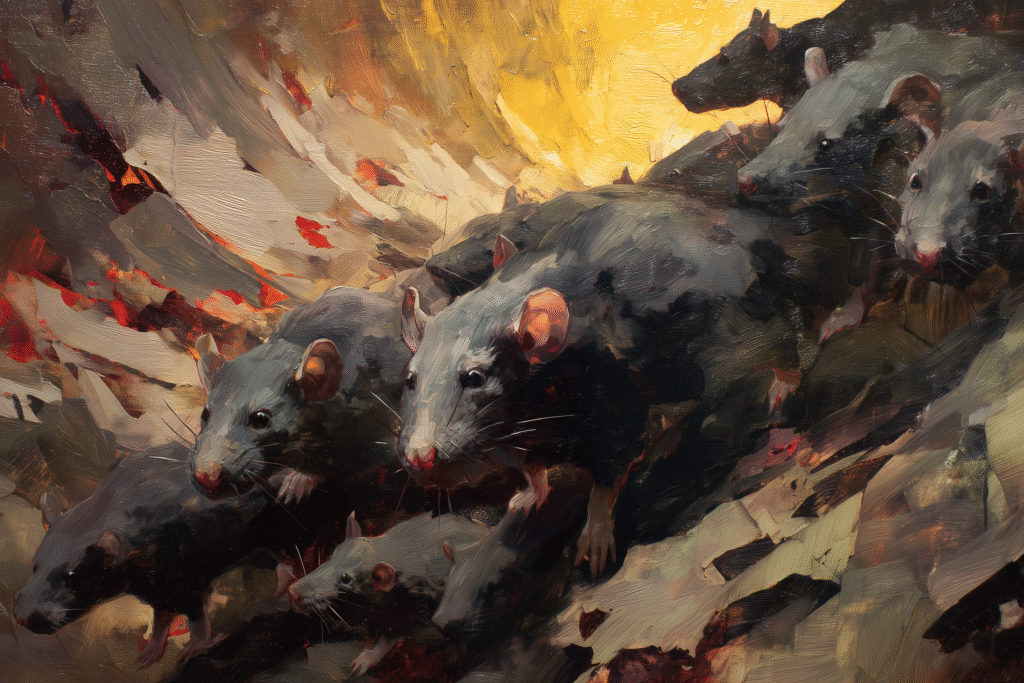
A chittering tide pours from the darkness, hundreds of bodies flowing over one another until floor, wall and prey disappear beneath grey fur and gnashing teeth.
A Swarm of Rats is not an intelligent monster, supernatural species or organised pack. It is a mass of ordinary rats driven into extraordinary concentration by hunger, disturbance, crowding, flood, fire, war or some outside influence. Individually insignificant, hundreds acting together become a dangerous living hazard capable of engulfing prey, disrupting movement and spreading disease through the confined spaces in which the swarm is strongest.
In SpiralWorlds, rat swarms are natural creatures by default. Sewers, granaries, docks, ruins, battlefields, mines, abandoned buildings and refuse-filled streets can produce them without any sorcery at all. Necromancers, witches, plague cults and other supernatural forces may gather or command swarms, but the mere presence of rats is not evidence of occult corruption.
Quick Rules Reference
Game Statistics
AC 12 Initiative +2 (12)
HP 36 (8d8)
Speed 30 ft., Climb 30 ft., Swim 15 ft.
| Ability | Score | Modifier | Save |
|---|---|---|---|
| Strength | 2 | −4 | −4 |
| Dexterity | 15 | +2 | +4 |
| Constitution | 10 | +0 | +2 |
| Intelligence | 2 | −4 | −4 |
| Wisdom | 12 | +1 | +1 |
| Charisma | 2 | −4 | −4 |
Skills Perception +3, Stealth +6
Resistances Bludgeoning, Piercing, Slashing
Immunities Charmed, Frightened, Grappled, Paralyzed, Petrified, Prone, Restrained, Stunned
Senses Darkvision 30 ft.; Passive Perception 13
Languages None
CR 2 (XP 450; PB +2)
Swarm. The swarm can occupy another creature’s space and vice versa, and it can move through any opening large enough for a Tiny rat. The swarm can’t regain Hit Points or gain Temporary Hit Points.
Keen Smell. The swarm has Advantage on Wisdom (Perception) checks that rely on smell.
Distraction. Constitution Saving Throw: DC 12, each creature other than a Construct or Undead that starts its turn in the swarm’s space. Failure: The target has the Incapacitated condition until the start of its next turn.
Filth Fever. The disease has no effect until 1d3 days after infection. When that time elapses, the infected creature gains 1 Exhaustion level. Every 24 hours thereafter, the creature makes a DC 12 Constitution saving throw. On a failed save, it gains 1 Exhaustion level. On a successful save, it gains no additional Exhaustion. Two consecutive successful saves end the disease. An effect that explicitly cures disease also ends Filth Fever.
Bites. Melee Attack Roll: +4, reach 5 ft. Hit: 10 (4d4) Piercing damage, or 5 (2d4) Piercing damage if the swarm is Bloodied. If the target isn’t already infected with Filth Fever, it is subjected to the following effect. Constitution Saving Throw: DC 12. Failure: The target contracts Filth Fever. Success: The target is immune to Filth Fever from this swarm for 24 hours.
The swarm closes rapidly through confined spaces and pours into the spaces occupied by isolated creatures. It relies upon Distraction to overwhelm engulfed prey while repeated bites expose victims to disease.
The rats possess no tactical intelligence. They follow food, movement, scent and openings. Once the swarm is Bloodied, the surviving animals become markedly less dangerous and instinctively seek cracks, drains, rubble or other cover if an obvious escape route exists.
Init +6; Senses low-light vision, scent; Perception +8
AC 14, touch 14, flat-footed 12 (+2 Dex, +2 size)
hp 16 (3d8+3)
Fort +4, Ref +5, Will +2
Defensive Abilities swarm traits; half damage from piercing and slashing attacks
Speed 15 ft., climb 15 ft., swim 15 ft.
Melee swarm (1d6 plus disease)
Space 10 ft.; Reach 0 ft.
Special Attacks disease, distraction (DC 12)
Str 2, Dex 15, Con 13, Int 2, Wis 13, Cha 2
Base Atk +2; CMB —; CMD —
Feats Improved Initiative, Skill Focus (Perception)
Skills Acrobatics +6, Climb +10, Perception +8, Stealth +14, Swim +10
Racial Modifiers uses Dexterity rather than Strength to modify Climb and Swim checks
Disease (Ex) — Filth Fever. Injury; Fortitude DC 12; onset 1d3 days; frequency 1/day; effect 1d3 Dexterity damage and 1d3 Constitution damage; cure 2 consecutive saves. The save DC is Constitution-based.
Distraction (Ex). A living creature that begins its turn in the swarm’s space must succeed on a DC 12 Fortitude save or be nauseated for 1 round. The save DC is Constitution-based.
Environment any
Organization solitary, pack (2–5 swarms), or infestation (6–12 swarms)
Treasure none
Before combat, the rats remain concealed among refuse, collapsed masonry, cellars, drains or other cover when possible. Once disturbed, the swarm moves directly into opponents’ spaces and relies upon automatic swarm damage, disease and Distraction rather than conventional attack rolls.
The swarm has no military discipline and does not intelligently select targets. If badly depleted and presented with an obvious route to safety, surviving rats normally scatter into nearby cover.
| Hit Dice | 4d8 (18 hp) |
|---|---|
| Initiative | +2 |
| Speed | 15 ft. (3 squares), climb 15 ft. |
| Armor Class | 14 (+2 size, +2 Dex), touch 14, flat-footed 12 |
| Base Attack/Grapple | +3/— |
| Attack | Swarm (1d6 plus disease) |
| Full Attack | Swarm (1d6 plus disease) |
| Space/Reach | 10 ft./0 ft. |
| Special Attacks | Disease, distraction |
| Special Qualities | Half damage from slashing and piercing, low-light vision, scent, swarm traits |
| Saves | Fort +4, Ref +6, Will +2 |
| Abilities | Str 2, Dex 15, Con 10, Int 2, Wis 12, Cha 2 |
| Skills | Balance +10, Climb +10, Hide +16, Listen +6, Move Silently +8, Spot +7, Swim +10 |
| Feats | Alertness, Stealthy, Weapon FinesseB |
| Environment | Any |
| Organization | Solitary, pack (2–4 swarms), or infestation (7–12 swarms) |
| Challenge Rating | 2 |
| Treasure | None |
| Alignment | Always neutral |
| Advancement | None |
| Level Adjustment | — |
A rat swarm attempts to surround warm-blooded prey and crawl over it. A creature whose space is occupied by the swarm at the end of the swarm’s movement takes 1d6 points of swarm damage.
Disease (Ex) — Filth Fever. Swarm attack; Fortitude DC 12; incubation 1d3 days; damage 1d3 Dexterity and 1d3 Constitution. The save DC is Constitution-based.
Distraction (Ex). A living creature that begins its turn in the swarm’s square must succeed on a DC 12 Fortitude save or be nauseated for 1 round. The save DC is Constitution-based.
Skills. A rat swarm has a +4 racial bonus on Hide and Move Silently checks and a +8 racial bonus on Balance, Climb and Swim checks. It can take 10 on Climb checks even while rushed or threatened and uses Dexterity rather than Strength for Climb and Swim checks.
The swarm also gains a +8 racial bonus on Swim checks made to perform special actions or avoid hazards. It may take 10 on Swim checks even while distracted or endangered and may use the run action while swimming, provided it swims in a straight line.
Appearance and Natural History
Appearance
At a distance the swarm resembles a dark, rippling stain flowing across the ground. Closer inspection resolves it into hundreds of rats climbing over one another in continual motion: grey, black and brown coats, twitching whiskers, naked tails and momentary flashes of teeth.
The swarm has no fixed outline. Its edges continually divide and reform as individual animals find passages around obstacles, squeeze beneath doors, scramble over fallen masonry or disappear into cracks.
Behaviour
There is no hive mind. What looks like coordination arises from hundreds of animals reacting to the same food, danger, scent and movement. Dense concentrations can nevertheless behave like a single flowing body when confined by walls, tunnels or streets.
An ordinary swarm does not pursue enemies from malice. Hunger, panic, territorial disturbance, flooding and lack of escape routes are far more likely causes.
Habitat
Rat swarms flourish wherever food and shelter accumulate: granaries, docks, markets, cellars, abandoned houses, ruined fortifications, mills, mines, drains, rubbish pits, warehouses and the undersides of crowded settlements.
In the countryside, dense swarms may emerge from barns, mills, battlefield refuse, flood-displaced burrows or food stores left unattended during famine and war.
Motivation
Food and survival dominate the swarm’s behaviour. Rats normally prefer accessible food to a dangerous living target, but starvation, magical compulsion, entrapment or extreme overcrowding can turn a normally evasive mass into a direct threat.
Only a swarm explicitly described as enchanted, possessed, summoned or controlled should be treated as having a supernatural purpose.
Running a Rat Swarm
Make the Terrain Matter
A rat swarm is most memorable when it changes how characters use the environment. Drains, stairwells, cellar doors, overturned furniture, rubble and narrow alleys should determine where the rats can pour through and where characters can escape.
Use Numbers, Not Intelligence
The swarm does not flank with military precision, choose targets through tactical analysis or understand complex magic. It converges on exposed food, trapped prey and obvious routes through obstacles.
A magically controlled swarm may behave with unnatural purpose, but such behaviour should itself be a clue that something beyond ordinary animal instinct is at work.
Give Players Counterplay
- Open ground and clear escape routes weaken the swarm’s ability to trap prey.
- Area attacks are normally more useful against a dense swarm than attacks aimed at individual rats.
- Fire, smoke, flooding, barriers and destroyed food stores can change the encounter without requiring every rat to be killed.
- Closing drains, broken walls or other entry routes may prevent further swarms from entering.
- Destroying one visible swarm may not remove a larger infestation from the surrounding structure.
Swarm Scale and Infestations
| Scale | Typical Use | What It Means in Play |
|---|---|---|
| Scattered Rats | Atmosphere or warning | Individual animals flee unless cornered; swarm statistics are unnecessary. |
| Single Swarm | Local hazard | One concentrated mass capable of engulfing creatures in a confined area. |
| Pack of Swarms | Serious encounter | Several independent swarms enter from different parts of the location. |
| Infestation | Location-scale problem | The visible combat swarms represent only part of a much larger population occupying the structure or district. |
Destroying one swarm does not necessarily eradicate an infestation. Food stores, nests, drains, cellars and neighbouring buildings may continue to support a much larger population.
Historical and Occult Development
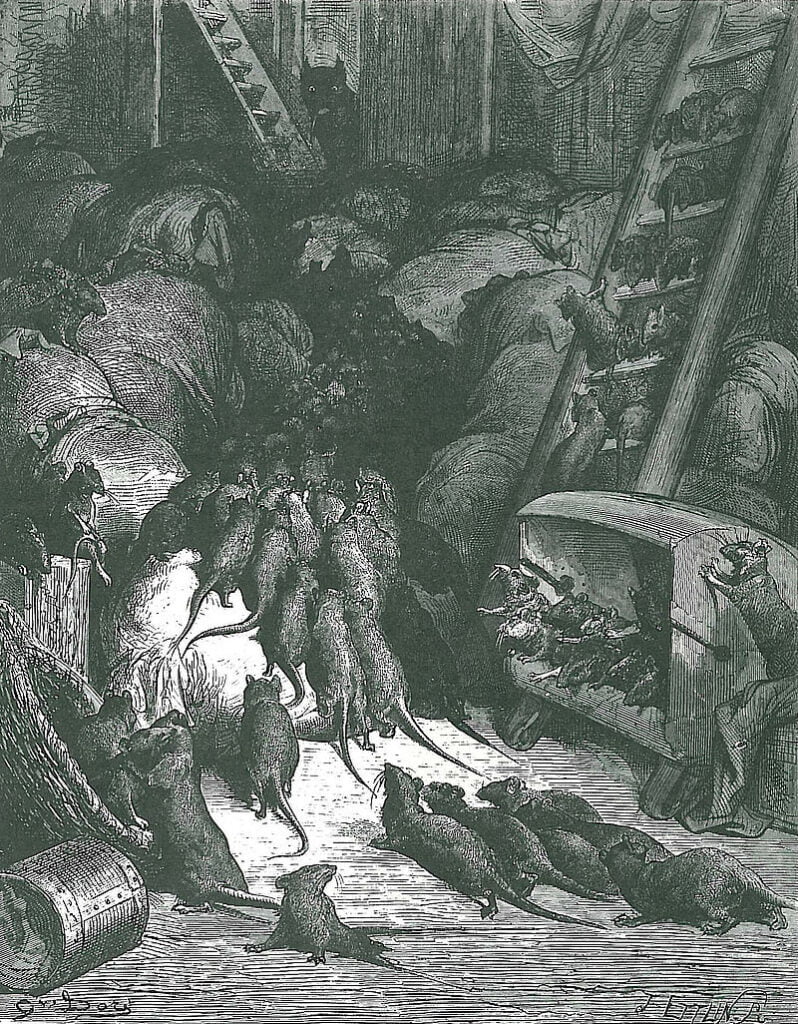
Black rats became closely associated with human settlement, food storage and long-distance trade. Archaeological and genetic evidence indicates major periods of expansion across Europe during both the Roman and medieval eras.
Their medieval resurgence accompanied the growth of towns, commerce and interconnected trade routes. Granaries, harbour districts, crowded houses, mills, ships, warehouses and military supply systems all created favourable environments for large rat populations.
This makes the rat particularly well suited to the late-medieval settlements of SpiralWorlds. A swarm can be both a mundane consequence of human habitation and a serious hazard without requiring magical explanation.
Disease gave rats a darker reputation. The historical transmission of epidemic disease was complex, but rats and their fleas became strongly associated in later cultural memory with plague, corruption, famine and neglected urban spaces.
Occult forces can exploit that existing fear. A sorcerer capable of compelling a city’s ordinary rat population is frightening precisely because the animals were already present beneath floors, behind walls and below the streets.
Historical reference: Max Planck Institute — Spread of Black Rats in Europe .
Mythological Parallels
The Pied Piper of Hamelin
The most famous European tale of a supernatural rat infestation is the Pied Piper of Hamelin. In the familiar version, a mysterious musician draws the town’s rats away and later takes its children after the citizens refuse to honour their bargain.
The history of the legend is more complicated. The oldest surviving tradition concerns the disappearance or departure of Hamelin’s children. The rat-catching portion of the story appears to have been attached to that earlier tradition later.
In SpiralWorlds, where myth may reflect real events, this leaves several possible interpretations. The Piper may truly have possessed power over animals; later chroniclers may have combined two unrelated supernatural events; or an ordinary rat-catcher may have become attached in memory to something far stranger.
Further reading: Cambridge University Library · City of Hameln .
Rat Swarms in Folklore and Sound

Rules Sources and Conversion Notes
Swarm rules: See the SpiralWorlds Swarm subtype for the wider rules and creature category.
D&D 3.5e: The D&D 3.5e statistics follow the System Reference Document Rat Swarm and provide the mechanical foundation for this multi-edition entry.
Pathfinder 1e: The Pathfinder statistics follow the Pathfinder Rat Swarm presentation, including its Pathfinder-specific ability scores, skills, movement, feats and disease rules.
D&D 5.5e / 2024: The first tab is an original SpiralWorlds CR 2 conversion. It translates the older monster’s disease, distraction and swarm identity into contemporary rules language rather than substituting the substantially weaker official 2024 rat swarm.
Keep this reference growing
If this page helped with your reading or game, you can support its upkeep or explore the curated books.
Explore the Bookshop — epics, classics and stories behind imagined worlds.