
Monster, “Astrapotherium: The Gentle Tusked Guardian of Forgotten Wetlands”
“Astrapotherium: The Gentle Tusked Guardian of Forgotten Wetlands”
Astrapotherium — a shaggy, tusked grazer with a tapir-like snout, this gentle giant wades through misty wetlands, feeding on reeds and leaves in the quiet depths of a vanished age.
Astrapotherium — A shaggy, tusked browser of ancient wetlands, the Astrapotherium is a semi-aquatic herbivore whose mournful eyes and flexible snout belie its surprising strength and stubborn temper.
Appearance
Astrapotherium resembles a stocky, long-bodied tapir with short legs and a low-slung back. Its snout extends into a short, muscular proboscis, used to pluck leaves and aquatic shoots. Two small, downward-curving tusks protrude from the lower jaw, more for shoving and display than true combat. Its mud-streaked hide ranges from slate gray to brown-green, often patterned with patches of moss or algae, giving it the look of a creature born from the swamp itself.
Behaviour
Normally calm and deliberate, Astrapotheria spend most of their time wading and grazing in shallow water, their nostrils just above the surface as they pull up reeds. When startled, they emit a deep, braying call and lunge clumsily toward cover or water, trusting their bulk and tough hide to deter predators. They are social in small herds, but prefer distance from humanoids and loud noises.
Habitat
These beasts inhabit lowland marshes, river deltas, and flooded forests, favoring warm, misty climates. They create mud wallows and shallow trails through reeds, shaping the wetland ecosystem much like wild boar or hippos. Their presence often marks fertile, undisturbed land.
Modus Operandi
When forced to fight, an Astrapotherium snorts, stamps, and charges, swinging its tusks in short arcs or attempting to knock foes into the mud. They use water and terrain to their advantage, retreating into deeper pools where they can move more easily and confuse pursuers.
Motivation
Ruled by simple drives — safety, grazing, and companionship — these gentle relics endure through instinct and caution. In myth and druidic lore, they are seen as guardians of balance, the quiet pulse of ancient swamps that existed long before civilization’s rise.
Astrapotherium 5e 2024
Astrapotherium, Pathfinder
Astrapotherium 3.5
Astrapotherium
Large Beast, Unaligned
Armor Class 13 (natural armor)
Hit Points 60 (8d10 + 16)
Speed 30 ft., swim 25 ft.
| STR | DEX | CON | INT | WIS | CHA |
|---|---|---|---|---|---|
| 18 (+4) | 11 (+0) | 15 (+2) | 2 (−4) | 12 (+1) | 6 (−2) |
Saving Throws Con +4
Skills Perception +3, Survival +3
Damage Resistances bludgeoning from nonmagical attacks
Senses passive Perception 13
Languages —
Challenge 2 (450 XP)
Proficiency Bonus +2
Traits
Amphibious Forager. The Astrapotherium can breathe both air and water and can hold its breath for up to 30 minutes.
Swamp Camouflage. The Astrapotherium has advantage on Dexterity (Stealth) checks made to hide in muddy, marshy, or heavily vegetated terrain.
Sure-Footed. The Astrapotherium has advantage on Strength and Dexterity saving throws made against effects that would knock it prone.
Thick Hide. Its dense hide grants it resistance to bludgeoning damage from nonmagical attacks.
Skittish Temperament. When the Astrapotherium takes damage and has no allies within 20 feet, it can use its reaction to move up to half its speed toward the nearest cover or body of water without provoking opportunity attacks.
Actions
Tusks. Melee Weapon Attack: +6 to hit, reach 5 ft., one target.
Hit: 14 (2d8 + 4) slashing damage.
Goring Shove (Recharge 5–6). The Astrapotherium lowers its head and charges. Each creature in a 10-foot line must make a DC 14 Strength saving throw, taking 16 (3d8 + 3) bludgeoning damage and being knocked prone on a failed save, or half as much on a success.
Trumpeting Bellow (1/Day). The Astrapotherium releases a deep, resonant call. Each creature of its choice within 30 feet that can hear it must succeed on a DC 13 Wisdom saving throw or become frightened until the end of its next turn.
Reactions
Defensive Charge. When a creature enters the Astrapotherium’s reach, it makes a tusk attack against that creature. On a hit, the target’s speed is reduced by 10 feet until the start of the Astrapotherium’s next turn.
Tactics
An Astrapotherium prefers to avoid combat, retreating into deep water or dense vegetation when threatened. When cornered, it fights with sudden bursts of aggression — charging, goring, and trampling before retreating again. In herds, adults form a defensive ring around their young, bellowing to startle predators before counterattacking in unison.
Description
Astrapotheria are stocky, long-bodied herbivores that resemble a cross between a tapir and a small hippopotamus, with short legs, a flexible snout, and small downward-curving tusks. Their mud-streaked, moss-tinted hides help them disappear into swampy terrain. Peaceful yet formidable when provoked, they are regarded by druids as keepers of the wetland’s balance—the living pulse of ancient, enduring wilderness.
Astrapotherium
Large Beast
CR 4
XP 1,200
N Medium, Animal
Init +0; Senses low-light vision, scent +2; Perception +6
DEFENSE
AC 15, touch 10, flat-footed 15 (+5 natural)
HP 52 (5d8+30)
Fort +9; Ref +2; Will +3
Defensive Abilities thick hide (resist bludgeoning 2), skittish retreat
OFFENSE
Speed 30 ft., swim 25 ft.
Melee tusks +9 (2d6+4)
Special Attacks goring charge, trumpeting bellow 1/day
STATISTICS
Str 19, Dex 11, Con 17, Int 2, Wis 12, Cha 6
Base Atk +3; CMB +8; CMD 18
Feats Improved Bull Rush, Power Attack, Run, Endurance
Skills Perception +6, Survival +7, Stealth +2 (in marshy terrain)
Languages —
SPECIAL ABILITIES
Amphibious Forager (Ex). The Astrapotherium can breathe underwater and remain submerged for up to 30 minutes.
Swamp Camouflage (Ex). Gains +4 bonus on Stealth checks in muddy, marshy, or heavily vegetated terrain.
Skittish Temperament (Ex). When damaged and no allies are within 30 ft., the Astrapotherium can use a swift move action to retreat into water or dense vegetation without provoking attacks of opportunity.
Goring Charge (Ex). When the Astrapotherium charges at least 20 ft., it may attempt a bull rush (CMB +8) as part of its attack. Creatures in the path take 2d6+4 bludgeoning damage and must succeed on a DC 15 Strength check or be knocked prone.
Trumpeting Bellow (Su) 1/day. A deep, resonant call that frightens nearby foes. All creatures within 30 ft. must succeed on a DC 14 Will save or become frightened for 1 round.
TACTICS
The Astrapotherium avoids combat when possible, using its camouflage and aquatic mobility to escape threats. When cornered or defending young, it charges aggressively, aiming to knock opponents prone with goring shoves. Herds form a defensive semicircle around juveniles, using trumpeting bellows to startle predators and coordinate charges.
ECOLOGY
Environment: Temperate and subtropical wetlands, swamps, marshes
Organization: Solitary or small herds (2–5)
Treasure: None
Description:
Astrapotheria are long-bodied, short-legged herbivores resembling a tapir crossed with a small hippopotamus, with short tusks for display and minor defense, a flexible proboscis for browsing aquatic plants, and mud-streaked, moss-flecked hides that render them nearly invisible in wetlands. Peaceful unless provoked, they are guardians of swamp ecosystems, protecting young and territory with surprising bursts of strength and stubborn endurance.
Astrapotherium
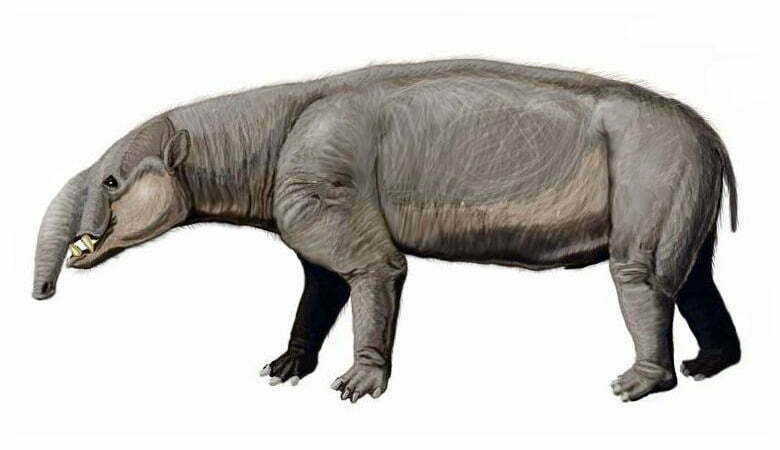
This creature resembles a large tapir with a short prehensile trunk. Two pairs of curved tusks grow from its mouth.
Originally Posted by Shade of the En World forums.
On this Thread
A xenungulate, Astrapotherium is a member of an odd lineage of herbivorous mammals. Despite their superficial resemblance to tapirs and elephants, they are not closely related to either. Astrapotheres are hippo-like in their behavior, wallowing in mudholes and swimming in rivers in order to graze on plants growing from the bottom.
An astrapotherium is over 8 feet long and weighs 500 to 600 pounds.
| Astrapotherium | |
| Large animal | |
| Hit Dice | 6d8+24 (51 hp) |
| Initiative | +0 |
| Speed | 30 ft. (6 squares) |
| Armor Class | 17 (-1 size, +8 natural), touch 9, flat-footed 17 |
| Base Attack/Grapple | +4/+14 |
| Attack | Gore +9 melee (1d8+6) |
| Full Attack | Gore +9 melee (1d8+6) and 2 stamps +7 melee (1d6+3) |
| Space/Reach | 10 ft./5 ft. |
| Special Attacks | – |
| Special Qualities | Hold breath, Low-Light Vision, Scent |
| Saves | Fort +9, Ref +5, Will +3 |
| Abilities | Strength 23, Dexterity 10, Constitution 19, Intelligence 2, Wisdom 13, Charisma 4 |
| Skills | Listen +8, Spot +7, Swim +10 |
| Feats | Alertness, Endurance, Multiattack |
| Environment | Temperate and warm forests |
| Organization | Solitary or herd (2–12) |
| Challenge Rating | 4 |
| Treasure | None |
| Alignment | Always neutral |
| Advancement | 7-9 HD (Large) |
| Level Adjustment | — |
COMBAT
Astrapotherium are generally docile, but are quite capable of defending themselves with tusks and hooves.
Hold Breath (Ex): An astrapotherium can hold its breath for a number of rounds equal to 4 x its Constitution score before it risks drowning.
Skills: Astrapotheriums have a +4 racial bonus on Swim checks.
Originally appeared in Dragon Magazine #137 (1988).
Keep this reference growing
If this page helped with your reading or game, you can support its upkeep or explore the curated books.
Explore the Bookshop — epics, classics and stories behind imagined worlds.