
Werewolf — Lycanthrope
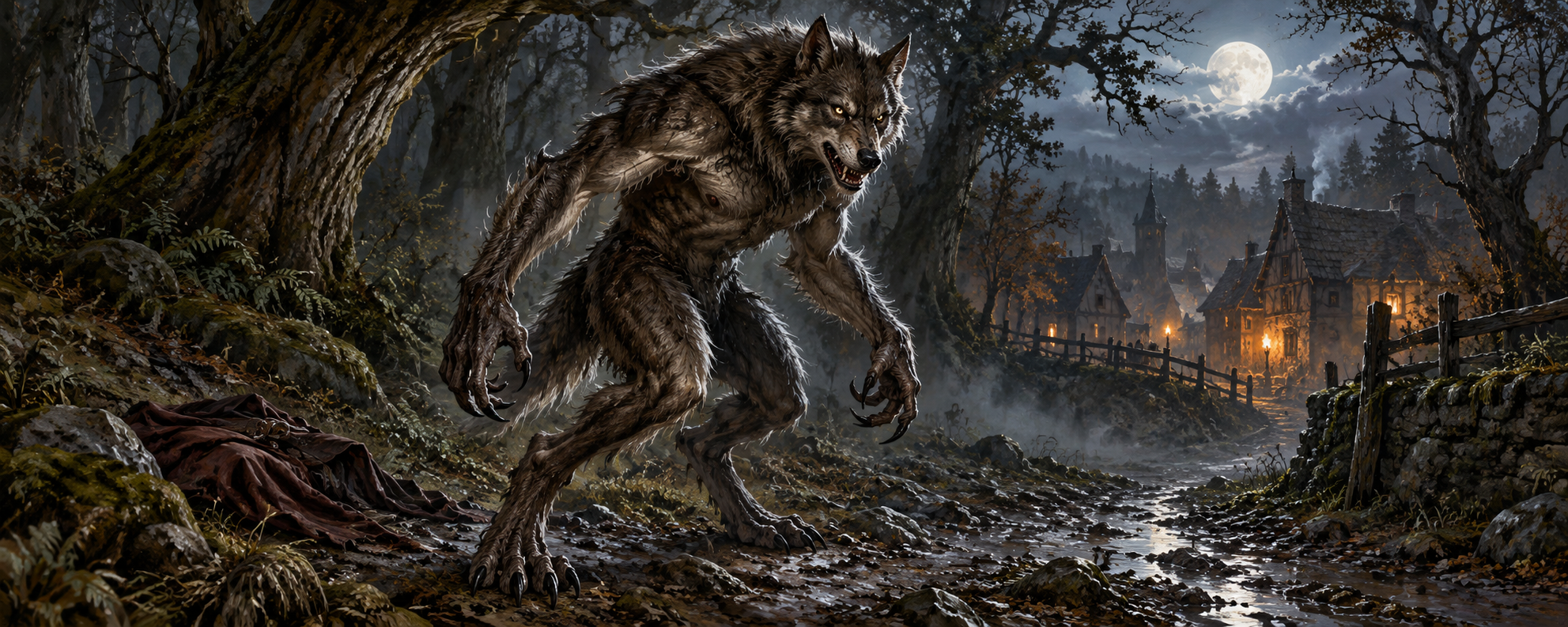
The sheep were found against the inside of their pen. At the forest’s edge, human boot prints give way to wolf tracks. The village has already named the culprit—but it has named the wrong person.
A werewolf is a person able to take wolf and hybrid shape. Some are born with the condition; others acquire a curse. One pack may hunt travellers, another hide to protect its young, and an afflicted villager may be desperate to find a cure before anyone else is hurt. The four rulesets below handle shapechanging, damage immunity and transmission of the curse differently.
Werewolf Rules by Edition
Use one edition consistently: the 2024 version does not have the 2014 werewolf’s immunity to ordinary non-silvered weapons. The Pathfinder and 3.5e templates have separate curse and change-form rules.
Werewolf — 2024
Medium or Small Monstrosity (Lycanthrope), chaotic evil. AC 15; Initiative +4 (14); HP 71 (11d8 + 22); Speed 30 ft., 40 ft. in wolf form.
STR 16 (+3), DEX 14 (+2), CON 14 (+2), INT 10 (+0), WIS 11 (+0), CHA 10 (+0).
Skills Perception +4, Stealth +4; darkvision 60 ft., passive Perception 14; Common (not spoken as wolf); longbow; CR 3 (700 XP; PB +2).
Pack Tactics. Advantage on an attack against a creature with a non-Incapacitated ally of the werewolf within 5 feet.
Multiattack (Action): Two Scratch or Longbow attacks in any combination; one may become a Bite. Scratch: +5 melee, 10 (2d6+3) slashing. Longbow: +4 ranged (150/600 ft.), 11 (2d8+2) piercing, humanoid or hybrid only.
Bite (wolf or hybrid): +5 melee, reach 5 ft., 12 (2d8+3) piercing; Humanoid target DC 12 Constitution save. Failure curses the target; should the cursed victim later drop to 0 HP, it instead becomes a werewolf controlled by the GM with 10 HP. Success: immune to this werewolf’s curse for 24 hours.
Shape-Shift (Bonus Action): become Large hybrid, Medium wolf or humanoid. Statistics other than size stay the same; equipment remains unchanged.
Rules source: Wizards of the Coast SRD 5.2.1 (CC BY 4.0), Werewolf. The separately published D&D Beyond Basic Rules are not the reuse licence.
Werewolf — 2014
Medium Humanoid (human, shapechanger), chaotic evil. AC 11 humanoid, 12 wolf/hybrid; HP 58 (9d8 + 18); Speed 30 ft., 40 ft. wolf.
STR 15 (+2), DEX 13 (+1), CON 14 (+2), INT 10 (+0), WIS 11 (+0), CHA 10 (+0).
Skills Perception +4, Stealth +3; passive Perception 14; Common (cannot speak in wolf form); CR 3 (700 XP).
Damage immunity: bludgeoning, piercing and slashing damage from nonmagical attacks that are not silvered. Keen Hearing and Smell: Advantage on relevant Perception checks.
Shapechanger (Action): human, wolf or hybrid; AC changes by form, other statistics remain. Equipment does not transform. Death restores the humanoid form.
Multiattack (humanoid or hybrid Action): two spear attacks as a human; one Bite and one Claws attack in hybrid shape. The wolf makes one Bite.
Bite (wolf or hybrid): +4 melee, 5 ft.; 6 (1d8+2) piercing; humanoid victim DC 12 Constitution save or lycanthropy curse. Claws (hybrid): +4 melee, 5 ft.; 7 (2d4+2) slashing.
Spear (human): +4 melee or ranged, 5 ft. or 20/60 ft.; 5 (1d6+2) piercing; with two hands in melee 6 (1d8+2).
Rules source: Wizards of the Coast SRD 5.1 (CC BY 4.0), Werewolf. Edition-specific 2014 mechanics are retained.
Werewolf — Pathfinder 1e
Human natural werewolf fighter 2; CR 2, XP 600. CE Medium humanoid (human, shapechanger).
Human Form: Defense
Init +5; low-light vision and scent; Perception +4. AC 17, touch 11, flat-footed 16 (+6 armor, +1 Dex); hp 19 (2d10+4, printed sample total); Fort +5, Ref +1, Will +2 (+3 vs. fear), bravery +1.
Offense
Speed 30 ft. (20 ft. in armor). Melee longsword +5 (1d8+4/19–20); ranged light crossbow +3 (1d8/19–20).
Statistics
Str 17, Dex 13, Con 14, Int 8, Wis 14, Cha 8; BAB +2, CMB +5, CMD 16. Feats Cleave, Combat Reflexes, Improved Initiative, Power Attack. Skills Climb +3, Intimidate +4, Perception +4. Language Common.
Hybrid Form
AC 22, touch 12, flat-footed 20 (+6 armor, +2 Dex, +4 natural); hp 21 (2d10+6, printed sample total); Fort +6, Ref +2, Will +2; DR 10/silver. Longsword +6 (1d8+6/19–20) and bite +1 (1d6+1, trip and lycanthropy curse); ranged light crossbow +4 (1d8/19–20). Str 19, Dex 15, Con 17, Int 8, Wis 14, Cha 8; BAB +2, CMB +6, CMD 18.
Ecology and Special Abilities
Environment any land; organization solitary, pair or pack (3–6); treasure NPC gear. A natural lycanthrope changes shape as a move action. Afflicted ones need a full-round action and Constitution checks (DC 15 to become animal/hybrid, DC 20 to become humanoid) with full-moon modifiers. In wolf or hybrid form a natural werewolf’s bite can curse a Humanoid on a failed DC 15 Fortitude save; a successful bite can also trip the opponent under the creature’s special rule. Wolf empathy grants +4 to relevant interactions with wolves and dire wolves.
Source: Archives of Nethys — Human Form and Hybrid Form, Pathfinder RPG Bestiary pp. 197–198. The listed hp are the published samples, not mathematical dice averages; consult the source for the complete template and licensing.
Werewolf — D&D 3.5e
Natural werewolf, human warrior 1 plus 2 wolf HD, CR 3.
Size/Type: Medium Humanoid (Human, Shapechanger) in all forms.
Hit Dice: 1d8+1 plus 2d8+6 (20 hp).
Initiative: +4 human, +6 wolf/hybrid.
Speed: 30 ft. human/hybrid, 50 ft. wolf.
Armor Class: 17 human (+2 natural, +4 chain shirt, +1 light shield), touch 10, flat-footed 17; 16 wolf/hybrid (+2 Dex, +4 natural), touch 12, flat-footed 14.
Base Attack/Grapple: +2/+3 human; +2/+4 wolf/hybrid.
Attack: human longsword +3 (1d8+1/19–20) or crossbow +2 (1d8/19–20); wolf bite +5 (1d6+3); hybrid claw +4 (1d4+2).
Full Attack: human longsword +3 or crossbow +2; wolf bite +5; hybrid two claws +4 (1d4+2) and secondary bite +0 (1d6+1).
Space/Reach: 5 ft./5 ft.
Special Attacks: wolf curse and trip; hybrid curse.
Special Qualities: alternate form, wolf empathy, scent, low-light vision; DR 10/silver in wolf or hybrid.
Saves: human Fort +6, Ref +3, Will +2; wolf/hybrid Fort +8, Ref +5, Will +2.
Abilities: human Str 13, Dex 11, Con 12, Int 10, Wis 11, Cha 8; wolf/hybrid Str 15, Dex 15, Con 16, Int 10, Wis 11, Cha 8.
Skills: human Handle Animal +1, Hide +1, Listen +1, Move Silently +2, Spot +1, Survival +2; wolf/hybrid Hide +6, Move Silently +6, with other listed values unchanged. +4 Survival when tracking by scent.
Feats: Improved Initiative, Iron Will (bonus), Stealthy, Track (bonus), Weapon Focus (bite).
Environment: temperate forests.
Organization: solitary, pair, pack (6–10), or troupe with wolves.
Challenge Rating: 3.
Treasure: standard.
Alignment: sample chaotic evil.
Advancement: by character class.
Level Adjustment: +3 for the natural werewolf sample.
Combat
A wolf-form bite allows a free trip attempt (+2 check modifier; no trip retaliation on failure). Hybrid attacks with two claws and a secondary bite. The bite of a natural lycanthrope can transmit the curse (DC 15 Fortitude); an afflicted 3.5e werewolf cannot pass it on. Changing form is a standard action, with a separate Control Shape system for afflicted characters.
Source: D&D 3.5e System Reference Document, OGL 1.0a. Werewolf — SRD mirror · Lycanthrope template — SRD mirror · d20srd.org reference. The complete applicable licence and notices are reproduced below.
The Person and the Wolf
A werewolf can pass as a neighbour for years. The shape of a nose, a limp or a familiar manner of speaking may survive the transformation more convincingly than folk tests involving eyebrows, palms or unusual teeth. Those supposed signs are unreliable, and accusing the wrong person can be as dangerous as failing to find the real predator.
Some werewolves have lived with their nature all their lives; others were bitten and have little understanding of what happens after dark. Neither condition tells a GM everything about a creature’s intentions. One has learned to keep away from roads; another uses the threat of violence to collect protection money; a third knows who spread the curse but refuses to name that person.
Where Werewolves Are Found
In the Vosges foothills, the dangerous territory is often the margin where timber tracks meet pasture. Herdsmen drive animals home before dusk. Forest watchmen know which paths remain usable after heavy rain. A killer with both human and wolf forms can cross that boundary unseen, conceal evidence in an occupied farmhouse, or deliberately make ordinary wolves take the blame.
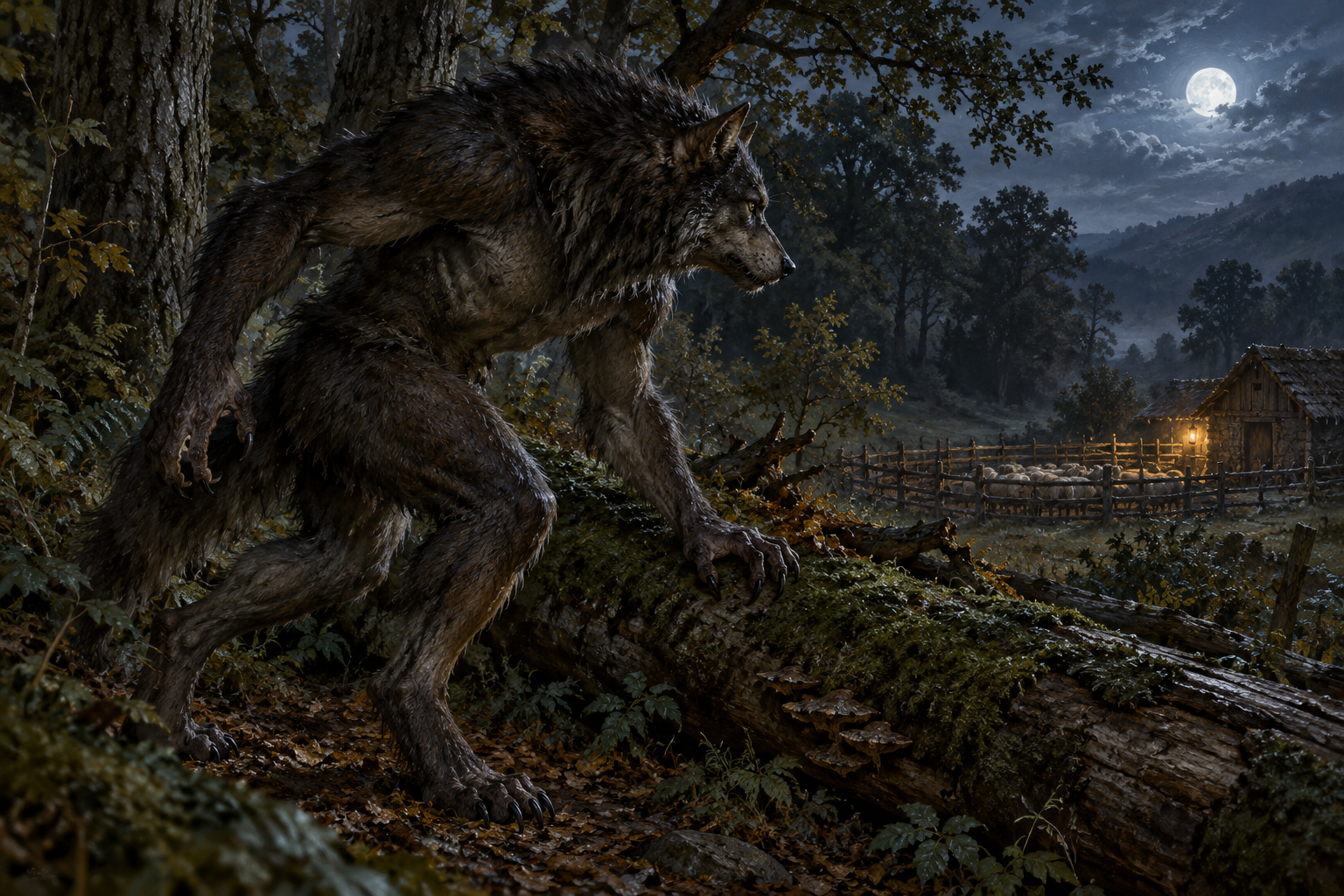
A werewolf may hunt sheep along a wooded pasture, follow a smugglers’ road, or sleep in a locked loft above a workshop. The Strasbourg region records dangers on the roads into the Vosges. A victim’s home, work and relationships can give investigators a firmer lead than searching miles of empty forest.
Around Dole, woodland killings have brought patrols and rewards, while rumours name Gilles Garnier. The Witches of the Howling Moon maintain a hidden woodland cabin outside the city; some of their witches may also be lycanthropes. Following a name to a door still leaves the hunters needing evidence of what happened.
Behaviour and Warning Signs
Wolves observe their prey before closing in; a werewolf also understands doors, watch rotations and the habits of people. A solitary hunter seeks a quick kill and a route home. A pack may test a caravan’s rearguard or force a traveller away from the safety of the road. A frightened afflicted person often takes precautions: a sturdy lock, a missing night’s wages, provisions left inside a shed.
Clues become useful when they lead somewhere: a lamb dragged toward the village instead of uphill, prints that become bare feet at a stream crossing, or the same torn cloth caught on a blackthorn and later found in someone’s sleeve. Ordinary wolves, frightened villagers and deliberate hoaxers can leave misleading evidence; let characters establish a pattern rather than accept a single clue as proof.
For a pursuit, the Ranger offers tracking and fieldcraft. The Survival and Track reference tables use legacy d20 rules; Pathfinder’s Scent rules explain when smell reveals a presence, a direction or an exact position.
If Violence Starts
A werewolf attacks an isolated opponent first, preferably where trees, outbuildings or broken ground prevent the rest of the party from helping. It may change shape to pass a guarded gate, spring from concealment or retreat into a space too narrow for mounted pursuers. A clever one identifies silver before taking a costly fight. A pack protecting its injured members or young may be slower to retreat.
D&D 2024: Position an ally within 5 feet of the target to enable Pack Tactics. Use the bonus-action transformation to change the battlefield threat; the bite’s curse matters even when it does not immediately win the fight. D&D 2014: The damage immunity makes preparation vital. Follow the 2014 stat block’s shape-limited attacks: in humanoid form, Multiattack allows two spear attacks; in hybrid form, it allows one Bite and one Claws attack; wolf form uses a single Bite. Pathfinder 1e: The published fighter sample has trained weapon attacks, armour, a hybrid bite and DR 10/silver. D&D 3.5e: Its wolf-form bite can trip, while the hybrid uses two claws and a weaker secondary bite. All four versions can flee, parley or surrender where the individual has reason to do so.
For older d20 equipment costs and weapon penalties, see alchemical silver. Those material rules belong to their own editions; use the defences in the selected werewolf panel.
Encounters in Play
A Rope at the Well
Three sheep are found dead beside a village well, and an angry crowd intends to hang the miller’s son. His coat was discovered near the pasture, but the torn cuff has been tied around a gate latch deliberately. The culprit is the respected night watchman, recently bitten and hiding injuries beneath his gloves. The players have until dusk to separate the evidence from the accusation, contain the watchman safely and decide whether to ask the villagers to risk a cure. The mob may do real harm before the werewolf does.
The Toll Keeper’s Pack
Travellers entering a forest are told the old toll road is unsafe. A smiling keeper offers escorts at twice the customary price, while companions wait in the trees. The attackers are his pack, taking lone travellers after dark and selling their belongings through a nearby market. He wants money and secrecy, not a glorious death: a convincing inspection warrant, a staged convoy or evidence offered to a rival toll-holder can break the scheme without fighting every wolf in the woods.
The Bolted Room
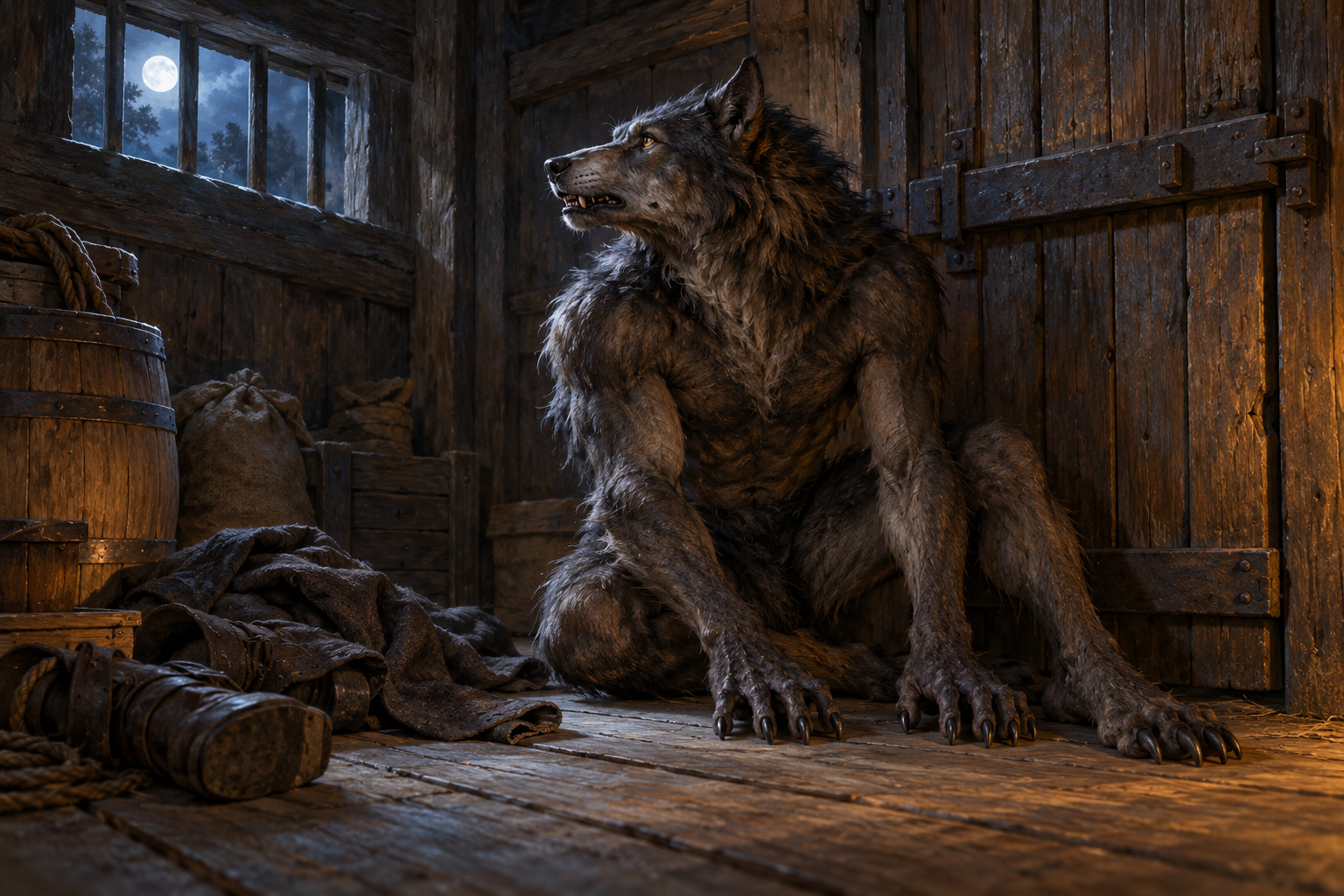
A family has reinforced an upstairs door with a bar from the outside. The person inside asks to be let out before sunset; the family begs the visitors to leave it shut until morning. No one knows whether the prisoner is a natural werewolf, an afflicted victim or merely ill, and a missing child is still somewhere on the road. The group must choose where to search, where to put guards, what confinement and cure actually mean in the chosen ruleset, and whether to believe the family’s account.
Alpha, Mauler and Lord
These named, stronger werewolves are separate third-party 2014-style monsters from Ultimate Bestiary: The Dreaded Accursed (Nord Games, 2020), not official versions of the CR 3 werewolf. The publisher’s book contains their full game rules.
Challenge and Aftermath
The standard 2024, 2014 and 3.5e werewolves are CR 3; the Pathfinder fighter sample is CR 2. Each can be a serious adversary for a low-level party. The 2024 monster is quick and dangerous with companions; the 2014 monster can shrug off unprepared weapon attacks. The Pathfinder and 3.5e examples rely on their own templates and do not substitute mechanically for either fifth-edition block. A pack on forest ground is more dangerous than an equal number trapped in a bare courtyard.
What happens after the fight can matter more than the treasure. A dead wolf may become a recognisable villager. An accused innocent may have no home to return to. A bitten survivor may need somewhere secure and a healer who understands the campaign’s actual curse rules. On a body, an engraved toll token, a child’s mitten or a half-written confession can lead to the next encounter.
For treatment, compare Remove Curse with the lycanthropy rules for the chosen edition. The condition’s origin and the creature’s specific curse determine which remedies can work.
Werewolves in Story and Folklore
Older tales describe enchanted skins, belts, inherited transformations, punishment and bargains as causes of wolf-changing. The full moon is a familiar modern shorthand but not a universal requirement in historic tales. Trial accounts of alleged werewolves record accusations, fear and prosecution; they are not evidence that an accused person changed shape. Use local folklore to give each rumour a voice, and let the game edition decide the mechanical curse.
Other Lycanthropes
For the broader curse and regional creature family see Lycanthropes. Compare the more solitary Werebear, the dangerous Wereboar and the city-dwelling Wererat. Those entries describe different creatures: a wolf pack is not a model for every shapechanger.
Further Viewing
Werewolf Mysteries (D&D Monster Tactics) — Runesmith (8 minutes). An illustrated framework for a small-community murder mystery: suspects, misleading evidence and a werewolf protecting its secret. Its 2014-era rules discussion is separate from the four edition panels above.
5 Historical Accounts of Werewolves — Voices of the Past (13 minutes). Readings from ancient accounts, medical writing and later accusations show how differently people have described wolf-changing. Useful for the voices of witnesses and chroniclers; these accounts are not evidence of physical transformation.
Sources, Editions and Credits
This work includes material from the System Reference Document 5.2.1 (“SRD 5.2.1”) by Wizards of the Coast LLC, available at https://www.dndbeyond.com/srd. The SRD 5.2.1 is licensed under the Creative Commons Attribution 4.0 International License, available at https://creativecommons.org/licenses/by/4.0/legalcode.
This work includes material taken from the System Reference Document 5.1 (“SRD 5.1”) by Wizards of the Coast LLC and available at https://dnd.wizards.com/resources/systems-reference-document. The SRD 5.1 is licensed under the Creative Commons Attribution 4.0 International License available at https://creativecommons.org/licenses/by/4.0/legalcode. Both fifth-edition entries have been condensed and reformatted for this reference.
Pathfinder First Edition: Pathfinder RPG Bestiary, pp. 197–198, reproduced at Archives of Nethys. D&D 3.5e: System Reference Document — Lycanthrope. These two edition panels and their rules summaries are Open Game Content distributed under the Open Game License version 1.0a reproduced below. Artwork and original narrative sections are not designated Open Game Content.
Third-party variants: Ultimate Bestiary: The Dreaded Accursed, © 2020 Chris Haskins and Nord Games LLC. Alpha, Mauler and Lord are separate creatures from that publication. Their full game rules are in the publisher’s book.
Folklore reading: Daniel Ogden, The Werewolf in the Ancient World (2020); Nadine Metzger, study of werewolves and early modern medicine (2013).
Open Game License version 1.0a and copyright notices
OPEN GAME LICENSE Version 1.0a
The following text is the property of Wizards of the Coast, Inc. and is Copyright 2000 Wizards of the Coast, Inc (“Wizards”). All Rights Reserved.
1. Definitions: (a)”Contributors” means the copyright and/or trademark owners who have contributed Open Game Content; (b)”Derivative Material” means copyrighted material including derivative works and translations (including into other computer languages), potation, modification, correction, addition, extension, upgrade, improvement, compilation, abridgment or other form in which an existing work may be recast, transformed or adapted; (c) “Distribute” means to reproduce, license, rent, lease, sell, broadcast, publicly display, transmit or otherwise distribute; (d)”Open Game Content” means the game mechanic and includes the methods, procedures, processes and routines to the extent such content does not embody the Product Identity and is an enhancement over the prior art and any additional content clearly identified as Open Game Content by the Contributor, and means any work covered by this License, including translations and derivative works under copyright law, but specifically excludes Product Identity. (e) “Product Identity” means product and product line names, logos and identifying marks including trade dress; artifacts; creatures characters; stories, storylines, plots, thematic elements, dialogue, incidents, language, artwork, symbols, designs, depictions, likenesses, formats, poses, concepts, themes and graphic, photographic and other visual or audio representations; names and descriptions of characters, spells, enchantments, personalities, teams, personas, likenesses and special abilities; places, locations, environments, creatures, equipment, magical or supernatural abilities or effects, logos, symbols, or graphic designs; and any other trademark or registered trademark clearly identified as Product identity by the owner of the Product Identity, and which specifically excludes the Open Game Content; (f) “Trademark” means the logos, names, mark, sign, motto, designs that are used by a Contributor to identify itself or its products or the associated products contributed to the Open Game License by the Contributor (g) “Use”, “Used” or “Using” means to use, Distribute, copy, edit, format, modify, translate and otherwise create Derivative Material of Open Game Content. (h) “You” or “Your” means the licensee in terms of this agreement.
2. The License: This License applies to any Open Game Content that contains a notice indicating that the Open Game Content may only be Used under and in terms of this License. You must affix such a notice to any Open Game Content that you Use. No terms may be added to or subtracted from this License except as described by the License itself. No other terms or conditions may be applied to any Open Game Content distributed using this License.
3. Offer and Acceptance: By Using the Open Game Content You indicate Your acceptance of the terms of this License.
4. Grant and Consideration: In consideration for agreeing to use this License, the Contributors grant You a perpetual, worldwide, royalty-free, non-exclusive license with the exact terms of this License to Use, the Open Game Content.
5. Representation of Authority to Contribute: If You are contributing original material as Open Game Content, You represent that Your Contributions are Your original creation and/or You have sufficient rights to grant the rights conveyed by this License.
6. Notice of License Copyright: You must update the COPYRIGHT NOTICE portion of this License to include the exact text of the COPYRIGHT NOTICE of any Open Game Content You are copying, modifying or distributing, and You must add the title, the copyright date, and the copyright holder’s name to the COPYRIGHT NOTICE of any original Open Game Content you Distribute.
7. Use of Product Identity: You agree not to Use any Product Identity, including as an indication as to compatibility, except as expressly licensed in another, independent Agreement with the owner of each element of that Product Identity. You agree not to indicate compatibility or co-adaptability with any Trademark or Registered Trademark in conjunction with a work containing Open Game Content except as expressly licensed in another, independent Agreement with the owner of such Trademark or Registered Trademark. The use of any Product Identity in Open Game Content does not constitute a challenge to the ownership of that Product Identity. The owner of any Product Identity used in Open Game Content shall retain all rights, title and interest in and to that Product Identity.
8. Identification: If you distribute Open Game Content You must clearly indicate which portions of the work that you are distributing are Open Game Content.
9. Updating the License: Wizards or its designated Agents may publish updated versions of this License. You may use any authorized version of this License to copy, modify and distribute any Open Game Content originally distributed under any version of this License.
10. Copy of this License: You MUST include a copy of this License with every copy of the Open Game Content You Distribute.
11. Use of Contributor Credits: You may not market or advertise the Open Game Content using the name of any Contributor unless You have written permission from the Contributor to do so.
12. Inability to Comply: If it is impossible for You to comply with any of the terms of this License with respect to some or all of the Open Game Content due to statute, judicial order, or governmental regulation then You may not Use any Open Game Material so affected.
13. Termination: This License will terminate automatically if You fail to comply with all terms herein and fail to cure such breach within 30 days of becoming aware of the breach. All sublicenses shall survive the termination of this License.
14. Reformation: If any provision of this License is held to be unenforceable, such provision shall be reformed only to the extent necessary to make it enforceable.
15. COPYRIGHT NOTICE
Open Game License v 1.0 Copyright 2000, Wizards of the Coast, Inc.
Open Game License v 1.0a Copyright 2000, Wizards of the Coast, Inc.
System Reference Document. Copyright 2000. Wizards of the Coast, Inc; Authors: Jonathan Tweet, Monte Cook, Skip Williams, based on material by E. Gary Gygax and Dave Arneson.
System Reference Document Copyright 2000-2003, Wizards of the Coast, Inc.; Authors Jonathan Tweet, Monte Cook, Skip Williams, Rich Baker, Andy Collins, David Noonan, Rich Redman, Bruce R. Cordell, John D. Rateliff, Thomas Reid, James Wyatt, based on original material by E. Gary Gygax and Dave Arneson.
Pathfinder Roleplaying Game Core Rulebook © 2009, Paizo Publishing, LLC; Author: Jason Bulmahn, based on material by Jonathan Tweet, Monte Cook, and Skip Williams.
Pathfinder RPG Bestiary. © 2009, Paizo Publishing, LLC; Author: Jason Bulmahn, based on material by Jonathan Tweet, Monte Cook, and Skip Williams.
The Archives of Nethys. Copyright 2010, Blake Davis.
Keep this reference growing
If this page helped with your reading or game, you can support its upkeep or explore the curated books.
Explore the Bookshop — epics, classics and stories behind imagined worlds.