
Giant Ant Soldier – Vermin Guard and Tunnel Monster
Giant Ant Soldier – Vermin Guard and Tunnel Monster
The armed jaw of a buried colony, built to seize, sting, and drag prey into the dark.
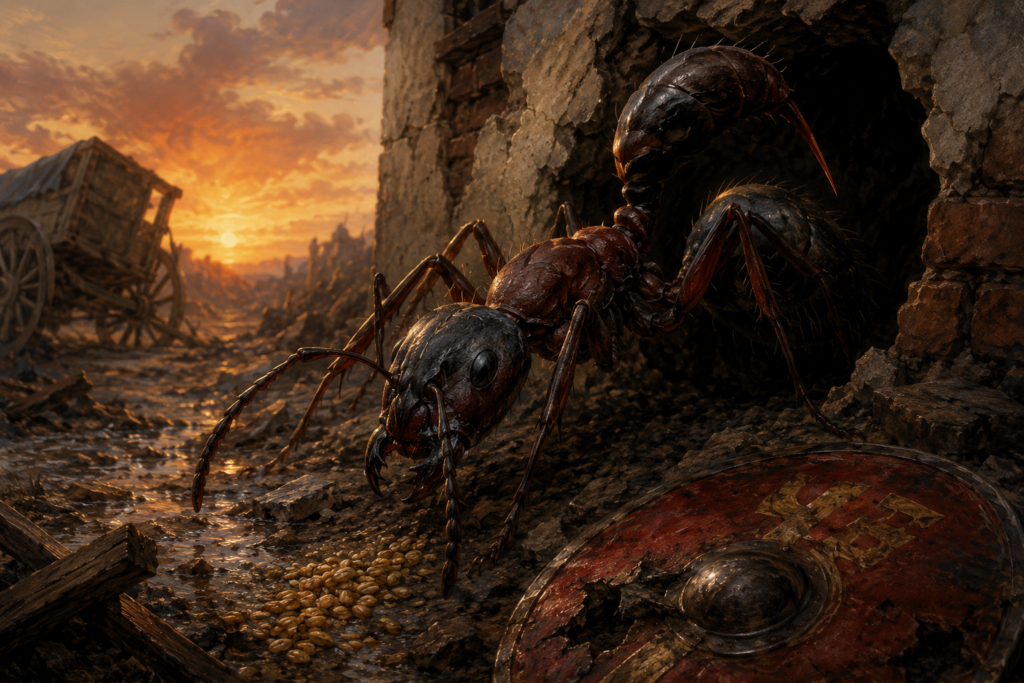
Creature Type: Vermin / Beast
Usual Alignment: Unaligned
Typical Challenge: Low-level wilderness, ruin, mine, farmstead, cavern, road, and settlement-edge encounter
Primary Threat: Grapple, sting, poison or acid, rapid pursuit, hive reinforcement
Best Used As: A guard, patrol beast, tunnel blocker, and warning that the colony is close
Overview
A giant ant soldier is not merely an oversized insect. It is the armed mouth of a colony.
Workers dig, carry, tend eggs, strip carcasses, cut fungus, widen tunnels, and harvest the land. Soldiers guard. They patrol scent roads, defend nest mouths, ambush intruders in narrow passages, and drag struggling prey into the lower chambers where the colony’s hunger becomes organised labour.
A lone soldier can kill a careless traveller, mule, dog, or low-ranking guard. A pair can turn a tunnel into a trap. A patrol means the colony has marked the area. A marching line of soldiers and workers means the nest has found a reliable food source and is expanding its reach.
Giant ant soldiers are dangerous because they do not posture, threaten, bargain, or retreat for pride. They decide by scent, vibration, obstruction, hunger, and alarm. Once a victim is marked as food or threat, the soldier closes, bites, holds, stings, and pulls.
Appearance
A giant ant soldier stands roughly the height of a pony at the shoulder, though its long body, lifted head, and raised abdomen make it seem larger when it rears to strike. Its body is divided into hard black, red-brown, rust, or amber plates with the sheen of polished horn.
Heavy mandibles jut from its head like hooked shears. They are strong enough to clamp around a shield rim, boot, ankle, forearm, or animal’s throat. Its legs are long, jointed, and fast, ending in hooked feet that grip bark, stone, packed earth, timber, and tunnel walls.
The abdomen carries the soldier’s second weapon. In some breeds the sting injects weakening venom. In older, harsher, or more acidic breeds, the sting pumps a burning corrosive fluid into the wound.
Its head never looks angry. That is part of the horror. The soldier may freeze for several heartbeats, antennae moving through the air, before every limb snaps into motion at once.
Habitat
Giant ant soldiers appear wherever a colony can anchor itself and find steady food.
They favour warm valleys, dry banks, forest margins, abandoned fields, ruined towers, old hillforts, quarry faces, mine spoil, river bluffs, termite-haunted groves, battlefield edges, collapsed cellars, grain stores, plague pits, orchard roots, and old tunnels where stonework gives them ready-made foundations.
A giant ant nest is rarely a simple hole. Mature colonies create layered underground works: upper patrol galleries, brood chambers, fungus gardens, refuse pits, air shafts, deadfall tunnels, queen chambers, and long scent roads leading to food grounds.
In settled lands, the first sign of a colony may be missing livestock, cut grain, stripped bones, sinkholes, or a road verge that seems to move at dusk.
Ecology
Giant ant soldiers are a caste, not a species by themselves. They are produced by the colony to defend tunnels, guard workers, seize food, and stop intruders reaching the queen.
Giant ant colonies are smaller than ordinary ant colonies in number, but their scale makes even a modest nest a serious local force. A handful of soldiers and a hundred workers can strip a carcass, undermine a shed, collapse a lane, or make a hillside unsafe for grazing.
Workers handle most labour. Soldiers guard and kill. Drones emerge when the colony is ready to spread. The queen remains hidden deep inside the nest, swollen with eggs and attended by workers.
Killing soldiers weakens the colony’s perimeter. It does not end the nest. Killing enough soldiers may expose workers, brood chambers, or surface mouths, but the colony survives while the queen and brood remain intact.
Giant ants are omnivorous. They take meat, grain, fruit, fungus, carrion, leather, glue, fat, soft wood, and sometimes paper or parchment treated with animal binders. Villages fear them not only because they eat people, but because the colony turns property, harvest, animals, and bodies into supply.
Their tunnels can improve wild soil, but near settlements they become a hazard. Walls crack. Fields slump. Wells foul. Cellars open into black passageways. A careless landowner may ignore a few missing hens until the road beneath his wagons collapses.
Behaviour
A giant ant soldier does not hunt like a wolf or stalk like a cat. It responds to signs.
It follows scent. It reacts to vibration. It investigates blood, rot, spilled grain, honey, fruit, sweat, mule dung, oil, and smoke. Once it finds prey, it tries to lock its mandibles onto the target, sting repeatedly, and drag the victim toward a tunnel or into reach of other ants.
Soldiers do not understand surrender. They do not accept tribute unless trained handlers, druids, alchemists, or ant-cultists have conditioned the colony through scent marks and repeated feeding. They are not evil. They are not cruel. They are worse in practical terms: obedient, tireless, and difficult to frighten.
A soldier away from the nest may withdraw if badly injured, especially if it has marked the intruders with alarm scent. A soldier near the nest usually fights until killed, trapped, or overwhelmed.
Signs of a Giant Ant Colony
Use one or more of these before the soldiers appear.
- A road edge sinks beneath a cartwheel, revealing smooth-sided tunnels below.
- A mule refuses to cross a patch of earth that smells faintly of vinegar and wet clay.
- A sheep carcass is found cleanly stripped, with the bones carried into a neat line.
- A granary floor is dusted with black soil from below.
- Tree roots are exposed, cleaned, and undercut.
- Small animals vanish from traps without breaking the trigger.
- The party finds a boot, shield, or broken spear dragged halfway into a narrow hole.
- A line of workers crosses a path in silence, each carrying a piece of grain, flesh, fungus, or bone.
- A hillside hums faintly when a staff or spear butt is pressed against the soil.
- Rainwater vanishes into the ground instead of pooling where it should.
- Dogs bark at a cellar wall, then refuse to enter the room.
- A corpse is found untouched above the waist but stripped clean from the legs downward.
Mechanics Tabs
The rules below are mechanics compatible for different game editions.
Giant Ant Soldier 5.5e
Giant Ant Soldier Pathfinder
Giant Ant Soldier 3.5e
Giant Ant Soldier 5.5e-Compatible Rules
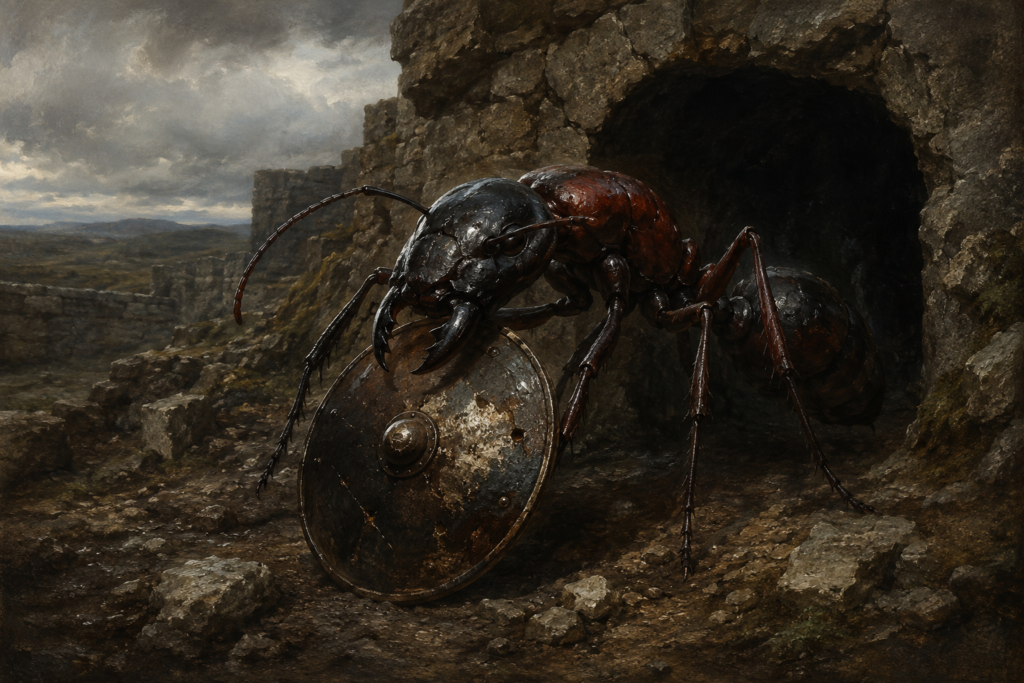
Medium Beast (Vermin), Unaligned
Armor Class 15 natural armor
Initiative +1
Hit Points 37 (5d8 + 15)
Speed 40 ft., climb 20 ft.
Proficiency Bonus +2
| STR | DEX | CON | INT | WIS | CHA |
|---|---|---|---|---|---|
| 14 (+2) | 12 (+1) | 16 (+3) | 1 (-5) | 12 (+1) | 4 (-3) |
Saving Throws Con +5
Skills Athletics +4, Perception +3, Survival +3
Damage Resistances —
Damage Immunities —
Condition Immunities Charmed, Frightened
Senses Darkvision 60 ft., Tremorsense 10 ft., passive Perception 13
Languages —
Challenge 2 (450 XP)
Traits
Hive Scent. The giant ant soldier has advantage on Wisdom (Perception) and Wisdom (Survival) checks that rely on smell.
Sure-Footed Climber. The giant ant soldier can climb difficult surfaces, including rough stone, roots, timber, bark, and packed earth tunnel walls, without needing to make an ability check unless the surface is slick, magical, or actively collapsing.
Dragging Grip. The giant ant soldier does not spend extra movement to drag a creature it has Grappled, provided the creature is Medium or smaller. While dragging a Grappled creature, the ant’s Speed is halved.
Colony Alarm. When the giant ant soldier takes damage within 60 feet of another giant ant, that other ant becomes aware of the injured soldier’s direction until the end of its next turn, provided there is an open tunnel, scent trail, shared surface, or connected ground vibration between them.
Actions
Multiattack. The giant ant soldier makes one Bite attack and one Sting attack.
Bite. Melee Weapon Attack: +4 to hit, reach 5 ft., one target. Hit: 6 (1d8 + 2) piercing damage. If the target is Medium or smaller, it is Grappled. Escape DC 12.
Sting. Melee Weapon Attack: +4 to hit, reach 5 ft., one target. Hit: 5 (1d6 + 2) piercing damage, and the target must make a DC 13 Constitution saving throw. On a failed save, the target takes 7 (2d6) poison damage and has disadvantage on the next Strength check or Strength saving throw it makes before the end of its next turn. On a successful save, the target takes half as much poison damage and suffers no further effect.
D&D 5.5e Combat Notes
A giant ant soldier bites first, holds the target, then stings. It does not waste time changing targets unless a new creature blocks its path, injures it badly, or threatens the tunnel entrance.
Use one soldier as a warning. Use two soldiers as a real fight. Use three or more only if the party has room to retreat, fire, elevation, allies, or a strong reason to avoid killing the whole patrol.
D&D 5.5e Encounter Groups
Roadside Probe: 1 giant ant soldier and 2–4 giant ant workers.
Tunnel Guard: 2 giant ant soldiers in a narrow passage.
Foraging Line: 1 giant ant soldier, 6–12 workers, and a scent trail leading back to the nest.
Hive Mouth: 3 giant ant soldiers, workers in the background, unstable ground, and alarm scent.
Brood Guard: 2 giant ant soldiers and several workers moving eggs or larvae away from danger.
Related D&D 5.5e Giant Ant Castes
Use these as pointers to the other giant ant pages, not as replacements for those pages.
Giant Ant Worker, CR 1/2. A labour caste that digs, carries, repairs, feeds larvae, moves brood, and harvests food.
Giant Ant Drone, CR 3. A winged reproductive caste used for mating flights, scouting, and colony spread.
Giant Ant Knight, CR 4. An elite defensive caste or specialised hive guardian, best used to block tunnels and hold key chambers.
Giant Ant Queen, CR 5–7. The colony centre and correct page for flagship nest, hive, lair, escalation, and colony-management material.
Giant Ant Soldier 3.5e-Compatible Rules
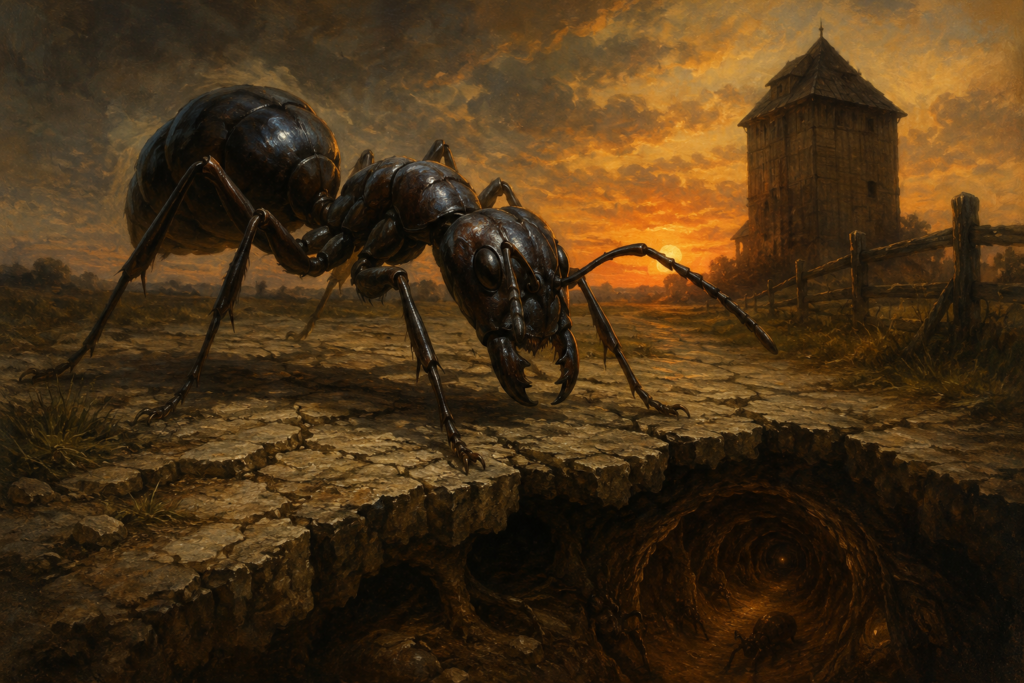
For the older acid-sting breed, use the 3.5e-compatible version below.
Soldier Giant Ant
Medium Vermin
Hit Dice 2d8+2, usually 11 hp
Initiative +0
Speed 50 ft., climb 20 ft.
Armor Class 17, touch 10, flat-footed 17; +7 natural
Base Attack/Grapple +1/+3
Attack Bite +3 melee
Full Attack Bite +3 melee
Damage Bite 2d4+3
Space/Reach 5 ft./5 ft.
Special Attacks Improved grab, acid sting
Special Qualities Vermin traits, scent
Saves Fort +4, Ref +0, Will +1
Abilities Str 14, Dex 10, Con 13, Int —, Wis 13, Cha 11
Skills Climb +10
Feats TrackB
Environment temperate plains
Organization solitary or gang (2–4)
Challenge Rating 2
Treasure none
Advancement 3–4 HD Medium; 5–6 HD Large
Level Adjustment —
Improved Grab (Ex). To use this ability, the giant ant must hit with its bite attack. A giant soldier ant that wins the ensuing grapple check establishes a hold and can sting.
Acid Sting (Ex). A giant soldier ant has a stinger and an acid-producing gland in its abdomen. If it successfully grabs an opponent, it can attempt to sting each round. On a hit, the sting deals 1d4+1 piercing damage plus 1d4 acid damage.
Giant Ant Soldier Pathfinder Compatible Rules
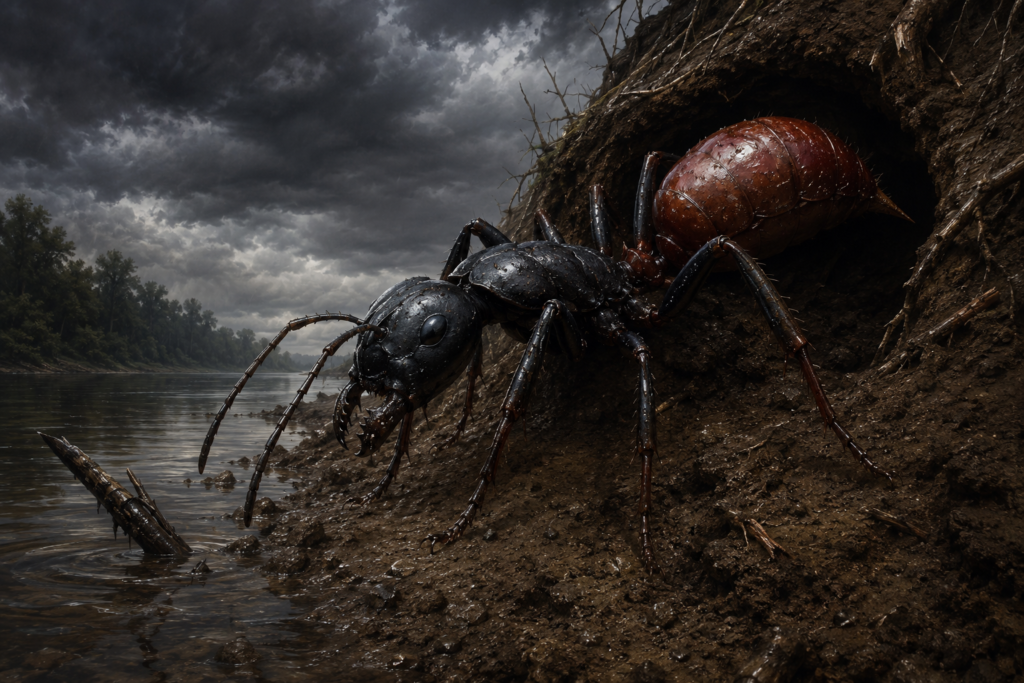
A thin, six-legged ant the size of a pony stands at the ready, its mandibles chittering and its stinger dripping with venom.
Giant Ant Soldier CR 2
XP 600
N Medium vermin
Init +0; Senses darkvision 60 ft., scent; Perception +5
DEFENSE
AC 15, touch 10, flat-footed 15; (+5 natural)
hp 18 (2d8+9)
Fort +6, Ref +0, Will +1
Immune mind-affecting effects
OFFENSE
Speed 50 ft., climb 20 ft.
Melee bite +3 (1d6+2 plus grab), sting +3 (1d4+2 plus poison)
STATISTICS
Str 14, Dex 10, Con 17, Int —, Wis 13, Cha 11
Base Atk +1; CMB +3 (+7 grapple); CMD 13 (21 vs. trip)
Feats ToughnessB
Skills Climb +10, Perception +5, Survival +5; Racial Modifiers +4 Perception, +4 Survival
SPECIAL ABILITIES
Poison (Ex)
Sting—injury; save Fort DC 14; frequency 1/round for 4 rounds; effect 1d2 Str; cure 1 save
ECOLOGY
Environment any
Organization solitary, pair, gang (3–6), or hive (7–18 plus 10–100 workers, 2–8 drones, and 1 queen)
Treasure none
Giant ants are as industrious as their normal-sized kin. While their nests generally don’t consist of thousands, their greatly increased size more than compensates.
Combat Tactics
Open Ground
In open ground, a giant ant soldier runs directly at the strongest scent or moving creature. It does not circle cleverly unless trained, magically influenced, or part of a warped colony. Its speed makes it dangerous to archers, torchbearers, drovers, and lightly armoured scouts who assume a “bug” will be slow.
Tunnels
In tunnels, the soldier becomes much more dangerous. It blocks passages, grapples the front rank, and gives workers time to drag away food, eggs, or wounded enemies. A narrow tunnel lets one soldier matter.
Around the Nest
Near the nest, a giant soldier ant fights more stubbornly. It bites, stings, drags, and delays. It may not be trying to win the battle alone. It is buying time for more ants to arrive.
Against Mounted Travellers
Giant ant soldiers attack the legs, belly, tack, and scent-heavy parts of mounts. A mount that is bitten and grappled may stumble, rear, or fall prone, but it should not automatically become frightened simply because it falls or is pulled. Use fear only if the animal is surrounded, badly injured, separated from its rider, or trapped at the nest mouth.
Using Giant Ant Soldiers in Your Game
A giant ant soldier works best when the party realises it is part of something larger, but the soldier page should stay focused on first contact, patrols, guards, and tunnel defence.
Do not make every encounter a frontal fight. Make the players ask questions. Where is the tunnel? Why is the soldier here? What is it guarding? What has it already dragged away? How far is the nest? Who owns the land above it?
The soldier is the warning. The queen is the campaign problem.
In civilised territory, giant ants are usually treated as dangerous animals or vermin. Destroying soldiers that threaten roads, cellars, livestock, harvests, or travellers is normally lawful pest or hazard clearance. That changes if the ants are guarding protected ground, a druidic reserve, a lord’s managed wilderness, a goblin-held tunnel network, or a frontier claimed by non-human powers.
The important rule is simple: killing creatures has legal and political consequences depending on place, personhood, status, threat, custom, and authority.
Soldier-Specific Encounter Uses
Patrol Contact
A single giant soldier ant crosses the party’s path, antennae working. It is not attacking yet. It is tasting the air, deciding whether the party is food, threat, obstacle, or irrelevant movement.
Tunnel Blocker
Two soldiers hold a narrow passage while workers behind them drag eggs, grain, bones, or stolen goods deeper into the nest.
Dragging Ambush
A soldier attacks from a collapsed bank, bites a weak or isolated target, then tries to pull the victim down a slope or into a side tunnel.
Scent Road Guard
A soldier stands beside a worker trail. It attacks anyone who steps into the trail, spills blood across it, blocks workers, or damages the food line.
Alarm Carrier
A wounded soldier retreats rather than dies, leaving alarm scent through the tunnel. The encounter becomes a question of whether the party pursues, withdraws, or prepares for more ants.
Treasure and Remains
Giant ant soldiers carry no treasure. Anything valuable is usually found in the nest, dragged in with victims, carts, livestock, miners, or ruined expeditions. Most finds are dirty, broken, chewed, acid-marked, or useful mainly as evidence.
Useful discoveries include:
- Belt buckles, knives, coins, keys, and rings dragged in with victims: usually 1d6 gp total, or more only if a named traveller, merchant, tax collector, or noble retainer was taken.
- Chewed shields and snapped spear hafts: usually worthless as weapons, but useful for repairs, firewood, identification, or proof of an attack.
- Armour pieces too hard or awkward for the workers to consume: 2–10 gp total as scrap, or up to 20 gp if a usable piece survived.
- Waxed cloth bundles taken from carts: 1–10 gp if the contents survived. Common finds include grain, salt, dried fruit, wool, parchment, lamp oil, or merchant samples.
- Alchemical jars broken in refuse chambers: 5–20 gp in recoverable goods if any jars remain sealed. Broken jars may also explain warped ants, strange fungus, acid vapours, or unusual aggression.
- Unspoiled metal tools from vanished miners: 2–10 gp total. Picks, wedges, hammers, chisels, lamps, nails, chain, and measuring rods survive better than leather, rope, and wood.
- Shed casing, damaged eggs, or brood traces: usually worthless to ordinary villagers, but 1–5 gp to a specialist as research material. Living viable brood belongs on the Giant Ant Queen page.
- Acid glands, venom sacs, mandibles, chitin plates, and antennae: usually worthless unless carefully harvested. A specialist may pay 1–5 gp for usable mandibles or chitin, and 5–15 gp for a fresh venom sac or acid gland.
A soldier’s mandibles can be shaped into crude hooks, climbing aids, trophies, trap parts, or ritual charms. Venom sacs and acid glands must be harvested quickly or preserved with salt, alcohol, wax, or alchemical stabiliser; otherwise they spoil within a day. A complete, carefully harvested soldier carcass may be worth 10–20 gp to the right alchemist, anatomist, poisoner, beast-handler, or monster scholar, but most villages pay only a token bounty for proof that the immediate patrol has been dealt with.
Adventure Hooks
The Road That Opens Beneath Them
A trade road begins collapsing under horses, carts, and marching feet. Local officials blame rain, bad stonework, or neglected drainage, but the broken sections reveal smooth-walled ant tunnels beneath the packed earth. The first monsters encountered are giant ant soldiers guarding the newly opened road galleries.
The Red Field Patrol
A battlefield from a recent feud has been stripped of bodies faster than burial crews can work. Families accuse each other of theft, necromancy, and dishonour. The truth begins with soldier ants guarding corpse trails through the grass. If the dead are not recovered and named, grief, denied burial, and false accusation may create something worse than ants.
The Ant-Crowned Bandit
A bandit chief has learned that soldiers follow scent marks made from crushed larvae and stolen alchemical oils. He cannot command the colony, but he can redirect patrols toward roads, camps, and tax wagons. When his scent stores run low, he raids the nest itself, provoking wider attacks across the region.
Source, Natural History, and Mythic Context
The giant ant soldier has a clear tabletop source lineage. In Pathfinder, the creature appears under the broader name Giant Ant in the Pathfinder RPG Bestiary, with the listed statistics specifically representing the soldier caste. The Pathfinder version is a CR 2 Medium vermin with bite, grab, sting, poison, scent, darkvision, climbing speed, hive organisation, and simple adjustments for workers, drones, and queens. See Archives of Nethys: Giant Ant for the Pathfinder reference.
The older 3.5e System Reference Document version appears at d20srd.org. That version is important because its soldier ant uses improved grab and an acid sting rather than the Pathfinder poison sting. This entry preserves both traditions by treating the poison-sting soldier as the main Pathfinder-compatible version and the acid-sting soldier as an older or regional 3.5e-compatible breed.
Natural history gives the creature its strongest game logic. Real ants are social insects of the family Formicidae, living in organised colonies. Ant colonies commonly include queens, males, and workers, and the colony functions through coordinated labour rather than individual independence. General ant biology is summarised by Encyclopaedia Britannica’s ant overview, while the wider concept of social insects, including group integration, division of labour, and overlapping generations, is discussed in Britannica’s page on social insects.
For a myth-history fantasy world, the giant ant soldier should not be treated as a one-room monster. Its real power is the colony behind it. A soldier is the visible weapon of a hidden social body: queen, workers, eggs, scent roads, tunnels, refuse chambers, fungus gardens, and harvest lines. This makes the creature useful in stories about collapsing roads, vanishing livestock, ruined stores, battlefield scavenging, mine infestations, alchemical exploitation, druidic disputes, and frontier law.
The creature is not a person by default. Most communities treat giant ant soldiers as dangerous animals or vermin, especially when they threaten roads, homes, harvests, and livestock. That does not mean every nest can be attacked without consequence. A colony may lie under protected land, mark a disputed border, belong to a managed wilderness, feed on plague dead, or have been deliberately cultivated by druids, goblins, alchemists, or local powers. The important question is not whether the ant has legal personhood, but who claims authority over the land, the nest, the damage, and the right to destroy it.
Keep this reference growing
If this page helped with your reading or game, you can support its upkeep or explore the curated books.
Explore the Bookshop — epics, classics and stories behind imagined worlds.