
Gorgon — The Stone-Breathing Iron Bull
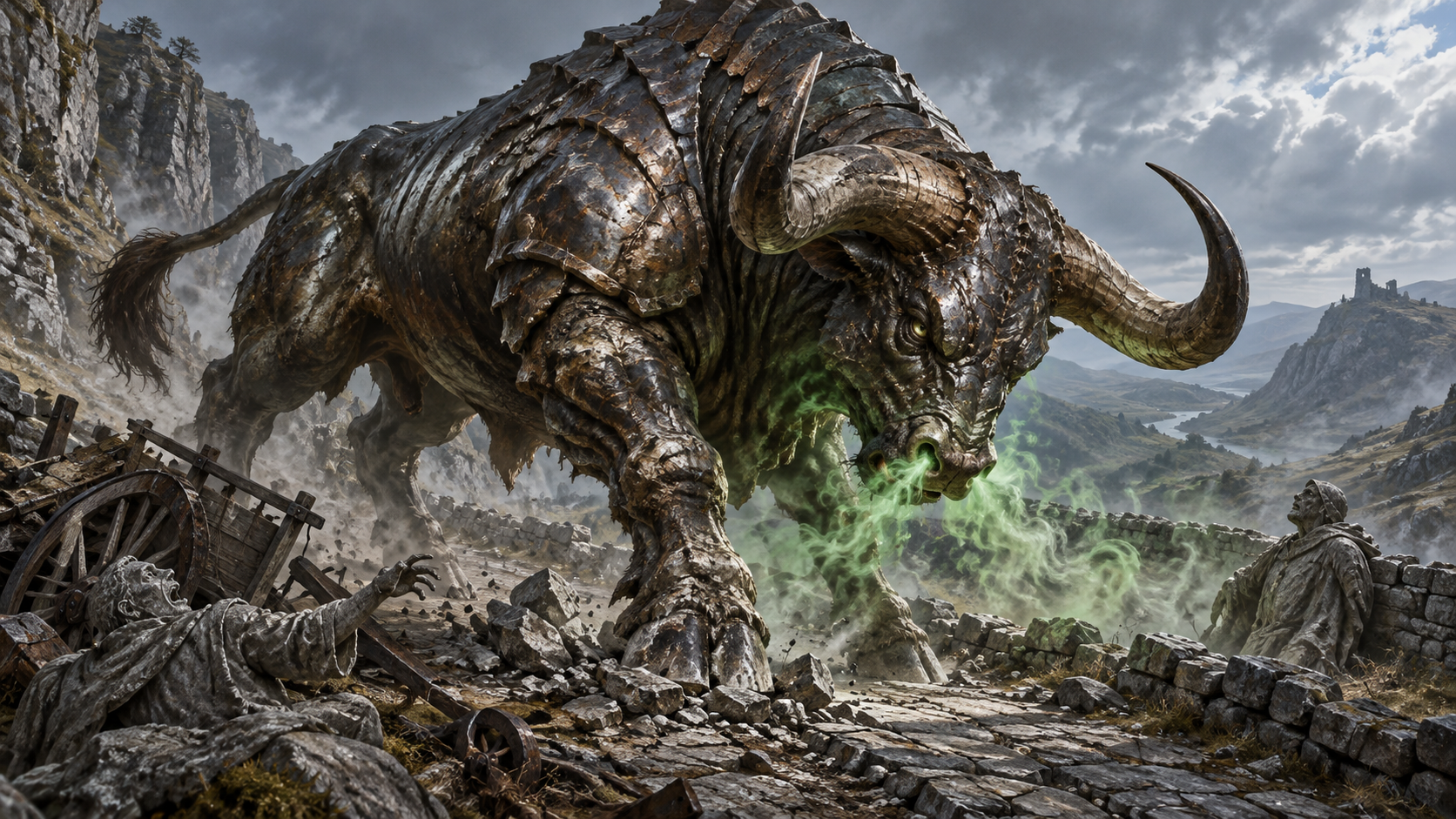
At dawn, the farmer’s son was found standing in the field, turned entirely to stone. The gates had been broken outward, the crops ground flat and the earth marked by hoofprints wider than a man’s chest. From the low hills came a sound like an anvil dragged over rock. Then the green vapour began to rise.
The gorgon is an immense bull-shaped magical creature plated in overlapping metallic armour. Despite its appearance, the older rules describe flesh and bone beneath the plates; it is no simple clockwork beast. Its snorting breath can turn victims to stone, and its iron-hard horns smash anything still standing in its path.
What Is Happening Right Now?
A merchant caravan is overdue at a lonely crossroads. On the old drove road stand three statues with packs still strapped to their shoulders. A shepherd insists the statues were living travellers yesterday; he has also seen a plated bull scraping the mineral-rich stone from a ruined waymarker. A nearby lord wants the creature captured alive as a weapon, while local families need their people brought home.
The safest approach lies through an abandoned quarry where the ground is broken by gullies and masonry. The characters can rescue trapped survivors, seek magic to reverse the petrification, or expose the lord’s attempts to lure the beast across the trade road. A decision about the creature’s fate must be made before the next market convoy arrives.
Armoured Hide and Stone Breath
Gorgons feed on minerals and may gnaw the surface of petrified creatures. Their territory can be recognised by shattered statues, strange streaks in bare rock and grey powder containing fragments of stone. They defend a grazing ground like savage bulls. A herd’s most powerful member drives away rivals, and a solitary bull may challenge anything that looks large enough to threaten it.
The beast’s metallic plates are natural armour in some rule sets, though the 2024 rules classify it as a construct. It should not automatically be confused with an iron golem or a forged automaton. The true danger comes from what happens when its breath reaches allies clustered in one place.
Signs and Behaviour
Before the charge, stones tremble beneath its feet. The plates along its neck scrape together, a green mist escapes its nostrils and its horns drop towards the ground. The beast prefers a straight rush to knock down prey; after the first blow, it turns to face the largest group of intruders before breathing its petrifying vapour. The party should have opportunities to use walls, trenches or a sudden change of elevation to break its charge.
A surviving statue should be treated as a person who may still be restored, not automatically as a corpse. A gorgon may leave victims petrified on the roadway or smash them while defending its ground. In Pathfinder the first petrification can sometimes be shrugged off; in D&D 3.5e the breath’s effect is immediately permanent unless reversed by magic.
The clues lead towards feeding grounds as well as victims. A broken statue with its stone surface scraped or bitten away is different from one shattered by falling masonry. Grey mineral dust, deep hoof ruts, stripped rock around a spring and fragments of precious ore in the ground can reveal a trail through the hills. Keep one victim intact so the players can recognise a real person and decide whether rescue matters more than taking the beast’s horns.
Gorgon Stat Blocks
Choose the edition you are running. All four gorgon blocks derive from published rules, but their creature types, breath DCs, petrification durations and charging attacks differ. The mythic Khalkotauroi below are a separate pair of fire-breathing bronze bulls, not an alternative name for these petrifying stat blocks.
Gorgon — D&D 2024
Large Construct, Unaligned · CR 5 (1,800 XP; PB +3)
AC 19; Initiative +0 (10); HP 114 (12d10 + 48); Speed 40 ft.
| STR | DEX | CON | INT | WIS | CHA |
|---|---|---|---|---|---|
| 20 (+5) | 11 (+0) | 18 (+4) | 2 (−4) | 12 (+1) | 7 (−2) |
Skills Perception +7; Condition Immunities Exhaustion, Petrified; Senses Darkvision 60 ft., Passive Perception 17; Languages None.
Actions
Gore. Melee Attack Roll: +8, reach 5 ft. Hit: 18 (2d12 + 5) Piercing damage. If it moved at least 20 feet straight towards the target before this hit, a Large or smaller target falls Prone.
Petrifying Breath (Recharge 5–6). Constitution Saving Throw: DC 15, each creature in a 30-foot Cone. First failure: Restrained; the creature repeats its save at the end of its next turn while still Restrained, ending the effect on a success. Second failure: Petrified instead.
Bonus Actions
Trample. Dexterity Saving Throw: DC 16, one Prone creature within 5 feet. On failure the target takes 16 (2d10 + 5) Bludgeoning damage; on success, half damage.
Published D&D 2024 Gorgon, from the 2024 Monster Manual / D&D Beyond and SRD 5.2.1. It is a Construct in this edition. Do not import the 2014 DC 13 or Pathfinder’s 60-foot breath into this block.
Gorgon — D&D 2014
Large Monstrosity, Unaligned · CR 5 (1,800 XP)
Armor Class 19 (natural armour); Hit Points 114 (12d10 + 48); Speed 40 ft.
| STR | DEX | CON | INT | WIS | CHA |
|---|---|---|---|---|---|
| 20 (+5) | 11 (+0) | 18 (+4) | 2 (−4) | 12 (+1) | 7 (−2) |
Skills Perception +4; Condition Immunities petrified; Senses darkvision 60 ft., passive Perception 14; Languages —.
Traits
Trampling Charge. After moving 20 or more feet straight towards a creature and hitting it with Gore, the gorgon forces a DC 16 Strength save or knocks the creature prone. It may then make one Hooves attack against the prone target as a bonus action.
Actions
Gore. Melee Weapon Attack: +8 to hit, reach 5 ft., one target. Hit: 18 (2d12 + 5) piercing damage.
Hooves. Melee Weapon Attack: +8 to hit, reach 5 ft., one target. Hit: 16 (2d10 + 5) bludgeoning damage.
Petrifying Breath (Recharge 5–6). The gorgon breathes a 30-foot cone of gas. Each creature in the area makes a DC 13 Constitution saving throw. Failure causes the creature to begin turning to stone and become restrained. It repeats the save at the end of its next turn; success ends the effect, failure means petrification until freed by greater restoration or other magic.
Published D&D 2014 / SRD 5.1 gorgon. Unlike the 2024 version it is a Monstrosity; its breath save DC is 13, not 15. 2014 Basic Rules monster reference.
Gorgon — Pathfinder 1e
CR 8 (XP 4,800) · Neutral Large Magical Beast · Published Pathfinder 1e
Initiative +4; Senses darkvision 60 ft., low-light vision, scent; Perception +17.
Defence
AC 20, touch 9, flat-footed 20 (−1 size, +11 natural); HP 100 (8d10 + 56); Fort +13, Ref +6, Will +7.
Offence
Speed 30 ft.; Melee gore +14 (2d8 + 7), 2 hooves +9 (1d6 + 3); Space/Reach 10 ft./5 ft.; Special Attacks petrifying breath (60-foot cone, Fort DC 21), trample (2d8 + 10, Reflex DC 21 half).
| STR | DEX | CON | INT | WIS | CHA |
|---|---|---|---|---|---|
| 24 (+7) | 10 (+0) | 24 (+7) | 2 (−4) | 16 (+3) | 9 (−1) |
BAB +8; CMB +16; CMD 26; Feats Improved Initiative, Iron Will, Power Attack, Skill Focus (Perception); Environment temperate plains, rocky hills and underground; Organisation solitary, pair, pack (3–4), herd (5–12); Treasure none.
Special Abilities
Breath Weapon (Su). Every 1d4 + 1 rounds, the gorgon breathes a 60-foot cone of green gas. Creatures in it must succeed on a DC 21 Fortitude save or become Petrified. An affected creature repeats the DC 21 save each round to recover naturally unless it is struck by the breath a second time while petrified. That second exposure makes the condition permanent, requiring magic to reverse. The DC is Constitution-based.
Trample (Ex). The creature runs over smaller opponents, dealing 2d8 + 10 damage, Reflex DC 21 half, according to Pathfinder trample rules.
Published Pathfinder 1e gorgon, Pathfinder SRD / Bestiary. The distinction between temporary first exposure and permanent second exposure is specific to Pathfinder and should not be copied into other editions.
Gorgon — D&D 3.5e
CR 8 · Neutral Large Magical Beast · Published D&D 3.5e SRD
Hit Dice 8d10 + 40 (85 HP); Initiative +4; Speed 30 ft.; AC 20 (−1 size, +11 natural), touch 9, flat-footed 20.
BAB/Grapple +8/+17; Attack gore +12 melee (1d8 + 7); Full Attack gore +12 melee (1d8 + 7); Space/Reach 10 ft./5 ft.
| STR | DEX | CON | INT | WIS | CHA |
|---|---|---|---|---|---|
| 21 (+5) | 10 (+0) | 21 (+5) | 2 (−4) | 12 (+1) | 9 (−1) |
Special Attacks breath weapon, trample (1d8 + 7); Special Qualities Darkvision 60 ft., Low-Light Vision, Scent; Saves Fort +11, Ref +6, Will +5; Skills Listen +9, Spot +8; Feats Alertness, Improved Initiative, Iron Will; Environment temperate plains; Organisation solitary, pair, pack (3–4), herd (5–13); Treasure none.
Special Abilities
Breath Weapon (Su). A 60-foot cone of gas that petrifies permanently, Fortitude DC 19 negates. The gorgon can breathe once every 1d4 rounds, no more than five times in a day. There is no automatic round-by-round recovery as in Pathfinder.
Trample (Ex). Deals 1d8 + 7 Bludgeoning damage; Reflex DC 19 half. Both save DCs are part of the original D&D 3.5e creature.
Published D&D 3.5e SRD Gorgon, CR 8. Pathfinder changed the attacks and petrification recovery; the versions are intentionally kept separate.
The Bronze Bulls of Colchis
In the tales of Jason and the Golden Fleece, King Aeëtes of Colchis possesses two immense bulls with bronze hooves and flame pouring from their metal mouths. They are the Khalkotauroi, creatures made by the divine smith Hephaestus. The king challenges Jason to yoke them, plough a field and sow dragon’s teeth. Medea gives him magical protection against their burning breath.
These fire-breathing bulls are not the same as the living, stone-breathing gorgon used in most fantasy roleplaying bestiaries. The resemblance explains why old stories sometimes call both bronze bulls, but neither should gain the other’s powers by accident. If a party encounters the original Khalkotauroi, treat the encounter as a distinct mythical test with fire, forged yokes and the danger of an armed host rising from planted dragon’s teeth, not an automatic petrification encounter.

Running the Gorgon
Give the players a real route choice: open plain where it can build speed, a quarry where its horns can catch on stonework, or a bridge too narrow for easy turning. Foreshadow the breath with intact statues and with victims whose faces show the moment they realised what was happening. Present a rescue objective alongside the risk of fighting it.
Do not combine the editions’ petrification mechanics. In 2014 and 2024, victims first become Restrained; Pathfinder allows repeat saves after initial petrification until a second exposure makes it permanent; 3.5e petrifies permanently on a single failed save. Those differences fundamentally change the encounter.
Before the bull reaches the party, show where its breath could travel: a hollow between quarry walls, a crowded drove road or a broken gateway. The players may choose to scatter, secure a stone barrier, draw it down a narrow turn or remain exposed to save a petrified companion. The 2014 and 2024 clouds reach 30 feet; the Pathfinder and 3.5e breaths reach 60 feet. Those distances should shape the terrain and the rescue, not merely the damage of an unseen attack.
Adventure Encounters
The Market Road of Statues
Travellers are found turned to stone beside their unsold goods. The local magistrate accuses a nearby stone-carving guild of sorcery and sends guards to seize its artisans, while a gorgon is drinking from the mineral-rich water outside their quarry. The party can clear the guild, rescue the victims and decide whether to drive the beast away or secure the quarry as a refuge from its charge.
The King’s Living Siege Engine
A noble wishes to trap the gorgon behind a palisade and release it against enemies. Its holding pens are being built beside an occupied village, and the workers have been told nothing of its breath. When the creature breaks free, the party can move the villagers, sabotage the pens or expose the noble’s plan before his soldiers arrive to silence the witnesses.
The Forged Yoke
A merchant offers an extraordinary bronze yoke said to have restrained the fire-breathing bulls of Colchis. A scholar insists it is a later imitation; a local lord nevertheless sends men to use it on an iron-hided gorgon. The device is poorly suited to a creature whose gas turns flesh to stone. The characters can recover the real story, protect the would-be handlers or trace the yoke’s origin to a far stranger pair of beasts.
Remains and Rewards
The gorgon’s heavy hide, horns and mineral-rich grazing territory may attract hunters and alchemists. Powdered horn is prized by some workers of stone magic, but hunting a gorgon risks destroying the evidence needed to restore its victims. The most valuable prize may be a rescued traveller, recovered possessions from a shattered caravan or knowledge of a safer road through the hills.
Related Creatures and Magic
Compare the Iron Golem, Stone Golem and the Bestiary; related lore includes Jason and Hephaestus.
Watch: The Gorgon
The Dungeoncast — Gorgons: D&D Monster Lore. A creature-focused discussion of the armoured bull and its petrifying breath. These are lore perspectives; use the edition tabs above for game rules.
Rules references: 2024 Gorgon; D&D 2014 SRD 5.1; Pathfinder 1e Gorgon; D&D 3.5e Gorgon. Mythology: Theoi — Bronze Bulls of Aeëtes, recording the account in Argonautica. Edition rules remain separate from mythic lore. The historical fire-breathing Khalkotauroi are a separate pair of mythical bulls, not the petrifying RPG gorgon; the ancient source above covers their story.
Keep this reference growing
If this page helped with your reading or game, you can support its upkeep or explore the curated books.
Explore the Bookshop — epics, classics and stories behind imagined worlds.