
Andrewsarchus — Giant of the Eocene Riverlands
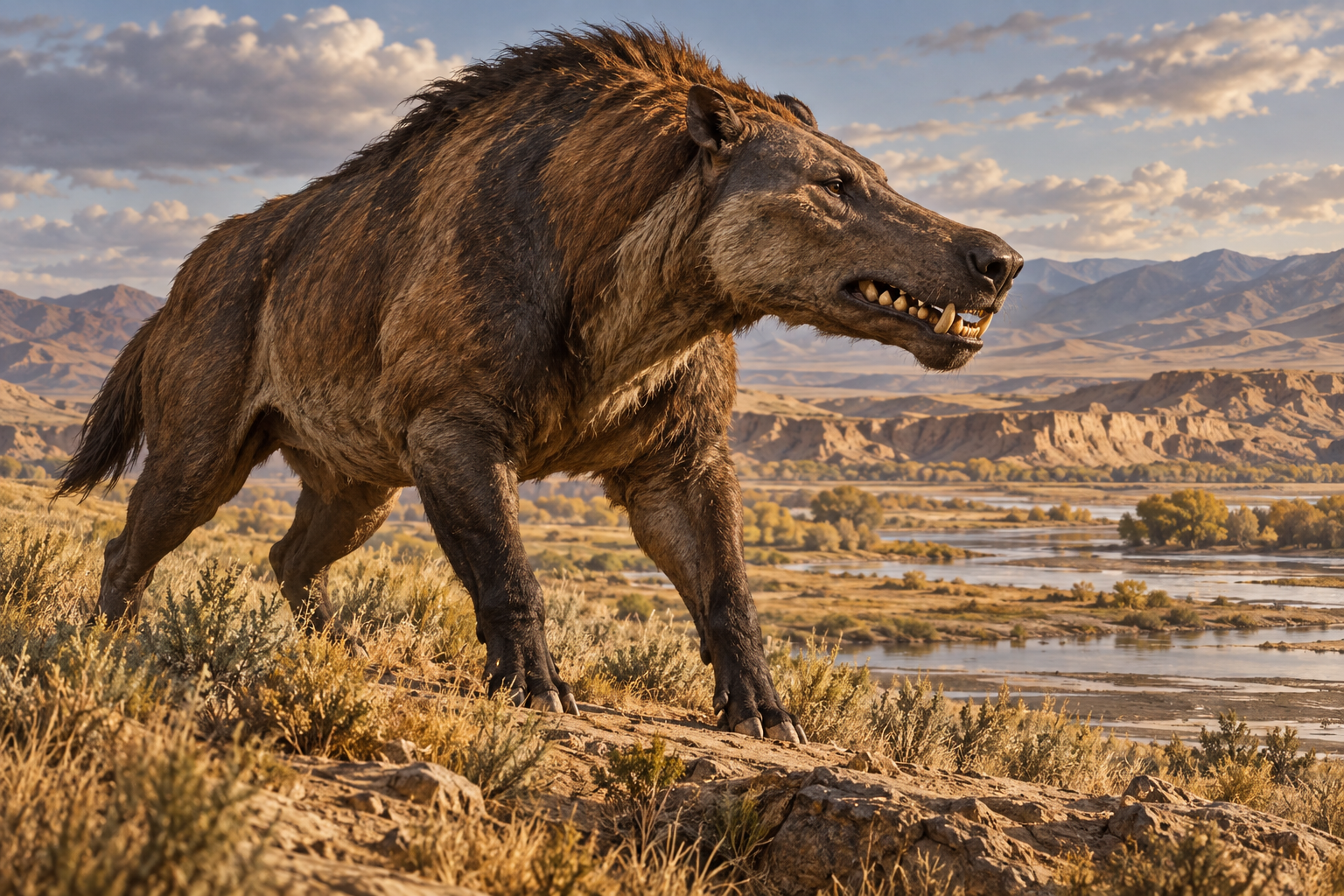
Giant Eocene mammal · crushing jaws · riverland opportunist · prehistoric megafauna
At the Table
At a Glance
- Creature
- Andrewsarchus, giant of the Eocene riverlands
- Size & Type
- Large prehistoric mammal; Beast/Animal by edition
- Temperament
- Wary, opportunistic and dangerous around food or escape routes
- Combat Role
- Heavy charger and single-target bruiser
- Signature Attack
- Driving rush → knockdown pressure → crushing bite
- Habitat
- River margins, floodplains, open woodland and scrub
- Campaign Range
- Hollow Earth — isolated Paleogene riverland refuges; rare wanderers reach the Threshold Depths
- 5.5e / 2024
- CR 5
- 5e / 2014
- CR 5
- PF1e / 3.5e
- CR 5 / CR 5
Mechanics
Rules by Edition
Pick the edition you are running. Challenge Rating, action economy, saves and combat manoeuvres are calculated separately; do not mix mechanics between tabs.
Andrewsarchus — D&D 5.5e / 2024
Large Beast, Unaligned
AC 15 · Initiative +1 (11) · HP 114 (12d10 + 48) · Speed 40 ft.
| STR | DEX | CON | INT | WIS | CHA |
|---|---|---|---|---|---|
| 21 (+5), save +8 | 12 (+1), save +1 | 18 (+4), save +7 | 2 (−4), save −4 | 14 (+2), save +5 | 7 (−2), save −2 |
Skills Perception +5, Survival +5 · Senses Passive Perception 15 · Languages — · CR 5 (1,800 XP; PB +3)
Traits
Keen Smell. Andrewsarchus has Advantage on Wisdom (Perception) checks that rely on smell.
Driving Rush. If Andrewsarchus moves at least 20 feet straight toward a creature and then hits it with Shoulder Slam on the same turn, that target must succeed on a DC 16 Strength saving throw or have the Prone condition.
Actions
Multiattack. Andrewsarchus makes one Bite attack and one Shoulder Slam attack.
Bite. Melee Attack Roll: +8, reach 5 ft. Hit: 18 (2d12 + 5) Piercing damage.
Shoulder Slam. Melee Attack Roll: +8, reach 5 ft. Hit: 14 (2d8 + 5) Bludgeoning damage.
Tactics
Andrewsarchus uses open ground to build momentum, knocks one opponent down with a driving rush and then keeps its enormous jaws on that target. It is dangerous because it commits hard to one creature, not because it has magical or highly complex abilities.
Andrewsarchus — D&D 5e / 2014
Large beast, unaligned
Armor Class 15 (natural armor) · Hit Points 114 (12d10 + 48) · Speed 40 ft.
| STR | DEX | CON | INT | WIS | CHA |
|---|---|---|---|---|---|
| 21 (+5) | 12 (+1) | 18 (+4) | 2 (−4) | 14 (+2) | 7 (−2) |
Saving Throws Str +8, Con +7, Wis +5 · Skills Perception +5, Survival +5 · Senses passive Perception 15 · Languages — · Challenge 5 (1,800 XP)
Traits
Keen Smell. Andrewsarchus has advantage on Wisdom (Perception) checks that rely on smell.
Driving Rush. If Andrewsarchus moves at least 20 feet straight toward a creature and then hits it with a shoulder slam on the same turn, the target must succeed on a DC 16 Strength saving throw or be knocked prone.
Actions
Multiattack. Andrewsarchus makes one bite attack and one shoulder slam attack.
Bite. Melee Weapon Attack: +8 to hit, reach 5 ft., one target. Hit: 18 (2d12 + 5) piercing damage.
Shoulder Slam. Melee Weapon Attack: +8 to hit, reach 5 ft., one target. Hit: 14 (2d8 + 5) bludgeoning damage.
Andrewsarchus — Pathfinder 1e
CR 5 · XP 1,600 · N Large animal
Init +1 · Senses low-light vision, scent; Perception +11
Defense
AC 17, touch 10, flat-footed 16 (−1 size, +1 Dex, +7 natural) · hp 85 (9d8 + 45) · Fort +11, Ref +7, Will +4
Offense
Speed 40 ft. · Melee bite +13 (2d6 + 12), slam +8 (1d8 + 4) · Space 10 ft.; Reach 5 ft. · Special Attacks driving rush
Statistics
Str 27, Dex 13, Con 20, Int 2, Wis 12, Cha 6 · Base Atk +6 · CMB +15 · CMD 26
Feats Alertness, Endurance, Improved Natural Attack (bite), Power Attack, Run · Skills Perception +11
Ecology
Environment temperate plains, river valleys and open woodland · Organization solitary or pair · Treasure none
Special Abilities
Driving Rush (Ex). When Andrewsarchus charges at least 20 feet and hits with its bite, it can immediately attempt a bull rush combat maneuver against that target as a free action without provoking an attack of opportunity. It gains a +4 bonus on this combat maneuver check but does not move with the target.
Tactics
Before Combat Andrewsarchus circles downwind or watches from cover before closing. During Combat it charges an exposed foe, uses driving rush to break formation and follows with its bite and body weight. Morale it withdraws if badly hurt unless cornered or defending a claimed carcass.
Andrewsarchus — D&D 3.5e
| Size/Type | Large Animal |
|---|---|
| Hit Dice | 9d8+45 (85 hp) |
| Initiative | +1 |
| Speed | 40 ft. (8 squares) |
| Armor Class | 14 (−1 size, +1 Dex, +4 natural), touch 10, flat-footed 13 |
| Base Attack/Grapple | +6/+18 |
| Attack | Bite +13 melee (2d6+12) |
| Full Attack | Bite +13 melee (2d6+12) |
| Space/Reach | 10 ft./5 ft. |
| Special Attacks | — |
| Special Qualities | Low-light vision, scent |
| Saves | Fort +11, Ref +7, Will +4 |
| Abilities | Str 27, Dex 13, Con 20, Int 2, Wis 12, Cha 6 |
| Skills | Hide +1, Listen +7, Spot +7 |
| Feats | Alertness, Endurance, Improved Natural Attack (bite), Run, TrackB |
| Environment | Temperate plains |
| Organization | Solitary or pair |
| Challenge Rating | 5 |
| Treasure | None |
| Alignment | Always neutral |
| Advancement | 10–18 HD (Large); 19–27 HD (Huge) |
| Level Adjustment | — |
B Bonus feat.
Combat
Andrewsarchus relies on a single exceptionally powerful bite. It closes quickly on an isolated or weakened target and keeps pressure on that creature rather than spreading attacks across a group.
The Animal
A Giant Built Around Its Jaws
Andrewsarchus is an immense, heavy-bodied mammal whose head looks almost too large for the rest of it. The jaws are the first thing most travellers notice: long, deep and packed with teeth capable of tearing meat, breaking smaller bones and making a warning display impossible to ignore.
It is not a relentless killing machine. A living Andrewsarchus spends far more time walking feeding routes, investigating scent, searching river margins and testing carcasses than attacking healthy prey. When it does decide to fight, it uses body mass and forward momentum to disrupt a target before bringing the jaws in close.
Where Andrewsarchus Is Found
In the campaign present, wild Andrewsarchus are not part of ordinary surface fauna. Their strongest surviving populations live in the Hollow Earth, inside isolated warm Paleogene refuges separated from the dinosaur basins and Ice-Age valleys.
They favour broad interior river systems, reed-choked floodplains, open woodland and scrub where large mammals gather around water. These territories lie mainly in the great inner-world refuge networks beneath Asia, although connected Black Roads, faults and ancient waterways can carry individual animals far from their usual range.
Rare Andrewsarchus encountered in the Threshold Depths are usually displaced wanderers following prey, carrion or reopened passages. A surface sighting should therefore be unusual and significant: it normally means a deep route has opened, an animal has been deliberately moved, or something below is forcing prehistoric wildlife outward.
Behaviour
Andrewsarchus is usually encountered alone. It follows broad feeding circuits between water, carrion sites and places where large animals cross rivers or narrow ground. It investigates smell before sight and often knows that a wounded animal, butchered carcass or travelling pack train is present long before anyone sees it.
Its first response to competitors is normally assessment rather than an immediate charge. It may stand broadside, expose its jaws, make short rushes or push forward deliberately until weaker animals give ground. A creature that abandons food or opens an escape route may end the confrontation without bloodshed.
If Violence Starts
Once committed, Andrewsarchus closes hard and tries to break formation. It prefers an exposed creature at the edge of a group, especially one already prone, injured or separated. The animal does not divide its attention neatly among opponents; it keeps pressure on the easiest target until pain, fire, magic or a stronger threat forces it to disengage.
A hungry animal can be driven away if the expected meal becomes too costly. A cornered Andrewsarchus is much less predictable because escape, not feeding, becomes the priority. It attacks whichever creature blocks the clearest route out.
Signs an Andrewsarchus Is Near
- Enormous hoofed tracks pressed deep into soft riverbank mud.
- Large carcasses with heavy bite damage concentrated around the ribs, neck and limbs.
- Scavengers waiting at an unusual distance from a fresh kill.
- Low, repeated grunts or jaw-clacking carried across open ground.
- Scrub flattened along the same route between water and feeding sites.
- Old bones scattered from a carcass after repeated feeding visits.
Using Andrewsarchus in Play
At a River Crossing
The animal is already using the ford when the party arrives. It may ignore travellers who keep their distance, but pack animals, blood, food or a panicked mount can turn a tense crossing into a confrontation. The encounter has choices before initiative: wait, reroute, distract it or force passage.
At a Carcass
Andrewsarchus has claimed a dead animal that the characters also need to examine. Evidence, equipment or a missing person may lie beneath the body. The creature wants control of the carcass rather than a pointless fight, giving the party room to bargain with distance, noise, fire or another food source.
As a Predator
Use a predatory individual when it has learned that livestock, wounded mounts or isolated travellers are easier meals than healthy wild prey. It follows scent, waits for separation and commits only when it believes the target cannot escape.
As an Ecological Clue
Its presence tells the party that the region can support extremely large mammals and a functioning scavenger guild. Smaller predators alter their routes, carcasses disappear quickly and local people learn which riverbanks are unsafe at dusk.
Challenge Rating and Encounter Scale
Across these rules sets, Andrewsarchus is built as a straightforward CR 5 bruiser. It has enough durability to survive focused attacks, enough speed to close with a party and a bite that matters, but it does not rely on supernatural defences, legendary actions or complicated control effects.
The fifth-edition versions reach their threat through two solid melee attacks and a knockdown opportunity after a charge. Pathfinder adds a bull rush rider to the same idea. The 3.5e block preserves the established CR 5 conversion and its deliberately simple single-bite routine.
Motivation and Reactions
| Situation | Likely response | What may end the encounter |
|---|---|---|
| Claiming carrion | Approaches directly, displays the jaws and pushes competitors away. | Leaving the carcass, offering another food source or making the contest obviously costly. |
| Following blood scent | Trails the group from downwind and probes for an isolated or weakened target. | Removing the scent source, reaching defensible ground or presenting strong resistance. |
| At water | Holds its route or drinking place and watches before escalating. | Giving it space, waiting or choosing another crossing. |
| Cornered | Charges the creature blocking the clearest escape route. | Opening a path and ceasing pursuit. |
Adventure Hooks
- The Ford Is Closed. A huge Andrewsarchus has begun resting beside the only safe river crossing for miles, trapping merchants on both banks while something worse follows the stranded caravans.
- The Wrong Killer. Villagers blame Andrewsarchus for mutilated livestock, but the feeding pattern shows it arrived after death. The real predator is still hunting nearby.
- Skull in the Shrine. A fossilised Andrewsarchus skull is stolen from a ruler’s collection. The thieves believe it marks the route to a surviving population hidden beyond the known valleys.
- The Empty Kill. Hunters find a freshly slain giant herbivore stripped of every useful possession but barely eaten. Andrewsarchus has driven the true killers away and now guards the scene.
- River Teeth. Repeated attacks on ferry animals are blamed on one giant individual. Killing it is easy to demand; discovering why it has abandoned its normal range is harder.
Natural History and Fossil Context
Andrewsarchus mongoliensis is known securely from an enormous skull discovered in 1923 in Mongolia and described the following year. The American Museum of Natural History notes that it remains the only known specimen of the species and dates the animal to roughly 45 million years ago in the Eocene.
That matters because the famous full-body image is much less certain than the skull. The shoulders, limbs, feet, coat, exact mass and overall proportions are reconstructed by comparison rather than preserved as a complete skeleton. Older restorations often made Andrewsarchus look like an immense wolf-like mesonychian. Later phylogenetic work placed it within the broader even-toed ungulate and whale radiation, closer to hippopotamus-and-whale relatives than those old reconstructions implied.
The jaws and teeth establish a very large animal capable of powerful feeding, but they do not prove one narrow lifestyle. Hunting, scavenging and opportunistic omnivory have all been discussed. For play, the most useful interpretation is a dominant large-bodied opportunist that can hunt, displace other feeders and exploit carrion without behaving like a monster that attacks everything it sees.
Research and Further Reading
After the Encounter
Andrewsarchus carries no deliberate treasure. A feeding site may contain torn packs, damaged tack, weapons or valuables belonging to previous victims, while the animal’s teeth and skull attract collectors who value rare prehistoric trophies. Removing a dominant individual can also open the territory to smaller predators and scavengers that had been kept away.
Sources and Licensing
D&D 5.5e / 2024 and D&D 5e / 2014: Andrewsarchus is presented here as an original fifth-edition adaptation using the relevant edition’s monster conventions. It is not an official SRD monster.
Pathfinder 1e: The Pathfinder stat block is an original conversion using Pathfinder First Edition rules conventions.
D&D 3.5e: The legacy CR 5 statistics preserve the established conversion attributed to Shade of the EN World forums, with calculations retained and presentation cleaned for play.
Earlier tabletop appearance: Andrewsarchus appeared in David Howery’s “Back to the Age of Mammals,” Dragon Magazine #167 (1991). That publication is identified for history only; its prose and artwork are not reproduced here.
Artwork: Original site hero illustration. As with every full-body reconstruction of Andrewsarchus, the body remains necessarily speculative because the animal is known principally from cranial material.
Keep this reference growing
If this page helped with your reading or game, you can support its upkeep or explore the curated books.
Explore the Bookshop — epics, classics and stories behind imagined worlds.