
Monster, Kronosaurus, Tyrant of the Inner Deeps
Kronosaurus, Tyrant of the Inner Deeps
In the elder waters of the world, where the old food chains were never broken, the Kronosaurus remains what it was at the beginning: a ruler made of hunger, speed, and bone.
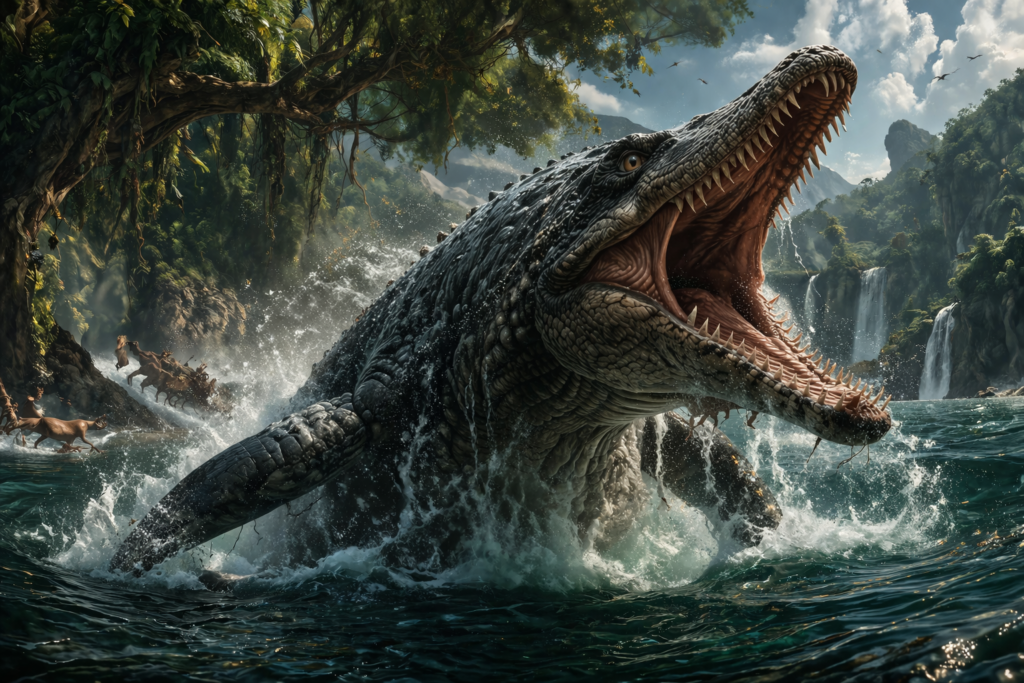
The Kronosaurus is one of the great surviving tyrants of the world’s primal seas, a colossal marine predator from ages that never fully passed away. In many worlds such a beast would be treated as a relic or curiosity from a buried past. However it is something far more convincing and far more dangerous. It belongs.
There are still regions of the world where ancient life was never wholly driven out: the vast hidden waters of Hollow Earth, the drowned depths and ruined coasts of Lemuria, and the savage primal basins that endure in places such as the Lost Valley of the Beastlands. In such realms the Kronosaurus is not an impossible survivor. It is one of the rightful sovereigns of the sea.
It is not a dragon, not a sea serpent, and not some abyssal horror padded with unnecessary sorcery. The Kronosaurus is terrible in the older way. Its body is built for predatory force, its neck short and brutal, its skull immense, and its jaws made to seize prey large enough to matter. It does not horrify because it is unnatural. It horrifies because, in the right waters, it is perfectly natural.
Lore
There are monsters sailors boast about in port, and there are monsters they do not name until they stand again on dry land. The Kronosaurus belongs to the second kind.
In Hollow Earth, captains who work the inner seas know that some waters belong to older powers than kings. There are volcanic-lit channels where red reflections tremble across black water, cavern-oceans whose roofs vanish into darkness, and shelf-seas where a vessel may pass over a moving shadow broad enough to still every voice on deck. There the Kronosaurus hunts as it always has, one of the ancient reasons the inner world’s sea-roads are learned through taboo, inheritance, and hard survival rather than chart alone.
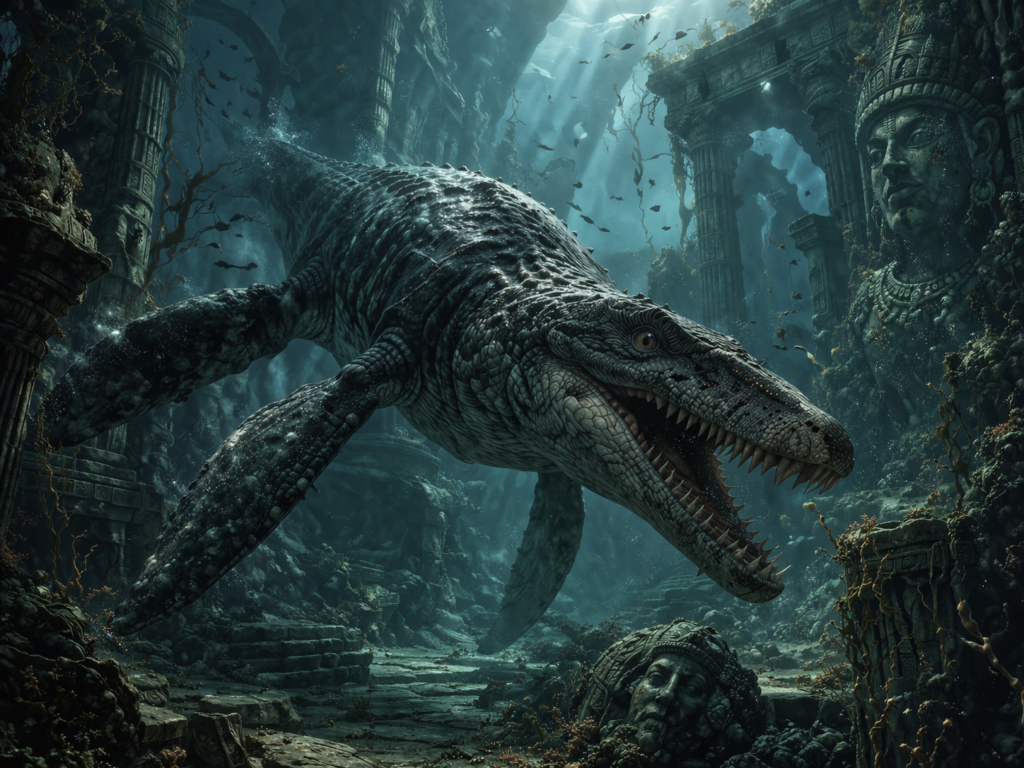
In Lemuria, where drowned cities lie beneath weed-dark depths and broken temple harbours sink into silence, the Kronosaurus moves like the living claim of the sea upon the ruins. Treasure-seekers may fear curses, wards, or forgotten gods in those waters, and sometimes they are right. But often the real danger is simpler and older: the relic-filled depths lie inside the hunting grounds of something large enough to treat divers, boats, and reef-beasts as passing opportunities.
In the Lost Valley of the Beastlands, the creature becomes more primal still. There it does not feel like a surviving prehistoric reptile, but like one of the original hunting forms of creation, preserved in a realm where wildness was never softened for the comfort of man. It is not evil there. It is simply apex life, complete and unquestioned.
Wherever it lives, the Kronosaurus alters the world around it. Fishing grounds fail. Trade routes bend. Other predators become scarce, desperate, or strangely cautious. Coastlines inherit rules that survive longer than dynasties: no pearl-diving in still water, no anchoring beyond the shelf edge, no blood spilled overboard after dusk. Such customs endure because enough people ignored them and vanished.
Appearance
The Kronosaurus is a colossal marine reptile with a broad, heavy body, four immense flippers, a short thick neck, and a skull so large that it seems built for impact as much as feeding. It lacks the serpentine elegance of sea-dragons and the uncanny half-human suggestion of many legendary water horrors. It is older, blunter, and far more convincing than either.
Its jaws are deep and crushing, lined with conical teeth meant to grip massive prey rather than neatly slice flesh. Once those jaws close, leverage, weight, and violent motion do the rest. The whole front of the beast seems constructed around one decisive act: overtake, seize, drown, tear.
Its hide is thick, pebbled, and dark with the colours of ancient water. Hollow Earth specimens often bear the black-green sheen of mineral seas, volcanic ash, and cavern growth. Those from Lemurian waters may be scarred pale with coral abrasion and ruin-worn contact, mottled in deep blue, drowned green, and old stone grey. Beastlands specimens often look richest and harshest of all, dark as wet jungle rock and marked by battles with other colossal predators of the primal wild.
Age does not diminish a Kronosaurus. It magnifies it. Old beasts are carved with scar-lines across jaw, brow, and flank. Harpoons may remain embedded and overgrown. Rival bites may have healed into pale furrows. Some are so weathered by battle and environment that when they surface they look less like animals than living pieces of the world’s first violence.
Behaviour
The Kronosaurus is not a frenzied killer. It is a patient sovereign predator.
It prefers waters where prey must cross predictable lines: shelf edges, reef gates, trench mouths, flooded causeways, cave-straits, migration routes, and the approaches to ancient harbours. It can wait beneath a vessel, beside a descending ledge, or under the broken line of a drowned quay for astonishing lengths of time. Then it attacks with a speed so abrupt that witnesses struggle to describe the event in the right order.
Its true terror lies not merely in size, but in economy. It wastes little effort. It does not thrash without cause. It does not chase mindlessly when darkness, terrain, or patience will serve better. In regions where it lives to great age, it learns the world around it. It knows where shoals gather, where vessels slow, where prey tires, and where panic narrows escape. This remains animal intelligence, but it is old, tested, and lethally efficient.
Most Kronosauruses are solitary. In especially rich primal waters, their ranges may briefly overlap, particularly in breeding seasons or along vast feeding routes. Such encounters are disastrous. Water turns red for miles. Shorelines fill with dead fish, broken shell, torn weed, and the debris of a conflict fought by creatures large enough to treat the sea itself as a battlefield.
Habitat
The Kronosaurus belongs wherever the campaign world has preserved its elder waters.
- In Hollow Earth, it is most at home in warm mineral seas, cavern-lit shelf waters, vast hidden oceans beneath the crust, and the deep maritime routes between ancient inner kingdoms. Here it should feel completely native, one of the primal authorities that proves the inner world is not merely hidden, but old.
- In Lemuria, it belongs among drowned city-rings, reef-choked harbours, submerged ceremonial roads, and blue shelves where broken empires sink into pressure and darkness. There it turns underwater exploration into something more dangerous than discovery. It makes it trespass.
- In the Lost Valley of the Beastlands, it belongs in steaming inland seas, impossible jungle estuaries, green watercourses broad enough to feed megafauna, and deep lakes where the oldest hunting laws remain unbroken. There it should feel less like a surviving species than like one of the great original shapes of predation.
It can also inhabit isolated warm archipelagos, drowned crater seas, forbidden shelf waters, and hidden interior basins elsewhere in the world, but it is strongest when tied to places where ancient life still has space to remain itself.
Modus Operandi
The Kronosaurus kills by commitment.
Its most feared strike is the upward assault from below. A vessel or swimmer crosses calm water, and then the beast rises in a surge of weight and speed, smashing first, biting second, and letting panic finish what force began.
It also attacks laterally from murk, weed-shadow, ruin corridors, reef passages, and drowned architecture. In Lemurian waters especially, it may use toppled pillars, submerged streets, and collapsed harbour works as ambush geometry, appearing only when escape has already narrowed.
Against vessels, it attacks like a true giant predator. Hull, steering, balance, oars, and bodies in the water all matter more than spectacle. It wants confusion. It wants separation. It wants one clean failure in order to create many.
In the Beastlands, the same methods become even more primal. There it may strike at river-herds, ford crossings, or jungle margins where thirsty life comes down to drink and discovers that even paradise contains older laws of death.
Kronosaurus 5.5
Elder Kronosaurus 5.5
Kronosaurus, Pathfinder
Kronosaurus
Huge beast, unaligned
Armor Class 17 (natural armor)
Hit Points 217 (14d12 + 126)
Speed 10 ft., swim 60 ft.
| STR | DEX | CON | INT | WIS | CHA |
|---|---|---|---|---|---|
| 25 (+7) | 12 (+1) | 22 (+6) | 2 (-4) | 14 (+2) | 7 (-2) |
Saving Throws Str +11, Con +10, Wis +6
Skills Perception +6, Stealth +5 in water
Senses passive Perception 16
Languages —
Challenge 13 (10,000 XP)
Proficiency Bonus +5
Hold Breath. The Kronosaurus can hold its breath for 1 hour.
Aquatic Ambusher. The Kronosaurus has advantage on attack rolls against creatures it surprises while underwater.
Siege Predator. The Kronosaurus deals double damage to objects and structures made primarily of wood, including ships, docks, and piers.
Depth Rush. If the Kronosaurus swims at least 30 feet straight toward a target and then hits it with a Bite attack on the same turn, the attack deals an extra 13 (3d8) piercing damage. If the target is Large or smaller, it must succeed on a DC 19 Strength saving throw or be knocked prone. If the target is Large or smaller and is in the water, the Kronosaurus can grapple it.
Massive Body. The Kronosaurus has advantage on Strength saving throws against effects that would knock it prone, push it, pull it, or otherwise forcibly move it.
Actions
Multiattack. The Kronosaurus makes two attacks: one with its Bite and one with its Flipper.
Bite. Melee Weapon Attack: +11 to hit, reach 10 ft., one target. Hit: 23 (3d10 + 7) piercing damage. If the target is Large or smaller, it is grappled (escape DC 19). Until this grapple ends, the target is restrained, and the Kronosaurus cannot bite a different target.
Flipper. Melee Weapon Attack: +11 to hit, reach 10 ft., one target. Hit: 17 (3d6 + 7) bludgeoning damage.
Shattering Surge (Recharge 5–6). The Kronosaurus surges through the water in a 20-foot line that is 10 feet wide. Each creature in that line must make a DC 19 Strength saving throw, taking 22 (4d10) bludgeoning damage on a failed save, or half as much on a successful one. A wooden vehicle or structure in that line takes 44 (8d10) bludgeoning damage instead.
Bonus Actions
Drag Below. The Kronosaurus moves up to half its swim speed with one Large or smaller creature grappled by it. This movement does not provoke opportunity attacks from the grappled creature.
Tactics
The Kronosaurus attacks from beneath whenever possible. It uses Depth Rush to hit hard, knock prey off balance, and seize victims in the water. Against boats, it attacks hulls, oars, steering, and anyone thrown overboard before closing for the kill.
The Kronosaurus in the World
A Kronosaurus should alter more than a single scene. It should alter the life around it.
Where one of these beasts rules the water, trade changes course, fisheries fail, pilots demand higher fees, and whole ports prosper or decline according to whether they can endure its range or escape it. Priests shape rites around it. Sailors give dangerous channels old names and pass down warnings more faithfully than charts. Hunters may speak boldly of it on land, but not for long. A creature of this scale becomes part of local law, local fear, and local memory.
That matters in SpiralWorlds because the Kronosaurus is strongest when it is treated as part of a place rather than as an isolated encounter. In Hollow Earth it helps prove that the hidden world preserves complete ancient ecologies. In Lemuria it gives the drowned realm not only wonder and ruin, but living territorial danger. In the Beastlands it reminds travellers that primal beauty and primal death are never far apart.
Using the Kronosaurus Well
The best Kronosaurus stories begin long before the beast is seen.
Begin with consequences: missing vessels, ruined nets, frightened divers, abandoned banks, convoys no outsider can fully explain, harbour warnings carved into old stone, or stretches of water crossed only in silence. Let the creature first appear as pressure on a region, not as a sudden fight. By the time it surfaces, it should feel like the answer to a mystery the coastline already lives under.
That is where the Kronosaurus becomes most. Not as a prehistoric novelty restored for spectacle, but as one of the surviving authorities of the campaign world’s primal seas.
It is not a relic intruding on the present.
It is one of the ancient powers by which the elder world still holds its ground.
Kronosaurus
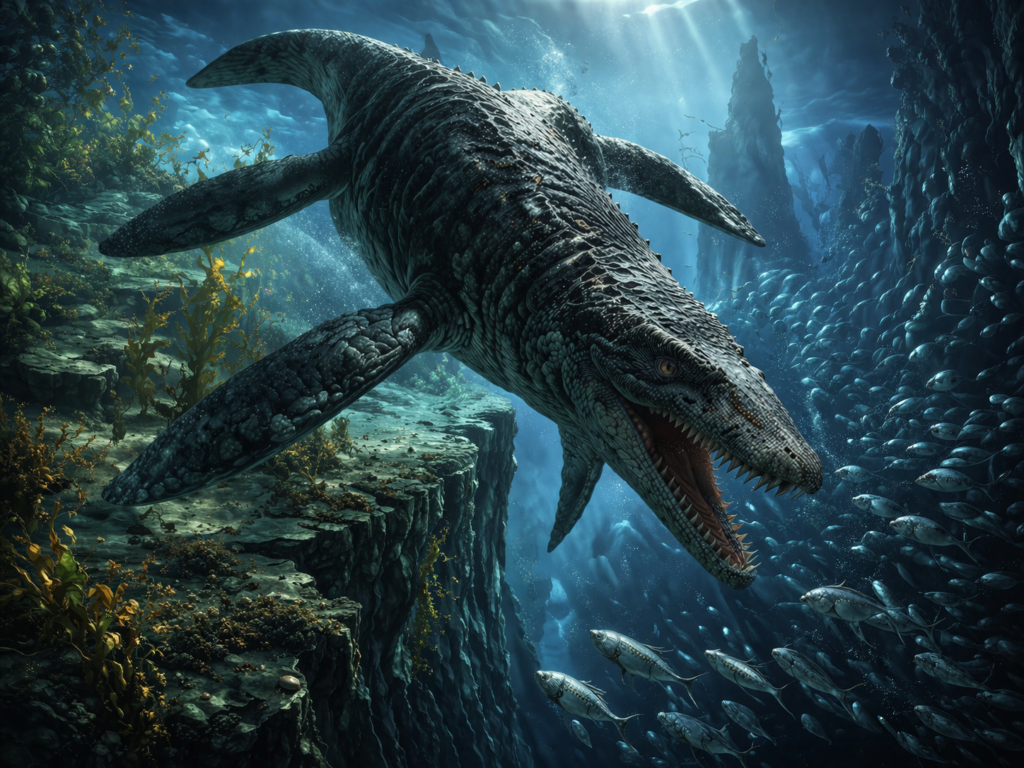
This enormous, finned reptile has a long mouth full of sharp teeth and moves through the water with incredible speed.
Kronosaurus CR 10
XP 9,600
N Gargantuan animal
Init +1; Senses low-light vision, scent; Perception +20
DEFENSE
AC 23, touch 7, flat-footed 22 (+1 Dex, +16 natural, –4 size)
hp 138 (12d8+84)
Fort +15, Ref +9, Will +7
OFFENSE
Speed swim 60 ft.
Melee bite +19 (3d8+19/19–20 plus grab)
Space 20 ft.; Reach 20 ft.
Special Attacks swallow whole (3d6+12 damage, AC 18, 13 hp)
STATISTICS
Str 36, Dex 13, Con 24, Int 2, Wis 13, Cha 9
Base Atk +9; CMB +26 (+30 grapple); CMD 37 (can’t be tripped)
Feats Endurance, Improved Critical (bite), Iron Will, Power Attack, Skill Focus (Perception), Weapon Focus (bite)
Skills Perception +20, Swim +26
ECOLOGY
Environment warm oceans
Organization solitary, pair, or school (3–8)
Treasure none
The mighty kronosaurus is a relentless hunter that, once it picks up a potential meal’s scent, rarely stops seeking its prey until its appetite is sated. A kronosaurus’s diet consists of everything from large fish and sharks to small whales, giant squids, and sea turtles. Remains of other giant saurians have reportedly been found in the stomachs of those rare kronosauruses that are killed by hunters or wash up dead on shore. Unlike other reptiles, a kronosaurus does not lay eggs, but instead births its young live.
The young kronosauruses stay with their mother for less than a year before parting ways and hunting on their own. A fully grown kronosaurus can reach lengths of up to 50 feet and weigh as much as 40,000 pounds.
Primeval Sea Creatures
The ocean is full of myriad life forms, as varied and specialized as those in any other environment. But not all sea creatures are the result of millennia upon millennia of continual evolution. Some found themselves perfectly suited for their roles as apex predators millions of years ago and have simply remained as such to the present day, presenting terrible threats to those creatures that cross them, from their natural prey to unsuspecting sailors who find themselves in the wrong place at the wrong time.
In most cases, these creatures are closely related to other waterborne animals, be they fish, reptiles, or mammals, and some even have distinctive similarities to primarily land-based creatures.
Section 15: Copyright Notice
Pathfinder Adventure Path #60: From Hell’s Heart © 2012, Paizo Publishing, LLC; Authors: Jason Nelson and Rob McCreary.
Elder Kronosaurus
Gargantuan beast, unaligned
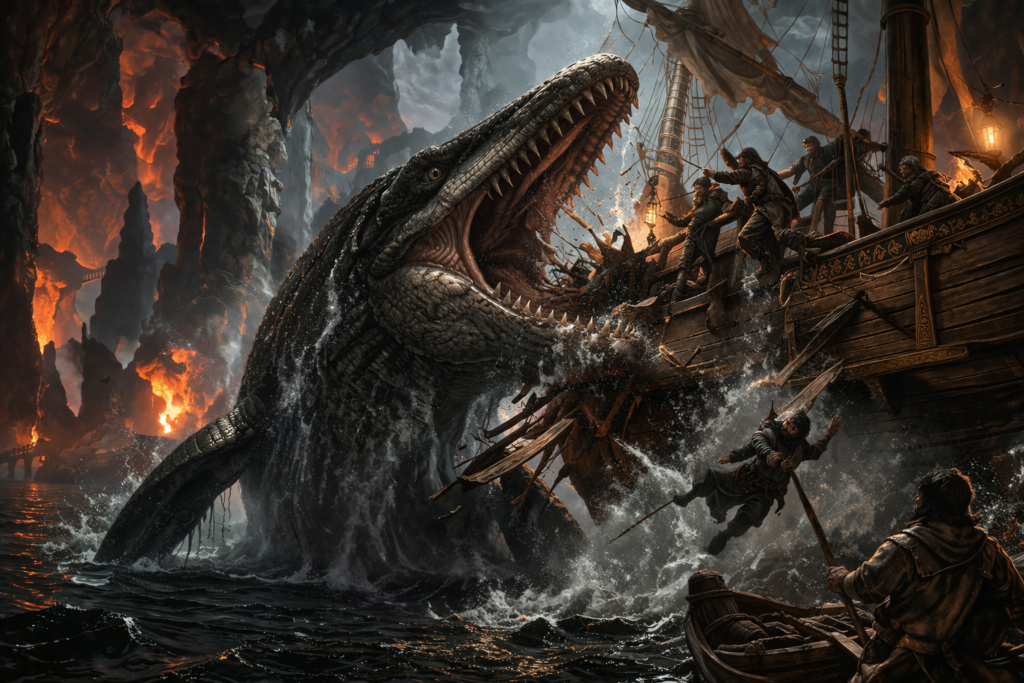
An elder kronosaurus is the oldest and greatest natural expression of its kind: a colossal primal sea-predator that has survived long enough to become a regional power. Such specimens are most at home in the vast inner seas of Hollow Earth, the drowned reaches of Lemuria, and the primeval waters of the Beastlands’ Lost Valley, where ancient life still has room to grow to its fullest and most terrifying scale.
Armor Class 18 (natural armor)
Hit Points 297 (17d20 + 119)
Speed 10 ft., swim 70 ft.
| STR | DEX | CON | INT | WIS | CHA |
|---|---|---|---|---|---|
| 28 (+9) | 12 (+1) | 24 (+7) | 3 (-4) | 15 (+2) | 9 (-1) |
Saving Throws Str +15, Con +13, Wis +8
Skills Perception +8, Stealth +7 in water
Senses passive Perception 18
Languages —
Challenge 17 (18,000 XP)
Proficiency Bonus +6
Hold Breath. The elder kronosaurus can hold its breath for 1 hour.
Aquatic Ambusher. The elder kronosaurus has advantage on attack rolls against creatures it surprises while underwater.
Siege Predator. The elder kronosaurus deals double damage to objects and structures made primarily of wood or stone, including ships, docks, piers, gates, causeways, and submerged ruins.
Depth Rush. If the elder kronosaurus swims at least 30 feet straight toward a target and then hits it with a Bite attack on the same turn, the attack deals an extra 18 (4d8) piercing damage. If the target is Huge or smaller, it must succeed on a DC 23 Strength saving throw or be knocked prone. If the target is Large or smaller and is in the water, the elder kronosaurus can grapple it.
Massive Body. The elder kronosaurus has advantage on Strength saving throws against effects that would knock it prone, push it, pull it, restrain it, or otherwise forcibly move it.
Tyrant of the Deeps. The elder kronosaurus ignores difficult terrain caused by water, surf, submerged ruins, coral, weed, and shallow debris.
Actions
Multiattack. The elder kronosaurus makes two attacks: one with its Bite and one with its Flipper. It can replace its Flipper attack with Tail Wash.
Bite. Melee Weapon Attack: +15 to hit, reach 15 ft., one target. Hit: 31 (4d10 + 9) piercing damage. If the target is Huge or smaller, it is grappled (escape DC 23). Until this grapple ends, the target is restrained, and the elder kronosaurus cannot bite a different target.
Flipper. Melee Weapon Attack: +15 to hit, reach 10 ft., one target. Hit: 22 (3d8 + 9) bludgeoning damage.
Tail Wash. Melee Weapon Attack: +15 to hit, reach 20 ft., one target. Hit: 19 (3d6 + 9) bludgeoning damage, and the target must succeed on a DC 23 Strength saving throw or be pushed up to 20 feet away and knocked prone. If the target is in the water, it is pushed up to 30 feet away instead.
Shattering Surge (Recharge 5–6). The elder kronosaurus surges through the water in a 30-foot line that is 15 feet wide. Each creature in that line must make a DC 23 Strength saving throw, taking 36 (8d8) bludgeoning damage on a failed save, or half as much on a successful one. A vehicle or structure in that line takes 72 (16d8) bludgeoning damage instead.
Ruinbreaker Jaws (Recharge 6). The elder kronosaurus makes one Bite attack against a ship, wall, gate, pier, or similar structure. On a hit, the attack deals double damage.
Bonus Actions
Drag Into the Black. The elder kronosaurus moves up to half its swim speed with one Huge or smaller creature grappled by it. This movement does not provoke opportunity attacks from the grappled creature.
Tactics
An elder kronosaurus should feel like a true maritime tyrant. It does not simply attack prey. It breaks vessels, controls water, and chooses where the fight happens. It strikes from below, cripples the target’s position, seizes one victim, then vanishes into the depths before returning from a worse angle.
Keep this reference growing
If this page helped with your reading or game, you can support its upkeep or explore the curated books.
Explore the Bookshop — epics, classics and stories behind imagined worlds.