
Isitoq — Tiny Undead Watching Eye
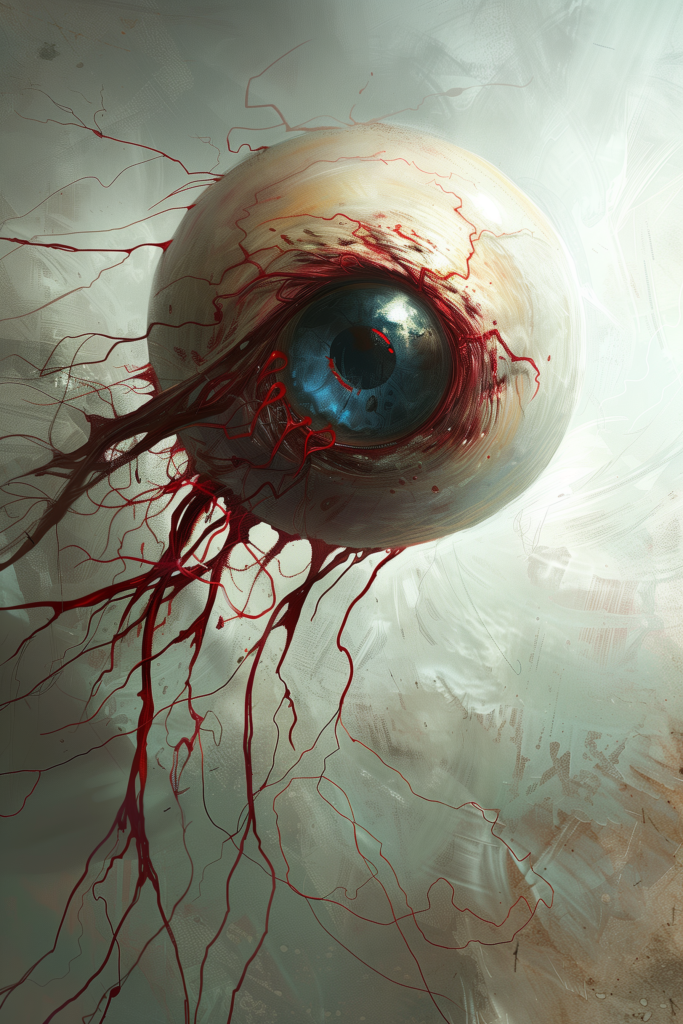
Along the Inuit coast, a wet red eye slips through a gap in the snowhouse wall. Its ragged nerves beat like wings; salty tears freeze where they fall. Someone has made an undead spy and sent it among the winter shelters. The creature resembles nothing that an elder has described of Issitôq, the watchful helping spirit.
Game Statistics
Isitoq — D&D 2024
Tiny Undead, Neutral Evil · CR 1/2 (100 XP; PB +2)
AC 14 (natural armour); Initiative +2 (12); HP 13 (3d4 + 6); Speed 5 ft., Fly 40 ft. (hover).
| Ability | Score | Modifier | Save |
|---|---|---|---|
| STR | 4 | −3 | −3 |
| DEX | 14 | +2 | +2 |
| CON | 14 | +2 | +2 |
| INT | 7 | −2 | −2 |
| WIS | 14 | +2 | +4 |
| CHA | 12 | +1 | +1 |
Skills Perception +4, Stealth +6; Damage Immunities Poison; Condition Immunities Charmed, Exhaustion, Frightened, Poisoned; Senses Darkvision 60 ft., Passive Perception 14; Languages understands one language of its creator but cannot speak.
Traits
Death’s Last Witness. An Isitoq’s wing or tears impress a vision of its corpse’s final living moments on a victim affected by Dazing Vision. The vision can contain a face or other clue only if the dying creature actually saw it. The vision is not speech or reliable omniscient divination.
Dazing Vision. When a living creature fails a saving throw against Nerve Wing or Tears of Anguish, it has the Incapacitated condition until the end of its next turn as it relives the corpse’s death. This is a magical fear effect.
Visual Sensor. The Isitoq’s creator can take a Bonus Action to perceive through its eye until the start of the creator’s next turn while the Isitoq is within 60 ft. The creator uses the eye’s sight and Darkvision instead of their own sight during this time; the link does not grant unlimited range, shared hearing, telepathy or spellcasting through the eye.
Undead Nature. The Isitoq doesn’t need air, food, drink or sleep. It is corporeal and can’t pass through solid doors or walls.
Actions
Nerve Wing. Melee Attack Roll: +4, reach 5 ft., one creature. Hit: 4 (1d4 + 2) Piercing damage. The target must succeed on a DC 11 Wisdom Saving Throw or suffer Dazing Vision.
Tears of Anguish (Recharge 5–6). Ranged Attack Roll: +4, range 30 ft., one creature with eyes. Hit: 3 (1d6) Psychic damage. The creature must succeed on a DC 11 Wisdom Saving Throw or suffer Dazing Vision.
Isitoq — D&D 2014
Tiny Undead, Neutral Evil · CR 1/2 (100 XP)
AC 14 (natural armour); HP 13 (3d4 + 6); Speed 5 ft., Fly 40 ft. (hover).
| STR | DEX | CON | INT | WIS | CHA |
|---|---|---|---|---|---|
| 4 (−3) | 14 (+2) | 14 (+2) | 7 (−2) | 14 (+2) | 12 (+1) |
Saving Throws Wis +4; Skills Perception +4, Stealth +6; Damage Immunities Poison; Condition Immunities Charmed, Exhaustion, Frightened, Poisoned; Senses Darkvision 60 ft., Passive Perception 14; Languages understands one language of its creator but cannot speak.
Traits
Death’s Last Witness. An Isitoq’s wing or tears impress a vision of its corpse’s final living moments on a victim affected by Dazing Vision. The vision can contain a face or other clue only if the dying creature actually saw it. The vision is not speech or reliable omniscient divination.
Dazing Vision. When a living creature fails a saving throw against Nerve Wing or Tears of Anguish, it is incapacitated until the end of its next turn as it relives the corpse’s death. This is a magical fear effect.
Visual Sensor. The Isitoq’s creator can use an action to perceive through its eye until the start of the creator’s next turn while the Isitoq is within 60 ft. The creator uses the eye’s sight and Darkvision instead of their own sight during this time; the link does not grant unlimited range, shared hearing, telepathy or spellcasting through the eye.
Undead Nature. The Isitoq doesn’t need air, food, drink or sleep. It is corporeal and can’t pass through solid doors or walls.
Actions
Nerve Wing. Melee Weapon Attack: +4 to hit, reach 5 ft., one creature. Hit: 4 (1d4 + 2) Piercing damage. The target must succeed on a DC 11 Wisdom saving throw or suffer Dazing Vision.
Tears of Anguish (Recharge 5–6). Ranged Spell Attack: +4 to hit, range 30 ft., one creature with eyes. Hit: 3 (1d6) Psychic damage. The creature must succeed on a DC 11 Wisdom saving throw or suffer Dazing Vision.
Encounter Use. The Isitoq prefers Tears of Anguish at range and Nerve Wing only when cornered. It withdraws toward its master’s sanctum rather than stand and fight to the death.
Isitoq — Pathfinder 1e
NE Diminutive Undead · CR 1/2 (200 XP)
Initiative +1; Senses Darkvision 60 ft., Perception +7.
AC 15, Touch 15, Flat-Footed 14 (+1 Dex, +4 Size); HP 9 (2d8); Fort +0, Ref +1, Will +5; Immune Undead traits.
Speed 5 ft., Fly 60 ft. (perfect); Melee Slam +6 (1d2−3), 2 Wings +6 (1d1−3 plus Daze); Space/Reach 1 ft./0 ft.; Special Attacks Daze, Tears of Anguish.
| STR | DEX | CON | INT | WIS | CHA |
|---|---|---|---|---|---|
| 4 (−3) | 13 (+1) | — | 7 (−2) | 14 (+2) | 11 (+0) |
BAB +1; CMB −2; CMD 5 (can’t be tripped); Feat Weapon Finesse; Skills Fly +15, Perception +7, Stealth +18; Languages one language of its creator (cannot speak); SQ Visual Sensor.
Environment any (typically necromantic interiors); Organisation solitary or gang (2–8); Treasure none.
Special Abilities
Daze (Ex). A creature struck by an Isitoq’s wings must succeed on a DC 11 Will save or be Dazed for 1 round while it sees the last moments of the corpse’s life. This is a mind-affecting fear effect; the DC is Charisma-based.
Tears of Anguish (Su). As a full-round action, the Isitoq makes a ranged touch attack against one creature within 30 ft. If the target fails a DC 11 Will save, it suffers the Isitoq’s Daze effect. The DC is Charisma-based.
Visual Sensor (Su). Its creator or master can see through its eye while within 60 ft., using its normal vision and Darkvision. Detect Chaos, Detect Evil, Detect Good, Detect Law, Detect Magic and Message have a 5% chance per creator caster level of functioning through the eye. At creator level 15 or higher, Read Magic and Tongues have the same chance.
Creating an Isitoq
A spellcaster animates the head of a Small or Medium corpse with an intact eye as a 1-HD Undead via Animate Dead (counting against the spell’s creation and control limits), then casts Clairaudience/Clairvoyance or Locate Object for the sensory connection, and Air Walk, Fly, Levitate or Wind Wall for flight. One eye separates from the head and becomes the sentinel; the rest remains. An evil spellcaster with Improved Familiar can gain an Isitoq as a familiar at 5th level.
Isitoq — D&D 3.5e
Diminutive Undead, Neutral Evil · CR 1/2
Hit Dice 2d12 (13 hp); Initiative +1; Speed 5 ft., Fly 60 ft. (perfect); AC 15 (+1 Dex, +4 Size), Touch 15, Flat-Footed 14; BAB/Grapple +1/−14; Space/Reach 1 ft./0 ft.; Fort +0, Ref +1, Will +5.
| STR | DEX | CON | INT | WIS | CHA |
|---|---|---|---|---|---|
| 4 (−3) | 13 (+1) | — | 7 (−2) | 14 (+2) | 11 (+0) |
Attack Wing +6 melee (1 point damage plus Daze), or Slam +6 melee (1 point damage); Full Attack 2 Wings +6 melee (1 point damage each plus Daze); Special Attacks Daze, Tears of Anguish; Special Qualities Undead Traits, Visual Sensor.
Skills Hide +18, Spot +7; Feat Weapon Finesse; Senses Darkvision 60 ft.; Language understands Common, cannot speak; Environment any (normally a warded interior); Organisation solitary or gang (2–8); Treasure none.
Special Abilities
Daze (Ex). A creature struck by a wing must succeed on a DC 11 Will save or be Dazed for 1 round by the dead creature’s final vision. This mind-affecting fear effect is Charisma-based.
Tears of Anguish (Su). As a full-round action, the Isitoq makes a +6 ranged touch attack against one creature within 30 feet. On a hit, the target must succeed on a DC 11 Will save or be Dazed for 1 round.
Visual Sensor (Su). The creature’s master may see through its eye while within 60 feet. Detect Chaos, Detect Evil, Detect Good, Detect Law, Detect Magic and Message each have a 5% chance per creator caster level of operating through it; Read Magic and Tongues gain the same chance when that creator reaches caster level 15.
Undead Traits. No Constitution score and no need for air, food or sleep; immune to Poison, Sleep, Paralysis, Stunning and mind-affecting effects, plus the other immunities of the Undead type.
Creation Ritual
Creating one requires a corpse’s intact eye, Animate Dead, Clairaudience/Clairvoyance and Fly or equivalent flight magic. For this original conversion, the eye separates during an hour-long necromantic rite; count its 2 HD against undead control limits and expend the normal Animate Dead material component. The ordinary spell by itself does not animate independent eyes.
What Is Happening Right Now?
The hunters return from the sea ice to find salt-stained tears on the wall of a winter shelter. An eye, raw and bloodshot, hovers beside the stores, its torn nerves beating like the wings of a moth. It flees when challenged, but a hunter who catches one of its trailing strands sees a stranger’s final moments: an abandoned boat, a gloved hand and a knife driven beneath the ribs. Someone nearby has killed a traveller and turned his eye into a spy.
The elders know accounts of Issitôq, the remarkable helping spirit that can discover those who have broken taboos. The grotesque thing now prowling the settlement is no such spirit. It is a corpse’s stolen eye, animated by a spellcaster who has borrowed a familiar name to conceal a murder. The distinction matters. A false accusation could destroy a household’s standing long before the company reaches the actual killer.
The Corpse’s Last Witness
An isitoq is made, not born. Its creator takes an eye from the dead and sends it through openings too narrow for a human lookout. Its only report is what its master sees through it when the eye comes close enough. It can watch a storehouse, circle the edge of a camp or return to a concealed chamber when it finds danger. Though it understands orders, it cannot speak, negotiate or identify the murderer by magic alone.
Its watch is merciless. It returns night after night to a captive’s shelter, marks those who come to help and strikes anyone who approaches the door it guards. A spellcaster who has made several eyes may place them in separate passages or among the rocks beyond the camp, but each remains a fragile servant rather than a powerful fighter. The eye remembers nothing of its former life except the final vision that its wounds can force upon the living.
Signs of the Watching Eye
- Salty tears frozen beneath a narrow roof opening, even when no one has entered
- Blood-fine marks where ragged nerves have dragged over a lintel or a storage chest
- A traveller’s disturbed body, with one eye removed
- A watcher that turns back toward the same rock shelter whenever it is followed
- A struck hunter who falls silent and describes the dying stranger’s last sight
Watching, Pursuit and Battle
On watch. The isitoq lurks above a passage or in the dark beneath an overhang, following anyone who approaches its master’s hiding place. It does not announce itself. Once a stranger enters the watched ground, the eye flutters ahead to bring the visitor within sight of its creator.
First strike. When discovered, it squirts its Tears of Anguish towards an enemy’s eyes. The victim sees the dead person’s last breath and may be unable to act for a moment. The vision reveals only what the deceased truly saw; a killer hidden behind him remains hidden in the vision.
If trapped. The creature lashes with its nerve-wings, then climbs out of reach or flees through the nearest opening. Its master may exploit that brief distraction to close a passage or send Skeletons to defend a chamber, but those allies act separately.
Defeating the watcher. The eye is corporeal, unlike an incorporeal Ghost. A sealed door, a covered opening or a heavy hanging can stop it from passing or looking through. Darkness alone is no protection against its darkvision. Its master can borrow its sight only within sixty feet, so a party can draw it beyond that distance, close off the route home or strike it down. The slain eye cannot tell anyone where its creator is hiding.
Three Encounters
The Stolen Eye. A stranger is found dead near a winter landing, and the body has been robbed of one eye. Each night a weeping watcher returns to the place where the dead man left his belongings. Adventurers who resist its dreadful vision may recognise a distinctive knife and find the murderer among those who arrived with the stranger. The community has offered shelter to the killer; discovery must rest on evidence, not suspicion of the dead man’s hosts.
False Judgment. A traveller trained in forbidden necromancy claims that a wandering eye exposes breaches of taboo. He uses the undead thing to spy on families, then names private conversations as evidence of wrongdoing. A trusted elder knows that the stories of Issitôq describe a helping spirit, not a corpse’s eye under a stranger’s command. The company can trace the tears to the traveller’s hidden workroom and end the deception before accusations split the camp.
The Watches Beneath the Ice. A sorcerer shelters in a cave above the shore and has set several isitoqs to guard the narrow approaches. Each eye flies back when it reaches the limit of its master’s vision. Characters who watch those patrols can locate the hidden chamber, close the passage behind the sentries or lure them downwind across the sea ice before entering. The stronger threat is the spellcaster who made them, not the eyes themselves.
What the Dead Leave Behind
The floating eye carries no treasure. Its final vision may contain a piece of a boat’s painted prow, the colour of a glove or the face of the person who knelt over the corpse. Such signs become evidence only when they can be checked against other witnesses. Restoring the dead traveller’s remains to those entitled to mourn him is a greater victory than merely destroying the spy.
Origins, Rules and Licensing
In this campaign an Isitoq understands one language selected by its necromantic creator, not a universally spoken Common. The Pathfinder source’s language entry is retained as an acknowledged source variant, not claimed as the revised campaign text.
The necromantic Isitoq and its published Pathfinder statistics come from Pathfinder Roleplaying Game Bestiary 4 (2013), p. 159. The D&D 2024, D&D 2014 and D&D 3.5e panels contain original conversions, not official D&D monster statistics. Creation through Animate Dead, Clairvoyance, Locate Object and Fly follows the particular ritual described in the published Pathfinder creature entry, not a universal power of those spells.
Inuit source tradition. Issitôq, also written Issitoq or Isitoq, belongs to Iglulik Inuit mythology. In Knud Rasmussen’s Intellectual Culture of the Iglulik Eskimos (1929), Anarqâq describes the melancholy giant-eyed helping spirit, which came to him after the death of his parents, offered companionship and could find people who had broken taboos. The account gives it bristling hair, divided eyes and a vertical mouth with teeth; it is not described as a dead eye animated by a necromancer. The Pathfinder creature borrows a closely associated name and eye-and-watcher motif for a very different undead fantasy monster. No claim is made that the source tradition itself describes necromancy, nerve-wings or the game’s combat abilities. The traditional spirit is also listed under the Arctic and Subarctic chapter of the North American Bestiary.
The reused Pathfinder Open Game Content is governed by Open Game License v1.0a. The full text and applicable copyright notices follow. Return to the Undead Bestiary.
Full Open Game License 1.0a and Section 15 notices
OPEN GAME LICENSE Version 1.0a
The following text is the property of Wizards of the Coast, Inc. and is Copyright 2000 Wizards of the Coast, Inc (“Wizards”). All Rights Reserved.
1. Definitions: (a)”Contributors” means the copyright and/or trademark owners who have contributed Open Game Content; (b)”Derivative Material” means copyrighted material including derivative works and translations (including into other computer languages), potation, modification, correction, addition, extension, upgrade, improvement, compilation, abridgment or other form in which an existing work may be recast, transformed or adapted; (c) “Distribute” means to reproduce, license, rent, lease, sell, broadcast, publicly display, transmit or otherwise distribute; (d)”Open Game Content” means the game mechanic and includes the methods, procedures, processes and routines to the extent such content does not embody the Product Identity and is an enhancement over the prior art and any additional content clearly identified as Open Game Content by the Contributor, and means any work covered by this License, including translations and derivative works under copyright law, but specifically excludes Product Identity. (e) “Product Identity” means product and product line names, logos and identifying marks including trade dress; artifacts; creatures characters; stories, storylines, plots, thematic elements, dialogue, incidents, language, artwork, symbols, designs, depictions, likenesses, formats, poses, concepts, themes and graphic, photographic and other visual or audio representations; names and descriptions of characters, spells, enchantments, personalities, teams, personas, likenesses and special abilities; places, locations, environments, creatures, equipment, magical or supernatural abilities or effects, logos, symbols, or graphic designs; and any other trademark or registered trademark clearly identified as Product identity by the owner of the Product Identity, and which specifically excludes the Open Game Content; (f) “Trademark” means the logos, names, mark, sign, motto, designs that are used by a Contributor to identify itself or its products or the associated products contributed to the Open Game License by the Contributor (g) “Use”, “Used” or “Using” means to use, Distribute, copy, edit, format, modify, translate and otherwise create Derivative Material of Open Game Content. (h) “You” or “Your” means the licensee in terms of this agreement.
2. The License: This License applies to any Open Game Content that contains a notice indicating that the Open Game Content may only be Used under and in terms of this License. You must affix such a notice to any Open Game Content that you Use. No terms may be added to or subtracted from this License except as described by the License itself. No other terms or conditions may be applied to any Open Game Content distributed using this License.
3. Offer and Acceptance: By Using the Open Game Content You indicate Your acceptance of the terms of this License.
4. Grant and Consideration: In consideration for agreeing to use this License, the Contributors grant You a perpetual, worldwide, royalty-free, non-exclusive license with the exact terms of this License to Use, the Open Game Content.
5. Representation of Authority to Contribute: If You are contributing original material as Open Game Content, You represent that Your Contributions are Your original creation and/or You have sufficient rights to grant the rights conveyed by this License.
6. Notice of License Copyright: You must update the COPYRIGHT NOTICE portion of this License to include the exact text of the COPYRIGHT NOTICE of any Open Game Content You are copying, modifying or distributing, and You must add the title, the copyright date, and the copyright holder’s name to the COPYRIGHT NOTICE of any original Open Game Content you Distribute.
7. Use of Product Identity: You agree not to Use any Product Identity, including as an indication as to compatibility, except as expressly licensed in another, independent Agreement with the owner of each element of that Product Identity. You agree not to indicate compatibility or co-adaptability with any Trademark or Registered Trademark in conjunction with a work containing Open Game Content except as expressly licensed in another, independent Agreement with the owner of such Trademark or Registered Trademark. The use of any Product Identity in Open Game Content does not constitute a challenge to the ownership of that Product Identity. The owner of any Product Identity used in Open Game Content shall retain all rights, title and interest in and to that Product Identity.
8. Identification: If you distribute Open Game Content You must clearly indicate which portions of the work that you are distributing are Open Game Content.
9. Updating the License: Wizards or its designated Agents may publish updated versions of this License. You may use any authorized version of this License to copy, modify and distribute any Open Game Content originally distributed under any version of this License.
10. Copy of this License: You MUST include a copy of this License with every copy of the Open Game Content You Distribute.
11. Use of Contributor Credits: You may not market or advertise the Open Game Content using the name of any Contributor unless You have written permission from the Contributor to do so.
12. Inability to Comply: If it is impossible for You to comply with any of the terms of this License with respect to some or all of the Open Game Content due to statute, judicial order, or governmental regulation then You may not Use any Open Game Material so affected.
13. Termination: This License will terminate automatically if You fail to comply with all terms herein and fail to cure such breach within 30 days of becoming aware of the breach. All sublicenses shall survive the termination of this License.
14. Reformation: If any provision of this License is held to be unenforceable, such provision shall be reformed only to the extent necessary to make it enforceable.
15. COPYRIGHT NOTICE
Open Game License v 1.0a Copyright 2000, Wizards of the Coast, Inc.
System Reference Document Copyright 2000–2003, Wizards of the Coast, Inc.; Authors Jonathan Tweet, Monte Cook, Skip Williams, Rich Baker, Andy Collins, David Noonan, Rich Redman, Bruce R. Cordell, John D. Rateliff, Thomas Reid and James Wyatt, based on original material by E. Gary Gygax and Dave Arneson.
Pathfinder Roleplaying Game Bestiary 4 Copyright 2013, Paizo Publishing, LLC; Authors Dennis Baker, Jesse Benner, Savannah Broadway, Ross Byers, Adam Daigle, Tim Hitchcock, Tracy Hurley, James Jacobs, Matt James, Rob McCreary, Jason Nelson, Tom Phillips, Stephen Radney-MacFarland, Sean K Reynolds, F. Wesley Schneider, Tork Shaw and Russ Taylor.
Keep this reference growing
If this page helped with your reading or game, you can support its upkeep or explore the curated books.
Explore the Bookshop — epics, classics and stories behind imagined worlds.