
Scelidosaurus — The Walking Coat of Mail
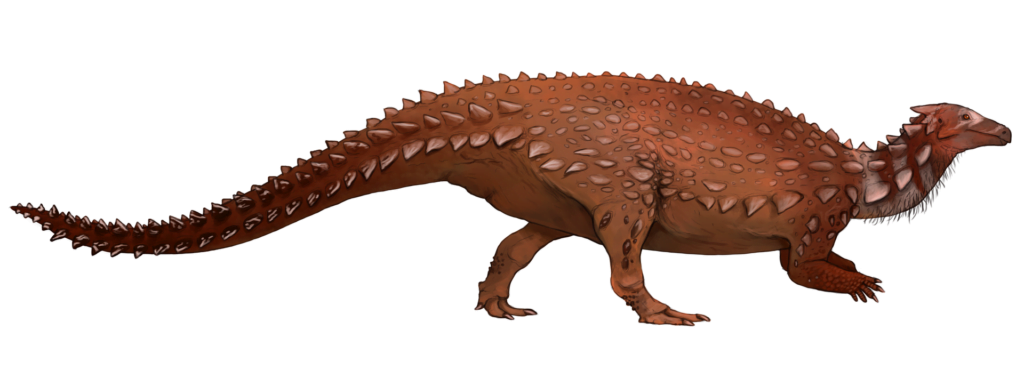
The wind is rising over the black rocks of the inner sea. Between the stunted conifers a squat animal walks steadily towards the high ground, its back rough with rows of bony scales. It stops beside the old road and lifts a beaked head. A long tail trails behind, armoured almost to its tip. When the travellers move closer, it turns slowly across their path, placing its plated flank between them and a smaller shape crouched among the ferns.
At a Glance
| Nature | Early armoured thyreophoran herbivore |
|---|---|
| Alignment | Unaligned or neutral; cautious, protective and guided by instinct |
| Appearance | Four-legged body, beaked head, low broad neck, rows of raised osteoderms and a long armoured tail |
| Habitat | Warm coastal woodlands, fern plains and rocky stream valleys of the Old-Earth Wilds |
| Behaviour | Low browsing, solitary or paired movement, flight from danger and defence of young |
| Threat | Armoured flank, heavy tail and the weight of a desperate animal in narrow terrain |
| Signs | Wide footprints, clipped ferns, scuffed undergrowth and long scrape marks at tail height |
The Walking Coat of Mail
Scelidosaurus belongs to the older line of armoured dinosaurs from which the great plated stegosaurs and the heavily shielded ankylosaurs arose. It does not carry the towering back plates and long tail spikes of Stegosaurus, nor the crushing tail club of Ankylosaurus. Instead, its protection consists of numerous rows of bony scales and raised osteoderms distributed across the neck, shoulders, back and tail.
An adult is about four metres long, with a broad torso and strong limbs able to carry its weight through broken woodland. Its narrow beaked muzzle crops plants close to the ground, and its lower jaws work through the tougher stems growing among ferns and cycads. The animal can rise slightly to survey a clearing, but it normally moves on all fours. In dense vegetation its long tail sweeps a narrow track behind it, and the small bony points along the sides can snag leaves and vines.
The body armour is more elaborate than it first appears. Some osteoderms are oval with raised ridges; others form small knobs between larger rows. The neck carries partial collars of protective plates, while the tail is ringed by rows of keeled ossifications. The armour is neither removable mail nor an invulnerable shell. It protects the animal from many bites, but it still needs room to turn and reach the plants on which it feeds.
A Survivor of the Early World
In the ancient woods, Scelidosaurus feeds where fern growth is dense and the ground is firm enough for short-legged animals to move without sinking. It follows low stream valleys and sheltered coastal slopes, taking refuge behind fallen timber when the wind blows hard across the water. Its preferred routes are well worn, marked by small crushed branches and the prints of four broad feet. A traveller following those trails may find a safe way across broken ground that a cart could not use.
The creature is not notably aggressive. An adult that sees a stranger may stop and turn the armoured side towards the approach while considering its escape. A pair accompanied by young is slower to withdraw, because a smaller animal may be hidden beneath the bracken or standing in the only open route away from danger. The protective behaviour is a response to immediate risk, not the defence of a sacred place.
In the Lost World, a few isolated settlements have learned to rear young Scelidosaurs from the egg. Such beasts can become accustomed to a handler and may carry light burdens along forest trails, but they remain living animals with strong habits. They are not tame horses in scales. A sudden predator call or rising flood can make even a familiar animal refuse a command or bolt towards the nearest cover.
Tracks, Plates and Warning Signs
Fresh Scelidosaurus tracks show a sturdy four-footed gait, with the wider rear prints pressed into the mud behind smaller forefoot marks. The creature’s low feeding height leaves clipped ferns and broken stems beneath the reach of larger sauropods. Near resting places the ground may bear the outline of a flank and tail, with small parallel scrapes where the osteoderms have brushed across grit.
The most useful warning is not a roar. It is a sudden pause in feeding and a steady turn towards the threat. The animal lifts its head, gives a short breathy call and plants its feet. If the approach continues, the tail moves into the path and the creature shuffles sideways to protect its softer underside. A patient traveller can take the hint and give it room.
Among dense coastal ferns the animal’s low silhouette is easy to mistake for a fallen log. The ridges on its back may look like rotten bark until the entire shape rises and moves. A scout who sees a row of low plates along the edge of the path should not assume they belong to a harmless pile of driftwood.
Defence, Flight and Burden
Scelidosaurus survives chiefly by avoiding an attack. If a carnivore or a reckless traveller comes too close, it turns the armoured flank into the threat and strikes with the tail to make space. It may shove a smaller enemy aside with its shoulder, but it has no magical stun, thrown spines or bloodthirsty hunting instinct. Its first purpose is to open a route to cover.
Where the ground is broken, its broad feet and low centre of gravity help it keep its balance. A narrow path can make the animal more dangerous, because it cannot pass an obstacle without using its weight. A handler trying to move one across a broken bridge might discover that the greater challenge is calming the animal, not urging it to strike.
At the table, describe the animal’s intentions before dice are rolled. The party sees a defensive turn, a lifted head and the movement of the tail. Characters who stop and choose another route should be rewarded with a peaceful passage. Combat occurs when those signals are ignored, the animal is trapped or a more dangerous predator forces both sides into the same confined space.
Scelidosaurus Statistics
Scelidosaurus — D&D 2024
Large Beast, Unaligned
AC 15 (Natural Armor) Initiative +0 (10)
HP 52 (8d10 + 8)
Speed 30 ft.
| Ability | Score | Modifier | Save |
|---|---|---|---|
| STR | 18 | +4 | +4 |
| DEX | 10 | +0 | +0 |
| CON | 12 | +1 | +1 |
| INT | 2 | −4 | −4 |
| WIS | 12 | +1 | +3 |
| CHA | 6 | −2 | −2 |
Saving Throws Wisdom +3
Skills Perception +3
Senses Passive Perception 13
Languages None
CR 2 (XP 450; PB +2)
Traits
Protective Scutes. The Scelidosaurus has Advantage on ability checks and saving throws against being knocked Prone while its feet are planted on solid ground.
Armoured Tail. The Scelidosaurus carries rows of sharp-edged osteoderms along its tail but does not have a stegosaur’s spiked thagomizer or an ankylosaur’s tail club.
Actions
Multiattack. The Scelidosaurus makes one Tail Slap attack and one Shoulder Check attack.
Tail Slap. Melee Attack Roll: +6, reach 10 ft. Hit: 13 (2d8 + 4) Bludgeoning damage.
Shoulder Check. Melee Attack Roll: +6, reach 5 ft. Hit: 8 (1d8 + 4) Bludgeoning damage. If the target is Medium or smaller, it must succeed on a DC 14 Strength saving throw or have the Prone condition.
Reactions
Turn the Armour. When a creature within 5 feet misses the Scelidosaurus with a melee attack, the Scelidosaurus can move 5 feet into an unoccupied space without provoking an Opportunity Attack from that creature.
Scelidosaurus — D&D 2014
Large beast, unaligned
Armor Class 15 (natural armor)
Hit Points 52 (8d10 + 8)
Speed 30 ft.
| STR | DEX | CON | INT | WIS | CHA |
|---|---|---|---|---|---|
| 18 (+4) | 10 (+0) | 12 (+1) | 2 (−4) | 12 (+1) | 6 (−2) |
Saving Throws Wis +3
Skills Perception +3
Senses passive Perception 13
Languages —
Challenge 2 (450 XP)
Traits
Protective Scutes. The Scelidosaurus has advantage on ability checks and saving throws made to resist being knocked prone while standing on solid ground.
Armoured Tail. The animal’s tail bears rows of protective bony plates but lacks both a spiked tail-tip weapon and a heavy tail club.
Actions
Multiattack. The Scelidosaurus makes one tail slap attack and one shoulder check attack.
Tail Slap. Melee Weapon Attack: +6 to hit, reach 10 ft., one target. Hit: 13 (2d8 + 4) bludgeoning damage.
Shoulder Check. Melee Weapon Attack: +6 to hit, reach 5 ft., one target. Hit: 8 (1d8 + 4) bludgeoning damage. A Medium or smaller target must succeed on a DC 14 Strength saving throw or be knocked prone.
Reactions
Turn the Armour. When an attacker within 5 feet misses the Scelidosaurus in melee, the animal moves up to 5 feet into an unoccupied space without provoking an opportunity attack from that attacker.
Scelidosaurus — Pathfinder 1e
Scelidosaurus CR 2 (XP 600)
N Large animal
Init +0; Senses low-light vision; Perception +5
Defense
AC 15, touch 9, flat-footed 15 (−1 size, +6 natural)
hp 26 (4d8+8)
Fort +6, Ref +4, Will +2
Offense
Speed 30 ft.
Melee tail slap +5 (1d8+3)
Space 10 ft.; Reach 5 ft.
Statistics
Str 15, Dex 10, Con 15, Int 2, Wis 13, Cha 4
Base Atk +3; CMB +6; CMD 14
Feats Endurance, Weapon Focus (tail slap)
Skills Perception +5, Survival +4
Languages —
Ecology
Environment warm coastal woodlands, fern plains and inland stream valleys
Organization solitary, pair or small group (3–5)
Treasure none
Special Abilities
Scute Guard (Ex). The Scelidosaurus has a +4 racial bonus to CMD against trip attempts while on firm ground (CMD 18 against trip).
Domestication. A creature raised from infancy can be trained with the Handle Animal skill. It never becomes a war mount merely because it tolerates a harness, and a frightened adult may ignore commands in favour of escape.
Scelidosaurus — D&D 3.5e
Large Animal (Neutral)
Hit Dice 4d8+8 (26 hp)
Initiative +0
Speed 30 ft. (6 squares)
Armor Class 15 (−1 size, +6 natural), touch 9, flat-footed 15
Base Attack/Grapple +3/+9
Attack tail slap +5 melee (1d8+3)
Full Attack tail slap +5 melee (1d8+3)
Space/Reach 10 ft./5 ft.
Special Attacks —
Special Qualities low-light vision
Saves Fort +6, Ref +4, Will +2
Abilities Str 15, Dex 10, Con 15, Int 2, Wis 13, Cha 4
Skills Listen +5, Spot +4
Feats Endurance, Weapon Focus (tail slap)
Environment warm plains, open woodlands and coastal forests
Organization solitary or pair
Challenge Rating 2
Treasure none
Alignment always neutral
Advancement 5–8 HD (Large), 9–12 HD (Huge)
Level Adjustment —
Combat
The Scelidosaurus trusts its bony hide and retreats when the way is clear. A cornered animal brings its armoured flank towards the threat, then strikes with its long tail to force an opening. It neither charges enemies without warning nor chases them across the valley.
Animal Companions
A druid of at least 4th level may select a Scelidosaurus as an alternative animal companion in a campaign where such creatures are available. The original source uses a DC 18 Handle Animal check to rear one from infancy. Apply the druid’s effective level and companion progression normally; the animal’s existing Hit Dice and size do not vanish when trained.
Encounter: The Saltwind Shelf
A stone road follows the edge of an ancient inland sea before descending to a narrow shelf beneath black cliffs. The tide is turning, and the party must reach the far end before water covers the low passage. A Scelidosaurus and its smaller companion have been feeding among the coastal ferns. As the travellers approach, the animals move towards the only dry path: the same ledge the party must cross.
First signs. Wide prints lead out of a stand of stunted conifers onto the salt-splashed stones. The larger animal stands beneath a dark rock overhang, its armoured back partly hidden by shadow. A sharp cry from the smaller beast causes the adult to lift its head. The sound of breaking waves grows louder beyond the point.
The ground. The road narrows beside a steep drop to the sea. An old lookout niche has been cut into the cliff, with a rough stair reaching the upper ridge. The lower shelf is already wet and slippery. A tide pool beneath the rock overhang is filling, and loose stones on the upper steps threaten to fall if horses are driven upwards too quickly.
Choices. The party may wait on the high steps until the animals have moved onto safer ground, take the narrow ridge trail or quietly encourage the younger animal towards a sheltered opening farther along the cliff. A long rope secured to the lookout post can help move supplies without forcing the animals and the pack train into the same space. The safest option may cost time, and the tide is beginning to rise.
Complication. A rockslide from the upper path blocks the animals’ retreat. The smaller Scelidosaurus becomes separated on the wet shelf, and the adult turns broadside to shield it. At the same moment the first large wave washes across the lower stones. A pack animal slips, and its load begins to slide towards the water. The party must choose how to secure the cargo, clear the retreat and give both dinosaurs room to reach the dry ground.
Resolution. If the party opens the high route or waits for the animals to pass, the Scelidosaurs disappear among the coastal pines. The expedition can continue without a fight. If panic drives the animals against the weakened lookout wall, the ledge may collapse, leaving everyone to scramble for the upper trail as the water rises.
Adventure hook. Behind the old lookout niche is a sealed chamber carved with the emblem of a forgotten coastal survey. The chamber contains a map of stone beacons that once guided ships across the inland sea. One beacon lies upon an island absent from all modern charts, though a fresh light has recently been seen on the horizon.
Sources and Credits
Earlier community material credited to InsanePsychoRabbit of the Wizards Community forums. The traditional large-animal statistics, tail defence and possibility of careful rearing remain part of this creature’s game presentation. Its defensive character and low browsing habits inform the present adaptations.
Natural history: Natural History Museum — Scelidosaurus; David Norman (2020), the dermal skeleton and arrangement of Scelidosaurus armour; University of Cambridge, research on the early armoured dinosaur of Dorset. The known fossils support the placement of osteoderms along the body and tail, but the precise behaviour of living animals remains an interpretation for the setting.
Existing artwork credited to Jack Mayer Wood, CC BY-SA 4.0, and retained from the original page. A replacement painted hero remains outstanding because the image generated during this pass showed a different stegosaur-like animal and was rejected.
Keep this reference growing
If this page helped with your reading or game, you can support its upkeep or explore the curated books.
Explore the Bookshop — epics, classics and stories behind imagined worlds.