
Desmatosuchus — Armoured Triassic Aetosaur
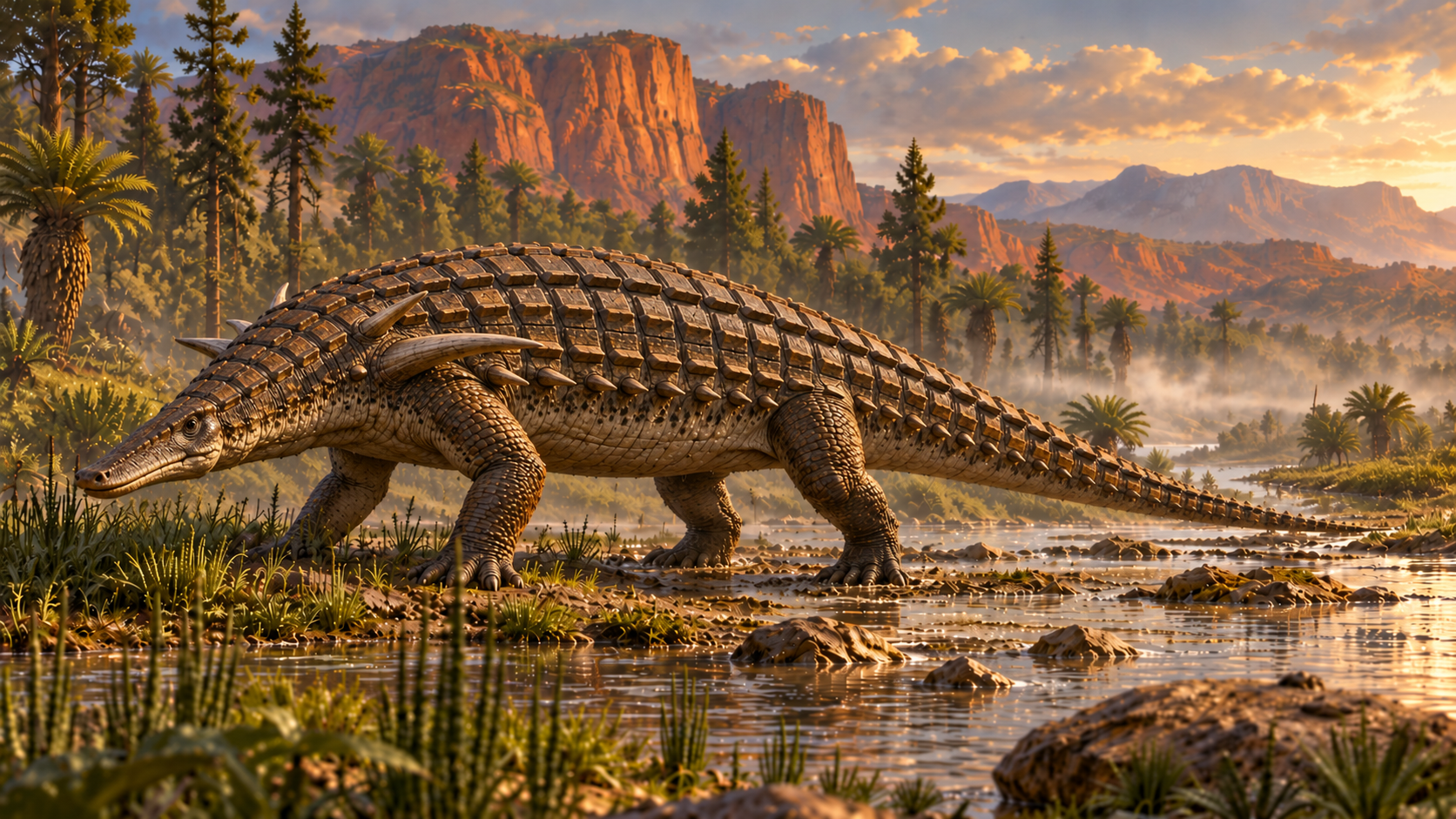
The mule stops dead. Across the narrow river track stands an animal almost as long as a wagon, its back plated with bone and two immense shoulder spikes angled towards the path. Its snout is buried in the soft earth. It has not noticed the travellers yet.
Desmatosuchus was a real Late Triassic aetosaur, not a dinosaur. It carried rows of bony armour along its back and large curved spikes at its shoulders. Its narrow, upturned snout suggests a low-feeding animal; exactly what it ate remains debated.
Here the danger is accidental. A heavily armoured forager blocks the only firm ground to the ferry. Try to force past its spines and it may lash out; give it space and it may simply move on.
At the Table
- Notice it: Scraped soil, broken scrub and a broad, armoured body blocking the track.
- Read its warning: It turns a shoulder towards anyone who approaches too closely.
- Avoid a fight: Calm the mules and leave the animal a clear way back to the scrub.
- If it charges: Stay clear of its outward-curving shoulder spikes and open a retreat.
Choose your rules edition · Run the river crossing · Explore its fossil history
Desmatosuchus Monster Statistics — Four Editions
Choose the tab for your edition. Each block provides a playable CR 4 estimate for this armoured aetosaur; the behaviour and encounter advice below apply regardless of ruleset.
Desmatosuchus — D&D 2024
Large Beast, Unaligned · CR 4 (1,100 XP; PB +2)
AC 17 (natural armour); Initiative +0 (10); HP 85 (9d10 + 36); Speed 30 ft.
| STR | DEX | CON | INT | WIS | CHA |
|---|---|---|---|---|---|
| 20 (+5) | 10 (+0) | 18 (+4) | 2 (−4) | 12 (+1) | 5 (−3) |
Skills Perception +3, Survival +3; Senses Passive Perception 13; Languages —; Habitat Primeval river plains and scrubby forests; Treasure None.
Traits
Armoured Back. A desmatosuchus has a thick covering of bony plates and long shoulder spines. Its natural armour is included in AC 17; the shoulder spines are a defensive weapon, not venomous or magical.
Defensive Spines. The first time each round a creature within 5 feet of the desmatosuchus hits it with a melee attack, the attacker takes 3 (1d6) Piercing damage from the shoulder armour. A weapon with Reach greater than 5 feet does not trigger this trait when used from farther away.
Protective Disposition. A desmatosuchus usually threatens, sidesteps or backs away from unfamiliar creatures. It fights mainly when cornered, injured or separated from its feeding ground by an intruder.
Actions
Multiattack. The desmatosuchus makes one Snout Shove attack and one Shoulder Spike attack.
Snout Shove. Melee Attack Roll: +7, reach 5 ft. Hit: 14 (2d8 + 5) Bludgeoning damage.
Shoulder Spike. Melee Attack Roll: +7, reach 5 ft. Hit: 12 (2d6 + 5) Piercing damage.
Shoulder Rush (Recharge 5–6). If the desmatosuchus moves at least 15 feet straight toward a creature immediately before hitting it with Snout Shove on the same turn, the hit deals an additional 7 (2d6) Bludgeoning damage, and the target must succeed on a DC 15 Strength saving throw or fall Prone.
Encounter note. Both attacks hitting deal 26 damage before any defensive spike injury. Keep the retreat route and the warning display visible: a party that clears the path can end the confrontation without reducing the creature to zero Hit Points.
Desmatosuchus — D&D 2014
Large beast, unaligned · Challenge 4 (1,100 XP)
Armor Class 17 (natural armor); Hit Points 85 (9d10 + 36); Speed 30 ft.
| STR | DEX | CON | INT | WIS | CHA |
|---|---|---|---|---|---|
| 20 (+5) | 10 (+0) | 18 (+4) | 2 (−4) | 12 (+1) | 5 (−3) |
Skills Perception +3, Survival +3; Senses passive Perception 13; Languages —.
Traits
Armoured Back. A desmatosuchus has a thick covering of bony plates and long shoulder spines. Its natural armour is included in AC 17; the shoulder spines are a defensive weapon, not venomous or magical.
Defensive Spines. The first time each round a creature within 5 feet of the desmatosuchus hits it with a melee attack, the attacker takes 3 (1d6) piercing damage from the shoulder armour. A weapon with reach greater than 5 feet does not trigger this trait when used from farther away.
Protective Disposition. A desmatosuchus usually threatens, sidesteps or backs away from unfamiliar creatures. It fights mainly when cornered, injured or separated from its feeding ground by an intruder.
Actions
Multiattack. The desmatosuchus makes one Snout Shove attack and one Shoulder Spike attack.
Snout Shove. Melee Weapon Attack: +7 to hit, reach 5 ft., one target. Hit: 14 (2d8 + 5) bludgeoning damage.
Shoulder Spike. Melee Weapon Attack: +7 to hit, reach 5 ft., one target. Hit: 12 (2d6 + 5) piercing damage.
Shoulder Rush (Recharge 5–6). If the desmatosuchus moves at least 15 feet straight toward a creature immediately before hitting it with Snout Shove on the same turn, the hit deals an additional 7 (2d6) bludgeoning damage, and the target must succeed on a DC 15 Strength saving throw or fall prone.
Encounter note. A lone CR 4 desmatosuchus awards 1,100 XP. Its shoulder spines are most dangerous to adjacent melee combatants; the animal prefers an open escape to a prolonged fight.
Desmatosuchus — Pathfinder 1e
CR 4 · XP 1,200 · N Large animal
Defence
Init +4; Senses low-light vision; Perception +11.
AC 18, touch 9, flat-footed 18 (−1 size, +9 natural); hp 67 (7d8 + 28 plus Toughness); Fort +9, Ref +5, Will +3.
Offence
Speed 30 ft.; Melee gore +11 (1d8 + 9); Space 10 ft.; Reach 5 ft.; Special Attacks armoured charge, defensive spikes.
Statistics
Str 22, Dex 10, Con 18, Int 2, Wis 12, Cha 5; Base Atk +5; CMB +12; CMD 22; Feats Endurance, Improved Initiative, Toughness, Weapon Focus (gore); Skills Perception +11; Languages —.
Ecology
Environment primeval semiarid river plains, scrub and woodland; Organization solitary, pair or small aggregation (2–5, speculative in game); Treasure none.
Special Abilities
Armoured Charge (Ex). If a desmatosuchus charges and hits with its gore attack, it deals 2d6 additional bludgeoning damage. This is part of its original game adaptation, not an established feeding behaviour.
Defensive Spikes (Ex). Once per round, when an adjacent creature strikes it with a melee weapon, the desmatosuchus may spend an immediate action to make a gore attack against that creature. This does not grant extra reach.
Tactics
Before combat, the aetosaur warns off intruders by turning its shoulder spikes towards them. If an open retreat remains, it withdraws once the threat backs away. The GM can allow calm observation, open terrain and careful withdrawal to resolve the encounter without an attack; Handle Animal does not automatically domesticate a wild prehistoric creature.
Rules calculations
Rules check: Seven animal HD grant BAB +5, good Fort/Ref saves (+5 each), poor Will (+2), and 7 total skill ranks at Int 2. Perception has 7 ranks +3 class skill +1 Wis. Toughness adds 7 hp. Attack +11 = BAB +5 + Strength +6 − size 1 + Weapon Focus 1.
This original stat block uses the Pathfinder 1e animal type and monster-building conventions and is not a published Paizo creature.
Desmatosuchus — D&D 3.5e
Large Animal · Neutral · CR 4
| Hit Dice | 6d8+24 (51 hp) |
|---|---|
| Initiative | +4 |
| Speed | 30 ft. (6 squares) |
| Armour Class | 18 (−1 size, +9 natural), touch 9, flat-footed 18 |
| Base Attack/Grapple | +4/+14 |
| Attack | Gore +9 melee (1d8+9) |
| Full Attack | Gore +9 melee (1d8+9) |
| Space/Reach | 10 ft./5 ft. |
| Special Attacks | Armoured rush |
| Special Qualities | Defensive spines, low-light vision |
| Saves | Fort +9, Ref +5, Will +3 |
| Abilities | Str 22, Dex 10, Con 18, Int 2, Wis 12, Cha 5 |
| Skills | Listen +7, Spot +8 |
| Feats | Alertness, Endurance, Improved Initiative |
| Environment | Primeval dry river plains, scrub woodland |
| Organization | Solitary or pair; larger groups speculative |
| Challenge Rating | 4 (original estimate) |
| Treasure | None |
| Alignment | Always neutral |
| Advancement | 7–10 HD (Large) |
| Level Adjustment | — |
Special Abilities
Armoured Rush (Ex). A desmatosuchus that charges and hits with its gore attack deals an extra 1d6 bludgeoning damage. It may not use this ability if its movement was blocked.
Defensive Spines (Ex). Once per round when a creature hits the desmatosuchus with a melee attack from an adjacent square, it may make a gore attack against that creature as an attack of opportunity, provided it has an attack of opportunity remaining.
Rules calculations and historical source
Rules check. Six animal HD yield BAB +4, base Fort/Ref +5, base Will +2, and 9 skill points including first-HD multiplication. Spot ranks 5 + Wis 1 + Alertness 2 = +8; Listen ranks 4 + Wis 1 + Alertness 2 = +7. Gore +9 = BAB +4 + Str +6 − size 1. The powerful primary gore adds 1.5 × Strength to damage.
Historical credit: An earlier version of this entry included a separate D&D 3.5e Desmatosuchus by Bhu, originally shared on the now-defunct Wizards Community forums. That source is acknowledged here, but its text and statistics are not reproduced because the original reuse terms could not be verified. The rules above are independently calculated.
The Armoured Forager
A Desmatosuchus moves low to the ground on four sturdy legs. Rectangular bony plates cover the back; the largest spines rise from its shoulders and sweep outward, making a narrow passage dangerous even when the creature is standing still. Its comparatively small, upturned snout is better suited to working through soil and low growth than to pursuing prey.
At a distance it can be mistaken for a rough-backed fallen trunk. Look closer and the plates move as the animal breathes. Its forefeet have churned the soil; a broad body has pushed a passage through the scrub. Those traces give adventurers a chance to spot it before reaching the shoulder spikes.
The encounter assumes a wary ground-forager that prefers to keep feeding or withdraw rather than chase armed travellers. Its precise diet, social behaviour and temperament are not known from fossils; those details are game interpretations. The shoulder armour, not a taste for combat, is what makes the animal memorable.
Where Desmatosuchus Is Found
Desmatosuchus belongs to the Late Triassic. In the current campaign, the most credible place to encounter a living survivor is a warm, isolated Triassic refuge in the Old-Earth Wilds of Hollow Earth. Its river flats should have plentiful low vegetation, space for rooting and routes that let a heavy animal withdraw from danger. The Lost World Bestiary collects other possible survivors, but their presence in the same valley is not automatic.
What Is Happening Right Now?
At the edge of one such survivor valley, travellers use a narrow stone-cut track to move grain and pack animals between a sheltered settlement and a ferry crossing. A small group of armoured reptiles has begun feeding beside the water. One old individual refuses to shift from the only firm approach to the ford. Traders report that its shoulder spikes can tear a load from a mule without the creature intending to attack.
A caravan master wants the beast killed before the sun goes down. A young drover insists she watched it dig up roots far from the path and could lure it toward another feeding place. The ferryman fears that stampeding animals will destroy his mooring stakes. None has an interest in provoking a battle, but the evening ferry is waiting and tempers are rising.
Behaviour and Counterplay
First contact: The desmatosuchus stops feeding, turns its armoured side toward the intruders and makes a low warning sound. Its spines are protection; the animal does not stalk or hunt the party.
Escalation: If a pack beast bolted into its flank, or a character tries to climb over the plated back, it rushes and swings the shoulders. The attack is a panic response, not a vendetta.
Safe alternatives: A patient party can make a noisy detour well away from its preferred vegetation, draw the pack animals back, or leave a clear exit. Food might distract it if the GM decides the species is foraging, but an unknown prehistoric animal cannot be handled like a trained horse.
Scientific uncertainty: The game’s feeding and defensive behaviours are plausible inventions, not observations of living Desmatosuchus. The fossil record reveals armour and bones, not a reliable temperamental profile.
If Violence Starts
First warning: It stops rooting, angles one spiked shoulder toward the nearest intruder and backs towards open scrub. Give the characters a chance to step away before initiative is rolled. A Desmatosuchus does not treat every stranger as prey.
First target: If a person or pack animal closes within its shoulder span or obstructs its retreat, the aetosaur strikes the nearest obstruction with its snout and shoulder. It does not single out spellcasters or pursue the weakest adventurer; it is trying to clear space.
Using its defences: The back plates are already included in its Armour Class. The spikes punish attackers who crowd the shoulders, and its rush is most dangerous along a clear, straight path. Characters who move away, fight at a distance or leave a wide exit can reduce the danger.
Breaking contact: If an escape route opens, it withdraws toward cover rather than fighting to the death. If surrounded or repeatedly struck, it pushes towards the least obstructed direction. This also gives the GM a natural end to the fight when the party changes tactics.
Encounter: The Armoured Crossing
Recommended use: One CR 4 animal along a tight water crossing, with a visible non-combat resolution. Four adventurers around level 4–5 can face a dangerous fight if they crowd its shoulder spikes; let them recognise the warning posture and withdraw before the first attack. For smaller or lower-level parties, use distant tracks and a glimpse of spikes without forcing combat.
What the Characters See
The trail narrows between thorn scrub and a shallow river. A dense, plated body blocks the path. Two sickle-like shoulder spikes jut outward and its narrow snout pushes into mud at the water’s edge. Behind the party, two pack mules begin to strain against their ropes; one more shout may send them into the river.
What the Players Can Learn
- Survival or Nature: The animal is feeding, not hunting. Its tracks show that it entered from a grassy bank and still has a retreat in that direction. In Pathfinder 1e and D&D 3.5e, see Survival for reading spoor.
- Observation: It presents a spike-covered shoulder when crowded and relaxes when people withdraw.
- Choice: The travellers can secure the mules, clear the retreat route, and wait, or force the path and accept the consequences. The Handle Animal rules help with the trained pack animals in 3.5e/PF1e; they do not make the wild aetosaur tame.
Three Approaches
- Go around: Scout a dry stony path through the trees, accepting lost daylight and a possible broken cart wheel.
- Wait it out: Calm the mules and protect the ferry lines while the creature returns to the vegetation.
- Force through: Use the full CR 4 stats. Show the shoulder warning first; if a character backs off, allow the animal to break contact.
Consequence: A panicked mule may drag supplies into the shallows. Finding and recovering sacks should matter at least as much as defeating an animal that never wanted a fight.
Adventure Hooks
The Fossil Valley
A scholar claims the armoured herd proves that a remote valley connects to an ancient age. Her patron demands a living specimen, but the safest objective is careful observation and a preserved footprint cast.
The Missing Drover
A herdsman disappeared after a stampede near an abandoned causeway. The ‘monster’s victims’ may simply be stranded on a narrow island, waiting for someone to lower a rope.
The Shoulder-Spike Trade
A collector pays for polished bony armour. A local smuggler is injuring animals to obtain plates while passing off the wounds as predator attacks. Tracking him may matter more than fighting the beasts.
Rewards and Lasting Changes
There is no traditional treasure hoard. The rewards are rescued cargo, goodwill from the ferryman, safer caravan routes, and a naturalist’s payment for reliable drawings and observations. The animal’s fate affects whether the valley remains a sanctuary or turns into a hunting ground.
Desmatosuchus: History and Fossil Evidence
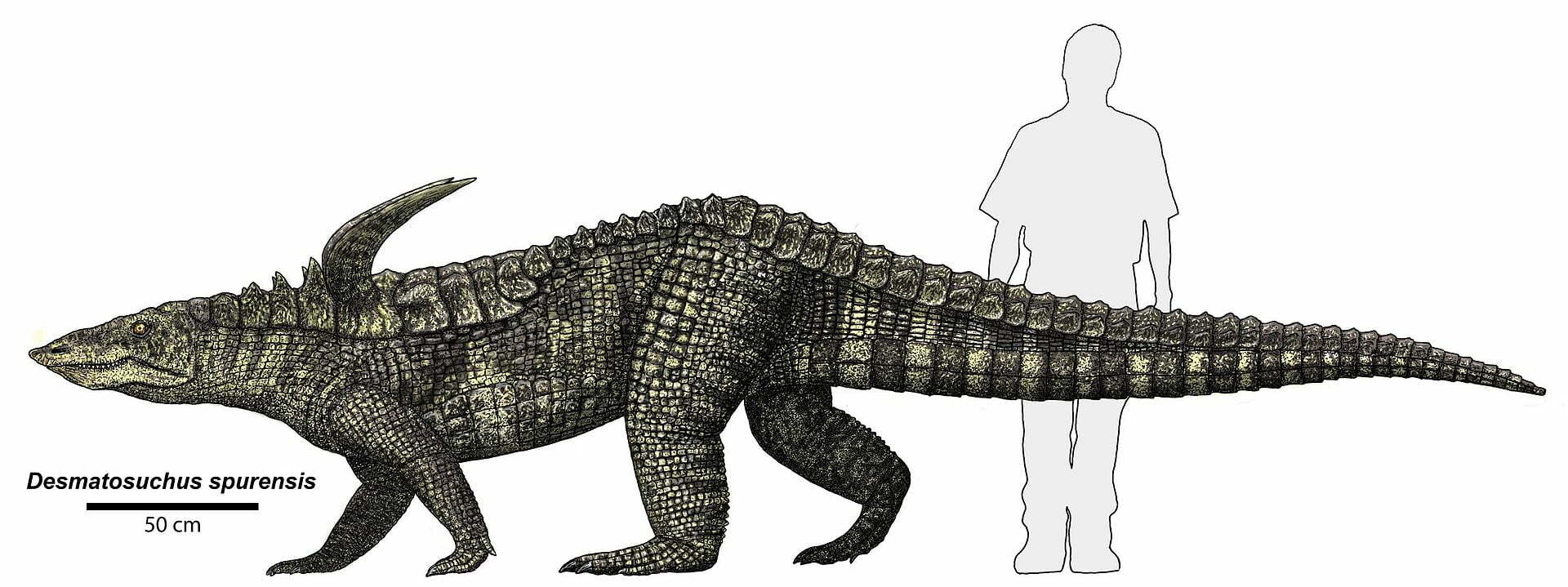
Desmatosuchus spurensis is a large member of the Aetosauria, a branch of pseudosuchian archosaurs from the Late Triassic, not a dinosaur. Its specimens have been reported from the southwestern United States, including formations in Texas, New Mexico and Arizona. The animal’s body was protected by rows of heavy bony plates called osteoderms, with striking shoulder spines among the most recognisable elements.
Its upturned, tooth-poor snout is consistent with rooting or digging, although the details of its feeding ecology remain debated. A study of cranial anatomy suggests that insectivory or omnivory deserves consideration alongside the familiar image of a primarily plant-eating aetosaur.
Ecological behaviour in the playable encounter is imagined. The scientific references describe fossils, anatomy and localities; they do not establish that Desmatosuchus lived in modern fantasy settlements, was tameable, or formed defensive herds of any particular size.
Reference Notes
- Parker et al., revised phylogenetic analysis of Aetosauria — classification, Triassic age and known fossils.
- Small, cranial anatomy of Desmatosuchus — unusual jaws and dietary uncertainty.
- Smithsonian fossil record: Desmatosuchus spurensis — specimen data and classification.
Related creatures: Compare its plates and shoulder spikes with Stagonolepis, another Triassic aetosaur. For a dangerous crocodile-line predator of the same broad period, see Postosuchus (which is not a dinosaur despite its archive path). The Animal Bestiary covers other animal stat blocks; the Lost World Bestiary gathers extinct animals that might survive in isolated refuges. These are reading and encounter links, not a claim all species share one valley.
Desmatosuchus Frequently Asked Questions
Was Desmatosuchus a dinosaur?
No. It was an aetosaur within the pseudosuchian branch of archosaurs, from the Late Triassic.
Did it hunt people?
There is no evidence it hunted humans; humans did not coexist with it. In a fantasy encounter, it may become dangerous when cornered or protecting access to food and water.
What were its shoulder spikes for?
They are generally interpreted as defensive structures. Their exact effects in combat are original game mechanics.
Was it a herbivore?
It is often reconstructed as a low-feeding herbivore. Some research argues for possible omnivory or insect-eating, so the precise diet should not be presented as certain.
What challenge rating is Desmatosuchus?
These independent four-edition monster designs are aimed around CR 4, with alternative manoeuvres and encounter rules for each game. Challenge ratings are provisional, not official published values.
Can it be bypassed without fighting?
Yes. Create a broad escape route, settle the pack animals and let the creature return to feeding. Patience and positioning often solve the encounter.
Artwork, Adaptation and Game Licences
Artwork: The main painted hero is an original fantasy reconstruction. The additional scientific reconstruction in the fossil-history section is credited to Dr Jeff Martz / Petrified Forest National Park (NPS), via Wikimedia Commons, whose file page lists the author, source and reuse terms (including CC BY 2.0 and a US-government public-domain notice). The historical illustration has not been presented as original SpiralWorlds artwork.
Rules: D&D 2024 stat block is original and uses SRD 5.2.1 conventions (CC BY 4.0); D&D 2014 uses SRD 5.1 conventions; Pathfinder 1e and D&D 3.5e are original conversions, not publisher stat blocks. The earlier Bhu/Wizards Community version is acknowledged in the 3.5e section but is not reproduced because its reuse rights were not verified.
Open Game Content: The 3.5e SRD-derived mechanics are Open Game Content. This page’s original fiction, editorial commentary, specific encounter situations and new illustrations are not designated OGC. No official publisher endorsement is implied.
Open Game License v1.0a — complete text and copyright notices
OPEN GAME LICENSE Version 1.0a
The following text is the property of Wizards of the Coast, Inc. and is Copyright 2000 Wizards of the Coast, Inc (“Wizards”). All Rights Reserved.
1. Definitions: (a)”Contributors” means the copyright and/or trademark owners who have contributed Open Game Content; (b)”Derivative Material” means copyrighted material including derivative works and translations (including into other computer languages), potation, modification, correction, addition, extension, upgrade, improvement, compilation, abridgment or other form in which an existing work may be recast, transformed or adapted; (c) “Distribute” means to reproduce, license, rent, lease, sell, broadcast, publicly display, transmit or otherwise distribute; (d)”Open Game Content” means the game mechanic and includes the methods, procedures, processes and routines to the extent such content does not embody the Product Identity and is an enhancement over the prior art and any additional content clearly identified as Open Game Content by the Contributor, and means any work covered by this License, including translations and derivative works under copyright law, but specifically excludes Product Identity. (e) “Product Identity” means product and product line names, logos and identifying marks including trade dress; artifacts; creatures characters; stories, s torylines, plots, thematic elements, dialogue, incidents, language, artwork, symbols, designs, depictions, likenesses, formats, poses, concepts, themes and graphic, photographic and other visual or audio representations; names and descriptions of characters, spells, enchantments, personalities, teams, personas, likenesses and special abilities; places, locations, environments, creatures, equipment, magical or supernatural abilities or effects, logos, symbols, or graphic designs; and any other trademark or registered trademark clearly identified as Product identity by the owner of the Product Identity, and which specifically excludes the Open Game Content; (f) “Trademark” means the logos, names, mark, sign, motto, designs that are used by a Contributor to identify itself or its products or the associated products contributed to the Open Game License by the Contributor (g) “Use”, “Used” or “Using” means to use, Distribute, copy, edit, format, modify, translate and otherwise create Derivative Material of Open Game Content. (h) “You” or “Your” means the licensee in terms of this agreement.
2. The License: This License applies to any Open Game Content that contains a notice indicating that the Open Game Content may only be Used under and in terms of this License. You must affix such a notice to any Open Game Content that you Use. No terms may be added to or subtracted from this License except as described by the License itself. No other terms or conditions may be applied to any Open Game Content distributed using this License.
3. Offer and Acceptance: By Using the Open Game Content You indicate Your acceptance of the terms of this License.
4. Grant and Consideration: In consideration for agreeing to use this License, the Contributors grant You a perpetual, worldwide, royalty-free, non-exclusive license with the exact terms of this License to Use, the Open Game Content.
5. Representation of Authority to Contribute: If You are contributing original material as Open Game Content, You represent that Your Contributions are Your original creation and/or You have sufficient rights to grant the rights conveyed by this License.
6. Notice of License Copyright: You must update the COPYRIGHT NOTICE portion of this License to include the exact text of the COPYRIGHT NOTICE of any Open Game Content You are copying, modifying or distributing, and You must add the title, the copyright date, and the copyright holder’s name to the COPYRIGHT NOTICE of any original Open Game Content you Distribute.
7. Use of Product Identity: You agree not to Use any Product Identity, including as an indication as to compatibility, except as expressly licensed in another, independent Agreement with the owner of each element of that Product Identity. You agree not to indicate compatibility or co-adaptability with any Trademark or Registered Trademark in conjunction with a work containing Open Game Content except as expressly licensed in another, independent Agreement with the owner of such Trademark or Registered Trademark. The use of any Product Identity in Open Game Content does not constitute a challenge to the ownership of that Product Identity. The owner of any Product Identity used in Open Game Content shall retain all rights, title and interest in and to that Product Identity.
8. Identification: If you distribute Open Game Content You must clearly indicate which portions of the work that you are distributing are Open Game Content.
9. Updating the License: Wizards or its designated Agents may publish updated versions of this License. You may use any authorized version of this License to copy, modify and distribute any Open Game Content originally distributed under any version of this License.
10. Copy of this License: You MUST include a copy of this License with every copy of the Open Game Content You Distribute.
11. Use of Contributor Credits: You may not market or advertise the Open Game Content using the name of any Contributor unless You have written permission from the Contributor to do so.
12. Inability to Comply: If it is impossible for You to comply with any of the terms of this License with respect to some or all of the Open Game Content due to statute, judicial order, or governmental regulation then You may not Use any Open Game Material so affected.
13. Termination: This License will terminate automatically if You fail to comply with all terms herein and fail to cure such breach within 30 days of becoming aware of the breach. All sublicenses shall survive the termination of this License.
14. Reformation: If any provision of this License is held to be unenforceable, such provision shall be reformed only to the extent necessary to make it enforceable.
15. COPYRIGHT NOTICE
Open Game License v 1.0a Copyright 2000, Wizards of the Coast, Inc.
System Reference Document Copyright 2000-2003, Wizards of the Coast, Inc.; Authors Jonathan Tweet, Monte Cook, Skip Williams, Rich Baker, Andy Collins, David Noonan, Rich Redman, Bruce R. Cordell, John D. Rateliff, Thomas Reid, James Wyatt, based on original material by E. Gary Gygax and Dave Arneson.
END OF LICENSE
Keep this reference growing
If this page helped with your reading or game, you can support its upkeep or explore the curated books.
Explore the Bookshop — epics, classics and stories behind imagined worlds.