
Shambling Mound – Swamp Plant Monster
A Shambling Mound is a thinking mass of rotting vegetation that rises from swamp, fen, ruin, or drowned forest to crush, smother, and absorb the living.
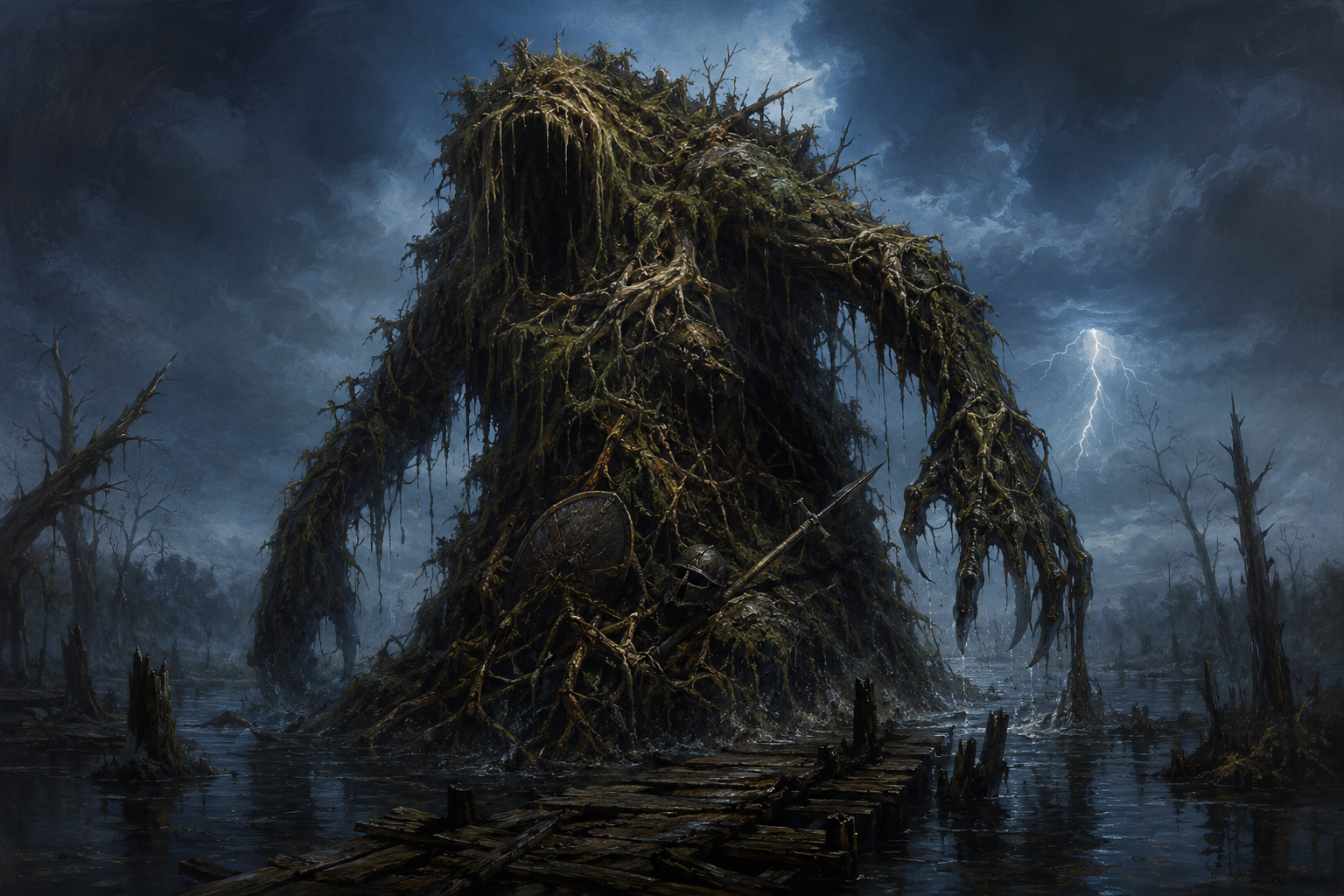
A Shambling Mound is not an animated pile of leaves. It is a living predator grown from wet decay, old roots, soaked moss, drowned branches, and the dark patience of places where the ground never fully dries. It waits where paths sink, where bridges rot, where bodies vanish under reeds, and where lightning storms wake old vegetable hunger beneath the mud.
At rest, a Shambling Mound may look like storm-tossed weed, a collapsed hedge, a heap of swamp refuse, or the remains of a fallen tree wrapped in creepers. Only when prey comes close does the mound gather itself into a huge, lurching shape. Its limbs are not true arms, but crushing folds of vine, root, bark, fungus, and waterlogged fibre.
Unlike ordinary plant hazards, a Shambling Mound has a slow, alien intelligence. It learns paths. It remembers noise. It can distinguish a careless traveller from a dangerous hunting party. In old wetlands, one may become the hidden reason a ford is abandoned, a village field is never reclaimed, or a ruined shrine remains untouched.
The creature is strongest when it feels less like a monster entering the scene and more like the scene itself deciding to kill.
Appearance
A Shambling Mound is a dense, upright mass of wet vegetation, usually taller and broader than a person. Its body may include reeds, peat, black roots, dead leaves, fungus, water plants, drowned branches, and tangles of moss. In different lands, it may carry the vegetation of its home: mangrove roots, cypress knees, kelp, jungle vines, heather, sphagnum moss, lotus stems, rice-field weeds, or the dead reeds of a drained marsh.
Its “face” is rarely fixed. A hollow in the vegetation may resemble a mouth one moment and close the next. Eye-like gaps appear where trapped water reflects torchlight. Its breath smells of sour mud, crushed green stems, and the inside of a rotten log.
A Shambling Mound should look heavy. It is not a graceful vine creature. It drags itself forward with the weight of a soaked hayrick and the patience of a bog.
Habitat
Shambling Mounds belong in wet, overgrown, or heavily decayed places:
- swamps, bogs, fens, mires, and drowned forests
- abandoned canals, ditches, fishponds, and irrigation works
- ruined gardens, temple pools, sacred groves, and overgrown estates
- river deltas, mangrove coasts, jungle marshes, and flooded battlefields
- places struck repeatedly by lightning or soaked in old magic
They are especially dangerous in places where the ground hides depth: floating mats of vegetation, reed beds, flooded cart tracks, peat pools, corpse-marshes, overgrown wells, and old field boundaries swallowed by water.
Ecology
A Shambling Mound feeds by crushing prey into its body and slowly breaking it down. Bones, metal, jewellery, buckles, spearheads, teeth, belt fittings, and holy tokens may remain trapped inside it for years. In regions where it hunts often, animals avoid its ground. Birds fall silent around it. Deer trails bend away. Dogs refuse to cross the mud.
The creature may be born in several ways. Some arise naturally in places of exceptional rot, moisture, and old vegetative force. Others are awakened by druidic error, lightning-struck sacred groves, failed plant magic, polluted wetlands, battlefield burial pits, or fey punishment. A Shambling Mound in the Beastlands, Lemuria, Hollow Earth, or a primal drowned valley may be older, larger, and stranger than the common swamp-haunt.
It is not evil by default. It is predatory. It wants food, territory, moisture, and silence. That makes it more frightening, not less.
Behaviour
A Shambling Mound prefers ambush. It waits in stillness until prey comes within reach, then rises suddenly and closes the distance with shocking force. It does not chase like a wolf. It advances like bad ground becoming worse.
It may use terrain intelligently:
- blocking a narrow causeway
- waiting beside a corpse or half-sunken cart
- standing motionless among reeds
- dragging prey into water
- attacking during rain, mist, or thunder
- retreating into vegetation when badly hurt
A Shambling Mound that has survived many fights may learn the difference between fire, axes, lightning, horses, boats, and spellcasters. It does not become clever in a human way, but it becomes difficult to fool twice.
Signs of a Shambling Mound
A Shambling Mound is usually present before it is seen. Careful travellers may notice the wetland behaving wrongly.
Useful signs include:
- animal trails that bend sharply away from one patch of reeds or mud
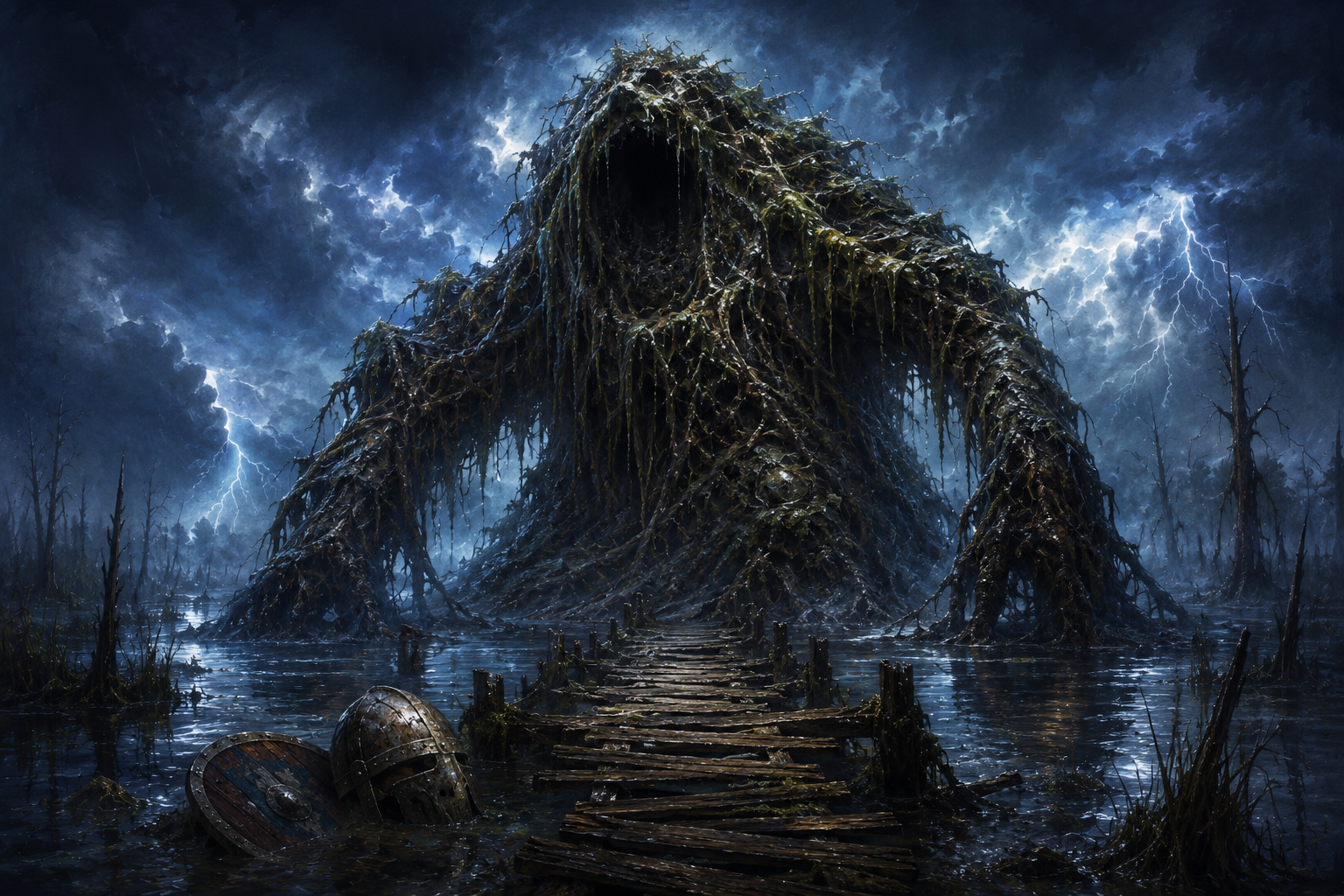
- a half-sunken boot, shield, pack, or cartwheel with no body nearby
- flies gathering over wet vegetation rather than exposed flesh
- reeds crushed inward, as if something heavy folded itself down into them
- black water that ripples against the wind
- lightning-scarred trees around a pool where the roots are still green
- a sour smell of crushed plants, stagnant water, and old blood
These signs should not automatically reveal the creature, but they give cautious players a fair chance to suspect that the ground itself is dangerous.
Combat Tactics
A Shambling Mound should fight like terrain has become a monster.
It opens from concealment if possible, targeting isolated or heavily armoured victims who cannot easily escape mud, water, or roots. It crushes with its whole body, then tries to engulf a target and smother them inside its mass. The fight should create immediate table pressure: someone is disappearing into the mound, someone else is being blocked by water or reeds, and fire may not be as decisive as the party expects.
The creature is most memorable beside a sinking ford, reed-choked canal, storm-lit causeway, ruined garden pool, drowned battlefield, or black-water shrine. In a plain room, it becomes a bruiser. In a wetland, it becomes the battlefield.
Mechanics Tabs
The rules below are mechanics tabs for different game editions.
Shambling Mound 5.5e / 2024-Compatible Version
Shambling Mound 5.0e Compatible Version
Pathfinder 1e / 3.5e-Compatible Version
Shambling Mound 5.5e / 2024-Compatible Version
Large Plant, Unaligned
Armor Class: 15
Initiative: +0
Hit Points: 136
Speed: 20 ft., swim 20 ft.
Proficiency Bonus: +3
| STR | DEX | CON | INT | WIS | CHA |
|---|---|---|---|---|---|
| 18 (+4) | 10 (+0) | 16 (+3) | 7 (-2) | 10 (+0) | 7 (-2) |
Saving Throws: Con +6
Skills: Stealth +3 in swamp, forest, bog, marsh, or dense vegetation
Damage Resistances: cold, fire
Damage Immunities: lightning
Condition Immunities: exhaustion
Senses: blindsight 60 ft. while in contact with ground, mud, water, or vegetation; passive Perception 10
Languages: understands no language; may respond to druidic magic, plant speech, or site-bound commands
Challenge: 5
Traits
False Appearance. While the Shambling Mound remains motionless, it is indistinguishable from a heap of wet vegetation, rotting reeds, swamp refuse, or collapsed plant matter.
Lightning Absorption. Whenever the Shambling Mound would take lightning damage, it instead takes no damage and regains hit points equal to the lightning damage dealt.
Swamp-Born Bulk. The Shambling Mound ignores nonmagical difficult terrain caused by mud, shallow water, roots, reeds, dense undergrowth, and similar natural wetland growth.
Waterlogged Body. The Shambling Mound has resistance to fire damage.
Actions
Multiattack. The Shambling Mound makes two Slam attacks.
Slam. Melee Attack: +7 to hit, reach 5 ft., one target. Hit: 13 bludgeoning damage. If the target is Medium or smaller and the Shambling Mound hits it with two Slam attacks on the same turn, the target is Grappled. The escape DC is 15.
Engulf. The Shambling Mound engulfs one Medium or smaller creature it is grappling. The engulfed creature is Blinded, Restrained, unable to breathe, and has total cover against attacks and effects outside the mound. At the start of each of the Shambling Mound’s turns, the engulfed creature takes 13 bludgeoning damage.
An engulfed creature can use its action to make a DC 15 Strength or Dexterity check, escaping on a success and falling prone in an unoccupied space within 5 feet of the mound. Another creature within reach may use an action to make the same check, pulling the engulfed creature free on a success. The Shambling Mound can have only one creature engulfed at a time.
Notes
This is a strong CR 5 creature when fought in water, mud, dense reeds, storms, or narrow causeways. In dry open ground, it becomes much less dangerous.
Use this version when you want the Shambling Mound to feel like a bruising terrain monster with one strong crisis point: engulfment. The party should quickly understand that the danger is not simply damage, but losing air, visibility, movement, and rescue time.
If the mound has been dried out by prolonged heat, drought, or magical desiccation, remove its fire resistance until it becomes soaked again.
Lightning Absorption should matter. In storm scenes, ruined druid circles, fey groves, or alchemical marshes, lightning can turn the fight against the party if used carelessly.
Shambling Mound 5.0e Compatible Version
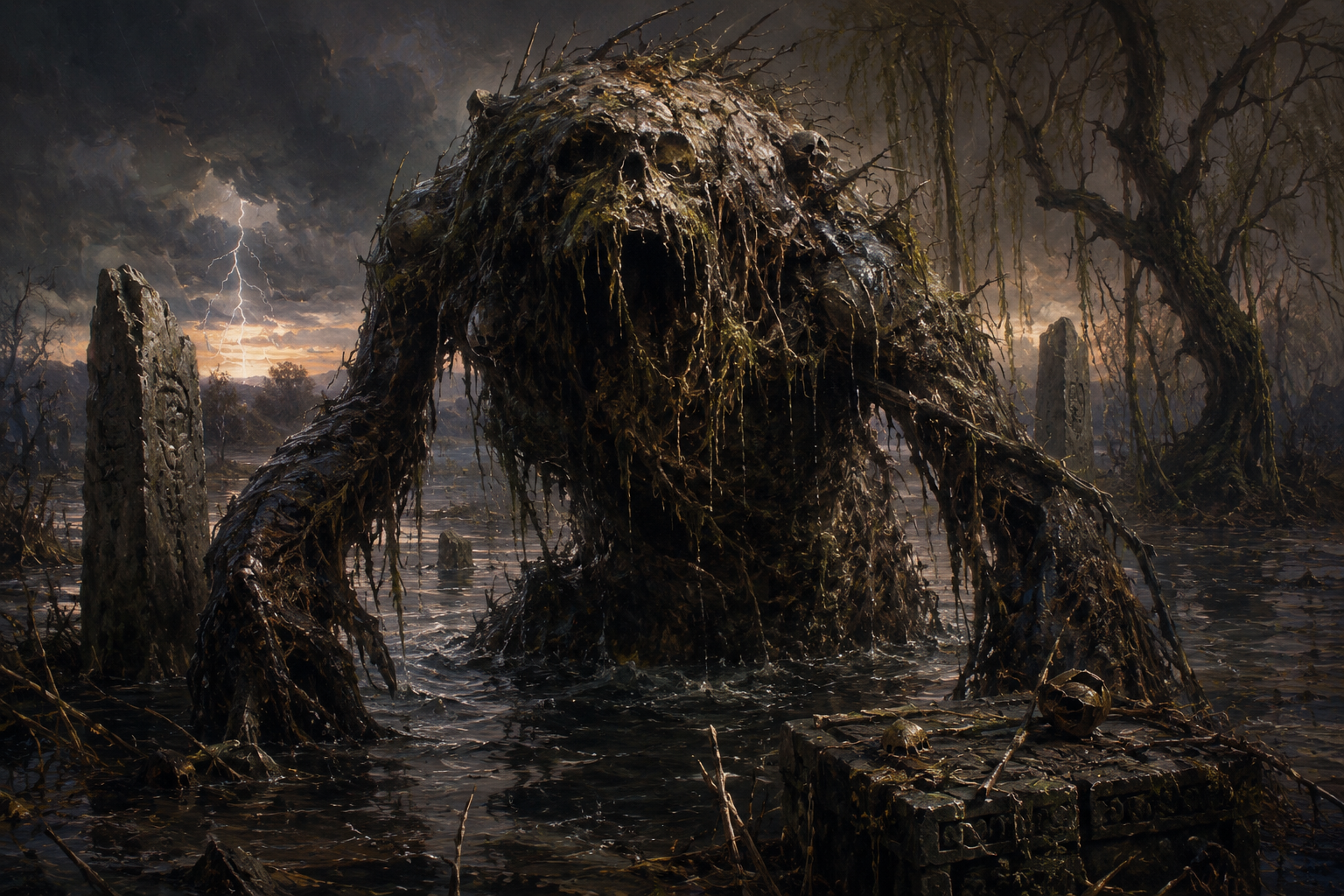
A mass of tangled vines and dripping slime rises on two trunk-like legs, reeking of rot and freshly turned earth.
Large plant, unaligned
Armor Class 15 (natural armor)
Hit Points 136 (16d10 + 48)
Speed 20 ft., swim 20 ft.
| STR | DEX | CON | INT | WIS | CHA |
|---|---|---|---|---|---|
| 18 (+4) | 8 (-1) | 16 (+3) | 5 (-3) | 10 (+0) | 5 (-3) |
Skills Stealth +2
Damage Resistances cold, fire
Damage Immunities lightning
Condition Immunities blinded, deafened, exhaustion
Senses blindsight 60 ft. (blind beyond this radius), passive Perception 10
Languages –
Challenge 5 (1,800 XP)
Special Traits
- Lightning Absorption: Whenever the shambling mound is subjected to lightning damage, it takes no damage and regains a number of hit points equal to the lightning damage dealt.
Actions
- Multiattack: The shambling mound makes two slam attacks. If both attacks hit a medium or smaller target, the target is grappled (escape DC 14), and the shambling mound uses its Engulf on it.
- Slam: Melee Weapon Attack: +7 to hit, reach 5 ft., one target. Hit: 13 (2d8 + 4) bludgeoning damage.
- Engulf: The shambling mound engulfs a Medium or smaller creature grappled by it. The engulfed target is blinded, restrained, and unable to breathe, and it must succeed on a DC 14 Constitution saving throw at the start of each of the mound’s turns or take 13 (2d8 + 4) bludgeoning damage. If the mound moves, the engulfed target moves with it. The mound can have only one creature engulfed at a time.
Section 15: Copyright Notice
System Reference Document 5.1 Copyright 2016, Wizards of the Coast, Inc.; Authors Mike Mearls, Jeremy Crawford, Chris Perkins, Rodney Thompson, Peter Lee, James Wyatt, Robert J. Schwalb, Bruce R. Cordell, Chris Sims, and Steve Townshend, based on original material by E. Gary Gygax and Dave Arneson.
Pathfinder 1e / 3.5e-Compatible Version
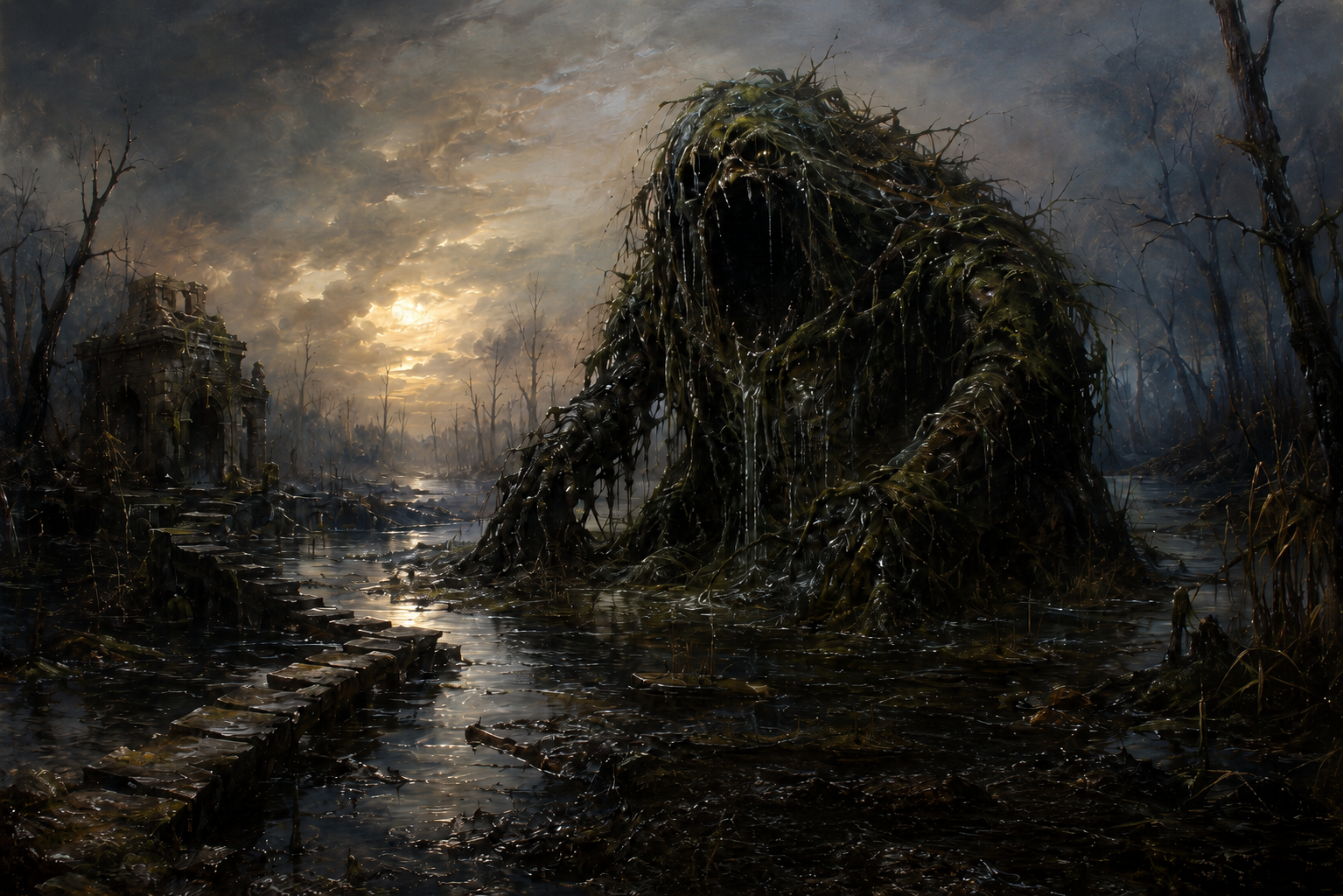
A mass of tangled vines and dripping slime rises on two trunk-like legs, reeking of rot and freshly turned earth.
Shambling mounds, also called shamblers, appear to be heaps of rotting vegetation. They are actually intelligent, carnivorous plants with a fondness for elf flesh in particular. What serve as a shambler’s brain and sensory organs are located in its upper body. Shambling mounds typically have an 8-foot girth and stand between 6 and 9 feet tall. They weigh about 3,800 pounds.
Shambling mounds are strange creatures, more akin to animate tangles of creeping parasitic vines than single rooted plants. They are omnivorous, able to draw their sustenance from nearly anything, wrapping their creepers around living trees to draw forth the sap, sending rootlets into the soil to absorb raw nutrients, or consuming flesh and bone from crushed prey.
Shamblers are frighteningly stealthy in their native environments. Blending in with the surrounding terrain, they can lie in wait for days on end without moving, waiting patiently for a potential meal. A shambler could be almost anywhere at any time, attacking without warning and not caring whether it leaves any survivors, so long as it acquires its next meal.
Shambling mounds normally lead solitary, nomadic existences in deep forests and fetid swamps, although they can also be found underground living among damp fungal thickets. Disturbing rumors persist, however, of shamblers gathering in strange congregations around great earthen mounds in the depths of marshes and jungles, often during the height of violent electrical storms. Their reasons for doing so are unknown, and many sages have wondered whether there is some obscure and alien purpose at work.
Shambling Mound CR 6
XP 2,400
N Large plant
Init +0; Senses darkvision 60 ft., low-light vision; Perception +11
Defense
AC 20, touch 9, flat-footed 20 (+11 natural, -1 size)
hp 76 (9d8+36)
Fort +9, Ref +3, Will +5
Immune electricity, plant traits
Resist fire 10
Offense
Speed 20 ft., swim 20 ft.
Melee 2 slams +11 (2d6+5 plus grab)
Space 10 ft.; Reach 10 ft.
Special Attacks constrict (2d6+7)
Statistics
Str 21, Dex 10, Con 17, Int 7, Wis 10, Cha 9
Base Atk +6; CMB +12 (+16 grapple); CMD 22
Feats Iron Will, Power Attack, Skill Focus (Stealth), Toughness, Weapon Focus (slam)
Skills Perception +11, Stealth +8 (+16 in swamps or dense vegetation), Swim +13
Racial Modifiers +8 Stealth in swamps or dense vegetation
Languages understands no language; may respond to druidic magic, plant speech, or site-bound commands
Ecology
Environment temperate or warm marshes, swamps, forests, ruins, and wetlands
Organization solitary, pair, or tangle (3–4)
Treasure incidental remains
Special Abilities
Electricity Absorption (Ex) A Shambling Mound takes no damage from electricity. Instead, any electricity effect that would damage it heals it by 1 hit point for every 3 points of damage the attack would otherwise deal.
Notes
This version gives Defense, Offense, Statistics, Ecology, and Special Abilities. It keeps the Shambling Mound close to its classic role as a Large intelligent plant that crushes, grabs, constricts, and becomes more dangerous when struck by electricity.
The main table pressure is the grapple. Do not run it as a static bruiser. It should grab, constrict, block movement, use wetland terrain, and make rescue difficult.
Treasure and Remains
A Shambling Mound does not collect treasure intentionally, but its body may contain the remains of those it has swallowed.
Useful finds include:
- a sealed bone scroll case
- a rusted holy symbol from a drowned pilgrim
- an old sword hilt wrapped in living roots
- a lightning-struck gemstone fused into wood
- a noble’s signet ring found deep inside the creature
- bones from several different disappearances
A slain Shambling Mound may also leave behind rare alchemical material: lightning-fed root, bog-black sap, heartwood grown around bone, or mud rich with corpse-fed plant magic.
When Shambling Mounds Appear
Use a Shambling Mound when the encounter should make the landscape feel hostile.
It works especially well when the party already distrusts the ground: a flooded road, a corpse-littered marsh, a ruined shrine, an overgrown battlefield, a lightning storm, a lost druid grove, or a village with too many disappearances and too few bodies.
The monster is strongest when the players realise the “thing” they are fighting was present the whole time.
Adventure Hooks
The Ford That Eats Horses
A trade road has not officially closed, but carts have stopped arriving. The ford is shallow, the water calm, and the reeds ordinary. The locals blame bandits because that is easier to accept than the truth: something in the ford has learned to wait for the third horse in a line.
The Saint’s Garden Will Not Die
A ruined healing shrine is overgrown with impossible green life. Sick villagers come to take cuttings, but some do not return. The mound at the centre of the garden may be a failed miracle, a protective guardian, or a thing feeding on centuries of buried offerings.
Thunder Over the Bog
Every storm makes the marsh more dangerous. Lightning strikes the same black pool again and again, and each strike strengthens the thing beneath it. A local lord wants the road reopened before tax season. The druids say the road should never have crossed that ground.
Natural History, and Mythic Context
The Shambling Mound belongs to the deep logic of wetlands: places where water, plant growth, decay, and hidden depth work together. Bogs, fens, marshes, swamps, drowned forests, and peatlands all provide the right imaginative ground for this creature. In such places, dead plant matter does not simply vanish. It gathers, sinks, compresses, ferments, and thickens into dark organic layers. Real peat forms from partially decomposed plant material in wetlands, while bogs are waterlogged, poorly drained, peat-rich ecosystems. For natural background, see Britannica: Wetland, Britannica: Bog, and Britannica: Peat.
A Shambling Mound is the fantasy expression of that process turned predatory. It is not a tree spirit, not an undead corpse, and not a simple animated heap. It is a carnivorous plant horror made from wet rot given appetite: reeds, moss, black roots, fallen branches, drowned leaves, fungus, mud, and buried organic matter forming a slow, intelligent hunter. Where ordinary predators leave tracks, a Shambling Mound may leave only changed ground, crushed reeds, vanishing animal trails, and a pool where no bird will land.
In the campaign world, Shambling Mounds are most often born where decay is unusually old, magically charged, or morally stained. A battlefield drowned by a river, a sacred grove struck by lightning, a plague pit swallowed by reeds, a ruined garden left to rot, a witch’s marsh, or a druidic boundary gone wrong can all give rise to one. The creature is especially suited to places where the land itself has been neglected, violated, or overfed with death.
Lightning is part of the Shambling Mound’s mythic identity. Storms do not merely reveal the creature; they can strengthen it, wake it, or mark the ground from which it rises. In old marsh villages, a repeated lightning strike on the same black pool may be treated as an omen that something beneath the water is feeding on the storm. Travellers who bring lightning magic into a Shambling Mound’s territory may discover that the swamp has already learned to drink it.
For game-history context, the Shambling Mound appears in open rules traditions as an intelligent carnivorous plant resembling a heap of rotting vegetation. Useful references include the 3.5 SRD Shambling Mound and the Pathfinder Archives of Nethys Shambling Mound.
Mythically, the Shambling Mound is the fear that the earth does not forgive being used as a grave. It is the bog remembering bodies, the drowned grove remembering axes, the abandoned field remembering blood, and the wetland turning trespass into compost. It need not be evil to be terrifying. It is hunger, patience, and place-bound life moving at last.
Keep this reference growing
If this page helped with your reading or game, you can support its upkeep or explore the curated books.
Explore the Bookshop — epics, classics and stories behind imagined worlds.