
Diprotodon
The largest marsupial known: a broad-bodied, pillar-legged herbivore whose sheer mass can turn a panicked charge into a battlefield hazard.
Usually peaceful, never harmless.
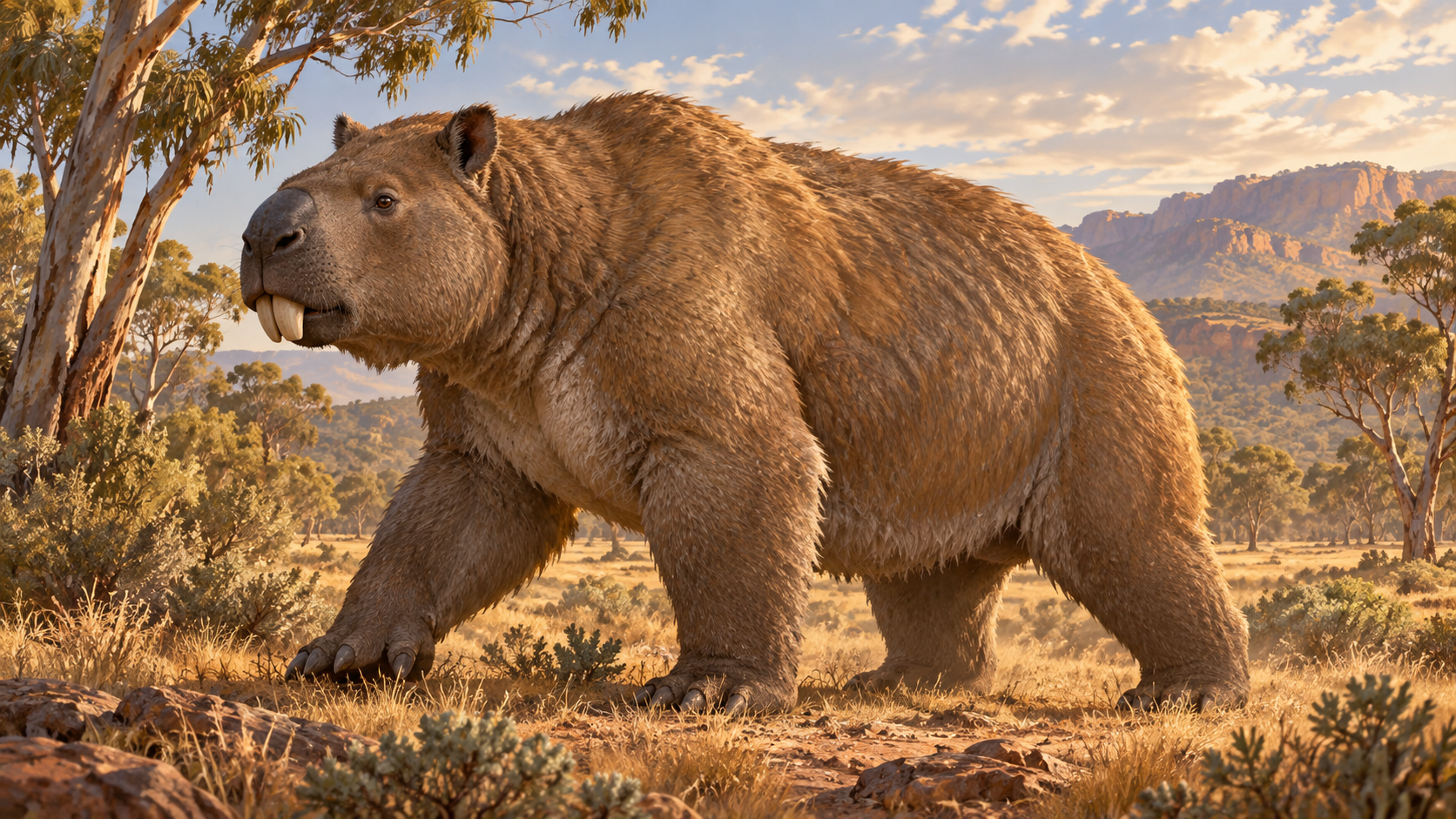
Diprotodon optatum is not simply a wombat enlarged to monstrous size. It belongs to an extinct family of diprotodontid marsupials, related to wombats and koalas but built on a far heavier scale. The largest adults can approach 3.8 metres in length, stand around 1.7 metres at the shoulder and weigh roughly 2.7 tonnes.
Diprotodons are browsers of open woodland, savannah and semi-arid plains. They cover long distances in search of shrubs, leaves and other vegetation, using powerful chisel-like incisors to crop and uproot food. Their immense mass makes them dangerous when alarmed even though they are not predators.
On the surface world they are known chiefly from old bones and trackways. Living populations endure in isolated refuges and within the prehistoric reaches of Hollow Earth, where dry grasslands and open woodland still support great-bodied herbivores.
Game Statistics
The four rules versions describe the same massive herbivore at different mechanical scales. The 5e-era conversions use the official Elephant as a benchmark for a multi-ton trampling beast; Pathfinder retains the established Creature Chronicle version; 3.5e converts that older design into native 3.5e animal rules.
Diprotodon — 5.5e / 2024
Large Beast, Unaligned • CR 4
Skills Perception +3, Survival +3
Senses Passive Perception 13
Languages None
CR 4 (1,100 XP; PB +2)
Actions
Multiattack. The Diprotodon makes two Incisor Bash attacks.
Incisor Bash. Melee Attack Roll: +8, reach 5 ft. Hit: 15 (2d8 + 6) Bludgeoning damage. If the Diprotodon moved 20+ feet straight toward the target immediately before the hit and the target is Huge or smaller, the target has the Prone condition.
Bonus Actions
Trample. Dexterity Saving Throw: DC 16, one Prone creature within 5 feet. Failure: 17 (2d10 + 6) Bludgeoning damage. Success: Half damage.
Diprotodon — 5e / 2014
Large beast, unaligned
Armor Class 14 (natural armor)
Hit Points 95 (10d10 + 40)
Speed 35 ft.
Skills Perception +3, Survival +3
Senses passive Perception 13
Languages —
Challenge 4 (1,100 XP)
Traits
Trampling Charge. If the Diprotodon moves at least 20 feet straight toward a creature and then hits it with an Incisor Bash on the same turn, that target must succeed on a DC 16 Strength saving throw or be knocked prone. If the target is prone, the Diprotodon can make one Stomp attack against it as a bonus action.
Actions
Incisor Bash. Melee Weapon Attack: +8 to hit, reach 5 ft., one target. Hit: 15 (2d8 + 6) bludgeoning damage.
Stomp. Melee Weapon Attack: +8 to hit, reach 5 ft., one prone creature. Hit: 17 (2d10 + 6) bludgeoning damage.
Diprotodon — Pathfinder 1e
CR 5 XP 1,600
N Large animal
Init +0; Senses low-light vision, scent; Perception +11
Defense
AC 18, touch 9, flat-footed 18 (−1 size, +9 natural)
hp 59 (7d8+28)
Fort +9, Ref +5, Will +5
Offense
Speed 40 ft., burrow 10 ft.
Melee bite +9 (1d8+5), 2 claws +9 (1d8+5)
Space 10 ft.; Reach 5 ft.
Special Attacks trample (1d8+7, DC 18)
Statistics
Str 21, Dex 10, Con 18, Int 2, Wis 13, Cha 5
Base Atk +5; CMB +11; CMD 21 (25 vs. trip)
Feats Endurance, Improved Natural Attack (claw), Iron Will, Skill Focus (Perception)
Skills Perception +11, Survival +7
Ecology
Environment warm plains, savannah and open woodland
Organization solitary, pair, or small family group
Treasure none
Diprotodon — D&D 3.5e
| Size/Type | Large Animal |
|---|---|
| Hit Dice | 7d8+28 (59 hp) |
| Initiative | +0 |
| Speed | 40 ft. (8 squares) |
| Armor Class | 18 (−1 size, +9 natural), touch 9, flat-footed 18 |
| Base Attack/Grapple | +5/+14 |
| Attack | Incisor bite +9 melee (1d8+5) |
| Full Attack | Incisor bite +9 melee (1d8+5) and 2 foreclaws +4 melee (1d6+2) |
| Space/Reach | 10 ft./5 ft. |
| Special Attacks | Trample 2d6+7 (Reflex DC 18 half) |
| Special Qualities | Low-light vision, scent |
| Saves | Fort +9, Ref +5, Will +5 |
| Abilities | Str 21, Dex 10, Con 18, Int 2, Wis 13, Cha 5 |
| Skills | Listen +5, Spot +5, Survival +3 |
| Feats | Endurance, Improved Natural Attack (bite), Iron Will |
| Environment | Warm plains, savannah and open woodland |
| Organization | Solitary, pair, or small family group |
| Challenge Rating | 5 |
| Treasure | None |
| Alignment | Always neutral |
| Advancement | 8–12 HD (Large); 13–18 HD (Huge) |
| Level Adjustment | — |
Special Attacks
Trample (Ex). As a full-round action, a Diprotodon can move up to twice its speed and run over creatures at least one size category smaller than itself. A trampled creature takes 2d6+7 bludgeoning damage. A target may make a Reflex save (DC 18) for half damage or make an attack of opportunity at a −4 penalty instead of attempting the save.
Behaviour
Diprotodons spend most of their time moving between feeding grounds and reliable water. They are not naturally aggressive and do not stalk other creatures. A calm animal usually watches an approaching group, turns away and keeps enough distance to leave if necessary.
Large numbers found around ancient waterholes should not be mistaken for evidence of enormous permanent herds. Small family groups and solitary adults converge when drought or seasonal movement concentrates animals around the same remaining water.
Adults are especially dangerous when a young animal is nearby or when frightened in confined terrain. Their first instinct is to create space. Unfortunately, a multi-ton animal creating space can crush a person, overturn a cart or push through a light structure without intending to hunt anything.
If Violence Starts
It tries to break through rather than hold ground. A threatened Diprotodon charges toward the clearest escape route, knocking creatures aside and trampling anything that falls beneath it.
It protects young by interposing its body. An adult places itself between danger and a calf, then advances only far enough to force the threat back.
It does not pursue far. Once an attacker retreats and the animal has open ground, it stops. A Diprotodon that chases for hundreds of yards should have a specific reason: injury, trapped young, fire, or sustained harassment.
Predators change its priorities. Against marsupial predators or Megalania, adults bunch around vulnerable young and use mass rather than speed.
Habitat, Feeding & Water
Diprotodons favour semi-arid plains, savannah and open woodland. Their fossils occur across much of Australia, but they are generally absent from steep, heavily forested coastal terrain. They can travel substantial distances between feeding areas and dependable water.
Their teeth are built for vegetation rather than flesh. Saltbush and other coarse plant material are plausible foods, and a full-grown animal may consume enormous quantities of vegetation in a day. Their large incisors are useful for cropping and uprooting plants but become dangerous weapons if the animal is forced into close combat.
Living animals are most often encountered where prehistoric ecosystems have survived: the deep grasslands and open woodland routes of Hollow Earth, or isolated regions where surface populations escaped extinction.
Natural History
Diprotodon optatum was the largest marsupial known. It lived across Pleistocene Australia and survived alongside the continent’s first human inhabitants for thousands of years. Fossils include complete skeletons, hair, footprints and large concentrations of animals trapped around drying water sources.
Its closest living comparisons are not exact. It was related to wombats and koalas, but belonged to its own extinct family of giant herbivorous diprotodontids. Calling it a “giant wombat” is useful shorthand for appearance, not a precise description of what the animal was.
Predation evidence links Diprotodon to the marsupial lion Thylacoleo carnifex, and the wider ecosystem also included giant kangaroos and enormous monitor lizards. That makes a Diprotodon encounter part of a much larger megafaunal food web rather than an isolated prehistoric curiosity.
Encounter Ideas
The Dry Waterhole
Several family groups converge on the last reliable water in the region. The party needs the same water, and a large predator is already watching the weakest animals.
The Blocked Road
A Diprotodon and calf are feeding beside a narrow trail. The safest answer is patience, but an approaching caravan refuses to wait.
The Broken Wagon
A panicked animal has smashed through a merchant train. The real threat is whatever frightened two tonnes of herbivore badly enough to run.
Tracks into the Hollow
Fresh Diprotodon footprints cross an area where the animals are supposedly unknown. Following them reveals a route into a surviving prehistoric ecosystem.
The Calf
A young animal has become separated from its mother after a flash flood. Returning it is safer than allowing a distressed adult to search the settlement.
The Predator’s Choice
A Megalania shadows a small family group. Intervening may save the calf, but it also places the party between predator and prey.
Watch: Australia’s Lost Megafauna
This ABC Science documentary is useful for running Diprotodon because it visits Lake Callabonna, explains the fossil evidence and places the animal inside the wider extinction problem of Australian megafauna.
Megafauna: What Killed Australia’s Giant Beasts? — ABC Science. Diprotodon appears near the beginning as the largest marsupial in the Australian megafauna story.
Explore Further
Sources & Licensing
Natural history: Australian Museum material on Diprotodon optatum, Australian megafauna and Pleistocene environments informs the size, habitat, diet, social behaviour and fossil context used here.
5.5e / 2024 and 5e / 2014: original Diprotodon conversions using the official Elephant as the mechanical benchmark for a large trampling herbivore.
Pathfinder 1e: based on the CR 5 Giant Wombat (Diprotodon) published by The Creature Chronicle, with ecology wording revised to reflect current palaeontological evidence.
D&D 3.5e: original conversion from the same CR 5 legacy concept, using 3.5e animal attack, save and trample conventions.