
Late Cretaceous Megaherbivore
Edmontosaurus, Titan of the Floodplains
A hoofed, duck-billed giant whose herds shake the coastal plains—and whose speed, vigilance and sheer mass make even tyrannosaurs choose their attack carefully.
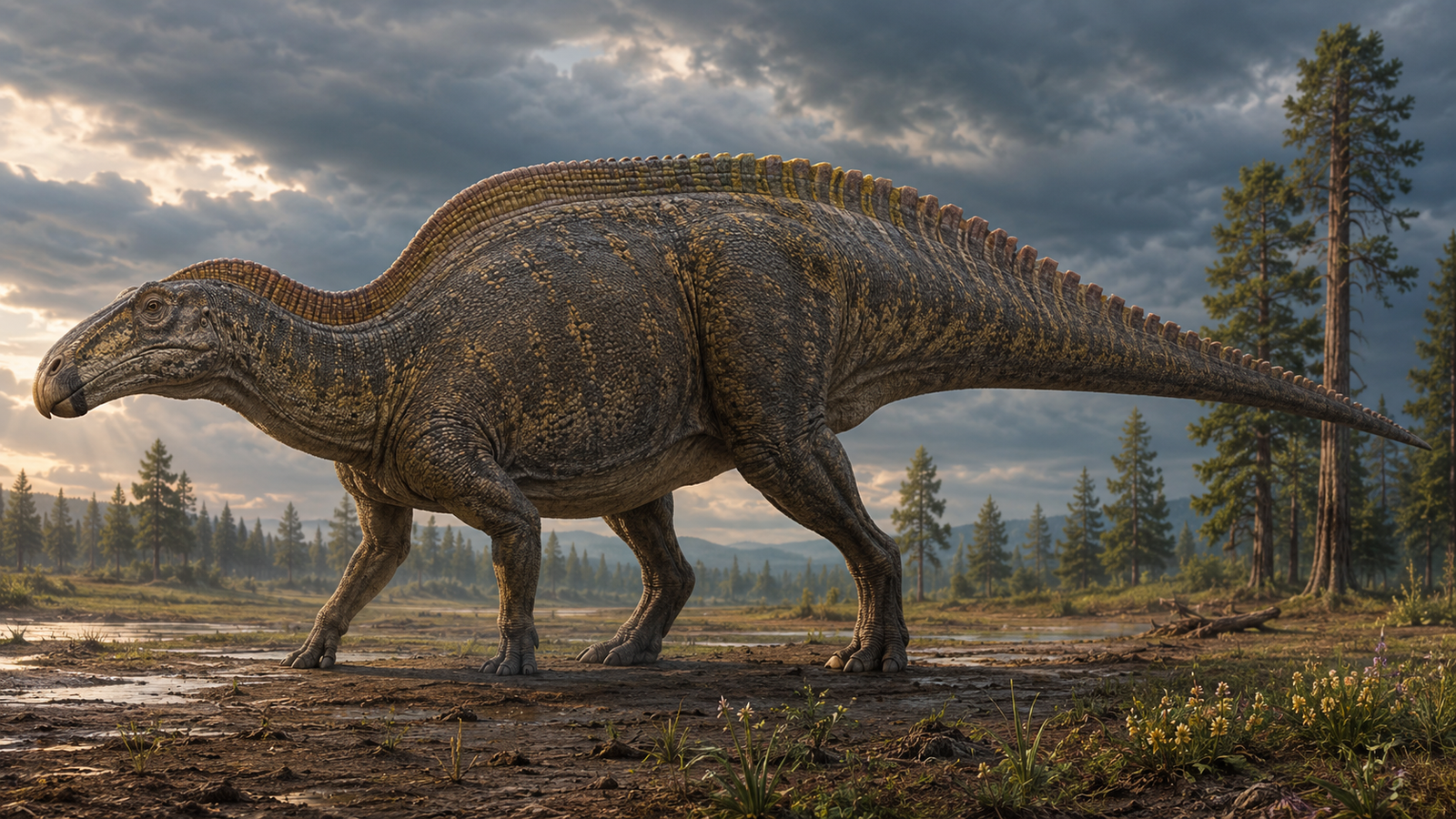
The Great Duck-Billed Grazer
Edmontosaurus is one of the largest and best-known hadrosaurs: a deep-bodied plant-eater with a broad keratinous beak, batteries containing hundreds of continually replaced teeth, powerful hindquarters and a long tail that balances its tremendous body.
It crops twigs, leaves, needles, seeds and other coarse growth with its beak, then grinds that material between densely packed cheek teeth. Adults usually travel on all fours, their forefeet and hind feet bearing different forms of hoof sheath. When danger closes, a healthy animal can lengthen its stride and drive forward with its stronger hind limbs.
Game Statistics
Use a single adult as a powerful but reluctant combatant. It flees when a route remains open, turns its bulk against attackers that block the herd, and fights hardest when trapped beside younger or injured animals.
Edmontosaurus
Huge Beast (Dinosaur), Unaligned
Armour Class
14 (natural armour)
Hit Points
147 (14d12 + 56)
Speed
40 ft.
Saving Throws
Str +9, Con +7, Wis +5
Skills
Perception +5, Survival +5
Senses
passive Perception 15
Languages
—
Challenge
6 (2,300 XP)
Proficiency Bonus
+3
Traits
Herd Vigilance. While another Edmontosaurus is within 30 feet of it, the Edmontosaurus has advantage on Wisdom (Perception) checks and saving throws against the Frightened condition.
Sure-Footed. The Edmontosaurus has advantage on ability checks and saving throws made to resist being knocked Prone or moved against its will.
Trampling Charge. If the Edmontosaurus moves at least 20 feet straight toward a creature and then hits it with Ram on the same turn, the target must succeed on a DC 16 Strength saving throw or have the Prone condition. If the target falls Prone, the Edmontosaurus can make one Stomp attack against it as a Bonus Action.
Actions
Multiattack. The Edmontosaurus makes one Tail Slam attack and one Stomp attack.
Ram. Melee Attack Roll: +9, reach 10 ft. Hit: 19 (3d8 + 6) Bludgeoning damage.
Stomp. Melee Attack Roll: +9, reach 5 ft. Hit: 22 (3d10 + 6) Bludgeoning damage.
Tail Slam. Melee Attack Roll: +9, reach 15 ft. Hit: 19 (3d8 + 6) Bludgeoning damage.
Reaction
Break from the Predator. When a creature the Edmontosaurus can see ends its turn within 10 feet of it, the Edmontosaurus moves up to 20 feet without provoking Opportunity Attacks. It cannot use this reaction if its Speed is 0.
Edmontosaurus
CR 7 XP 3,200 N Huge animal
Init +0; Senses low-light vision, scent; Perception +21
Defence
AC
19, touch 8, flat-footed 19
(−2 size, +11 natural)
hp
136 (13d8 + 78)
Fort
+14,
Ref
+8,
Will
+7
Defensive Abilities
herd vigilance, sure-footed
Offence
Speed
40 ft.
Melee
ram +16 (2d8 + 13)
or tail slap +16 (3d8 + 13)
and 2 stomps +11 (2d6 + 4)
Space
15 ft.;
Reach
10 ft. (15 ft. with tail slap)
Special Attacks
powerful charge (ram, 4d8 + 13),
trample (2d8 + 13, DC 25)
Statistics
Str
28,
Dex
10,
Con
22,
Int
2,
Wis
13,
Cha
7
Base Atk
+9;
CMB
+16 (+18 bull rush);
CMD
26 (30 vs. bull rush and trip)
Feats
Alertness,
Endurance,
Iron Will
,
Improved Bull Rush,
Improved Natural Attack
(tail slap),
Power Attack,
Run
Skills
Perception +21
Ecology
Environment
temperate coastal plains, floodplains and open woodland
Organisation
solitary, pair, herd (6–40)
or great herd (41–400)
Treasure
none
Special Abilities
Herd Vigilance (Ex). While another Edmontosaurus is within 30 feet, the Edmontosaurus gains a +2 morale bonus on Perception checks and saving throws against fear.
Sure-Footed (Ex). An Edmontosaurus gains a +4 racial bonus to CMD against bull rush and trip attempts.
Trample (Ex). As a full-round action, the Edmontosaurus may move up to twice its speed and pass through the spaces of creatures at least one size category smaller than itself. Affected creatures take 2d8 + 13 points of bludgeoning damage and may attempt a DC 25 Reflex save for half damage. The save DC is Strength-based.
Edmontosaurus
Huge Animal
Hit Dice
19d8+205 (290 hp)
Initiative
+0
Speed
40 ft. (8 squares)
Armour Class
18 (−2 size, +10 natural),
touch 8,
flat-footed 18
Base Attack/Grapple
+14/+30
Attack
Ram +20 melee (2d8+12)
or tail slam +20 melee (3d8+12)
Full Attack
Tail slam +20 melee (3d8+12)
and 2 stomps +15 melee (2d6+4)
Space/Reach
15 ft./10 ft.
(15 ft. with tail slam)
Special Attacks
Powerful charge,
trample 2d8+12
Special Qualities
Herd vigilance,
low-light vision,
scent,
sure-footed
Saves
Fort +21,
Ref +11,
Will +9
Abilities
Str 27,
Dex 10,
Con 31,
Int 1,
Wis 12,
Cha 10
Skills
Listen
+16,
Spot
+16
Feats
Iron Will
,
Improved Natural Attack
(tail slam),
Toughness
(5)
Environment
Temperate coastal plains, floodplains and open woodland
Organisation
Solitary, pair, herd (6–40)
or great herd (41–400)
Challenge Rating
10
Treasure
None
Alignment
Always neutral
Advancement
20–26 HD (Huge);
27–38 HD (Gargantuan)
Level Adjustment
—
Combat
An Edmontosaurus normally withdraws from danger. If surrounded, it uses its tail to open an escape route and tramples smaller enemies that stand between it and the herd.
Powerful Charge (Ex). An Edmontosaurus deals 4d8+12 points of damage when it makes a successful charge with its ram attack.
Trample (Ex). Reflex DC 27 half. The save DC is Strength-based.
Herd Vigilance (Ex). While another Edmontosaurus is within 30 feet, the Edmontosaurus gains a +2 morale bonus on Listen and Spot checks and on saving throws against fear.
Sure-Footed (Ex). An Edmontosaurus gains a +4 racial bonus on checks or rolls made to resist bull rush and trip attempts.
Skills. An Edmontosaurus has a +4 racial bonus on Listen and Spot checks.
Running an Edmontosaurus Stampede
A stampede belongs to the whole encounter, not to one animal. Use it when at least six Edmontosauruses are fleeing together. The moving herd should remain visible on the battlefield and should have an obvious direction, edge and possible escape route.
| Edition | Stampede effect |
|---|---|
| D&D 5.5e | Creatures in a 30-foot-wide path crossed by the herd make a DC 16 Dexterity save, taking 27 (6d8) Bludgeoning damage and falling Prone on a failure, or taking half damage without falling Prone on a success. |
| Pathfinder 1e | Creatures crossed by the herd take 6d6 bludgeoning damage and fall prone; a DC 21 Reflex save halves the damage and negates falling prone. |
| D&D 3.5e | Creatures crossed by the herd take 2d12 damage for every five Edmontosauruses in the moving group, to a maximum of 8d12; a DC 23 Reflex save halves the damage. |
Behaviour and Ecology
Herd Life
Mass bonebeds show that Edmontosauruses gathered in large numbers. Herd size and migration patterns vary with food, water, breeding and danger. Individuals watch one another closely, so alarm can travel through a group before a predator reaches striking distance.
A threatened herd does not form a disciplined military wall. Adults bunch together, turn away from the danger and search for open ground. Confusion, constricted terrain or attacks from several directions can turn that retreat into a lethal stampede.
Feeding
The broad beak strips vegetation while the tooth batteries grind tough material. Edmontosaurus feeds from ground level into the lower branches, taking conifer needles, twigs, seeds, leaves and other fibrous plants available across its range.
It is a land animal of coastal plains, river systems and open woodland. Waterways shape its habitat, but it neither filters food like a duck nor lives as a semi-aquatic grazer.
Predators
Tyrannosaurs are the most dangerous hunters in the animal’s world. Fossils preserve healed bite injuries, proving that some Edmontosauruses survived direct attacks. Speed, endurance, alert herd-mates and the difficulty of bringing down a healthy adult are its strongest defences.
Display and Sound
The fleshy crest and tail spikes give the animal a more striking silhouette than older reconstructions suggested. Colour is unknown. Calls, bellows and other low sounds are reasonable at the table, but their exact voices and social signals remain reconstruction rather than direct evidence.
Edmontosaurus in SpiralWorlds
Edmontosaurus first belongs to the Flowering World , when hadrosaurs, ceratopsians, armoured dinosaurs and tyrannosaurs occupy the last great dinosaur kingdoms of western North America.
In the campaign present of 1454 CE, surviving herds remain natural animals rather than summoned monsters or magical recreations. Their greatest populations inhabit the open plains, river basins and forest margins of Hollow Earth . Smaller groups can persist in isolated lost valleys or other refuges whose routes have remained closed to the surface world.
Most surface scholars know Edmontosaurus only through immense bones, travellers’ tales and objects carried back from disastrous expeditions. A living herd therefore signals that the characters have crossed into an older ecology—one where ordinary animals can be larger and more dangerous than many supernatural monsters.
Using Edmontosaurus in Play
River of Giants
A migrating herd crosses the party’s route for hours. Predators, frightened pack animals or a badly timed spell could turn a difficult wait into a stampede.
The Healed Bite
An old animal carries deep tyrannosaur scars and becomes agitated whenever the pursuing predator draws near. Reading its behaviour may warn the party before the hunter appears.
Broken Expedition
A Hollow Earth caravan has lost its route after a herd flattened its markers and scattered its supplies. The characters must recover the trail without driving the animals into another camp.
Open the Escape
A landslide, palisade or magical barrier traps a herd as predators approach. Saving the animals requires creating a visible route before panic makes the confined valley deadly.
Treasure and Usable Remains
Edmontosaurus carries no treasure. A carcass can nevertheless support a stranded expedition or provide materials to people accustomed to working enormous animals. Harvesting should follow a hunt, natural death or scavenging scene rather than turning every encounter into automatic loot.
| Material | Use | Typical check |
|---|---|---|
| Heavy hide | Shelters, shields, rawhide bindings or mundane hide armour | Survival or relevant Craft DC 15 |
| Beak and hoof keratin | Tool edges, bow fittings, decorative inlay or alchemical stock | Survival or relevant Craft DC 14 |
| Bone and tendon | Hafts, braces, cordage, sleds and structural supports | Survival or relevant Craft DC 13 |
| Meat | Large quantities of food, provided it can be preserved quickly | Survival DC 12 |
Historical and Scientific Context
The name means “Edmonton lizard,” referring to the Canadian rocks from which the genus was first described. Two recognised species occupy different parts of the closing Cretaceous: the earlier Edmontosaurus regalis and the later Edmontosaurus annectens.
Edmontosaurus has repeatedly changed how dinosaurs are reconstructed. Early workers treated duck-billed dinosaurs as swamp-dwelling animals and even mistook preserved tissue between the fingers for swimming membranes. Better anatomy, trackways and sedimentary evidence established a terrestrial animal able to walk on two or four legs.
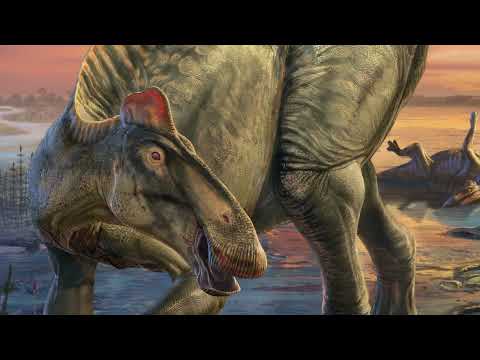
The fossils commonly called dinosaur “mummies” do not preserve an intact corpse. In the best recent examples, a paper-thin clay film formed around a dried carcass and recorded its outer surface before the organic material disappeared. That exceptional template preserves the scales, crest, spikes and hooves closely enough to reconstruct the animal’s external profile.
Video: The Hoofed Dinosaur Revealed
Related SpiralWorlds Entries
Dinosaur Directory
Browse the complete SpiralWorlds dinosaur collection for predators, herbivores and prehistoric encounter companions.
Late Cretaceous Neighbours
Build the closing dinosaur kingdoms with Tyrannosaurus , Triceratops and Ankylosaurus .
Sources and Further Reading
- Sereno et al., “Duck-billed dinosaur fleshy midline and hooves reveal terrestrial clay-template ‘mummification’,” Science (2025) .
- University of Chicago: Dinosaur “mummies” unlock secrets of life appearance .
- American Museum of Natural History: Fossil “Mummy” Shows Glimpse of Dinosaur Skin .
- Natural History Museum: Edmontosaurus .
Game material: The revised D&D 5.5e, Pathfinder 1e and D&D 3.5e statistics and encounter material on this page are original SpiralWorlds adaptations.
Return to the World Bestiary