
Lurking Rays — Executioner’s Hood, Lurker Above and Trapper
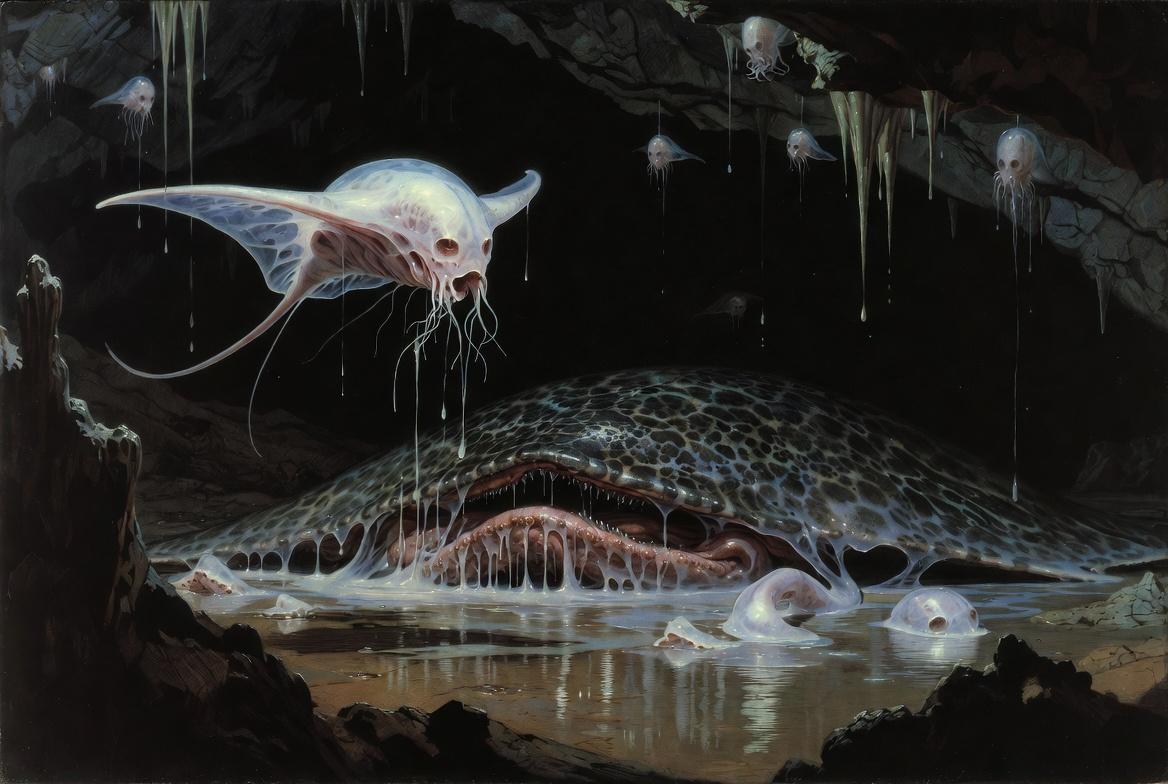
One subterranean predator, three life stages: the juvenile hood, the ceiling-hunting male and the floor-mimicking female.
Lurking rays are a family of ambush predators that imitate the surfaces of underground spaces. The juvenile Executioner’s Hood drops onto a victim’s head and smothers it. Adult males become Lurkers Above, gliding from ceilings. Adult females become Trappers, vast living floors capable of shaping their surface to lure prey into the centre of their bodies.
At a Glance
Choose a Lurking Ray
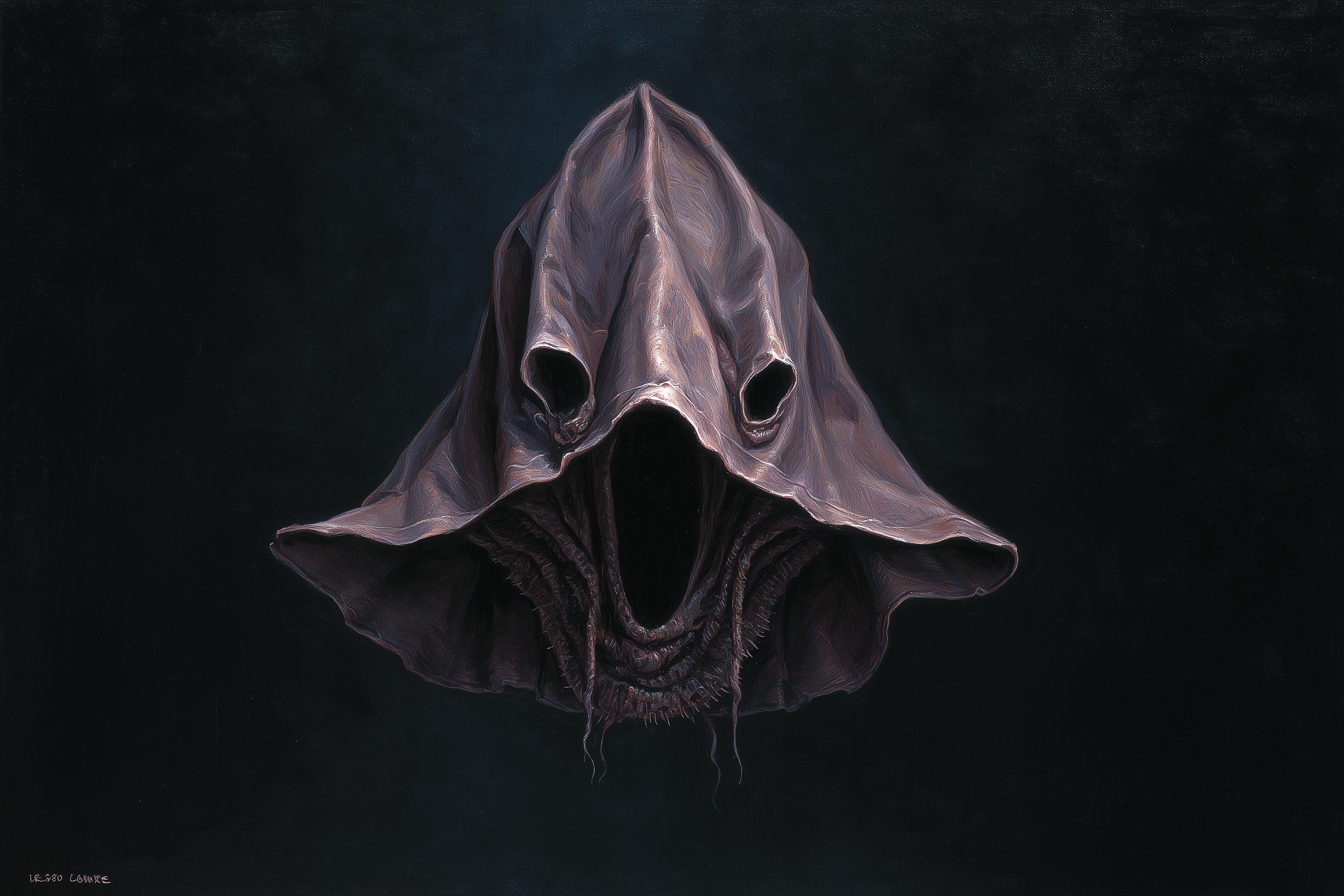
Executioner’s Hood
The juvenile form. It drops from ceilings, seals itself around a victim’s head and suffocates before feeding.
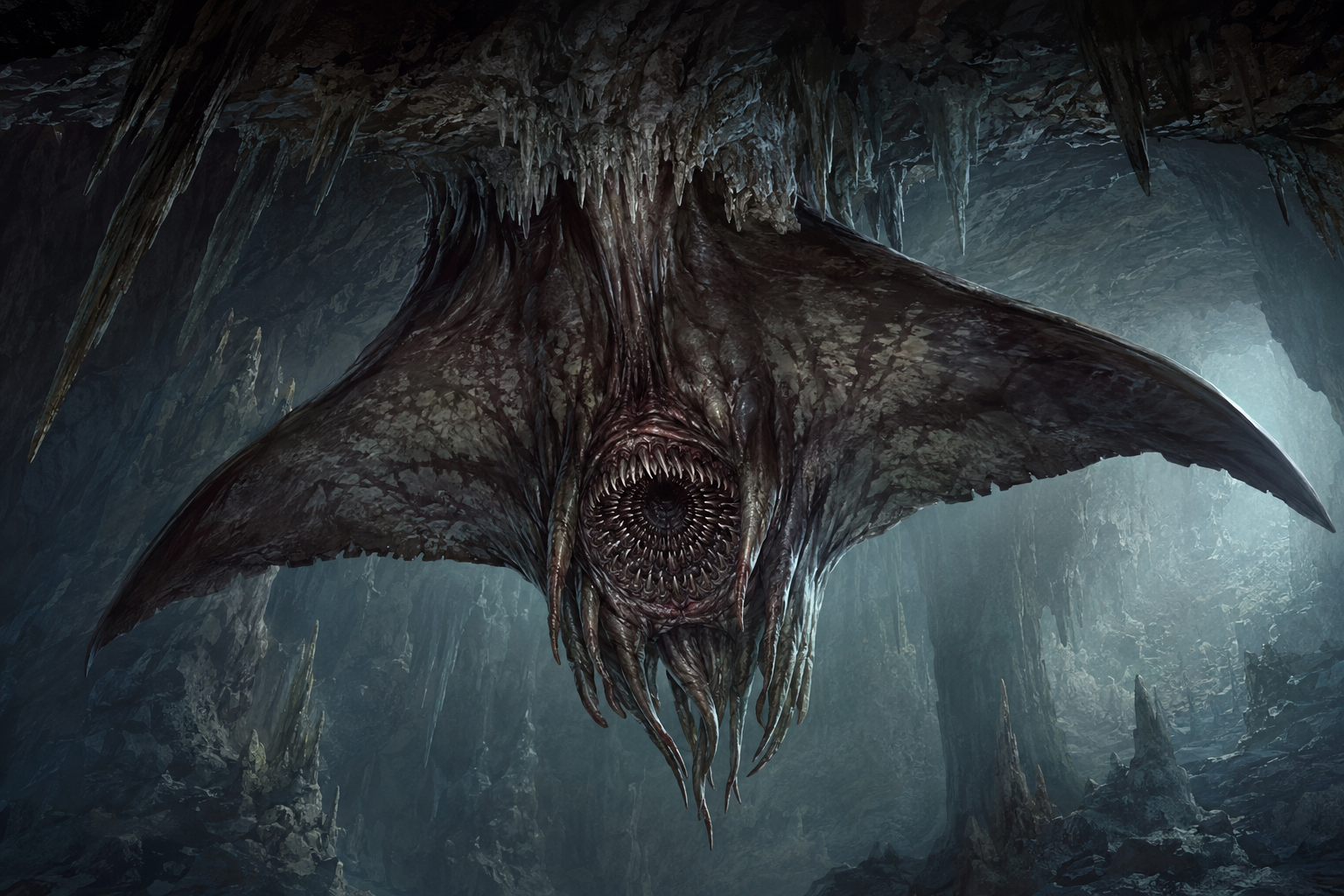
Lurker Above
The adult male. It clings to ceilings, glides silently through darkness and drops over prey from above.
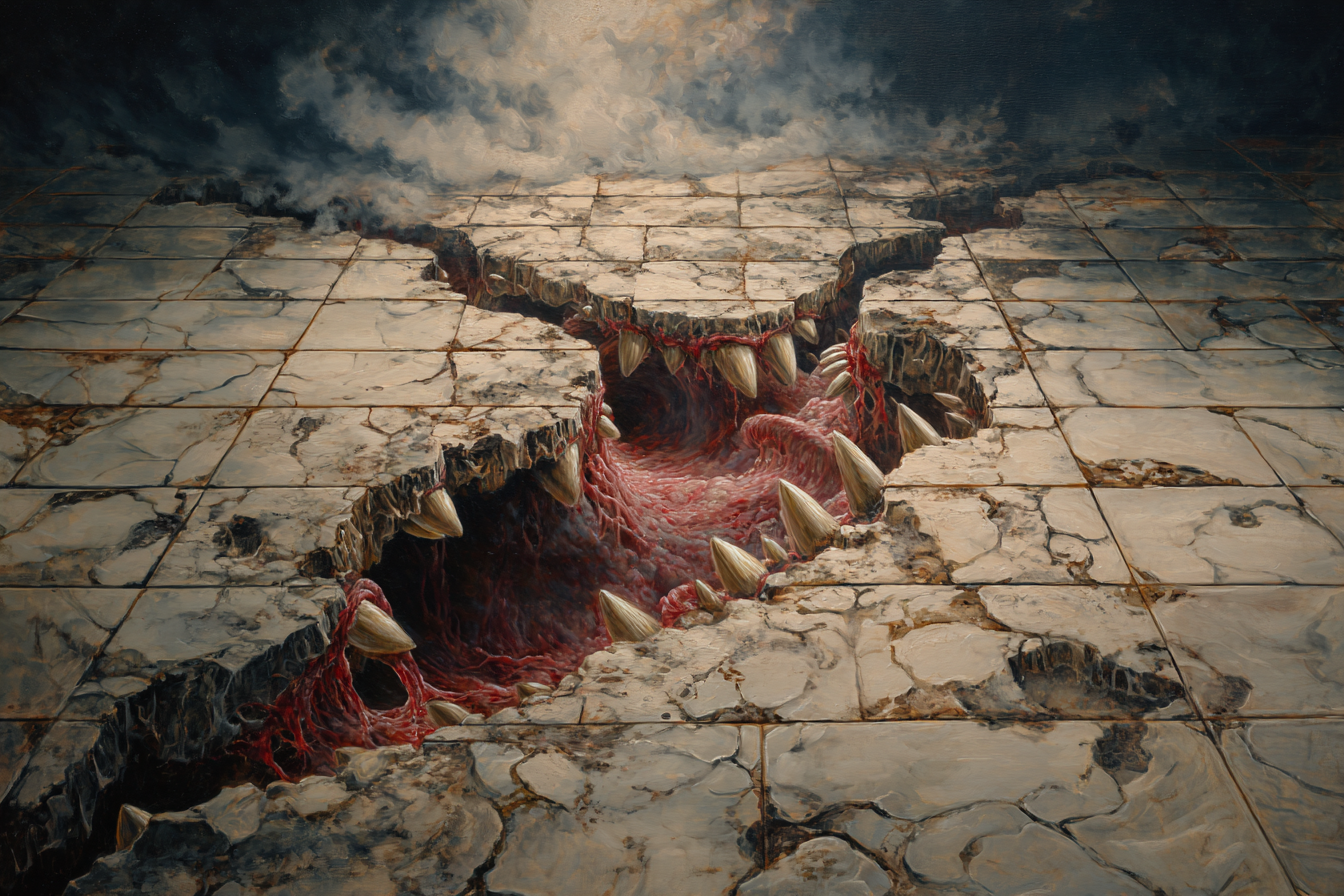
Trapper
The adult female. It becomes a living floor, shapes convincing lures and smothers several victims beneath its body.
The Lurking Ray Life Cycle
A lurking ray begins as a small Executioner’s Hood, typically about a foot long. Juveniles hang from ceilings and drop onto passing creatures, wrapping around the head and forming an airtight seal. During this stage their skin remains chemically fragile: strong alcohol can disrupt the tissue, a weakness they lose as they mature.
As the animal grows, the sexes diverge. Males become broad, manta-like Lurkers Above. They attach to ceilings and glide surprisingly long horizontal distances with little loss of height. Females become thick, square-bodied Trappers and settle into floors, where digestive secretions gradually shape a shallow depression beneath the body.
Male and Female Hunting Styles
Lurkers above must hunt more actively. They can absorb small amounts of mineral nourishment from stone, but not enough to remain still indefinitely. A male therefore chooses busy passages and overhead routes where prey regularly moves underneath.
Trappers can afford patience. A female can change the texture and contour of her upper surface until it resembles nearby stone, earth or worked flooring. She may create a raised shape resembling a chest, pack or other desirable object, placing the lure close to the centre where prey is hardest to escape once the body folds upward.
Smothering
All three major forms share the family’s defining attack: they wrap completely around prey and seal out the air. A captured creature cannot speak normally and may be unable to use magic requiring clear verbal components. In rules terms, the individual child pages handle exactly how the grapple, suffocation and digestion work in each edition.
Senses and Camouflage
Lurking rays do not rely on ordinary eyes. Fine sensory tissue across the body detects vibration, air movement, scent and nearby motion. This lets them remain convincing pieces of architecture until the moment they strike.
Trappers are especially sophisticated. Their enormous sensory memory lets them reproduce textures and ambient sounds that they have encountered before. A good trapper does not merely look like a floor; footsteps on it can sound like the surrounding stone until the creature chooses to attack.
Nurseries and Reproduction
Female trappers protect batches of young beneath their bodies. Juveniles begin as small translucent forms fed by partly digested organic matter, then practise on increasingly difficult live prey before leaving the nursery.
Adult males are cannibalistic toward young males but may herd immature females toward suitable territory. When breeding occurs, the female consumes the male during fertilisation. The surviving young then spread outward to establish new hunting grounds.
Behaviour
The family is governed by food, reproduction and territory rather than morality. Juveniles are almost entirely instinctive. Adult males remain simple but effective ambushers. Trappers are the exception: females can be cunning enough to understand nearby languages, negotiate temporary bargains and coordinate other lurking rays through scent and vibration.
Any such alliance remains transactional. A trapper fed by an underground settlement may guard an entrance for months, but the relationship lasts only while the arrangement remains more profitable than eating the negotiators.
Signs Before Initiative
- Footsteps sound strangely muffled across one stretch of floor.
- A cloak-like object hangs from the ceiling where nobody could have placed it.
- Victims are missing heads or show signs of suffocation without ligature marks.
- A treasure chest or loose pack sits in the exact centre of an otherwise empty chamber.
- The ceiling carries faint sucker marks or broad clean patches among old dust.
- Discarded metal gear is warped or corroded while magical objects remain intact.
Variants
Lurker Below. An aquatic analogue of the lurker above trades flight for strong swimming and becomes difficult to distinguish from a manta ray.
Aquatic Trapper. A reef-dwelling female anchors to the sea floor and moves bait-like projections on nearly invisible strands to draw prey into reach.
Surface-Bred Rays. Rare hermaphroditic lines can tolerate open spaces and bright conditions far better than normal lurking rays, allowing infestations in ruins, hillsides and settlements.
Great Mother. An ancient, gigantic trapper may survive for a century or more, accumulating vast sensory memories and seeking other old females with which to exchange experience. In PF1e terms, apply advanced and giant templates to the trapper rather than inventing a separate base creature.
Using the Family in a Campaign
The three stages can turn one ambush into a full infestation story. Start with a few unexplained suffocation deaths caused by executioner’s hoods. Later, reveal adult males hunting the same tunnels. The final discovery is the trapper nursery that produced both.
Because each form occupies a different surface—ceiling, air and floor—the family is especially effective in dungeons where players have learned to inspect only one direction for danger.
Related Creatures
The Cloaker uses a similar cloak-like ambush silhouette but is a distinct creature with its own moan and shadow abilities. Return to the Aberration Bestiary for the wider cluster.
Sources and Licensing
The lurking-ray lifecycle and family ecology used by these pages draws on open Pathfinder material and the expanded ecology formerly cited from Misfit Monsters Redeemed. This hub paraphrases and reorganises those ideas rather than reproducing the older article at length.
Edition-specific rules belong on the individual Executioner’s Hood, Lurker Above and Trapper pages.