
monster, Bluetip Eurypterid, the Dread Sea Scorpion
Bluetip Eurypterid, the Dread Sea Scorpion
Azure-tipped claws close from reef-shadow and wreck-dark, while a venomous tail turns one clean strike into paralysis, drowning, and silence.
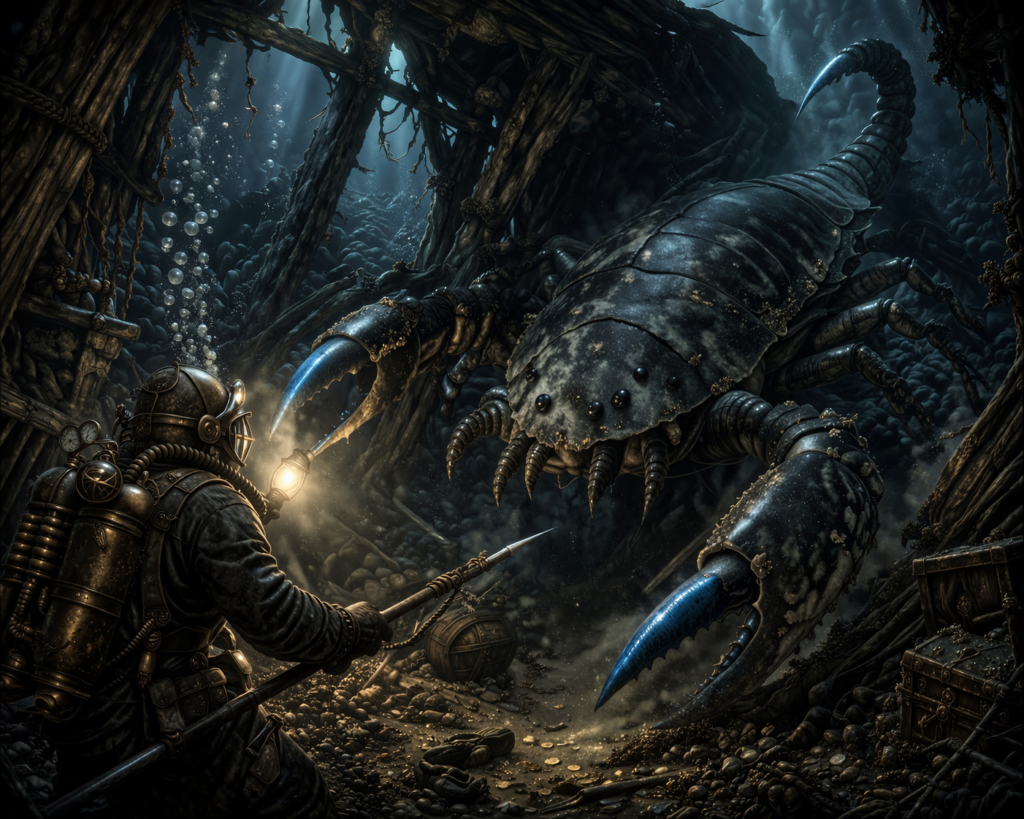
The Bluetip Eurypterid is a large, primeval aquatic predator that kills by concealment, impact, and venom. Sleek for its kind and far faster in the water than its armored body suggests, it lies hidden among reefs, rock shelves, weed-choked channels, and sunken wrecks until prey drifts too close. Then it surges forward, seizes with its great blue-tipped claws, and drives home the sting that gives the creature its name. Sailors know it as a reef-killer, divers fear it as a wreck-haunter, and those who survive it remember above all the flash of blue before the body stops obeying the will.
Lore
There are coasts where divers vanish in clear water, where nets come back blood-slick and torn, and where old wrecks seem empty only until someone disturbs the silt. In such places, mariners speak quietly of the Bluetip Eurypterid: a giant sea scorpion whose bright killing limbs flash once in murk or shadow before the victim goes rigid and sinks.
What makes the Bluetip Eurypterid so unnerving is not grandeur but plausibility. It does not bellow, brood, or circle like a monster of legend. It waits. It understands reef-shadow, hull-break, stone cleft, weed-bank, and coral dark as naturally as a tiger understands grass. In waters where it thrives, the sea itself begins to feel like cover for something patient, armored, and venomous. Wreck divers, pearl fishers, coastal smugglers, and salvagers all learn the same lesson in time: not every still shape below is timber, stone, or reef.
Appearance
The Bluetip Eurypterid resembles an enormous sea scorpion, reaching up to 10 feet in length from claw to tail. Its body is clad in a dark chitinous exoskeleton, usually iron-brown, wet slate, or black-green, with a hard sheen that catches stray light in cold underwater flashes. The creature’s signature features are the vivid blue tips of its oversized grasping claws and its long tail-sting, all marked in a striking azure that makes the killing parts of the body visible a moment before they are used.
Its front body is broad, plated, and heavy with leverage, while the rear narrows into a flexible tail built for sudden thrusting strikes. Multiple jointed legs let it scuttle over seabed, reef shelf, flooded stone, or wet shoreline rock, but in water it moves with a speed and smoothness that seem almost wrong for so armored a creature. Each claw is large enough to pin a grown humanoid, and the tail’s fine stinger looks almost delicate until it drives home.
Behaviour
Bluetip Eurypterids are aggressive ambush predators, but not mindless ones. They prefer stillness to pursuit and advantage to spectacle. Most remain motionless within cover until prey comes within reach, then launch with shocking speed, turning concealment into impact before the victim has fully understood the danger.
They are solitary by instinct and territorial by temperament. A reef cleft, wreck pocket, stone shelf, or tide cave claimed by one is defended with immediate violence. Once the creature has successfully seized prey, it becomes brutally focused, holding fast with its claws while striking with the tail or dragging the victim into deeper water, tighter cover, or a crevice where escape becomes harder and panic more deadly. Around breeding grounds and rich feeding sites, that aggression grows worse still, and even others of its own kind may be attacked.
Habitat
Bluetip Eurypterids inhabit temperate and warm coastal waters, especially wherever broken ground and layered structure create good ambush terrain. Coral reefs, rocky outcrops, kelp-shadowed channels, tide caves, wreck fields, drowned ruins, and submerged cliff shelves all suit them well. They flourish where there is:
- concealment
- a clear attack lane
- narrow terrain that traps prey
- a steady supply of fish, scavengers, divers, or unwary swimmers
Though primarily aquatic, they are amphibious enough to scuttle across wet rock, tidal mud, wreck timbers, and exposed shallows for short periods. That makes them especially dangerous around half-flooded caves, storm-broken coves, anchorages, and wreck sites where the boundary between sea and land offers only the illusion of safety.
Modus Operandi
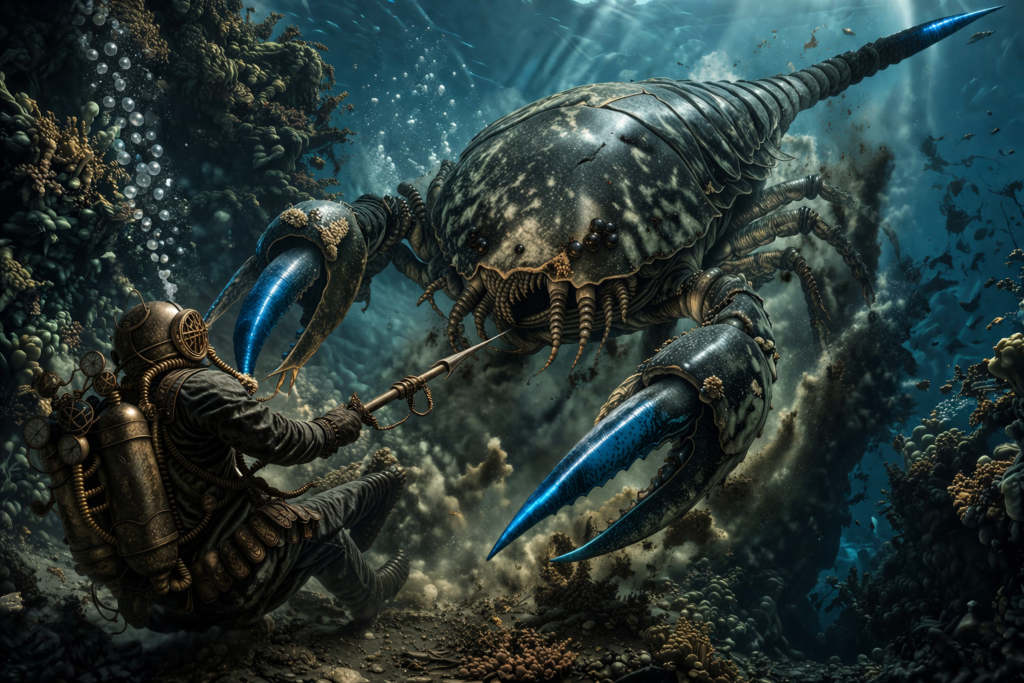
A Bluetip Eurypterid kills by sequence, not frenzy. It conceals itself first, then lunges to seize. One or both claws pin, crush, or hold the target in place while the tail drives in the venom. If the prey is weakened or paralyzed, the eurypterid drags it into deeper water, tighter cover, or the mouth of a crevice where resistance becomes useless.
Its violence is brutally practical. The claws are there to control. The sting is there to end struggle. The body’s weight and leverage do the rest. Against swimmers, divers, or lightly armored prey, this often settles the matter in seconds. Against larger foes, the creature continues with relentless instinctive pressure, striking again and again until the victim slows, sinks, or stops fighting. In cluttered underwater terrain, where reach and visibility are limited, it becomes far more dangerous, because every stone lip, coral fold, and broken spar may already lie within its killing space.
Motivation
The Bluetip Eurypterid is driven by hunger, territory, breeding pressure, and the hard instinct to seize what enters its reach. It is not malicious in the human sense, nor does it kill for display. It kills because its body is made to seize and disable, because good hunting ground must be defended, and because anything that blunders into its cover may become food.
Yet its instinctive aggression gives it a reputation out of proportion even to its size. Unlike a wary shark or a cautious scavenger, a Bluetip Eurypterid often commits hard once it begins. To those who meet it in murky water, that distinction is enough. What they remember is not the ecology. It is the speed of the claws, the flash of blue, and the cold betrayal of a body that suddenly will not move.
In the World
The presence of Bluetip Eurypterids changes the character of a coastline. Fishermen avoid certain reefs. Divers mark wrecks as cursed because too many who enter do not rise again. Smugglers lose men in shallow channels they thought they knew. Pearl beds go unworked. Local sailors leave charms at dangerous coves, warn children away from tide caves, and refuse to dive where the water lies too still over broken stone.
A single Bluetip Eurypterid can make a wreck dive fatal. A breeding pair can close an entire reef passage. A nesting ground would turn rich shallows into a graveyard. Where they thrive for long enough, the sea takes on the habits of a predator: silent, watchful, and waiting just below the point where light fails.
Bluetip Eurypterid 5.5e
Bluetip Eurypterid 5e
Bluetip Eurypterid, Pathfinder
Eurypterid, the Dread Sea Scorpion
Large Beast (Aquatic), Unaligned
Armor Class 16 (Natural Armor)
Hit Points 85 (10d10 + 30)
Speed 30 ft., swim 60 ft.
| STR | DEX | CON | INT | WIS | CHA |
|---|---|---|---|---|---|
| 18 (+4) | 14 (+2) | 16 (+3) | 1 (-5) | 12 (+1) | 3 (-4) |
Saving Throws Dex +5, Con +6
Skills Perception +3
Damage Resistances Bludgeoning, Piercing, and Slashing from Nonmagical Attacks
Condition Immunities Charmed, Frightened
Senses Darkvision 60 ft., Tremorsense 30 ft., Passive Perception 13
Languages —
Challenge 5 (1,800 XP)
Proficiency Bonus +3
Amphibious.
The eurypterid can breathe both air and water.D&D Wiki
Keen Smell.
The eurypterid has advantage on Wisdom (Perception) checks that rely on smell.
Pounce.
If the eurypterid moves at least 20 feet straight toward a creature and then hits it with a claw attack on the same turn, that target must succeed on a DC 14 Strength saving throw or be knocked prone. If the target is prone, the eurypterid can make one sting attack against it as a bonus action.
Multiattack.
The eurypterid makes three attacks: two with its claws and one with its sting.
Claw.
Melee Weapon Attack: +7 to hit, reach 5 ft., one target.
Hit: 12 (2d6 + 4) bludgeoning damage, and the target is grappled (escape DC 14). The eurypterid has two claws, each of which can grapple only one target.
Sting.
Melee Weapon Attack: +7 to hit, reach 10 ft., one creature.
Hit: 10 (1d10 + 4) piercing damage, and the target must succeed on a DC 14 Constitution saving throw or be poisoned for 1 minute. While poisoned in this way, the target is paralyzed. The target can repeat the saving throw at the end of each of its turns, ending the effect on itself on a success.
Tactics
The eurypterid is an ambush predator, lying in wait within underwater debris or crevices. It uses its Pounce ability to close the distance swiftly, aiming to knock prey prone and deliver a paralyzing sting. Once a target is grappled, the eurypterid focuses its attacks on that creature, attempting to incapacitate it quickly.
Environment
Eurypterids inhabit temperate or warm ocean waters, often found near reefs, rocky outcrops, and sunken shipwrecks. They are solitary creatures, fiercely territorial, and will attack any intruders that enter their domain.
Bluetip Eurypterid
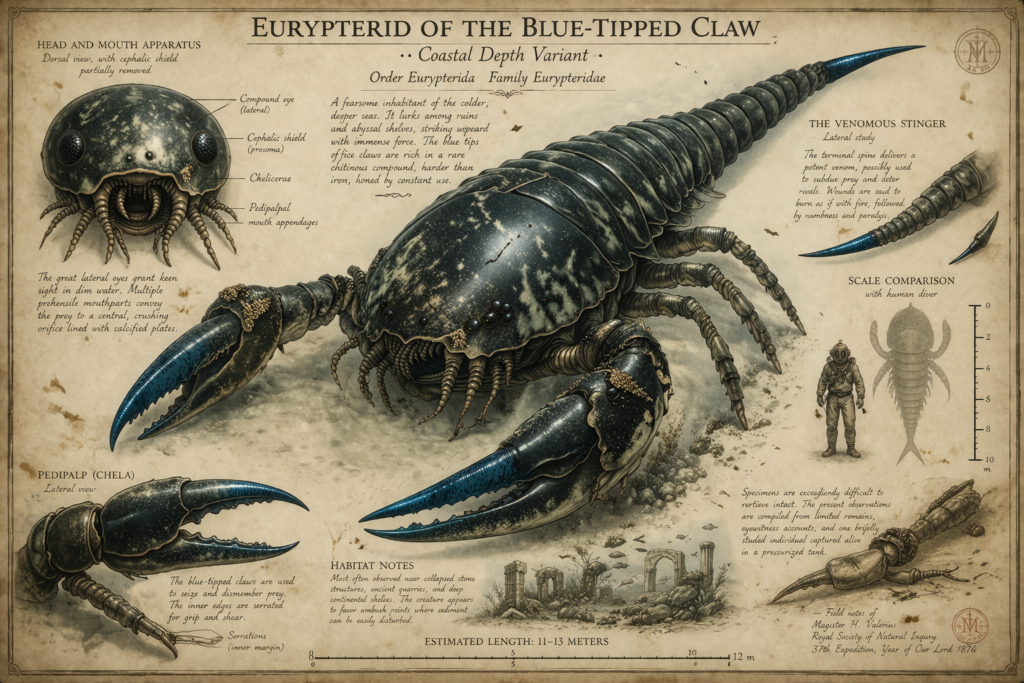
Two large azure-colored pincers grasp at the air before this sleek creature, while a finned tail bristling with a long, thin blue-colored stinger rises from behind.
Known to some as sea scorpions, eurypterids are aquatic crustaceans that blur the line between their terrestrial cousins and lobsters. Primeval and voracious, these vermin range in size from relatively harmless ochre eurypterids the size of a dog up to the truly immense spitting eurypterids.
There are even rumors of yet larger beasts, called whale eating eurypterids by sailors. Regardless of their size, all share one thing in common—an aggressive attitude. Eurypterids lash out at anything that might be food, and once they’ve tasted prey, are single-minded in their pursuit. Although quite at home in the open sea, most eurypterids are capable of scuttling around on land and can exist out of water indefinitely.
Unlike rats, eurypterids don’t spread disease or cause much damage to most cargos—traits that have led some captains to experiment with seeding colonies of ochre eurypterids in their holds to keep rodent populations under control. Alas, one can often tell the ships that use this tactic by the unusually high number of crewmen with missing fingers.
Bluetip Eurypterid CR 5
XP 1,600
N Large vermin (aquatic)
Init +7; Senses low-light vision, tremorsense 30 ft.; Perception +1
DEFENSE
AC 19, touch 12, flat-footed 16 (+3 Dex, +7 natural, –1 size)
hp 52 (7d8+21)
Fort +8, Ref +7, Will +3
Immune mind-affecting effects
OFFENSE
Speed 20 ft., swim 60 ft.
Melee 2 claws +8 (1d6+4), sting +8 (1d4+4 plus poison)
Space 10 ft.; Reach 10 ft. (15 ft. with sting)
Special Attacks pounce
STATISTICS
Str 18, Dex 17, Con 16, Int —, Wis 13, Cha 2
Base Atk +5; CMB +10; CMD 23
Feats Improved InitiativeB, Lightning ReflexesB
Skills Swim +12
SQ amphibious
SPECIAL ABILITIES
Poison (Ex)
Sting—injury; save Fort DC 16; frequency 1/round for 6 rounds; effect 1d4 Con; cure 2 consecutive saves.
ECOLOGY
Environment temperate or warm ocean
Organization solitary
Treasure none
Section 15: Copyright Notice
Pathfinder Adventure Path #37: Souls for Smuggler’s Shiv. © 2010, Paizo Publishing, LLC; Author: James Jacobs.
Bluetip Eurypterid, the Dread Sea Scorpion
Large monstrosity, unaligned
Armor Class 16 (natural armor)
Hit Points 95 (10d10 + 40)
Speed 30 ft., swim 60 ft.
| STR | DEX | CON | INT | WIS | CHA |
|---|---|---|---|---|---|
| 18 (+4) | 14 (+2) | 18 (+4) | 2 (-4) | 12 (+1) | 3 (-4) |
Saving Throws Dex +5, Con +7
Skills Perception +4, Stealth +5
Senses darkvision 60 ft., tremorsense 30 ft., passive Perception 14
Languages —
Challenge 5 (1,800 XP)
Proficiency Bonus +3
Traits
Amphibious. The bluetip eurypterid can breathe air and water.
Ambush Hunter. The bluetip eurypterid has advantage on attack rolls against any creature that has not yet taken a turn in combat.
Pounce. If the bluetip eurypterid moves at least 20 feet straight toward a creature and then hits it with a claw attack on the same turn, that target must succeed on a DC 15 Strength saving throw or be knocked prone. If the target is prone, the eurypterid can make one sting attack against it as a bonus action.
Actions
Multiattack. The bluetip eurypterid makes three attacks: two with its claws and one with its sting.
Claw. Melee Weapon Attack: +7 to hit, reach 10 ft., one target. Hit: 11 (2d6 + 4) bludgeoning damage, and the target is grappled (escape DC 15). The eurypterid has two claws, each of which can grapple only one target.
Sting. Melee Weapon Attack: +7 to hit, reach 10 ft., one creature. Hit: 9 (1d10 + 4) piercing damage, and the target must succeed on a DC 15 Constitution saving throw or be poisoned for 1 minute. While poisoned in this way, the target is also paralyzed. The target can repeat the saving throw at the end of each of its turns, ending the effect on itself on a success.
Bonus Actions
Drag Below. The bluetip eurypterid moves up to half its swim speed, dragging one creature grappled by it.
Tactics
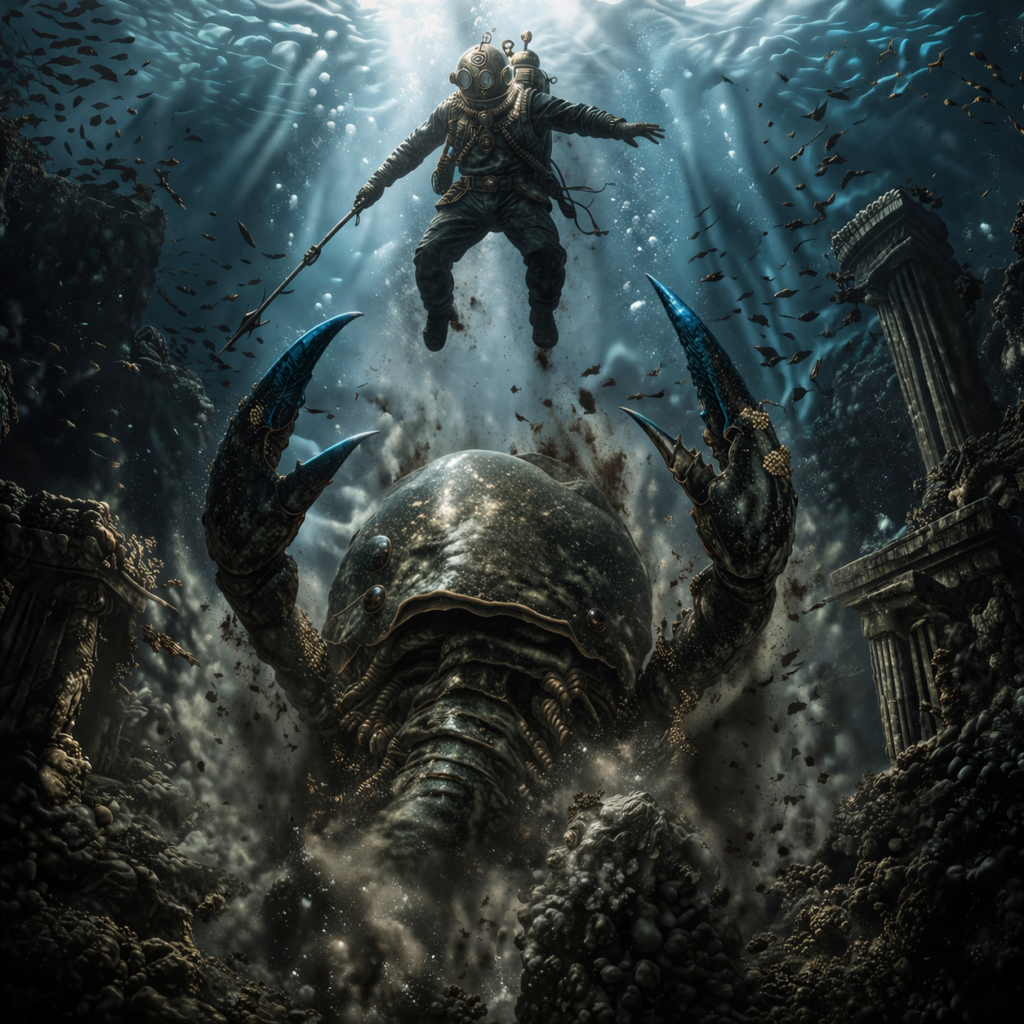
The Bluetip Eurypterid waits in cover, strikes first, and tries to end the fight immediately. It prefers to attack from concealment, knock prey prone with its rush, seize with the claws, and follow with the sting before the target can recover. If it successfully paralyzes a victim, it drags the body into deeper water, reef-shadow, wreckage, or the mouth of a crevice. In narrow underwater terrain, it becomes far more dangerous, because its reach, grapple, and venom combine with the environment to trap prey in place.
Treasure
A Bluetip Eurypterid does not hoard wealth intentionally, but its lairs often contain the remains of drowned divers, wreck scavengers, and prey dragged into reef cracks or wreck interiors. A typical lair contains 400–1,800 gp in mixed coinage, coral-fouled weapons, damaged jewelry, 1d4 pearls worth 100 gp each, and a 20% chance of one useful magic item lost with a body or sunken cache.
Use in Play
The Bluetip Eurypterid works best as a close-quarters aquatic ambush predator, not as a generic giant scorpion with a swim speed. It excels in:
- reef dives
- wreck exploration
- flooded caverns
- submerged ruins
- tide caves
- coastal smuggling routes
- retrieval missions in broken underwater terrain
Its strongest encounters are built around constrained space, limited sightlines, unstable footing, water pressure, and the knowledge that one successful grab may be enough to decide the fight. Used well, it does not merely threaten hit points. It changes how players regard underwater movement, dark cover, and every patch of still water around a wreck.
Keep this reference growing
If this page helped with your reading or game, you can support its upkeep or explore the curated books.
Explore the Bookshop — epics, classics and stories behind imagined worlds.