
Spinosaurus — The River’s Long Shadow
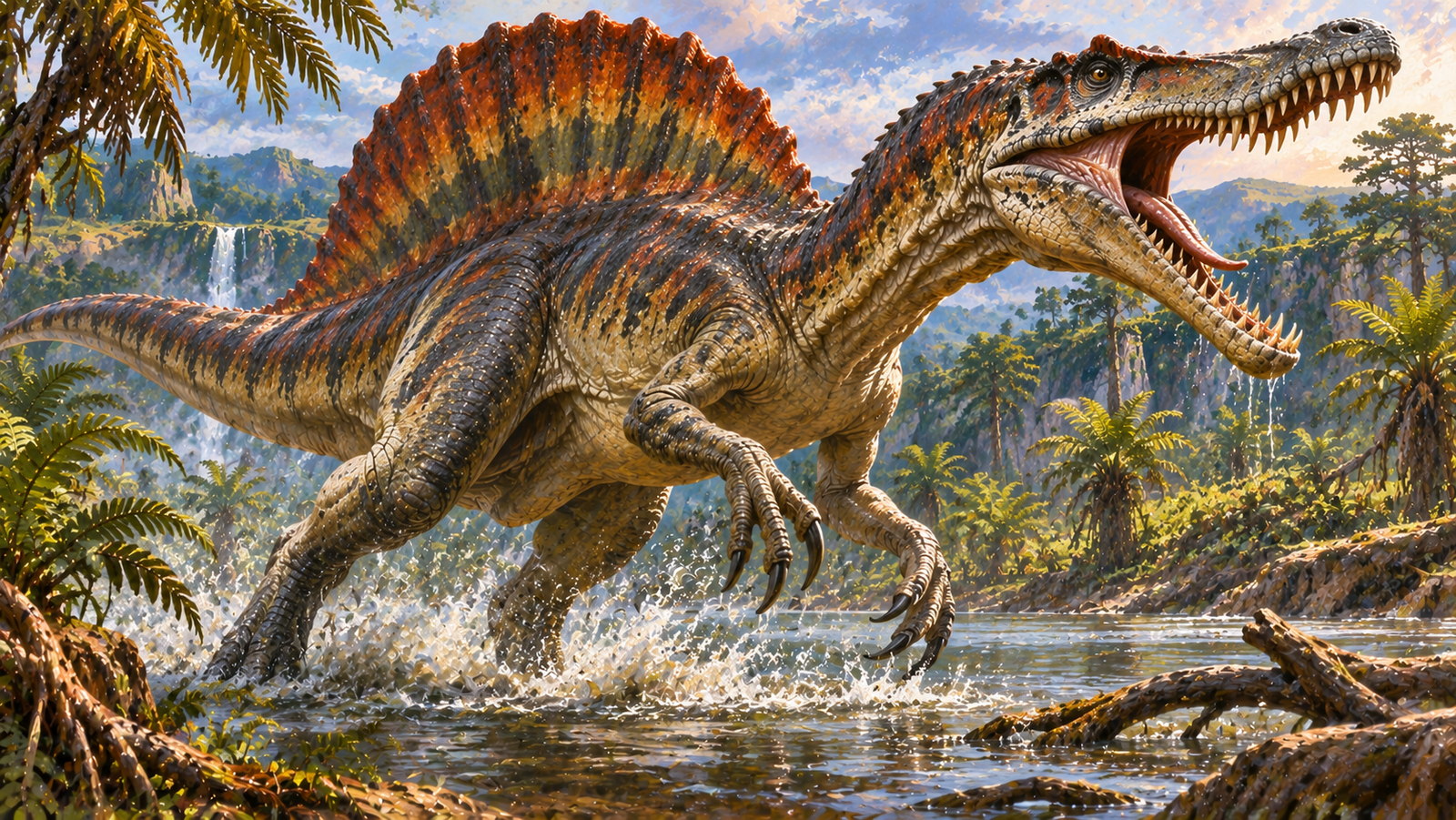
The fishing village has gone silent. Something vast has left a trough across the mudflats, and broken fish traps lie scattered among the reeds. Beyond the last pier, a high, ribbed sail moves through the morning mist as the river’s hunter enters the channel.
At a Glance
| Nature | Enormous sail-backed carnivorous dinosaur |
|---|---|
| Alignment | Unaligned or neutral; territorial and drawn to abundant prey |
| Habitat | Warm rivers, marshes, deltas, shallow channels and floodplains |
| Behaviour | Fishes along river margins, pursues prey in shallow water and may retreat into deep channels |
| Danger | Long jaws, powerful claws and a sudden strike from the bank |
| Campaign range | Isolated Cretaceous refuges of the Old-Earth Wilds and neighbouring river systems |
The River’s Hunter
In the great southern wetlands, the spinosaurus belongs as much to the riverbank as to the forest beyond it. The animal’s high, ribbed sail is visible when the reeds fall away, but its long, narrow jaws and heavy forelimbs reveal a hunter quite unlike the tyrannosaurs of the dry plains. Its teeth are adapted to gripping slippery prey. Fish are plentiful in its waters, and the animal follows their movements between shallow pools, channels and the edge of the main river.
At dawn, a traveller may find fish traps broken from their poles and the mud raked by long claws. Deep footprints lead towards the water, where the tracks end abruptly. The animal can vanish behind a bank of papyrus or a stand of river reeds even when the sail is taller than a man. The warning comes from the river itself: shoals scatter, water birds lift suddenly from the shallows and a broad wake crosses the current against the wind.
Spinosaurus seldom wastes its strength chasing a healthy mounted company over dry ground when the channels hold easier food. It can, however, be fiercely dangerous at a crossing, a fish-rich pool or a favoured basking place. An intruder who blocks its retreat to deep water may provoke a violent response. A hungry animal may take advantage of livestock brought to drink at dusk, or seize a struggling creature that has fallen from a boat.
Waterside Territory
A spinosaurus moves along an extended river system rather than occupying a neat lair. The same sandbar may show its tracks for several successive mornings, while a flooded forest upstream remains empty until the fish arrive. Favoured banks are marked by crushed vegetation and grooves cut into wet earth. An abandoned fishery near such a place is not necessarily deserted because of raiders; its owners may have learned to leave the water to the larger hunter.
Boatmen watch the river level as carefully as they watch for predators. In a flooded channel the animal can approach from many directions. During dry weather, rocky shallows may prevent it from following a small boat. Neither safety nor danger depends solely on its height above the reeds.
Conduct in Battle
When hunting from the water, the spinosaurus closes on its target before revealing its full bulk. It tries to seize prey at the edge of the channel, where a creature that loses its footing can be dragged into deeper water. Its formidable claws can drive off a rival at close range, but it is not a tireless engine of destruction. If injured and allowed an open route back to its pool, it may withdraw rather than pursue.
Let the party’s preparation matter. A lookout on high ground sees the moving sail before those in the boat. A boatman who understands the current can keep the vessel above shallows, while a frightened horse tied beside the water may turn a manageable crossing into disaster. In these marshes the river is part of the encounter, not a painted backdrop.
Spinosaurus Statistics
Spinosaurus — D&D 2024
Gargantuan Beast, Unaligned
AC 16 (Natural Armor) Initiative +1 (11)
HP 246 (17d20 + 68)
Speed 30 ft., Swim 40 ft.
| Ability | Score | Mod. | Save |
|---|---|---|---|
| STR | 25 | +7 | +7 |
| DEX | 12 | +1 | +1 |
| CON | 19 | +4 | +4 |
| INT | 2 | −4 | −4 |
| WIS | 14 | +2 | +2 |
| CHA | 8 | −1 | −1 |
Skills Perception +6, Stealth +5 (in water)
Senses Passive Perception 16
Languages None
CR 12 (XP 8,400; PB +4)
Traits
Hold Breath. The Spinosaurus can hold its breath for 30 minutes.
Shallow-Water Ambush. The Spinosaurus has Advantage on Dexterity (Stealth) checks while at least half its body is submerged in water.
Actions
Multiattack. The Spinosaurus makes one Bite attack and two Claw attacks.
Bite. Melee Attack Roll: +11, reach 15 ft. Hit: 29 (4d10 + 7) Piercing damage. If the target is Huge or smaller, it has the Grappled condition (escape DC 19). The Spinosaurus can grapple one creature in its jaws at a time.
Claw. Melee Attack Roll: +11, reach 10 ft. Hit: 20 (3d8 + 7) Slashing damage.
Bonus Actions
Drag Into the Channel. The Spinosaurus moves up to half its Swim Speed while holding a creature Grappled in its jaws, carrying the creature with it. This movement cannot pass through solid obstacles or water too shallow to accommodate the creature.
Spinosaurus — D&D 2014
Gargantuan beast, unaligned
Armor Class 15 (natural armor)
Hit Points 231 (14d20 + 84)
Speed 40 ft., swim 40 ft.
| STR | DEX | CON | INT | WIS | CHA |
|---|---|---|---|---|---|
| 27 (+8) | 9 (−1) | 22 (+6) | 2 (−4) | 11 (+0) | 10 (+0) |
Skills Perception +5
Senses passive Perception 15
Languages —
Challenge 13 (10,000 XP)
Traits
Hold Breath. The Spinosaurus can hold its breath for 30 minutes.
Siege Monster. The Spinosaurus deals double damage to objects and structures.
Actions
Multiattack. The Spinosaurus makes one bite attack and two claw attacks.
Bite. Melee Weapon Attack: +13 to hit, reach 15 ft., one target. Hit: 34 (4d12 + 8) piercing damage. A Large or smaller target is grappled (escape DC 18). The creature moves with the Spinosaurus until the grapple ends, and the Spinosaurus can’t bite another target while holding it.
Claw. Melee Weapon Attack: +13 to hit, reach 10 ft., one target. Hit: 22 (4d6 + 8) slashing damage.
Tail. Melee Weapon Attack: +13 to hit, reach 20 ft., one target. Hit: 21 (3d8 + 8) bludgeoning damage.
Optional Variant: River-Trained Spinosaurus
The great river kingdoms sometimes rear captured hatchlings as war-beasts. A trained specimen recognises its handlers and can carry riders, but this is learned behaviour, not an instinctive loyalty shared by the species. Use the normal adult statistics for a war-trained creature.
Optional Variant: Young Spinosaurus
Huge beast, unaligned. AC 14; HP 105 (10d12 + 40); Speed 40 ft., swim 30 ft.; STR 23 (+6), DEX 11 (+0), CON 19 (+4), INT 2 (−4), WIS 11 (+0), CHA 8 (−1); Skills Perception +3; Senses passive Perception 13; Languages —; CR 5 (1,800 XP). Multiattack. One Bite and two Claws. Bite. +9 to hit, reach 10 ft., 25 (3d12 + 6) piercing damage; Medium or smaller targets are grappled (escape DC 16). Claw. +9 to hit, reach 5 ft., 13 (2d6 + 6) slashing damage.
Spinosaurus — Pathfinder 1e
Spinosaurus CR 16 (XP 76,800)
N Gargantuan animal
Init +0; Senses low-light vision, scent; Perception +18
Defense
AC 26, touch 6, flat-footed 26 (−4 size, +20 natural)
hp 228 (24d8 + 120)
Fort +21, Ref +16, Will +10
Offense
Speed 40 ft., swim 40 ft.
Melee bite +24 (2d8+13 plus grab), 2 claws +18 (2d6+4)
Space 20 ft.; Reach 15 ft.
Special Attacks grab, swallow whole (2d8+13 damage, AC 18, 23 hp)
Statistics
Str 29, Dex 11, Con 21, Int 2, Wis 11, Cha 12
Base Atk +18; CMB +31 (+35 grapple); CMD 41
Feats Alertness, Diehard, Endurance, Great Fortitude, Iron Will, Lightning Reflexes, Power Attack, Skill Focus (Perception), Stealthy, Toughness, Track, Weapon Focus (bite)
Skills Perception +18, Stealth −10, Swim +21
Ecology
Environment warm marshes and river basins
Organization solitary, pair or family (2–5)
Treasure none
Special Abilities
Hold Breath (Ex). The creature can hold its breath for 35 rounds before beginning to risk suffocation.
Grab (Ex). A successful bite allows a grapple attempt against an appropriately sized creature without provoking an attack of opportunity.
Swallow Whole (Ex). A grappled creature can be swallowed according to the normal rule and may cut free by dealing 23 damage to internal AC 18.
Spinosaurus — D&D 3.5e
Gargantuan Animal (Neutral)
Hit Dice 24d8+120 (228 hp)
Initiative +0
Speed 40 ft. (8 squares), swim 40 ft.
Armor Class 13 (−4 size, +7 natural), touch 6, flat-footed 13
Base Attack/Grapple +18/+39
Attack bite +23 melee (2d8+9)
Full Attack bite +23 melee (2d8+9) and 2 claws +18 melee (2d6+4)
Space/Reach 20 ft./15 ft.
Special Attacks improved grab, swallow whole
Special Qualities low-light vision, hold breath, scent
Saves Fort +21, Ref +16, Will +10
Abilities Str 29, Dex 11, Con 21, Int 2, Wis 11, Cha 12
Skills Hide −10, Listen +7, Move Silently +2, Spot +7, Survival +4, Swim +17
Feats Alertness, Diehard, Endurance, Great Fortitude, Iron Will, Lightning Reflexes, Power Attack, Stealthy, Track
Environment warm marshes
Organization solitary, pair, or family (2–5)
Challenge Rating 16
Treasure none
Alignment always neutral
Advancement 25–48 HD (Gargantuan); 49–72 HD (Colossal)
Improved Grab (Ex). If its bite hits a suitable creature, the Spinosaurus may make a grapple attempt without provoking an attack of opportunity.
Swallow Whole (Ex). A creature caught in its jaws can be swallowed according to the standard rules. The original community entry presents the feature without full internal damage and escape statistics; use the applicable edition’s swallow-whole procedure when adjudicating it.
Hold Breath (Ex). The Spinosaurus can hold its breath for 35 rounds before beginning to suffocate.
Encounter: The Flooded Causeway
An old stone road crosses a broad marsh above the main river. Floodwater has covered the lower paving; in the middle of the crossing, an arch has collapsed into a deep channel. The local reed-cutters refuse to pass it. Their nets hang empty on their poles, and a heavy wake travels slowly behind the half-submerged stones. A spinosaurus has taken to fishing in the gap.
First warning. The approach is scattered with snapped wooden fish stakes, wet footprints pressed deep into silt and a wide drag mark across a mud shelf. Water birds rise from the near bank while those on the far side stay quiet. A lookout may glimpse the sail above the reed tops before the animal moves.
The crossing. The causeway is broad enough for two people abreast where the stones remain intact, but narrow above the collapsed arch. Shallow pools border the northern approach; the southern side drops into the old river channel. A stout rope can be fixed between the standing arches, yet raising it requires someone to approach the water.
Choices. The party may wait for the fish run to move the animal downstream, cross by the shallow northern pools, or distract it with a separate line of splashing bait while the others pass. None of these routes requires killing the dinosaur. The short route directly across the arch is fastest but places every traveller within reach of the channel.
Escalation. A frightened pack beast plunges from the stones, dragging its load towards the deep water. The spinosaurus responds to the commotion and rises from the bank. Those who rescue the animal while holding the rope may clear the causeway before the predator closes; those who flee without their equipment leave a cargo trail in the marsh for scavengers.
Aftermath. The spinosaurus abandons the crossing once its hunting ground is quiet. It does not follow travellers into dry upland forest. The reed-cutters, however, remember whether the party preserved their nets and boats or destroyed the banks to escape.
Adventure hook. A bronze tablet exposed beneath the collapsed arch bears the seal of a forgotten river city. Its inscription names an entrance to the drowned catacombs, but the second half of the tablet lies beneath the predator’s favoured fishing shelf.
Sources and Credits
The original community D&D 3.5e Spinosaurus entry was attributed to Raptorial on the Wizards Community forums. Earlier modern rules included a specially trained river-war-beast variant; that material remains a campaign option rather than a universal biological trait. Scientific interpretations of Spinosaurus aquatic locomotion continue to be debated. The encounter descriptions concern the isolated river populations of the Inner World.
Keep this reference growing
If this page helped with your reading or game, you can support its upkeep or explore the curated books.
Explore the Bookshop — epics, classics and stories behind imagined worlds.