
Lynx — The Silent Mountain Hunter
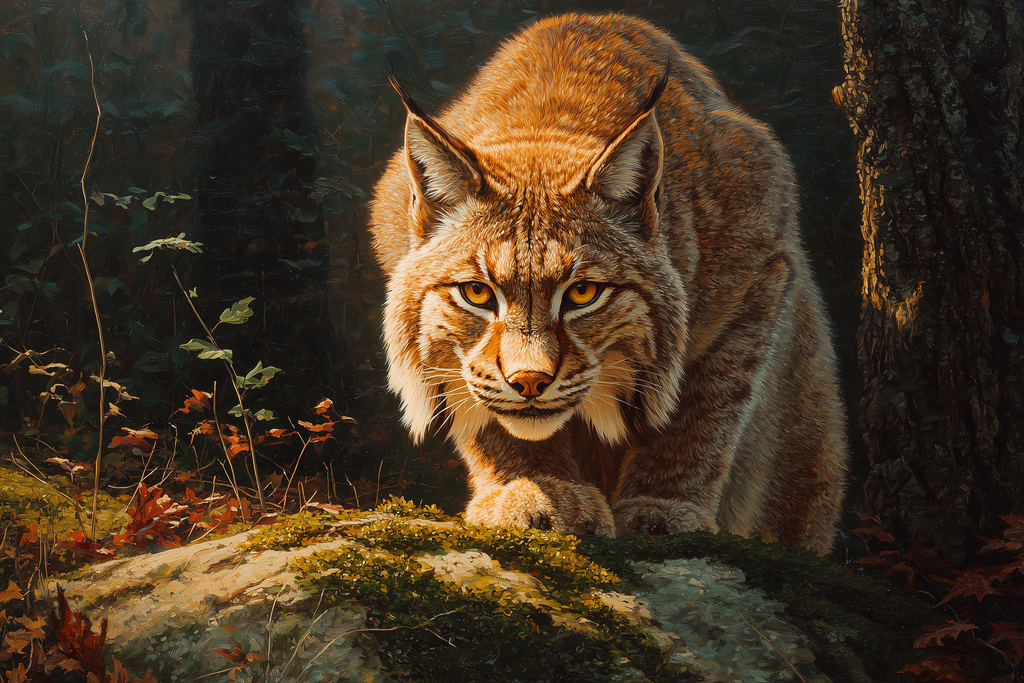
The hare’s tracks end suddenly beneath a wind-fallen pine. There are broad pawprints in the snow and a tufted ear glimpsed beneath the boughs. A lynx has hunted here, and a tracker who knows its ways may avoid disturbing the cat’s shelter.
At a Glance
- Identity: Lynx, a solitary tuft-eared wildcat; the Eurasian lynx (Lynx lynx) is one of several closely related species
- Build: Muscular, long-legged feline with a short black-tipped tail, tufted ears and broad furry paws
- Range: Wooded and mountainous regions of Europe and northern Asia; other lynx species live in North America
- Habitat: Northern forest, scrub, rocky hills and broken mountain woods with good cover and prey
- Behaviour: Usually hunts alone by stalking and short pursuit; avoids people when escape is possible
- Signs: Broad round tracks, scat, scratched trees, concealed prey remains and short-tailed shapes at the woodland edge
- Encounter role: Elusive hunter, warning of changing prey populations, injured animal or obstacle near a den
- Threat: Claws and bite in close quarters, especially when a cornered cat cannot withdraw
Game Statistics
The 2024, 2014 and 3.5e editions use separate original Lynx conversions. The Pathfinder 1e panel preserves third-party Tome of Horrors Complete material and is identified accordingly.
Lynx — CR 1
Medium Beast, Unaligned
AC 13 (natural agility) · Initiative +3 (13) · HP 30 (6d8 + 6) · Speed 40 ft., Climb 20 ft.
| STR | DEX | CON | INT | WIS | CHA |
|---|---|---|---|---|---|
| 12 (+1) | 16 (+3) | 12 (+1) | 3 (−4) | 14 (+2) | 6 (−2) |
Saving Throws Dex +5, Wis +4
Skills Perception +4, Stealth +5
Senses Darkvision 60 ft.; Passive Perception 14
Languages None
CR 1 (200 XP; PB +2)
Traits
Silent Stalker. The lynx can take the Hide action as a Bonus Action while Lightly Obscured by natural vegetation.
Swift Strike. The lynx uses Dexterity for its Bite and Claws attack rolls and damage.
Actions
Multiattack. The lynx makes one Bite and one Claws attack.
Bite. Melee Attack Roll: +5, reach 5 ft. Hit: 7 (1d8 + 3) Piercing damage.
Claws. Melee Attack Roll: +5, reach 5 ft. Hit: 6 (1d6 + 3) Slashing damage.
Original D&D 2024 Lynx conversion based on the site’s earlier homebrew and SRD 5.2.1 conventions. Not an official published Lynx.
Lynx — CR 1
Medium beast, unaligned
Armor Class 13 (natural armor)
Hit Points 30 (6d8 + 6)
Speed 40 ft., climb 20 ft.
| STR | DEX | CON | INT | WIS | CHA |
|---|---|---|---|---|---|
| 12 (+1) | 16 (+3) | 12 (+1) | 3 (−4) | 14 (+2) | 6 (−2) |
Saving Throws Dex +5, Wis +4
Skills Perception +4, Stealth +5
Senses passive Perception 14
Languages —
Challenge 1 (200 XP)
Traits
Keen Smell. The lynx has advantage on Wisdom (Perception) checks that rely on smell.
Swift Strike. The lynx uses Dexterity for its Bite and Claws attack rolls and damage.
Pounce. If the lynx moves at least 20 feet straight toward a creature and hits it with a Claws attack on the same turn, that creature must make a DC 12 Strength saving throw or be knocked prone. If the target is prone, the lynx can make one Bite attack against it as a bonus action.
Actions
Multiattack. The lynx makes one Bite attack and one Claws attack.
Bite. Melee Weapon Attack: +5 to hit, reach 5 ft., one target. Hit: 7 (1d8 + 3) piercing damage.
Claws. Melee Weapon Attack: +5 to hit, reach 5 ft., one target. Hit: 6 (1d6 + 3) slashing damage.
Original D&D 2014 Lynx adaptation, not a published SRD 5.1 creature. The Pounce trait belongs to this edition’s conversion and is not part of the 2024 panel above.
Lynx — CR 2
XP 600 · N Small animal
Init +2; Senses low-light vision, scent; Perception +9
Defense
AC 14, touch 13, flat-footed 12 (+2 Dex, +1 natural, +1 size)
hp 13 (2d8 + 4)
Fort +5, Ref +5, Will +1
Offense
Speed 40 ft., climb 20 ft.
Melee two claws +4 (1d3 + 2 plus grab), bite +4 (1d4 + 2)
Special Attacks pounce, rake (two claws +4, 1d3 + 2)
Space/Reach 5 ft./5 ft.
| STR | DEX | CON | INT | WIS | CHA |
|---|---|---|---|---|---|
| 15 | 15 | 15 | 2 | 12 | 6 |
Base Atk +1; CMB +2 (+6 grapple); CMD 14 (18 vs. trip)
Feat Skill Focus (Perception)
Skills Acrobatics +10, Climb +10, Perception +9, Stealth +10 (+14 in heavy undergrowth or tall grass)
Racial Modifiers +8 Acrobatics, +4 Stealth (+8 in heavy undergrowth or tall grass)
Ecology
Environment Cold forests, hills, mountains and plains
Organisation solitary, pair or den (one or two adults with one to six cubs)
Treasure none
Tome of Horrors Complete (2011), Lynx; Necromancer Games / Frog God Games, Scott Greene, under its applicable OGL. Retained legacy third-party statistics; not an official Paizo Bestiary Lynx. Review grapple arithmetic before using the more elaborate legacy attacks.
Lynx — CR 1
Small Animal, Always neutral
Hit Dice 2d8 + 4 (13 hp)
Initiative +2
Speed 40 ft. (8 squares), climb 20 ft.
Armor Class 14 (+1 size, +2 Dex, +1 natural), touch 13, flat-footed 12
Base Attack/Grapple +1/−1
Attack claw +4 melee (1d3 + 2)
Full Attack two claws +4 melee (1d3 + 2) and bite −1 melee (1d4 + 1)
Space/Reach 5 ft./5 ft.
Special Qualities low-light vision, scent
Saves Fort +5, Ref +5, Will +1
| STR | DEX | CON | INT | WIS | CHA |
|---|---|---|---|---|---|
| 15 | 15 | 15 | 2 | 12 | 6 |
Skills Hide +10, Listen +4, Move Silently +6, Spot +4, Climb +10
Feat Weapon Finesse
Environment Cold forest and wooded hills
Organisation solitary or pair
Treasure none
Combat
The lynx stalks and strikes small prey but withdraws from a determined larger threat. The attacks above are normal natural attacks under D&D 3.5e rather than Pathfinder’s grab, pounce and rake options.
Original D&D 3.5e Lynx conversion using 3.5e Animal and natural-attack rules. The Pathfinder 1e Tome of Horrors statistics are not silently imported into this edition.
The Lynx in the Wild
A lynx crosses a glade where the snow has a crust hard enough to bear its broad feet. Its short tail flicks once, then the cat disappears into a stand of fir. The tracks tell the hunter more than the fleeting glimpse: it has paused beside a rock, turned towards a small animal’s burrow and travelled on alone. It is a secretive predator whose presence depends on cover and prey rather than a hunger for human blood.
Several species share the name lynx. The Eurasian lynx ranges across northern and mountain forests, while the Canada lynx, bobcat and Iberian lynx belong to other countries and ecological circumstances. A heavy Eurasian lynx may take deer or other prey large enough to feed it over several visits. Smaller lynx species may depend strongly on hares, rabbits and rodents. Do not assume a single size, weight and hunting range for all of them.
Forest, Stone and Snow
Broad, furred paws help a lynx travel through snow. Tufted ears and a bobbed tail distinguish it from a Wildcat, while its winter coat conceals it among pale trunks and broken rock. Lynxes favour broken woodland and places where they can approach prey unseen; their movements can follow the change of seasons and the availability of hares, deer or other prey.
In the north of Europe, travellers might find signs beside a reindeer path or mountain forest. A lynx in the wooded approaches to the Alps may use rock ledges and fir cover to stalk prey. These are animals of particular habitats; they are not ordinary visitors to every desert, city or tropical riverbank.
Alone and With Young
Adults are usually solitary except when breeding or rearing young. A mother may move kittens to a quieter den if disturbed, and a cat near a fresh kill may remain close to protect its next meal. No strict wolf-style pack order governs the animals; a second lynx appearing in the same scene requires a reason such as a breeding pair, a dependent youngster or shared attraction to prey.
People may know the lynx through tracks long before they see one. Foresters blame a cat for the loss of game; hunters prize an undamaged hide; herders worry about small stock left near the woods. Such fears can become quarrels even when an animal has taken no livestock at all.
Signs Before the Encounter
A wide round print without an obvious claw impression is not necessarily a domestic cat’s. In snow, the spacing of tracks and the depth of the trail can reveal a larger animal moving with steady purpose. A hare’s tracks ending near a disturbed patch of powder may mark a successful ambush. A carcass hidden beneath branches or leaves may be a food cache, not the work of an undead creature.
A traveller using Perception may notice movement above a stone wall, a dark ear tuft between fir boughs or an abrupt disturbance in a flock of birds. A competent tracker using Survival can follow the cat without walking straight into a den or a concealed carcass. Reward careful observations with meaningful choices of route and distance.
A lynx crouching at the edge of cover usually seeks to remain unseen. A hiss, swat or refusal to retreat may signal that it is trapped or protecting young. Players ought to know where the animal can escape, and whether a dog or person is blocking that route, before the scene turns into a fight.
Running the Lynx
What It Wants
Prey, shelter, safety and undisturbed care of young. The cat has no reason to attack an armoured company passing far from a den. An animal caught at close range may strike with claws and bite to make room for an escape.
If Violence Starts
Use the selected edition’s rules panel. A lynx is a patient ambush hunter, capable of striking quickly at smaller prey and withdrawing when outmatched. The Pathfinder 1e legacy version has much stronger grappling and raking abilities than the original 3.5e conversion. They are not cumulative. It is a mistake to describe every lynx as a supernatural spectre merely because travellers seldom see one.
Counterplay and Morale
Notice the tracks, give a den or cached carcass space, keep dogs from chasing an animal into a narrow ravine, and retreat from a cornered cat. An arrow aimed at a concealed animal may drive it towards the party’s own horses. A guide who knows the forest can often take a safer route or let the predator cross the path before the convoy moves.
Consequences
Killing a lynx near its den may leave young animals helpless; merely driving it from prey can change where it hunts. A party that shows a forester how to protect a poultry pen may prevent a pointless bounty hunt and gain a useful ally for the next journey.
Encounters and Adventure Hooks
The Snowbound Snare
Forester Astrid finds the prints of a lynx beside a line of snares. One trap holds a wounded cat, and Astrid’s employer wants the pelt before dawn. The party can cut the snare, distract the animal while a healer helps, examine who laid traps across a public path or refuse the job. A living lynx is unlikely to become tame, but Astrid may remember the characters who prevented a needless death.
The Missing Goat of the Pass
Herdsman Jarek claims a lynx carried a valuable young goat into the pines. A party of hunters prepares to drive the animal from its den. Prints at the gate show a goat leaving with the rest of the herd before the alarm was raised. The party can track the missing animal, inspect the fence or negotiate time for a careful search. The goat is stranded on a ledge; a rash hunt will not bring it back.
The Hare Trails
A winter caravan discovers that the hares have vanished from a familiar stretch of woodland. The driver fears a dangerous predator, while local gatherer Milla knows a lynx has been hunting here for weeks. The party can follow the cat, check the caravan’s food, or take the older road around a frozen marsh. An impatient shortcut risks breaking the ice; patient observation may reveal a safer path the gatherer can use for years.
The Hollow Beyond the Fir Trees
A woodcutter hears a strange cry near his children’s hiding place and believes a fierce spirit has moved into the wood. A female lynx is sheltering kittens in a hollow fallen tree. The party can observe without approaching, arrange for cutting to continue elsewhere, or persuade the children to keep their distance. Destroying the hollow could turn the woodcutters against one another and leave the animals vulnerable.
The Trophy Hunter’s Claim
Sir Oren, a visiting hunter, presents a fine spotted hide and insists he killed the beast that had taken several lambs. The local shepherd does not recognise the hide’s markings and says the losses continued after the hunt. The party can compare signs, question the hunting party or watch the fold at night. Exposing an exaggerated trophy may save the village from more pointless killing and embarrass a proud noble whose favour might otherwise help the characters.
After the Encounter
A lynx has no coin or magic treasure. A skin may be coveted by a trader or wealthy hunter, but that value depends on local custom and scarcity, not on challenge rating. Tracks, a newly identified den, a safer forest path and relationships with foresters may be more useful rewards than any remains.
Rumours and Misread Signs
The ghost on the ridge: A pale cat that vanishes behind snow-covered rock may only be using a hidden ledge.
The creature that buries its victims: Prey hidden beneath brush suggests an animal protecting a later meal, not necessarily a supernatural murderer.
The caracal from the desert: A caravan’s account of a tuft-eared cat in dry country may describe a caracal rather than a Eurasian lynx. They are related but distinct animals.
Related Animals, Places and Rules
Compare the smaller Wildcat, the domestic Cat and the larger Leopard. Ordinary wildlife throughout the setting is found in the Animal Bestiary. The Alps and northern woodlands provide the terrain in which hunting signs matter to travellers.
Use the correct edition’s Survival, Perception, Climb and scent rules where applicable, rather than assuming every cat has the same skills in all editions.
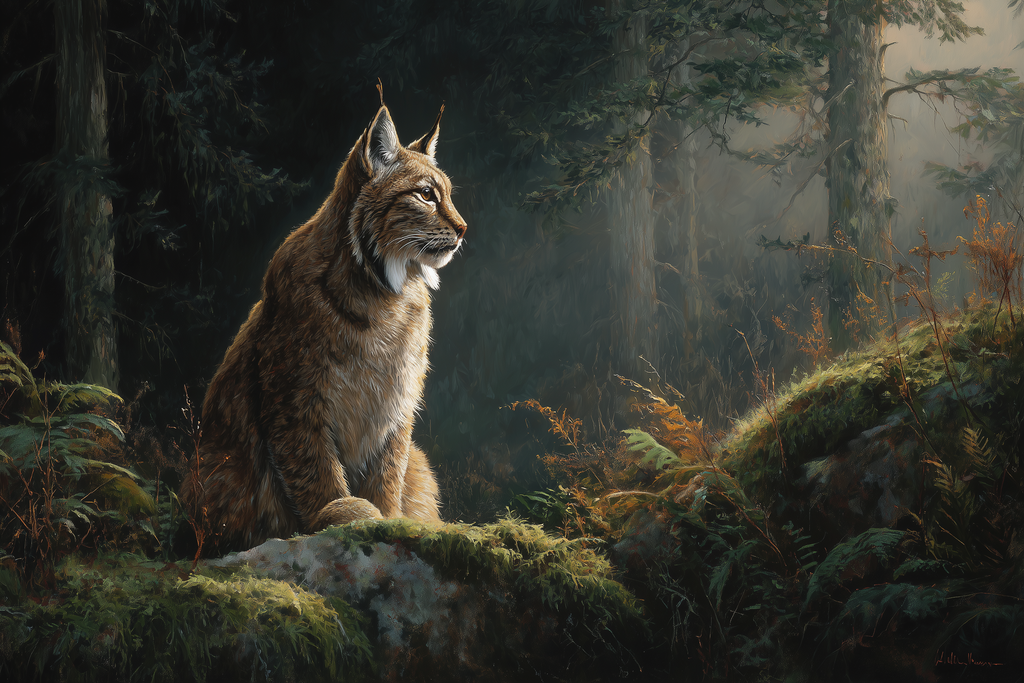
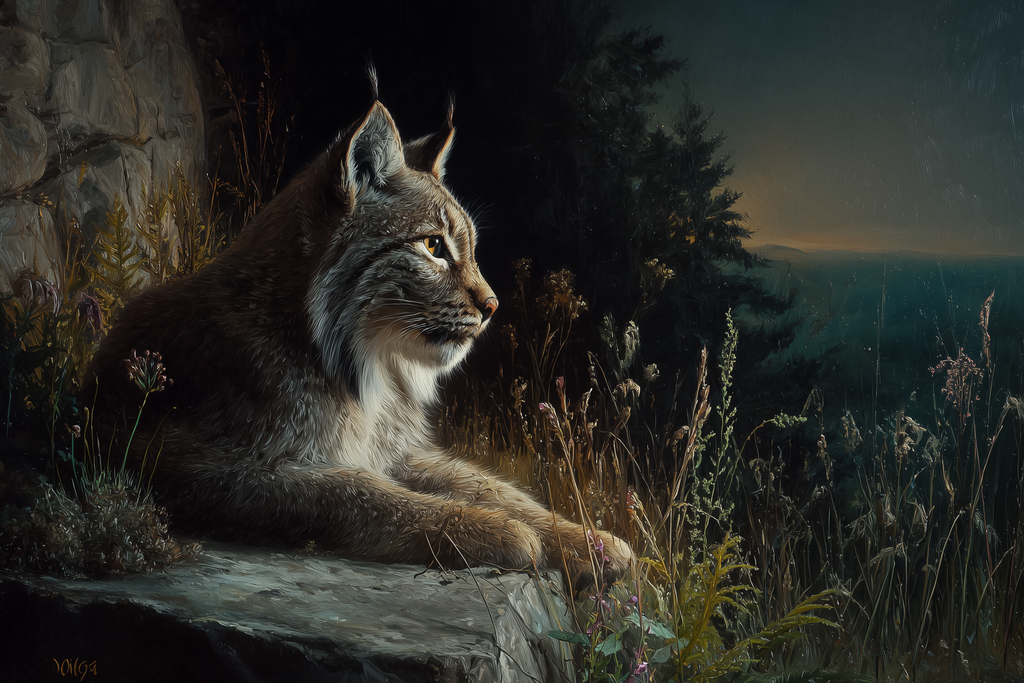
View two more painted lynx studies
Sources and Game Content
The Lynx entry from Tome of Horrors Complete, © 2011 Necromancer Games, Inc.; published and distributed by Frog God Games; author Scott Greene, supplies the Pathfinder 1e legacy mechanics under its licence. The other editions use original conversions informed by D&D SRD 5.2.1 and SRD 5.1 (CC BY 4.0) and the 3.5 SRD (OGL 1.0a), rather than falsely attributing a standalone official Lynx stat block to those references.
The three existing lynx paintings have been retained from this page. Named people, encounters and travel consequences are original campaign material. Lynx species are treated as distinct from the related caracal, whose natural range and habitat should not be conflated with a snow-adapted lynx.
Keep this reference growing
If this page helped with your reading or game, you can support its upkeep or explore the curated books.
Explore the Bookshop — epics, classics and stories behind imagined worlds.