
The British Isles
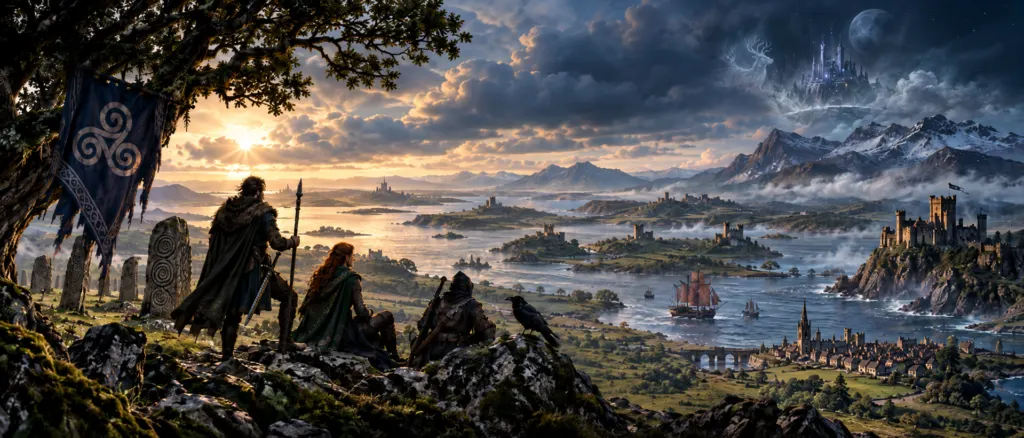
At a Glance
| Type | Geographic campaign region |
|---|---|
| Major Mortal Powers | Kingdom of England; Kingdom of Scotland; Wales under the English Crown; Gaelic and Anglo-Irish lordships throughout Ireland |
| Other Major Powers | Lordship of the Isles; Lordship of Man; elven courts and woodland realms; Otherworld courts; powerful noble houses |
| Northern Isles | Orkney and Shetland remain within the Scandinavian political world |
| Major Centres | London, York, Edinburgh, Dublin, Bristol, Cork and Galway |
| Major Seas | North Sea, English Channel, Irish Sea, North Channel, Celtic Sea and Atlantic Ocean |
| Languages | English, Scots, Scottish Gaelic, Welsh, Cornish, Irish, Manx and Norse; French and Latin remain important in particular courts, law, diplomacy and scholarship. Common does not exist. |
| Magic | Learned natural philosophy, court magic, druidic traditions, divine power, fey magic, standing-stone rites, ley lines and dangerous Otherworld crossings |
| Supernatural Character | Strong fey presence, surviving Arthurian legacies, ancient sacred landscapes, supernatural hunts, haunted waters and regional monsters |
| Campaign Style | Political intrigue, wilderness adventure, outlaw stories, maritime travel, border conflict, monster hunting, exploration and mythic quests |
| Major Dangers | Noble feuds, disputed authority, banditry, piracy, hostile courts, supernatural bargains, monsters, undead, Wild Hunt activity and unstable planar crossings |
A Land Where Every Road Crosses a Border
The British Isles are not one kingdom. They are a dense campaign region of rival crowns, marcher jurisdictions, island lordships, old sacred landscapes and supernatural territories whose borders rarely agree with one another.
A traveller leaving London can ride north through an England in political crisis, pass outlaw-haunted forests and noble estates raising armed retainers, cross a frontier watched by both English and Scottish lords, and eventually arrive at the court of James II. Turn west instead and the road climbs into Wales, where royal castles command valleys in which the memory of rebellion remains fresh and the paths into Annwn are older than either crown.
Sail across the Irish Sea and political certainty disappears almost completely. Ports, Gaelic kingdoms, Anglo-Irish lordships and rival dynasties make their own alliances and wage their own wars.
And the mortal map is only half the map.
Old forests contain realms whose rulers do not answer to mortal kings. Hills open into the Otherworld. Standing stones mark roads that appear only under particular moons. Arthur’s court vanished centuries ago, but Camelot has not simply become a story. The dead remember oaths. Gods still claim sacred ground. The Wild Hunt crosses boundaries that stop armies.
Adventurers come here because nearly every conflict has another conflict beneath it. A dispute over a manor may conceal an elven boundary. A missing heir may have crossed into Faerie. A royal messenger may carry evidence capable of starting a war. A monster hunted through a Welsh valley may turn out to be protected by an ancient compact. A ship bound for Ireland may discover that the quickest route home passes through waters belonging to something older than any human kingdom.
The party goes somewhere, becomes involved in the lives and dangers of the people there, and returns carrying consequences.
That is how adventures spread across the British Isles.
What Is Happening Right Now?
England: A Kingdom Waiting for the First Blow
Henry VI remains King of England, but royal government has entered a dangerous crisis. England has suffered catastrophic territorial losses in France, the king is incapacitated, and Richard, Duke of York, now exercises authority as Protector.
The fighting later remembered as the Wars of the Roses has not yet begun.
That makes the present moment more useful for adventurers.
Nobody knows which argument will become a battle. Great households recruit retainers. Old grievances are reopened. Positions at court matter. Information is valuable. A disputed arrest, intercepted letter, vanished witness or murdered servant can pull a party into national politics long before armies meet at St Albans.
London remains the centre of royal authority, commerce and political rumour, but England is not confined to its court. York is a major northern political and commercial centre. Bristol looks towards the Atlantic. Stonehenge remains an active sacred landscape. Sherwood Forest is a contested region of royal law, outlaw communities and older woodland powers.
And somewhere beneath the trees, Robin Hood is not a dead legend.
He is one of the people currently making trouble.
The Hooded Man operates in Sherwood with his outlaws, opposing oppressive officials and maintaining a particular relationship with Cernunnos and the wild. A party entering Sherwood therefore has to decide whose definition of law it accepts.
Scotland: A King Against Powers Almost as Great as Kings
James II is King of Scots, but kingship does not mean unquestioned control.
The Black Douglases possess enormous estates, fortresses, clients and military power. James murdered William, 8th Earl of Douglas, at Stirling in 1452 after trying to break Douglas’s alliances with other powerful magnates. The confrontation remains unresolved.
Another great power is John of Islay, Lord of the Isles and Earl of Ross. His western maritime lordship commands islands, sea routes and loyalties that make him something more than an ordinary royal subject.
For adventurers, Scotland is therefore not simply Edinburgh surrounded by wilderness. It is a contest between crown, great families, island lords, local powers and supernatural domains.
Elven rulers also exist within the wider British landscape. They do not replace James II as king. Their courts represent another layer of sovereignty: ancient forests, concealed settlements and territories whose borders mortal rulers may recognise, ignore or discover too late.
Edinburgh offers court intrigue and royal commissions. The Borders offer raids, feuds and espionage. The Highlands and western seaways lead towards powers that London or Edinburgh may only imperfectly understand.
Wales: The Conquest Is Over. The Argument Is Not.
Wales lies beneath the authority of the English Crown, but reducing it to a simple English province misses almost everything that makes it interesting.
The medieval conquest left a formidable network of royal strongholds, while marcher jurisdictions, Welsh communities, local dynasties and older identities make authority uneven. Owain Glyndŵr’s rebellion lies only a few decades in the past—close enough for its victories, reprisals and ambitions to remain within living memory.
Some people remember fighting for him. Some remember fighting against him. Some are still hiding what they did.
And unlike the political rebellion, the older Wales was never conquered.
Annwn is real.
Arawn rules an active Welsh Otherworld court. Math fab Mathonwy remains bound to Gwynedd, sovereignty, law and dangerous transformation. Arianrhod, Ceridwen and other Brittonic powers belong to a supernatural landscape in which royal legitimacy, prophecy, poetry and magic can become physically dangerous.
A castle may belong to the English Crown.
The mountain behind it may belong to somebody else.
Ireland: A Hundred Borders on One Island
Ireland is not one English-controlled kingdom.
English royal government is strongest around Dublin and the eastern districts, while Gaelic kingdoms and powerful Anglo-Irish dynasties command much of the island. Connacht, Leinster, Meath, Desmond, Ulster and smaller lordships are not decorative subdivisions. They are adventure territories.
A safe-conduct recognised in Dublin may mean little beyond another lord’s frontier. A merchant who pays one toll may be stopped for another before nightfall. A noble family can possess estates, clients and enemies on both sides of a cultural or political divide.
Cork, Galway, Waterford, Limerick and Dublin connect this fragmented political landscape to the wider seas. Inland roads lead through territories where local rulers, ancestral rights and supernatural claims overlap.
Ireland’s mythic politics are equally divided. The Tuatha Dé Danann, Fomorian powers, fairy-mound rulers, river gods and supernatural kings do not form one obedient divine government. Manannán mac Lir commands Otherworld sea-roads. Midir rules from the fairy mound. The Morrígan concerns herself with war, fate and sovereignty. Lugh, Nuada, Brigid, Goibhniu and the Dagda possess interests of their own.
A mortal dispute over a kingship can therefore attract witnesses who remember much older kings.
The Isles Between Kingdoms
The seas do not divide the British Isles as neatly as a map suggests. They connect them.
The Irish Sea and North Channel carry merchants, mercenaries, envoys, fishermen, raiders, pilgrims to old sacred sites, smugglers and adventurers. Control of a harbour can matter as much as possession of a castle.
The Isle of Man
The Stanley Lordship of Man sits almost in the centre of this maritime world. Its position makes it an ideal campaign crossroads between England, Scotland, Ireland and Wales.
Ships shelter there, information changes hands there, fugitives disappear there and rival powers have reasons to care who controls its harbours. Older Manx supernatural traditions make the island still less politically simple.
The Western Isles
The western islands form the maritime heartland of the Lordship of the Isles.
Power here moves by galley as readily as by road. Sea captains, island strongholds and kinship networks join Scotland to Ulster and the wider Atlantic.
A party accustomed to continental roads may discover that in the west, the person who owns the ships controls the map.
Orkney and Shetland
The Northern Isles are not yet Scottish territory.
Orkney and Shetland remain within the Scandinavian political world. Their politics, language, sea culture and supernatural traditions therefore look north and east as well as south towards Scotland.
These islands are natural bridges into the wider Midgard material of SpiralWorlds.
The Irish Sea
The Irish Sea is a political highway rather than empty water. Dublin, Man, western Britain, Ulster and the western Scottish seaways belong to one overlapping maritime theatre.
A voyage can cross several jurisdictions before the party ever leaves the deck.
Four Ways to Begin a British Isles Campaign
England — The Kingdom Before Civil War
Choose England for court politics, noble rivalry, royal roads, outlaw adventures, haunted forests and the question of whether law and justice still mean the same thing.
Start in London for politics, York for northern power, Nottingham and Sherwood for outlaw adventures, or Bristol for the Atlantic.
Scotland — Crown, Clan and Sea
Choose Scotland for royal intrigue, feuding magnates, mountain journeys, island politics, border conflict and elven or supernatural territories beyond easy royal control.
Start in Edinburgh for the court of James II. Head towards Douglas country for the crown’s struggle with the Black Douglases, west for the Lordship of the Isles, or north towards the Scandinavian edge of the British world.
Wales — Castles at the Gates of Annwn
Choose Wales for rebellion remembered within living memory, marcher politics, prophecy, dangerous landscapes and adventures in which entering the wrong valley can take the party out of the mortal world.
The royal road is watched.
The mountain path may not be.
Ireland — Every Lord Has a Frontier
Choose Ireland for shifting alliances, local courts, rival dynasties, sea voyages, Otherworld politics and journeys in which the party repeatedly leaves one system of law for another.
Dublin provides the strongest English administrative base. Galway, Cork, Waterford and Limerick open maritime routes, while Desmond, Connacht, Leinster, Meath and Ulster provide distinct political theatres.
Places Worth Going
The British Isles already contain a substantial network of locations. This page is the campaign gateway: it gives the Game Master a reason to choose a destination, then sends the adventure into the appropriate regional page.
England
London — Royal government, foreign envoys, merchants, spies, prisons, guild interests and rumours from every other part of the islands.
York — Northern political power, noble households and a natural starting point for the crisis surrounding Richard of York.
Nottinghamshire — Royal authority meets outlaw legend.
Sherwood Forest — Robin Hood, hidden roads, royal forest law and supernatural woodland.
Inglewood Forest — Northern forest country suited to outlawry, forest law, fey encounters and journeys towards the Scottish frontier.
Dartmoor — Open country, isolated settlements, haunted landmarks, ancient remains, strange weather and things that prefer travellers to leave the road.
Bristol — Western trade, shipyards, merchants and voyages into the Atlantic world.
Stonehenge — An ancient mortal-built sacred complex whose ritual significance reaches back thousands of years. SpiralWorlds establishes the site as a place of seasonal gathering, burial, treaty and negotiated sky-law long before the campaign present.
Scotland
Edinburgh — Royal court, political intelligence and a kingdom preparing for another confrontation with the Black Douglases.
Scotland remains comparatively underdeveloped as a SpiralWorlds child-location network. That is a reason to expand it later, not a reason for this parent page to invent destinations that do not yet have proper entries.
Ireland
Dublin — The principal centre of English royal government in Ireland and a natural starting point for diplomacy, trade and journeys beyond its effective authority.
The eastern English districts / developing Pale — Fortified frontier society rather than a boundary enclosing all meaningful civilisation.
Connacht and Galway — Western political networks, Atlantic trade and routes into regions far beyond Dublin’s everyday reach.
Leinster and Meath — Lordships, contested loyalties and the approaches to Dublin.
Desmond — A Gaelicised Anglo-Norman lordship where Geraldine power, crown pressure, local clans and supernatural landscapes create a strong existing campaign region.
Cork, Waterford and Limerick — Major ports through which political, commercial and supernatural trouble can enter from the sea.
Ulster — Northern lordships tied not only to Ireland but across the North Channel towards the Lordship of the Isles.
People Adventurers May Actually Meet
The British Isles contain hundreds of figures from history, legend and literature, but this campaign does not treat every person who ever belonged to a British story as alive in the same year.
The wider NPC collections remain the archive. This page surfaces people who matter to this campaign.
Henry VI
King of England. His incapacity has transformed a royal illness into a political crisis. Access to the king, evidence about his condition, intercepted orders and rival attempts to speak in his name can all become adventures.
Richard, Duke of York
Protector of England and one of the most important political figures in the islands. He does not openly rule as king, but every appointment and command can be judged according to whether it strengthens York or his rivals.
James II of Scotland
A young king determined to prevent his greatest magnates from becoming greater than the Crown. He has already demonstrated that he is willing to use extraordinary violence.
James, 9th Earl of Douglas
Head of the Black Douglases and inheritor of a struggle that is becoming something close to civil war.
John of Islay
Lord of the Isles and Earl of Ross. An island ruler whose fleets, territories and alliances make him indispensable to any serious western Scottish or North Channel campaign.
Robin Hood
The Hooded Man of Sherwood: outlaw, archer, champion of the oppressed and follower of Cernunnos. He can be ally, employer, criminal suspect or obstacle depending upon who sent the party into the forest.
The Sheriff of Nottingham
The office represents royal law in outlaw country. SpiralWorlds’ existing Sheriff material makes the conflict deliberately dangerous enough that a party may enter Sherwood believing either the outlaw or the official is the greater threat.
Arthur
Not King of England. Arthur fell at Camlann in 537 and was carried to Avalon rather than conclusively dying. His importance in the campaign comes from what his absence left behind.
Arawn
Lord of Annwn. A supernatural sovereign whose authority can become more immediate than that of any mortal ruler once a traveller crosses the wrong boundary.
Math fab Mathonwy
Magician-king of Gwynedd and a power concerned with sovereignty, court-law, transformation and dynastic legitimacy.
Continue to: British Isles Characters · Arthurian Characters · Heroes and Villains
Factions and Rival Claims
There is no single British political conflict. Adventurers can become entangled with the English Crown and royal household, Richard of York and his affinity, Lancastrian magnates suspicious of York’s rise, the Scottish Crown, the Black Douglases, the Lordship of the Isles, marcher lords and royal officers in Wales, families carrying memories of Glyndŵr’s rebellion, English administrators centred on Dublin, Gaelic Irish dynasties, powerful Anglo-Irish houses, maritime lords, outlaw communities, elven princes, Faerie courts, the Wild Hunt and the guardians of sacred places.
None of these powers needs to be wholly good or wholly evil.
A party can serve a legitimate ruler and still discover that the ruler’s local representative is a monster. It can help an outlaw and later discover why the law pursued him. It can defend a mortal village from fey raiders only to learn that the villagers broke the treaty first.
Creatures of Britain and Ireland
The British Isles are not populated by a generic pool of “Celtic monsters.” Creatures belong to landscapes, stories and local traditions.
The full Celtic Creatures collection contains a much larger Bestiary. The creatures below are regional starting points.
England and the Border Country
Black Shuck and other black dogs stalk roads, coastlands and lonely places.
Boggarts turn farms and houses hostile from within.
Brownies are particularly appropriate to northern England and the border country.
Redcaps belong to violent frontier stories where ruined towers and old bloodshed attract worse things.
Worms and great serpentine monsters, including the tradition represented by the Lambton Worm, give northern monster hunters something much larger than an outlaw to worry about.
Scotland and the Isles
Kelpies and each-uisge make apparently harmless water crossings deadly.
Baobhan sith turn hospitality, beauty and isolation into danger.
Boobries and other water creatures haunt lochs and remote wetlands.
Selkies make the boundary between human settlement and the sea a social as well as supernatural frontier.
Wales
Cŵn Annwn announce that a supernatural hunt has crossed into mortal country.
Addanc haunt dangerous waters.
Bendith y Mamau and other Welsh fey make bargains, offence and etiquette matters of survival.
A creature encountered here may be a monster. It may also be somebody’s subject.
Ireland
Púca mislead, transform and carry travellers where they did not intend to go.
Banshees bind death and family together.
Dullahan bring supernatural pursuit onto otherwise ordinary roads.
Merrow and other sea peoples complicate coastal travel.
The daoine sídhe and related Otherworld inhabitants turn ancient mounds into political borders invisible to most mortal authorities.
Gods and Sacred Powers
There is no single uniform Celtic religion across these islands.
SpiralWorlds treats Irish, Welsh/Brittonic and Continental Celtic traditions as related but distinct rather than flattening them into one pantheon. The Celtic Pantheon hub preserves those differences.
Ireland and the Goidelic World
Lugh, Brigid, the Dagda, Nuada, Goibhniu, Manannán mac Lir, Midir, the Morrígan and other powers of the Irish mythic cycles remain active.
Their interests include kingship, war, poetry, healing, smithcraft, sea travel, sovereignty and the Otherworld. Their alliances are not identical to those of mortal rulers.
Wales and the Brittonic World
Arawn, Math fab Mathonwy, Arianrhod, Ceridwen and neighbouring powers belong to a world of enchanted courts, transformation, prophecy, family conflict and dangerous sovereignty.
Annwn is therefore not merely “the Welsh version of Faerie.” It is a real realm with rulers and politics of its own.
Older and Shared Cults
Cernunnos and other powers remembered across different parts of western Europe may retain cults, shrines or local names within Britain. Their presence should reflect particular places and histories rather than assuming that everyone worships the same gods.
The Northern Isles
Orkney and Shetland remain culturally and politically connected to Scandinavia. Their divine and mythic landscape therefore also reaches naturally into the Asgardian gods and the wider Midgard setting.
The Otherworld Is Next Door
Faerie overlaps the mortal world without copying its geography.
Ley lines cross both realms, and where the barriers become thin, a breach may form: a pool, a ring, an arching tree, a patch of fog or another apparently ordinary feature can become a road from Terra into the Fey World.
In the British Isles those crossings are unusually important.
Some open only at twilight. Some answer to a phase of the moon. Some appear at a solstice. Some require a traveller to approach them in precisely the right way.
And some do not care whether the traveller meant to cross.
Time is also unreliable.
A traveller may spend a day in Annwn and return after an hour, a week, a month or much longer has passed outside. Other portals distort time in the opposite direction. Some routes can move travellers into distant times without ageing them in proportion to the years crossed.
This is not background lore. A party sent to find a missing child may return after the child’s father has died. A diplomatic mission can miss the war it was meant to prevent. A knight can walk into a hill during Arthur’s age and emerge into the campaign present.
Arthur’s Britain Has Not Gone Away
Arthur does not sit on the throne in London.
Camelot fell long ago.
In 537 CE, the battle of Camlann destroyed the unity of Arthur’s court. Arthur and Medraut fell, Arthur was carried to Avalon, and Camelot withdrew from ordinary geography behind unstable crossings into the Fey World.
More than nine centuries later, its consequences remain.
A ruined road may once have led to Camelot. A family may still be bound by an oath sworn to the Round Table. A weapon carried from Avalon may recognise an authority that England no longer possesses. A knight can emerge from Faerie believing only months have passed. An ancient enemy may discover that Arthur is absent.
Someone may find a road back to Camelot.
That does not mean every Arthurian hero is casually wandering England.
Use the extensive Arthurian Characters collection as a reservoir of people, legends, surviving supernatural figures, descendants, imprisoned enemies, ghosts, returned knights and Otherworld encounters.
The question is never simply:
Is King Arthur real?
In SpiralWorlds he is.
The better question is:
What happens if he comes back?
Follow Camlann, Avalon and Camelot through the SpiralWorlds timeline →
Magic in the British Isles
Magic is not confined to hedge witches and ancient ruins.
It is also studied.
Scholars learn magical principles through Latin texts, universities, courtly circles, civic schools, guild traditions, private masters and apprenticeship. Natural philosophy and magic overlap wherever observation, mathematics, astronomy, alchemy, language and ritual meet.
That learned tradition sits beside older forms of power.
Druids and local sacred specialists understand places rather than merely spells. Elven tutors preserve bodies of knowledge that predate some mortal kingdoms. Smiths may serve Goibhniu or other craft powers. Bards understand that words can alter honour, memory and supernatural obligation. Standing stones record agreements that may still be enforceable. Ley lines make particular valleys, roads and settlements magically important.
The result is not a world where every village contains a magic shop.
It is a world where magic has institutions, professions, traditions and geography.
Finding the right person is often the adventure.
Adventures in the British Isles
The Letter That Starts a War
A Yorkist household hires the party to carry sealed correspondence south. Someone wants the letters stolen before they reach London.
The documents contain evidence that one noble household is already preparing armed retainers. Delivering them may prevent a war—or begin it.
Two Days in Annwn
A Welsh family asks the adventurers to find a young heir who disappeared near an ancient stone.
The party crosses into Annwn, bargains for the captive and returns after two days. Three weeks have passed. The lord who hired them is dead and the rescued heir is now the centre of a succession crisis.
The Sheriff’s Road
Merchants hire the party to make the Nottingham road safe. The obvious suspects are Robin Hood and his outlaws.
Investigation reveals that somebody is committing murders in Robin’s name while officials use the panic to extract new tolls.
Douglas Gold
A Scottish noble employs the party to recover a chest stolen from one of his messengers.
The thieves appear to be ordinary border raiders. The chest contains money intended to buy allegiance in the struggle between James II and the Black Douglases.
The Galley from the Isles
A ship disappears between the Hebrides and Ulster. Both Irish and Scottish powers claim it carried envoys.
The Lordship of the Isles claims it carried nobody important at all. The adventurers discover the missing galley in a harbour that exists on no mortal chart.
A King Beneath the Hill
A knight appears on a road in western Britain wearing armour centuries out of date.
He knows Arthur. He knows Camelot. He believes Camlann happened last winter. Several factions immediately want custody of him.
The Black Hound
A series of deaths follows an English coastal road. Locals blame Black Shuck and a noble offers a reward for its destruction.
The hound is indeed supernatural—but it is following one particular traveller. The party must learn why before killing the only creature trying to stop something worse.
The Lord Who Returned Young
An Irish ruler vanished through a mound thirty years ago. He returns having aged only several months.
His son now rules his former lands. Both possess legitimate claims, and the Otherworld court that returned the old lord expects payment from whichever one keeps the kingship.
Stonehenge at Midwinter
Several rival groups arrive at Stonehenge for the same recognised gathering. An old prohibition forbids violence within the sacred centre.
When one delegate is found dead inside the enclosure, everybody knows that something has violated a law older than England.
The Atlantic Charter
A Bristol expedition preparing to sail west hires adventurers to retrieve stolen charts.
The thieves did not steal them for their value. Someone wants to conceal what the sailors found on the previous crossing—opening the campaign directly into SpiralWorlds’ alternate-history North American frontier.
Roads, Ships, Borders and Law
Travelling across the British Isles means repeatedly crossing jurisdictions.
A royal writ has power only where somebody is able and willing to enforce it. A noble’s safe-conduct can be invaluable in one territory and worthless in the next. Forest law can criminalise hunting that villagers consider necessary for survival. Marcher jurisdictions may possess customs different from neighbouring English counties. In Ireland, a traveller can move from an English-administered district into the territory of another lord without travelling particularly far.
At sea, authority becomes still less certain.
Roads
Major roads connect royal centres, ports, market towns and strongholds, but road quality varies enormously. Travel becomes slower in uplands, forests, marshes and winter weather.
The shortest road is not necessarily the safest.
And in places touched by Faerie, it may not even be the shortest.
Sea Travel
Ships often provide the quickest route between distant parts of the islands.
Bristol looks west. Dublin faces the Irish Sea. The North Channel connects Ulster and western Scotland. The Hebrides and western Scottish territories depend heavily upon maritime movement.
Storms, piracy, sea monsters, supernatural islands and Otherworld passages mean that a journey by ship should be treated as an adventure route rather than a loading screen.
Weapons and Retainers
This is an armed society. Nobles maintain household men, towns defend privileges, border communities expect violence and travellers with valuable goods employ guards when they can afford them.
Openly carrying weapons may therefore be normal in one context and deeply suspicious in another.
Who the party serves matters.
Money and Tolls
There is no universal adventurers’ price list. Coin travels, but its value, acceptance and quality can be questioned. Tolls, harbour dues, bridge payments, market charges and local rights create constant opportunities for legitimate expense, corruption and adventure.
Peoples and Languages
Humans form most mortal communities, but the British Isles are not exclusively human.
Elves possess old ties to Britain, especially forests, hidden courts and territories whose history predates current mortal states.
Dwarves are dispersed through mines, craft communities, guild networks, fortified holds and urban enclaves rather than belonging to one British dwarven kingdom.
Halflings live in both settled and itinerant communities and can be found wherever trade, farming and roads support them.
Other peoples arrive through ports, courts, mercenary service, scholarship and long-distance travel.
Language matters.
There is no Common tongue waiting to solve every encounter.
English may carry a traveller through much of England and parts of neighbouring political society, but Welsh, Irish, Scots, Scottish Gaelic, Cornish, Manx, Norse, French and Latin all have places where they matter.
An interpreter can be more useful than another sword.
A mistranslated oath can be more dangerous than either.
The British Isles in 1454
The campaign map is political rather than modern. England and Scotland are separate kingdoms; Wales remains under the English Crown but retains distinct political and cultural geography; Ireland is divided among Gaelic and Anglo-Irish powers; the Lordship of the Isles dominates much of the western seaways; Man occupies the centre of the Irish Sea; and Orkney and Shetland remain within the Scandinavian sphere.

Historical and Mythic Context
The British Isles have already accumulated thousands of years of history by the campaign present.
Stonehenge is ancient even to Arthur.
Arthur is ancient to Henry VI.
The Black Death is recent enough to remain in family memory. The English Crown’s continental ambitions have just suffered catastrophic defeat. Welsh rebellion remains within living memory. Scottish royal authority remains contested by magnates powerful enough to wage something close to private war. Ireland contains competing political traditions that neither Dublin nor London can simply command. Orkney and Shetland have not yet entered the Scottish kingdom.
None of this history pushes myth aside.
In SpiralWorlds, myth is part of history.
Stonehenge genuinely possesses ancient ritual importance while remaining the work of organised mortal communities rather than requiring giants or gods to have built it.
Arthur genuinely fell at Camlann.
Avalon genuinely received him.
Camelot genuinely withdrew from ordinary geography.
The Otherworld genuinely possesses routes into Britain and Ireland, and its time genuinely runs differently.
The gods behind Welsh and Irish traditions genuinely exist, even where mortal cultures remember them imperfectly or disagree about them.
History tells the Game Master who claims the land.
Myth tells the Game Master who else might answer that claim.
Stonehenge and the Breaking Paths · Arthur, Camlann and the Wars of Dominion
Explore the British Isles
Videos
These are kept below the playable campaign material so the page opens as a location first rather than as a media directory.
History Summarized: England
History Summarized: Scotland
Miscellaneous Myths: The Book of Invasions
Frequently Asked Questions
What are the British Isles in SpiralWorlds?
The British Isles are a geographic campaign region containing England, Scotland, Wales, Ireland and surrounding islands. They do not form one unified state.
When is the British Isles campaign set?
The main SpiralWorlds campaign present is 1454 CE, using real late-medieval geography and politics overlaid by a world in which myth, magic, nonhuman peoples and the supernatural are real.
Have the Wars of the Roses started?
No. Henry VI is incapacitated and Richard, Duke of York, is Protector of England, but the first major battle at St Albans does not occur until 1455. The campaign begins during the political build-up to open war.
Is King Arthur alive in SpiralWorlds?
Arthur fell at Camlann in 537 CE but was carried to Avalon rather than conclusively dying. Camelot withdrew from ordinary geography into unstable connection with the Fey World. Arthur is absent from ordinary political life but not necessarily dead.
Can adventurers enter the Otherworld from Britain or Ireland?
Yes. Faerie overlaps the mortal world, and breaches can form at particular natural or magical locations. Some crossings also distort time, so travellers may return much earlier or later than expected.
Are all Celtic gods and monsters found everywhere?
No. Irish, Welsh, Brittonic, Scottish, Manx, Cornish and other traditions have distinct supernatural landscapes. Creatures and divine powers should be placed where their traditions and SpiralWorlds canon justify them rather than used as one generic Celtic list.
Does everyone speak Common?
No. Common does not exist in SpiralWorlds. Language is part of geography, culture, diplomacy and adventure.
Sources and Further Context
The historical spine of this campaign region uses late-medieval chronology for England, Scotland, Wales, Ireland and the Northern Isles, while SpiralWorlds overlays those events with its established supernatural canon.
Historical reference starting points: UK National Archives — Wars of the Roses · Historic Environment Scotland — James II and the Black Douglases · Cadw — Owain Glyndŵr and medieval Wales · History Ireland — Ireland’s English Pale · Orkney.com — Viking Heritage.
SpiralWorlds campaign references: Celtic Pantheon · Fey World / Otherworld · Planar Links · Celtic Creatures · Arthurian Characters · Wars of Dominion timeline.
Rules and Licensing
This British Isles parent page contains original campaign-setting prose, historical synthesis and adventure guidance rather than edition-specific numerical mechanics. Linked creature, character, spell and rules pages retain their own appropriate source and licensing notices.
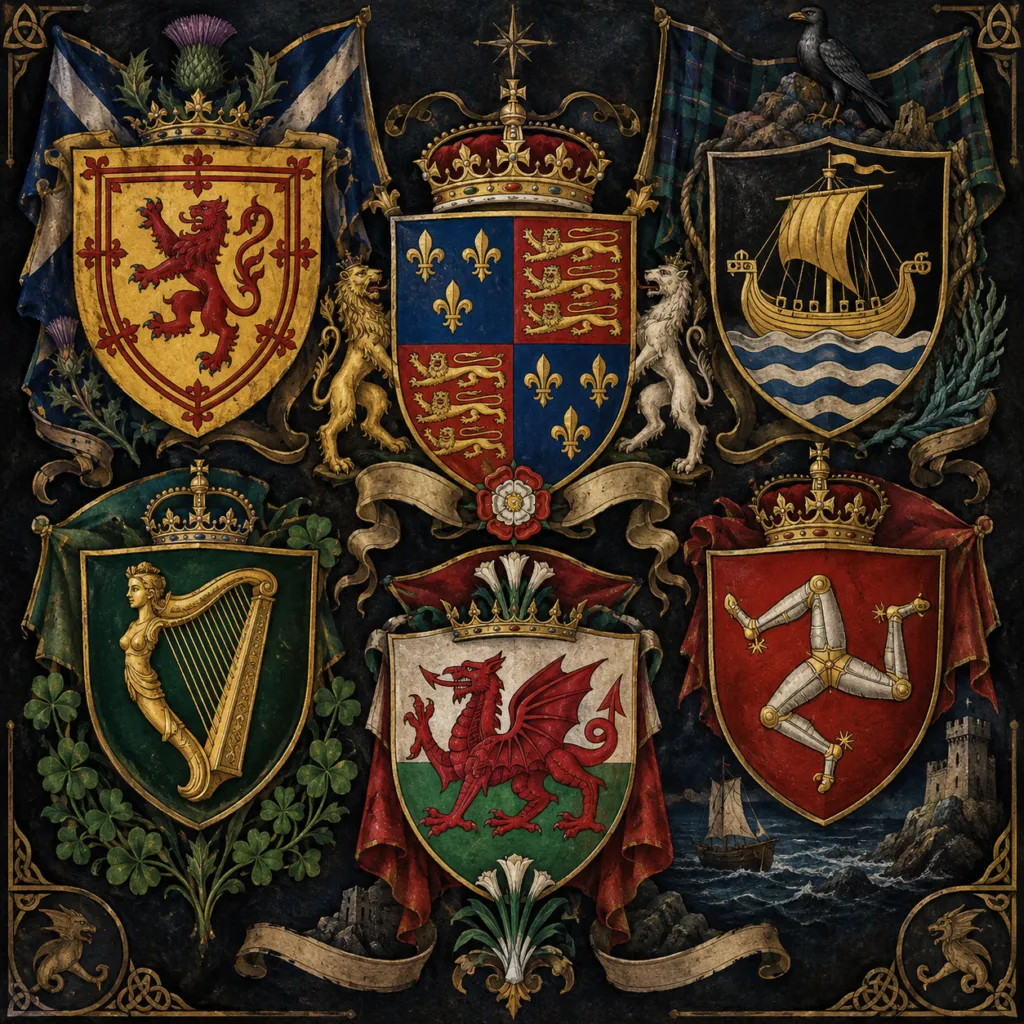
The page-specific hero, Heraldic Powers panel and 1454 campaign map are SpiralWorlds campaign artwork. Historical sources are cited for chronology and context; their text and illustrations are not reproduced here.
No edition-specific rules text is reproduced on this hub, so an OGL block is not required solely for this page.