
Limerick — Walled Port on the Shannon
Munster · Shannon port · King’s Island · Englishtown · Irishtown · Thomond frontier
At a Glance
| Realm | Lordship of Ireland |
|---|---|
| Region | Lower Shannon, between the O’Brien world of Thomond and the FitzGerald sphere of Desmond |
| Status | Chartered and fortified port retaining strong civic loyalty to the Crown |
| Urban core | Englishtown on King’s Island, King John’s Castle, the Sacred College of King’s Island and the developing walled Irishtown south of the eastern channel |
| Economy | River and overseas trade, agricultural produce, fisheries, tolls, warehousing and traffic through the Shannon estuary |
| Great dangers | Estuary piracy, river feuds, contested roads, factional pressure and supernatural traffic on the Shannon |
| Best for | Castle intrigue, merchant politics, river voyages, piracy, contested tolls, sieges and sacred kingship |
| Immediate pressure | The city holds royal privileges but sits between lordships strong enough to threaten its roads, river traffic and hinterland |
Limerick is a fortified river city built where the Shannon becomes a highway to the Atlantic. King’s Island holds the castle, sacred college and old Englishtown; across the eastern channel, Irishtown is expanding behind its own walls. The city possesses valuable royal privileges, but every ship, bridge and road ties it to the O’Brien and FitzGerald powers surrounding the lower Shannon.
What Is Happening Right Now?
Limerick has received repeated royal confirmations of its privileges during the present century, including grants in 1414, 1423 and 1433. Those documents matter because the city is increasingly distant from the core area of effective royal administration around Dublin.
The Shannon makes Limerick prosperous and vulnerable. Merchants can move goods deep inland or out to the Atlantic, while pirates and private raiders can use the same water. Ships entering the estuary may reach the city before warning riders arrive by land.
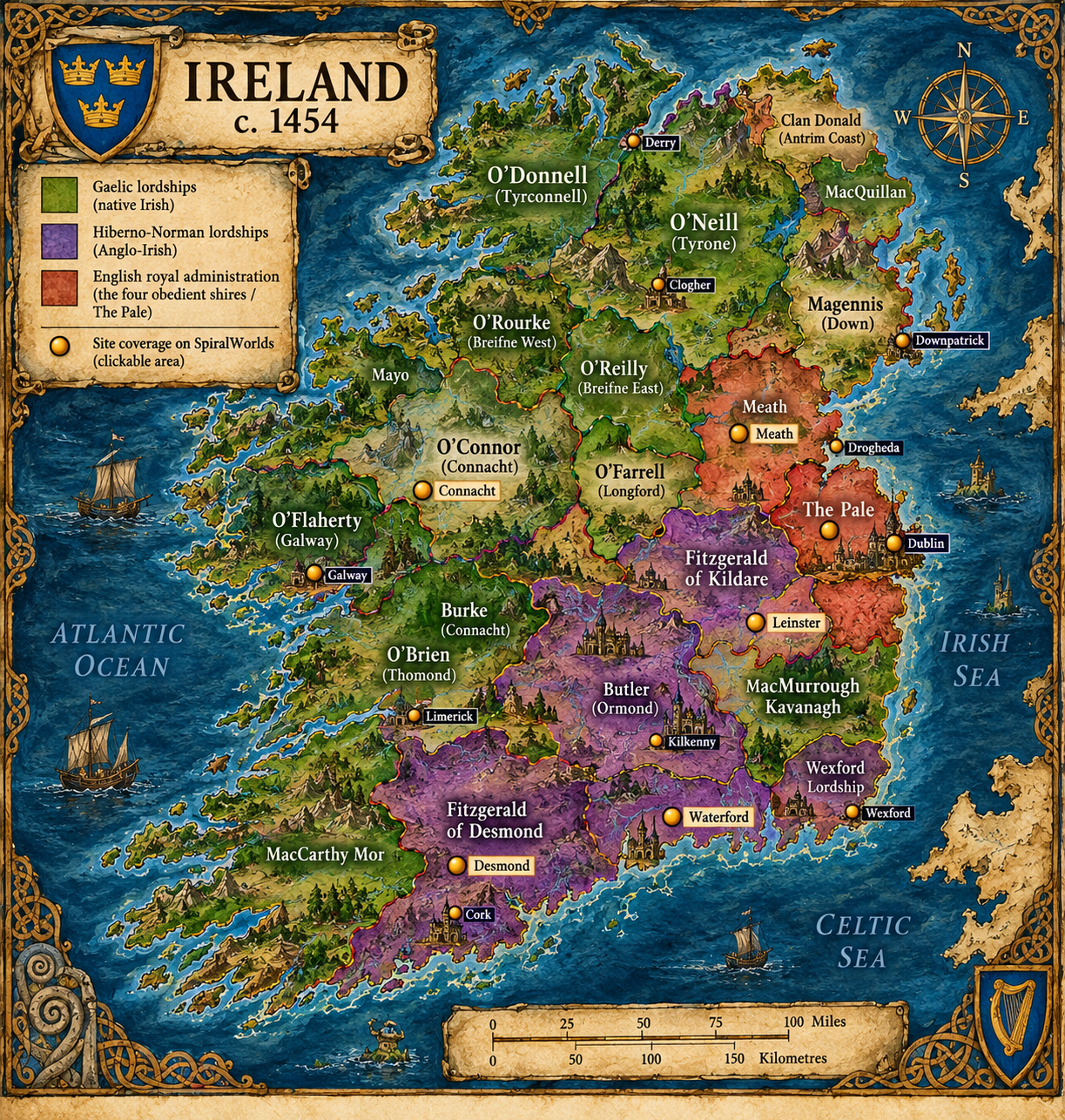
To the north and west, O’Brien Thomond remains a major Gaelic power. To the south, FitzGerald Desmond dominates much of Munster. Limerick cannot ignore either, even while its civic institutions insist on royal rights and urban liberties.
Irishtown’s walls are still part of the changing late-medieval city. Growth south of King’s Island creates new gates, property disputes and weak points where smugglers know construction better than the watch.
Run Limerick Tonight
The Pirate’s Safe Conduct
A notorious Shannon captain arrives openly under a written guarantee from a powerful lord. The city wants him arrested; the lord warns that touching him will close the western river to Limerick shipping.
The Bell Beneath Thomond Bridge
Boatmen hear a bell ringing below the river each night at low water. The following morning one bridge stone is found carved with the name of somebody who will die that day.
The Castle Ledger
A clerk at King John’s Castle discovers that one royal privilege has been copied incorrectly for decades. Correcting it would cost a merchant faction a fortune in toll exemptions.
The Irishtown Breach
Workers building a wall uncover a passage already running beneath the planned gate. The tunnel is older than the Norman city and leads toward the sacred college.
The Empty Grain Ship
A barge arrives from upriver laden with grain but no crew. Every sack is marked with a different lord’s seal, none of whom admits ownership.
King’s Island and Englishtown
King’s Island is the strategic core of medieval Limerick. The Shannon and eastern channel protect it naturally, while stone walls and the castle turn the island into one of the strongest urban positions in western Ireland.
Englishtown occupies this older fortified core. Its streets retain the pattern inherited from earlier Norse settlement and later Anglo-Norman rebuilding. Gates and bridges concentrate movement, making control of a few points more important than sheer population.
King John’s Castle
The castle dominates the northern end of King’s Island and guards the Shannon crossing. It is not merely a military monument: royal officers, prisoners, stores, weapons and records make it the practical centre of Crown power in the city.
A party entering the castle may encounter civic disputes, military orders, tax records and intelligence from the river. The fortress is strongest when used as a living administrative machine rather than a static dungeon.
The Sacred College of King’s Island
The Sacred College stands close to the political heart of the city on King’s Island. Its druids, brehons, poets and accumulated property make it one of Limerick’s oldest continuous institutions.
Druidic sanctuary can interrupt a pursuit; brehon records can settle an inheritance; a ritual procession can turn a narrow street into an impassable crowd. Sacred authority therefore shapes play beyond purely religious scenes.
Irishtown
South of the eastern channel, Irishtown is developing as a second enclosed urban area. Its walls and streets extend Limerick’s defended space while creating a distinct district tied to markets, craftsmen and people whose position within the older Englishtown hierarchy is less secure.
Construction itself creates adventure opportunities: unfinished walls, disputed plots, diverted watercourses and buried foundations produce weaknesses known to labourers long before officials understand them.
Trade on the Shannon
Limerick remains an important port even though Galway’s overseas commerce is increasingly formidable. The river gives the city access to a vast inland network while the estuary opens onto Atlantic routes.
| Traffic | Campaign Pressure |
|---|---|
| Grain and livestock produce | Depend on peaceful access to surrounding lordships. |
| Fish | Fisheries create valuable rights contested by townsmen and local lords. |
| Wine, cloth and imported goods | Carry high tolls and attract smugglers. |
| River passengers | Druids, hostages, messengers and fugitives can travel faster by water than road. |
| Piracy | Estuary raiders can seize cargo without ever approaching the walls. |
Between Thomond and Desmond
The city’s position is politically awkward. The O’Briens of Thomond possess deep power north and west of the Shannon; the FitzGeralds of Desmond dominate much of Munster to the south.
Limerick merchants need both worlds. A convoy may carry a civic safe conduct, an O’Brien guarantee and a FitzGerald letter because each document becomes useful at a different stage of the journey.
Places That Matter
King John’s Castle
Fortress, prison, storehouse and royal administrative centre at the northern end of King’s Island.
The Sacred College of King’s Island
The city’s great learned institution, surrounded by druids, brehons, burial rights and sacred property.
Thomond Bridge
The river crossing is a military chokepoint and commercial artery. Whoever controls it controls movement between city and north bank.
The Medieval Port
Wharves on the Shannon receive river craft and seagoing ships. Cargo can move from hold to warehouse faster than officials can inspect it.
Irishtown Gates
The newer southern defences are crowded with builders, carts and temporary structures—ideal cover for smuggling or sabotage.
Magic of the Shannon
The river carries more than trade. Floodwater exposes old stones, drowned roads and offerings left before the present city existed. Boatmen know stretches where speaking a dead person’s name aloud attracts an answering knock from beneath the hull.
River spirits care little for municipal charters. The best supernatural conflicts arise when a perfectly valid human right—bridge toll, fishery grant, quay ownership—contradicts an older compact made with the water itself.
Dungeon: The Vault Beneath King’s Island
Flood damage opens a stair below a storehouse between the castle and sacred college.
The Norse Wall
Timber and stone from an older settlement survive beneath the Norman city. Carved marks indicate a river entrance sealed centuries ago.
The Royal Store
Crates bear seals from reigns no living official remembers. One contains weapons that remain perfectly dry despite standing below river level.
The College Passage
A narrow tunnel ends beneath a sealed ritual chamber. Someone has recently moved stones from the college side.
The Shannon Gate
A final arch opens onto flowing black water. At certain tides it leads beneath the river to a bank that does not exist in daylight.
The Shannon After Dark
The Shannon is a trade route by day and a supernatural road by night. Boatmen know stretches where voices carry from the wrong bank and where a lantern seen ahead remains the same distance away no matter how hard the crew rows.
Pookas appear on the roads leaving the river crossings, while Clurichauns favour cellars attached to prosperous houses and waterside taverns. A clurichaun that adopts a cellar will defend its drink ferociously against thieves, including the owner if it decides the owner has become one.
Deaths in the river sometimes leave repeating ghosts at the quays: a ferryman asking for one last passenger, a merchant counting missing barrels or a soldier still waiting for an order that never came.
Food and Lodging
Travellers find alehouses, merchant guest rooms and paid floor-space around the river approaches and market districts. Wealthier visitors seek hospitality from trading families or powerful households, while crews often sleep close to their boats rather than risk missing the tide.
Historical and Mythic Context
Limerick developed from an early settlement on King’s Island into a major Norse base and then an Anglo-Norman fortified city. King John’s Castle and the walls of Englishtown secured the island, while Irishtown expanded south of the southern channel and acquired its own defences during the late medieval period.
The city remained an important port and repeatedly received royal privileges during the fifteenth century. Its overseas trade existed alongside persistent piracy in the Shannon estuary and increasing political isolation from the Pale.
Map of the Lower Shannon
Keep this reference growing
If this page helped with your reading or game, you can support its upkeep or explore the curated books.
Explore the Bookshop — epics, classics and stories behind imagined worlds.