
Math fab Mathonwy – Welsh Magician-King of Gwynedd
Math fab Mathonwy – Welsh Magician-King of Gwynedd
Welsh Magician-King of Gwynedd, Lord of Court-Law, Transformation, and the Wind-Hearing Hall

Math fab Mathonwy is the divine magician-king of Gwynedd, a ruler whose court hears treachery on the wind and whose wand turns wrongdoing into living sentence.
Pantheon: Celtic Pantheon, Welsh / Brittonic Tradition
Divine Rank: Lesser Deity
Alignment: Lawful Neutral
Portfolio: Sovereignty, court-law, magic, lawful transformation, hidden speech, dynastic legitimacy, naming, oath-breaking, compensation, enchanted making
Home Realm: Caer Dathyl, Gwynedd, Material Plane
Planar Thresholds: Caer Dathyl touches the Otherworld/Feywild through thin places, wind, dream, court-magic, and sovereignty rites
Holy Symbol: A bent wand above a carved royal footstool
Favoured Weapon: Quarterstaff or wand-staff
Sacred Signs: Wind moving through a closed hall, flowers blooming out of season, deer tracks at a court gate, a staff bending without breaking
Overview
Math fab Mathonwy rules from Caer Dathyl as magician, king, judge, and keeper of a dangerous royal order. His power is not the bright battle-magic of a wandering hero. It is court magic: the law spoken in the hall, the whisper carried by the wind, the punishment that fits the crime too closely to be mistaken for mercy.
He is one of the great powers of Gwynedd. His court is place-rooted, dynastic, and old. Those who enter it step into a realm where speech matters, disguise is never safe, and a ruler’s body is bound to the health of the kingdom. Math does not merely cast spells. He defines conditions. He names children. He changes forms. He turns family crime into public sentence. He makes impossible bodies possible.
Math is not a generic god of “all wisdom” or “all magic.” He is the lord of a court where magic, sovereignty, shame, compensation, and punishment belong to the same law.
Divine Identity
Math fab Mathonwy, also written Math ap Mathonwy, is the Lord of Caer Dathyl and the magician-king of Gwynedd. He is not a cosmic creator, primordial being, or universal high god. His divinity is rooted in Welsh sovereignty, court-law, magical judgement, naming, and the transformation of those who break the order of the hall.
His power is strongest where rule, kinship, testimony, inheritance, naming, punishment, and transformation intersect. Math manifests at human scale: an aged king-magician whose authority fills the hall without enlarging his body. His scale is legal, magical, territorial, and divine rather than physically monstrous.
Mythic Role
Math’s mythic role is the law of the court made supernatural.
He governs through presence. In source tradition, his sovereignty is bound to an archaic courtly condition expressed through the maiden who holds his feet except in time of war. In this entry, that condition is treated as a sacred royal office tied to legitimacy, ritual order, and the bodily condition of kingship.
His greatest acts are formal transformations. Gwydion and Gilfaethwy do not merely suffer a curse; they are forced to live in the natures of deer, swine, and wolves, and their punishment becomes part of the wider mythic order. Math’s justice is severe, embodied, humiliating, and time-bound. It teaches by making the offender dwell in the shape of the wrong.
He also presides over naming, magical legitimacy, and impossible making. Dylan is named under his authority. Lleu’s fate is shaped through his court. Blodeuwedd is made by Math and Gwydion from oak, broom, and meadowsweet. In game terms, Math is the deity of conditions that become reality.
Appearance
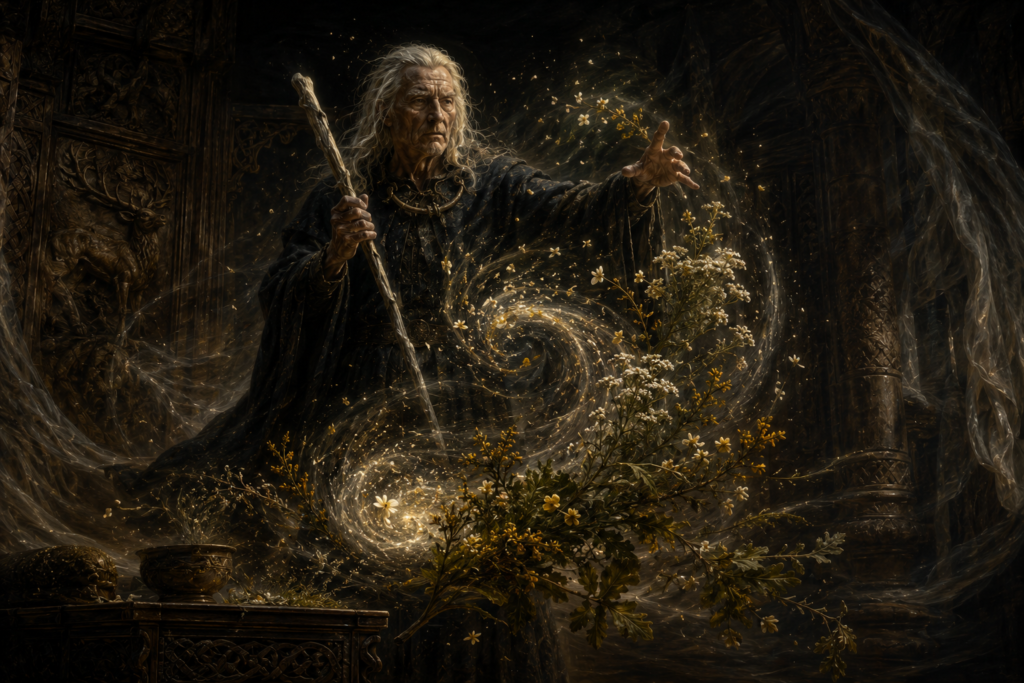
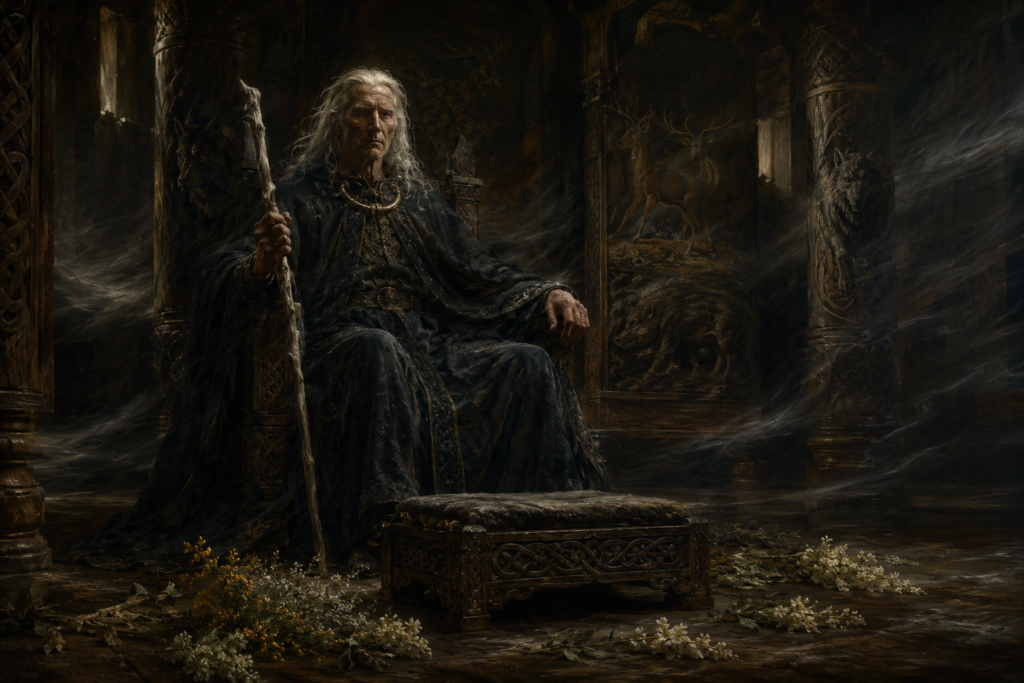
Math appears as an elderly or ageless Welsh king in heavy robes, a torc, and dark courtly garments worn with severe dignity. His hair is white or iron-grey, his face lined, and his eyes sharp enough to make deception feel childish. He carries a pale wand-staff of polished wood, slightly bent, as if law itself has flexed without breaking.
In Caer Dathyl, he is often seated in stillness, listening. The hall around him carries every low word. Curtains stir when no door is open. Those who lie before him may hear the footfalls of deer, the grunt of boars, or the breath of wolves before judgement is spoken.
His avatar appears more mobile: a stern old court-magician travelling under cloak and staff, accompanied by unnatural wind and the sense that every whispered aside has already reached him.
Sacred Law, Offerings, and Taboos
Sacred Law
Those who serve Math must respect the laws of court, kinship, testimony, office, and compensation. Speech in his presence is never casual. A promise made under his roof becomes a thing with weight. A false witness may draw his attention faster than an open killing.
Math’s followers preserve names, lineages, legal memory, courtly procedure, and magical knowledge. They are expected to know who owes what, who has been wronged, who has inherited, who has lied, and which old vow has not yet been paid.
Offerings
Offerings to Math include carved staffs, written genealogies, law-cords, oath-rings, court records, wind-chimes of bronze or bone, oak blossom, broom blossom, meadowsweet, and polished threshold-stones from lawful halls.
A wizard may offer a newly discovered spell. A judge may offer a corrected verdict. A ruler may offer compensation publicly paid to someone harmed under royal protection.
Taboos
Math despises concealed violation, corrupted testimony, forged inheritance, false compensation, and the use of cleverness to evade rightful judgement. He especially hates crimes committed while lawful protection has been deliberately distracted or abused.
His worshippers must not falsify lineage, erase a name from lawful memory, forge a judgement, or exploit a sworn office of protection.
Relationships
- Goewin is central to Math’s law. Her violation is the breach that exposes the vulnerability of Math’s court and triggers compensation, royal marriage, and severe punishment. Goewin should be treated as a person of legal and mythic consequence, not as disposable background tragedy.
- Gwydion fab Dôn is Math’s brilliant and dangerous kinsman: taught, trusted, exposed, punished, and later restored to cooperation.
- Gilfaethwy fab Dôn is the offender whose desire helps bring catastrophe into the court and who suffers Math’s transformative sentence.
- Arianrhod stands in tension with Math’s courtly tests, naming power, and dynastic authority. Her curses against Lleu shape a major line of conflict around legitimacy and identity.
- Dylan ail Don is named under Math’s authority and immediately belongs to the sea.
- Lleu Llaw Gyffes is protected through Math’s court and magic, then rises into kingship through the same mythic order.
- Blodeuwedd is an impossible being created through the flower-magic of Math and Gwydion. Her making, betrayal, punishment, and survival belong to the same field of named identity and transformed condition.
- Gronw Pebr enters Math’s mythic field through Blodeuwedd’s betrayal and Lleu’s near-death, making him useful in stories of unlawful desire, impossible wounds, formal compensation, and public reckoning.
- Pryderi of Dyfed is a wronged ruler whose conflict with Gwynedd reveals how dangerous deception becomes when royal politics and enchantment are joined.
Currently in the World
Math remains at Caer Dathyl, though the court is not always where ordinary travellers expect it to be. Shepherds in Arfon speak of a hill-fort whose hall appears only under certain winds. Lawyers, bards, and hedge-magicians dream of a chamber where every whisper becomes public truth.
At certain hours, Caer Dathyl is more than a court on the Material Plane. It becomes a threshold where Gwynedd and the Otherworld/Feywild touch without becoming the same place. Math is not one of the Eldest, not a generic fey power, and not a wandering Otherworld lord. His court can open toward the Otherworld, but his authority remains rooted in Gwynedd.
He does not wander Britain gathering worshippers. His power is strongest where Welsh sovereignty, local law, old kinship, forged succession, and magical inheritance are under pressure. He watches courts, dynasties, bardic houses, magical colleges, and families whose secrets are about to become public disaster.
In Gwynedd, Math acts as a hidden counterweight to false lordship, stolen inheritance, and concealed court-crime. He does not oppose every enemy directly. Instead, he causes names to return, witnesses to remember, forged charters to fail, and traitors to hear animal feet at the chamber wall.
Divine Scale and Defeat
Math is a Lesser Deity. He stands far above mortal archmages and ordinary divine servants, but he is not a greater god, primordial power, or universal master of all magic.
His true divine form should not be treated as an ordinary boss fight. A party may defeat his servants, survive his herald, bargain with his avatar, or break one local manifestation of his judgement. Destroying his true authority requires a mythic-legal act: breaking the Staff of Caer Dathyl under rightful sentence, severing his hall from the wind that carries testimony, exposing a judgement he cannot answer, or restoring a name or inheritance he has unjustly suppressed.
For gameplay, Math’s true divine form is Medium, with ordinary personal reach. His divine scale appears through Caer Dathyl, the wind, court-law, oath, ritual authority, lair actions, and the transformation of those judged by him.
Mechanics Tabs
The rules below are mechanics compatible for different game editions.
Math fab Mathonwy 5.5e
Math fab Mathonwy, Pathfinder 1e / 3.5e
Math fab Mathonwy 5.5e-Compatible Rules

True Divine Form: Domains, Granted Magic, Boons, and Curses
Math’s true divine magic is court-magic: judgement, transformation, hidden speech, naming, lawful punishment, and impossible making.
- Divine Rank: Lesser Deity
- Suggested Cleric Domains: Knowledge, Arcana, Order, Trickery
- Suggested Warlock Patron: The Court Behind the Wind
- Suggested Paladin Oaths: Oath of the Crown, Oath of the Watchers, Oath of Vengeance, or a custom Oath of Threefold Amends
- Favoured Weapon: Quarterstaff or wand-staff
- Holy Symbol: A bent wand above a carved royal footstool
Always-Prepared / Domain Spells
| Spell Level | Spells |
|---|---|
| Cantrip | guidance, mage hand, minor illusion |
| 1st | command, detect magic, disguise self |
| 2nd | detect thoughts, hold person, suggestion |
| 3rd | counterspell, major image, speak with dead |
| 4th | divination, polymorph |
| 5th | geas, legend lore, scrying |
| 6th | true seeing, mass suggestion |
| 7th | forcecage, plane shift |
| 8th | maze, power word stun |
| 9th | foresight, true polymorph |
Spell Notes
Math’s magic favours divination, illusion, enchantment, transmutation, naming, binding, and legal consequence. He is not a deity of unrestricted arcane omnipotence. He excels at hearing hidden speech, exposing false identity, imposing forms, breaking deceits, making impossible bodies, and turning a social wrong into a visible magical condition.
Divine Boon: Wind-Hearing
A creature blessed by Math can hear faint speech carried by moving air. Once per long rest, the blessed creature may ask the DM one question about a conversation, oath, betrayal, or secret spoken within the last day in a place where breath, wind, smoke, or open air could carry sound. The answer comes as fragments, not a perfect transcript.
Divine Boon: Court-Magician’s Hand
The blessed creature gains proficiency in Arcana or History. If already proficient, it gains expertise. Once per long rest, it may cast detect magic, disguise self, or suggestion without expending a spell slot.
Divine Curse: Threefold Shape
A creature cursed by Math begins to take on the nature of its wrongdoing. A violent deceiver may become stag, boar, then wolf across three nights. A false witness may grow a bird’s tongue. A lord who breaks hospitality may become unable to cross thresholds except on all fours.
This curse is story-facing first. Remove curse lifts only lesser cases. Greater cases require compensation, public admission, and judgement accepted by the wronged party or their lawful representative.
Using This Deity’s Forms
Servants are oath-witnesses, court-spirits, wind-listeners, transformed offenders, magical beasts, and bardic messengers.
The herald appears when a secret has been spoken and Math wishes it brought into the open. It carries summons, accusation, and warning before Math himself appears.
The avatar is the form most campaigns should meet directly. It judges, bargains, curses, advises, and punishes away from Caer Dathyl or in scenes where Math’s full divine court-presence would overwhelm the story.
The true divine form is Math himself in full divine authority, usually at Caer Dathyl or in a court ritually claimed in his name. Math’s home being on the Material Plane does not remove the need for avatars and heralds; those forms control manifestation, story scale, and political danger.
Servant: Wind-Listener of Caer Dathyl

CR 5
Alignment: Lawful Neutral
Size and Type: Medium spirit
Role: Secret-bearer, omen, scout, court witness
A Wind-Listener appears as a thin robed figure whose edges ripple like cloth in a draught. It is not a warrior of Math’s court, but a listening presence sent when a whispered crime, broken oath, concealed name, or hidden judgement needs a witness.
Armor Class 15
Hit Points 78
Speed 30 ft., fly 30 ft. (hover)
Proficiency Bonus +3
| STR | DEX | CON | INT | WIS | CHA |
| 8 (-1) | 16 (+3) | 16 (+3) | 16 (+3) | 18 (+4) | 14 (+2) |
Saving Throws Dex +6, Int +6, Wis +7
Skills Arcana +6, History +6, Insight +10, Perception +10, Stealth +6
Damage Resistances force, psychic; bludgeoning, piercing, and slashing from nonmagical attacks
Condition Immunities charmed, frightened
Senses darkvision 60 ft., passive Perception 20
Languages Welsh; understands any language spoken in a court, under oath, or in a whisper
Challenge 5
Traits
Wind-Borne Witness. The Wind-Listener can hear ordinary speech and whispers carried by moving air within 300 feet, even through cracks, curtains, arrow-slits, or partially closed doors.
Court-Spirit. While inside a hall, court, shrine, throne-room, or lawful assembly, the Wind-Listener has advantage on Dexterity (Stealth), Wisdom (Insight), and Wisdom (Perception) checks.
Oath-Scent. The Wind-Listener knows when a creature within 60 feet has knowingly broken an oath, falsified testimony, or concealed a formal name.
Actions
Whisper-Cut. Ranged Spell Attack: +7 to hit, range 60 ft., one target. Hit: 18 (4d8) psychic damage.
Repeat the Hidden Word. One creature the Wind-Listener can see within 60 feet must make a DC 15 Charisma saving throw. On a failed save, the creature involuntarily repeats one sentence it has whispered, concealed, or denied within the last 24 hours. The sentence must be relevant to an oath, crime, name, judgement, inheritance, or deception.
Mark the False Name (Recharge 5–6). One creature within 60 feet must make a DC 15 Wisdom saving throw. On a failed save, the creature is outlined by moving air for 1 minute. While marked, it cannot benefit from mundane disguise, and it has disadvantage on Charisma (Deception) checks involving its name, title, rank, or oath.
Reactions
The Wind Carries Warning. When a creature within 60 feet lies under oath or attacks after speaking a threat aloud, the Wind-Listener may move up to half its speed without provoking opportunity attacks.
Herald: The Bent-Wand Witness
CR 9
Alignment: Lawful Neutral
Size and Type: Medium Deity herald
Role: Exposes concealed wrongdoing, carries Math’s summons, marks offenders for sentence
Armor Class 17
Hit Points 136
Speed 30 ft., fly 40 ft. (hover)
Proficiency Bonus +4
| STR | DEX | CON | INT | WIS | CHA |
| 12 (+1) | 18 (+4) | 18 (+4) | 20 (+5) | 20 (+5) | 18 (+4) |
Saving Throws Dex +8, Int +9, Wis +9, Cha +8
Skills Arcana +9, History +9, Insight +13, Perception +9, Persuasion +8
Damage Resistances force, psychic; bludgeoning, piercing, and slashing from nonmagical attacks
Condition Immunities charmed, frightened
Senses truesight 60 ft., passive Perception 19
Languages Welsh; understands any language spoken in a court or under oath
Challenge 9
Traits
Wind-Hearing. The herald cannot be surprised by a creature that has spoken within 1 mile in the last hour.
Witness of the Wrong. The herald has advantage on Wisdom (Insight) checks against any creature that has broken an oath, falsified testimony, or hidden a serious crime.
Actions
Multiattack. The herald makes two Bent Staff attacks.
Bent Staff. Melee Weapon Attack: +9 to hit, reach 5 ft., one target. Hit: 13 (2d8 + 4) bludgeoning damage plus 14 (4d6) psychic damage.
Name the Fault. One creature the herald can see within 60 feet must make a DC 17 Charisma saving throw. On a failed save, the target cannot benefit from being invisible, disguised, or under a false name for 1 minute.
Mark for Sentence (Recharge 5–6). One creature within 60 feet must make a DC 17 Wisdom saving throw. On a failed save, spectral animal features mark it for 1 minute. While marked, it has disadvantage on Charisma checks and cannot willingly lie without taking 10 psychic damage.
Avatar of Math fab Mathonwy
CR 16
Alignment: Lawful Neutral
Size and Type: Medium Deity avatar
Role: Court judge, divine magician, hidden-law enforcer, giver of names, punisher of concealed crime
The avatar is the form most campaigns should encounter directly. It appears as an old king-magician with staff and torc, with wind moving around him even indoors.
Armor Class 20
Initiative +8
Hit Points 253
Speed 30 ft.
Proficiency Bonus +5
| STR | DEX | CON | INT | WIS | CHA |
| 14 (+2) | 18 (+4) | 22 (+6) | 26 (+8) | 24 (+7) | 22 (+6) |
Saving Throws Con +11, Int +13, Wis +12, Cha +11
Skills Arcana +18, History +18, Insight +17, Perception +12, Persuasion +11
Damage Resistances force, psychic; bludgeoning, piercing, and slashing from nonmagical attacks
Condition Immunities charmed, frightened, poisoned
Senses truesight 90 ft., passive Perception 22
Languages Welsh, Old Brittonic; understands any language carried to him by wind
Challenge 16
Traits
Avatar of the Lesser Deity. If the avatar is reduced to 0 hit points, it dissolves into wind, staff-light, and animal tracks. Math cannot manifest another avatar in the same place for 30 days unless Caer Dathyl is directly threatened.
Wind-Taken Whisper. The avatar knows when a creature within 300 feet deliberately lies, breaks an oath, or speaks his name in a whisper.
Magic Resistance. The avatar has advantage on saving throws against spells and magical effects.
Court-Bound Majesty. While inside a hall, court, throne-room, shrine, or lawful assembly, the avatar gains a +2 bonus to AC and saving throws.
Spellcasting
Math’s avatar casts spells using Intelligence (spell save DC 21, +13 to hit with spell attacks).
At will: command, detect magic, disguise self, mage hand, minor illusion
3/day each: counterspell, detect thoughts, divination, major image, polymorph, suggestion
1/day each: geas, legend lore, mass suggestion, scrying, true seeing, true polymorph
Actions
Multiattack. Math makes two Staff of Caer Dathyl attacks, or one Staff attack and one Name the Hidden Fault.
Staff of Caer Dathyl. Melee Weapon Attack: +13 to hit, reach 5 ft., one target. Hit: 17 (2d8 + 8) bludgeoning damage plus 18 (4d8) force damage.
Name the Hidden Fault. One creature Math can see within 60 feet must make a DC 21 Charisma saving throw. On a failed save, one hidden disguise, false identity, concealed magical effect, or suppressed oath-mark becomes visible for 1 minute.
Threefold Sentence (Recharge 5–6). One creature within 90 feet must make a DC 21 Wisdom saving throw. On a failed save, the target begins a threefold transformation for 1 minute. First failure: speed is halved and animal features appear. Second failure while already affected: the target is restrained until the end of its next turn. Third failure while already affected: the target is transformed into a beast chosen by Math, as polymorph, for 1 minute.
Reactions
The Wind Told Me. When a creature Math can see targets him with an attack or spell after speaking within the last minute, Math imposes disadvantage on the attack roll or gains advantage on the saving throw.
Legendary Actions
Math can take 3 legendary actions, choosing from the options below.
Staff. Math makes one Staff of Caer Dathyl attack.
Court Step. Math teleports up to 30 feet to a space inside the same structure or within the same courtly boundary.
Unmask (Costs 2 Actions). One illusion, disguise, or invisibility effect within 60 feet is suppressed until the end of Math’s next turn.
Bend the Wand (Costs 3 Actions). Math uses Threefold Sentence if available; otherwise it recharges.
True Divine Form: Math fab Mathonwy, Magician-King of Gwynedd
CR 30
Alignment: Lawful Neutral
Size and Type: Medium Deity
Role: Lesser deity of sovereignty, naming, hidden speech, lawful transformation, and court-magic
This is not a routine combat form. Use it when the campaign reaches Caer Dathyl itself, challenges Math’s divine authority, or brings a kingdom-level crime before his court.
Armor Class 24
Initiative +8
Hit Points 507
Speed 40 ft.
Proficiency Bonus +9
| STR | DEX | CON | INT | WIS | CHA |
| 22 (+6) | 18 (+4) | 27 (+8) | 30 (+10) | 28 (+9) | 28 (+9) |
Saving Throws Str +15, Con +17, Int +19, Wis +18, Cha +18
Skills Arcana +28, History +28, Insight +27, Perception +18, Persuasion +18, Religion +19
Damage Resistances force, necrotic, psychic; bludgeoning, piercing, and slashing from nonmagical attacks
Damage Immunities poison
Condition Immunities charmed, frightened, poisoned, stunned
Senses truesight 120 ft., passive Perception 28
Languages Welsh, Old Brittonic; can understand any language carried by wind through his domain
Challenge 30
Traits
Lesser Deity. Math cannot be permanently destroyed by hit point loss. If reduced to 0 hit points outside the fulfilment of his defeat conditions, his true form withdraws to Caer Dathyl and cannot manifest physically for one year and one day.
Defeat Conditions. Math’s true form can only be truly defeated if a rightful claimant, wronged witness, or oath-bound champion breaks his divine authority through court-law: exposing a judgement Math cannot answer, breaking the Staff of Caer Dathyl under lawful sentence, restoring a name or inheritance Math has wrongly suppressed, or severing his court from the wind that carries testimony.
The Court Hears the Wind. Math cannot be surprised. He knows when any creature within 1 mile speaks his name, plots betrayal, gives false testimony, or breaks an oath aloud.
Foot-Holding Rite. While Math is in his own court and the rite of sovereignty is intact, he regains 30 hit points at the start of each turn and has advantage on all saving throws. If the lawful footholding office is violated, corrupted, or ritually absent, this regeneration stops until Math spends an action to reassert court order.
Master of Named Conditions. Math has advantage on spell attacks and saving throw DCs against creatures whose true name, oath, crime, or formal title he knows.
Legendary Resistance (4/Day). If Math fails a saving throw, he can choose to succeed instead.
Magic Resistance. Math has advantage on saving throws against spells and magical effects.
Spellcasting
Math casts spells using Intelligence (spell save DC 27, +19 to hit with spell attacks).
At will: command, counterspell, detect magic, detect thoughts, disguise self, dispel magic, divination, major image, polymorph, suggestion
3/day each: forcecage, geas, legend lore, mass suggestion, plane shift, scrying, true seeing
1/day each: foresight, maze, time stop, true polymorph
Actions
Multiattack. Math makes three Staff of Mathonwy attacks, or two Staff attacks and one Name the Law Beneath the Lie.
Staff of Mathonwy. Melee Weapon Attack: +19 to hit, reach 5 ft., one target. Hit: 28 (4d8 + 10) bludgeoning damage plus 27 (6d8) force damage. If the target is under an oath, curse, disguise, or false identity, it takes an extra 18 (4d8) psychic damage.
Name the Law Beneath the Lie. One creature Math can see within 120 feet must make a DC 27 Charisma saving throw. On a failed save, Math names one hidden truth about the target: a crime, broken oath, false title, concealed lineage, magical disguise, or suppressed curse. For 1 minute, the target cannot benefit from invisibility, disguise, or magical silence, and it has disadvantage on saving throws against Math’s spells.
Threefold Transformation (Recharge 5–6). Math chooses up to three creatures he can see within 120 feet. Each target must make a DC 27 Wisdom saving throw. On a failed save, the creature is transformed into a beast-form reflecting its wrongdoing for 1 minute. While transformed, it uses the statistics of a beast chosen by Math but retains memory and awareness of its sentence. A creature that succeeds is partially marked and has disadvantage on its next attack roll or saving throw before the end of its next turn.
Make the Impossible Body (1/Day). Math creates a living magical being from symbolic natural matter within 60 feet, such as flowers, oak, broom, meadowsweet, river-weed, or court dust. The created being uses an appropriate fey, construct, beast, plant, or humanoid stat block of CR 12 or lower. It is not automatically loyal unless Math gives it a name and purpose as part of the action.
Reactions
I Heard It Before You Spoke. When a creature Math can see casts a spell, makes an attack, lies under oath, or speaks a command word, Math may impose disadvantage on the roll, force the creature to reroll one d20, or cast counterspell without expending a spell slot.
Legendary Actions
Math can take 3 legendary actions, choosing from the options below.
Staff. Math makes one Staff of Mathonwy attack.
Wind Through the Hall. Math moves up to half his speed without provoking opportunity attacks.
Unmake Disguise (Costs 2 Actions). One magical disguise, illusion, invisibility effect, or shapechange effect within 120 feet ends unless its bearer succeeds on a DC 27 Charisma saving throw.
Court Sentence (Costs 2 Actions). One creature marked by Name the Law Beneath the Lie takes 22 (4d10) psychic damage and must speak one truthful sentence chosen by the DM.
Bend the World to the Word (Costs 3 Actions). Math casts polymorph, geas, or mass suggestion.
Lair Actions: Caer Dathyl
On initiative count 20, Math may use one of the following effects while in Caer Dathyl or a court ritually claimed in his name.
The Wind Repeats It. A whispered statement, lie, or oath spoken in the area during the last day is heard by all creatures of Math’s choice.
The Floor Remembers Rank. Creatures standing under a false title, stolen authority, or forged office must succeed on a DC 27 Charisma saving throw or fall prone and become unable to speak that false title for 1 minute.
Animal Sentence. Spectral deer, boars, or wolves pass through the hall. Up to three creatures Math chooses must succeed on a DC 27 Wisdom saving throw or be frightened until the end of their next turn.
Flowers Become Witnesses. Blossoms grow from cracks in stone and wood. Until initiative count 20 on the next round, invisible creatures are outlined by petals, and hidden blood, poison, or magical writing becomes visible.
Math fab Mathonwy, Pathfinder 1e / 3.5e-Compatible Rules
True Divine Form: Domains, Granted Magic, Boons, and Curses
Domains
Knowledge, Law, Magic, Nobility, Trickery
Subdomains
Arcane, Deception, Leadership, Memory, Thought
Divine Boon: Wind-Hearing Courtier
The devotee gains a +4 sacred bonus on Sense Motive and Spellcraft checks. Once per day, they may use detect thoughts as a spell-like ability.
Divine Boon: Keeper of Names
The devotee gains a +4 sacred bonus on Knowledge checks involving genealogy, noble titles, magic lineages, and succession. Once per day, they may cast legend lore, but only concerning a person, family, oath, or magical inheritance.
Divine Boon: Threefold Sentence
Once per week, the devotee may pronounce a formal curse against a creature that has broken an oath, falsified testimony, or concealed a serious crime. This functions as bestow curse or baleful polymorph, chosen when used. The target gains a +4 bonus on the save if the accusation is false.
Divine Curse: Three Years in Borrowed Shape
A major curse of Math cannot be removed by ordinary remove curse. The victim passes through a sequence of animal forms or animal natures, each reflecting the wrong committed. The curse ends through public compensation, restoration of the wronged party’s name or status, and acceptance of judgement.
True Divine Spell-Like Abilities
At will — detect magic, detect thoughts, discern lies, disguise self, dispel magic, divination, greater command, major image, polymorph, suggestion, tongues
3/day — baleful polymorph, geas/quest, greater dispel magic, legend lore, plane shift, scrying, true seeing
1/day — foresight, limited wish, shapechange, time stop, weird
Caster level 29th. Save DCs are Charisma-based.
Avatar of Math fab Mathonwy
CR 16
Alignment: Lawful Neutral
Size and Type: Medium Deity avatar
Init +8; Senses true seeing 90 ft.; Perception +28
AC 31, touch 19, flat-footed 27
hp 248
Fort +20, Ref +18, Will +23
Defensive Abilities court-bound majesty, improved uncanny awareness; DR 10/epic; SR 27
Immune charm, fear, poison
| STR | DEX | CON | INT | WIS | CHA |
| 14 (+2) | 18 (+4) | 22 (+6) | 28 (+9) | 24 (+7) | 22 (+6) |
Speed 30 ft.
Melee Staff of Caer Dathyl +25/+20/+15/+10
Damage 1d6+8 plus 3d6 force
Special Attacks name the fault, threefold sentence
Spell-Like Abilities CL 18th; concentration +27
At will — detect magic, detect thoughts, disguise self, major image
3/day — baleful polymorph, divination, geas/quest, greater dispel magic, polymorph, suggestion
1/day — legend lore, scrying, true seeing, limited wish
Special Abilities
Wind-Hearing. Math’s avatar gains a +10 insight bonus on Perception and Sense Motive checks involving whispered speech, lies, oaths, and concealed magical identities.
Name the Fault. As a standard action, Math names a hidden wrong. One creature within 60 feet must succeed at a DC 24 Will save or lose the benefit of disguise, invisibility, false alignment, and magical silence for 1 minute.
Threefold Sentence. Once every 1d4 rounds, Math may force one creature within 90 feet to attempt a DC 24 Will save. Failure causes partial animal transformation, imposing a –4 penalty to Dexterity and Charisma for 1 minute. A second failed save during the same encounter causes the target to be affected as baleful polymorph.
True Divine Form: Math fab Mathonwy
CR 30 / MR 8
Alignment: Lawful Neutral
Size and Type: Medium Deity
Init +12; Senses true seeing 120 ft., wind-hearing 1 mile; Perception +50
AC 48, touch 25, flat-footed 40
hp 690
Fort +35, Ref +32, Will +38
Defensive Abilities divine court-law, wind-heard warning; DR 20/epic; SR 41
Immune ability damage, charm, compulsion, disease, fear, poison, polymorph unless willing
| STR | DEX | CON | INT | WIS | CHA |
| 22 (+6) | 26 (+8) | 28 (+9) | 36 (+13) | 30 (+10) | 30 (+10) |
Base Atk +30; CMB +42; CMD 60
Speed 40 ft.
Melee Staff of Mathonwy +45/+40/+35/+30
Damage 1d6+18 plus 6d6 force and transformative judgement
Space/Reach 5 ft./5 ft.
Skills Arcana +58, Diplomacy +43, History +58, Knowledge (nobility) +58, Knowledge (planes) +50, Perception +50, Sense Motive +50, Spellcraft +58
Spell-Like Abilities CL 29th; concentration +42
Mythic Power 11/day, surge +1d10
Mythic Note
Math’s true divine form uses mythic rules in Pathfinder-style play. Mythic subtype benefits are already included and must not be added again. His avatar and herald are not mythic unless the campaign deliberately upgrades them.
Special Abilities
Divine Court-Law. In a court, hall, throne-room, shrine, or lawful assembly, Math gains fast healing 30. This fast healing stops for 1 round whenever a rightful witness successfully proves that Math’s present judgement is unjust.
Wind-Heard Warning. Math is never flat-footed against a creature that has spoken within 1 mile during the last hour.
Transformative Judgement. When Math hits a creature with his staff, the target must succeed at a DC 35 Fortitude save or suffer partial transformation. The first failure gives the target a –4 penalty to Dexterity and Charisma. The second failure reduces speed by half and prevents speech except in broken animal sounds. The third failure transforms the target as baleful polymorph. This is a curse and transmutation effect.
Name Under the Wand. Math may spend one use of mythic power to force a creature within 120 feet to attempt a DC 35 Will save. On a failed save, the creature’s true name, false title, hidden oath, or concealed crime becomes known to Math and visible as a symbolic mark for 24 hours.
Worshippers and Servants
Math’s worshippers include court-magicians, legal scholars, bardic genealogists, oath-keepers, royal judges, dynastic advisors, diviners, and rulers who understand that magic and law cannot be separated.
His servants are not generic fairy followers. They are specific to court, wind, transformation, and Welsh sovereignty: wind-listeners, oath-spirits, staff-bearing heralds, transformed offenders, magical deer, boars, wolves, owls, and old bardic messengers.
A priest of Math is more likely to preserve a dangerous legal memory than to preach in public. A warlock of Math may be retained to uncover who lied in a succession dispute. A paladin of Math may drag a smiling murderer into court and demand that the wind repeat what was said behind the door.
Using This Deity in Your Game
Use Math when the adventure concerns hidden wrongdoing inside a court, succession dispute, magical inheritance, cursed transformation, false identity, violated protection, or a name that has been deliberately withheld.
He works especially well in Welsh campaigns, Arthurian border stories, bardic investigations, noble-house scandals, and adventures where the central question is not simply “can we kill it?” but “what is the lawful shape of the truth?”
Math is strongest as pressure behind the story. His presence makes players think before they lie in a hall, forge a genealogy, or assume magical judgement can be handled by brute force alone.
Adventure Hooks
The Wind Heard the Murder
A noble dies in a sealed chamber, and every witness swears innocence. At dusk, the curtains move though the windows are shut. A Wind-Listener of Caer Dathyl appears and repeats one sentence spoken too quietly for mortal ears. The party must prove the rest before Math’s avatar arrives and turns the wrong person into a beast.
The Child Without a Name
A magically gifted child cannot be named. Every attempted name burns away from parchment, and every witness forgets it by morning. The curse leads back to an old bargain involving Arianrhod’s line, a stolen inheritance, and a staff hidden beneath a ruined Welsh court.
The Threefold Sentence
A lord who escaped judgement begins changing shape: first stag, then boar, then wolf. His enemies call it divine justice. His family calls it murder by magic. Math’s law is at work, but the party must discover whether the sentence is rightful or whether someone has forged the accusation in Math’s name.
Relics and Signs
Staff of Mathonwy
A pale wand-staff, slightly bent, that does not break. In mortal hands it serves as a potent staff of divination, illusion, and transformation. In Math’s hand it is not merely a weapon but an instrument of sentence.
The Footstool of Caer Dathyl
A carved royal footstool used in sovereignty rites. It is never merely furniture. If stolen, it can destabilise a court, expose a false ruler, or draw Math’s immediate attention.
Blossoms of the Impossible Bride
Oak, broom, and meadowsweet blooming together out of season mark places where made bodies, false marriages, magically imposed identities, or dangerous acts of creation are about to matter.
Mythic and Historic Context
Math fab Mathonwy belongs to Welsh myth and medieval Welsh literature. His central source is the Fourth Branch of the Mabinogi, usually known as Math fab Mathonwy or Math, son of Mathonwy. In that tale, Math is lord of Gwynedd and dwells at Caer Dathyl in Arfon. His court becomes the centre of war, deception, violation, compensation, punishment, magical birth, naming, transformation, and succession.
A public-domain English version of Lady Charlotte Guest’s translation is available through the Internet Sacred Text Archive. The tale introduces Math’s unusual royal condition: except when war prevents it, he must rest with his feet in the lap of a maiden. This entry treats that condition as an archaic sovereignty rite and court office rather than as a decorative detail.
The same source gives Math one of his most important magical traits: he can know whispered speech if the wind catches it. This has been developed here as wind-hearing, court awareness, and the supernatural exposure of hidden testimony. Math’s magic is therefore not simply general wizardry. It belongs to the court, the hall, the spoken word, the oath, and the secret that cannot remain secret once the wind carries it.
Math’s most severe act of judgement falls on Gwydion and Gilfaethwy after the violation of Goewin under Math’s protection. He transforms them through animal forms, making them live as deer, swine, and wolves. This punishment is central to Math’s portrayal in this entry: his magic turns wrongdoing into embodied sentence, and his justice is legal, humiliating, transformative, and eventually time-bound.
Math is also bound to naming and impossible creation. He names Dylan, who immediately takes to the sea, and he later works with Gwydion to create Blodeuwedd from oak, broom, and meadowsweet. These episodes shape Math’s game-facing portfolio of naming, magical legitimacy, lawful transformation, and enchanted making.
Guest’s notes to the tale, also hosted at the Internet Sacred Text Archive, preserve older scholarly discussion of Math’s reputation as a great magician and connect the footholding office to Welsh court custom. Those notes are useful as reception history and background, but the strongest foundation for this entry remains the Fourth Branch itself.
The Welsh Otherworld is treated in this setting through the Otherworld/Feywild framework, but Math is not written as a generic fey power or one of the Eldest. His authority is rooted in Gwynedd and the court of Caer Dathyl. Caer Dathyl can touch the Otherworld through thin places, dream, wind, enchantment, and sovereignty rites without ceasing to be Math’s Welsh court on the Material Plane.
This entry therefore keeps Math place-rooted and source-led. His strongest playable relationships are those that create pressure in his own myth: Goewin, Gwydion, Gilfaethwy, Arianrhod, Dylan, Lleu, Blodeuwedd, Pryderi, Gronw, and the court of Gwynedd. His power is not treated as generic “all magic,” but as court-law, hidden speech, transformation, naming, dynastic legitimacy, and judgement made visible.
Keep this reference growing
If this page helped with your reading or game, you can support its upkeep or explore the curated books.
Explore the Bookshop — epics, classics and stories behind imagined worlds.