
Connacht — O’Connor Kings, Burke Lordships and the Atlantic West
Ireland · Western province · O’Connor Don · O’Connor Roe · Clanricard · MacWilliam Burke · Galway · Atlantic roads
At a Glance
| Political reality | Connacht is divided among O’Connor branches, Burke lordships, O’Kelly, O’Rourke, O’Connor Sligo and other regional powers |
|---|---|
| Leading O’Connor ruler | Aodh O’Connor Don, dominant around Roscommon and Ballintober |
| Rival O’Connor branch | O’Connor Roe, supported at different times by MacDermots and Burke allies |
| Burke powers | Uilleag Ruadh Burke of Clanricard in the south-east and Edmund na Féasóige Burke, MacWilliam of Mayo, in the west |
| Principal town | Galway, a wealthy self-governing port rather than a provincial capital |
| Landscape | Atlantic coast, islands, limestone, bog, lake country, river plains, mountains and cattle-rich lordships |
| Best for | Dynastic feuds, cattle raids, merchant politics, island voyages, sacred landscapes and fractured kingship |
| Immediate danger | Every major lord has allies inside a rival’s territory, so a local feud can spread across the province quickly |
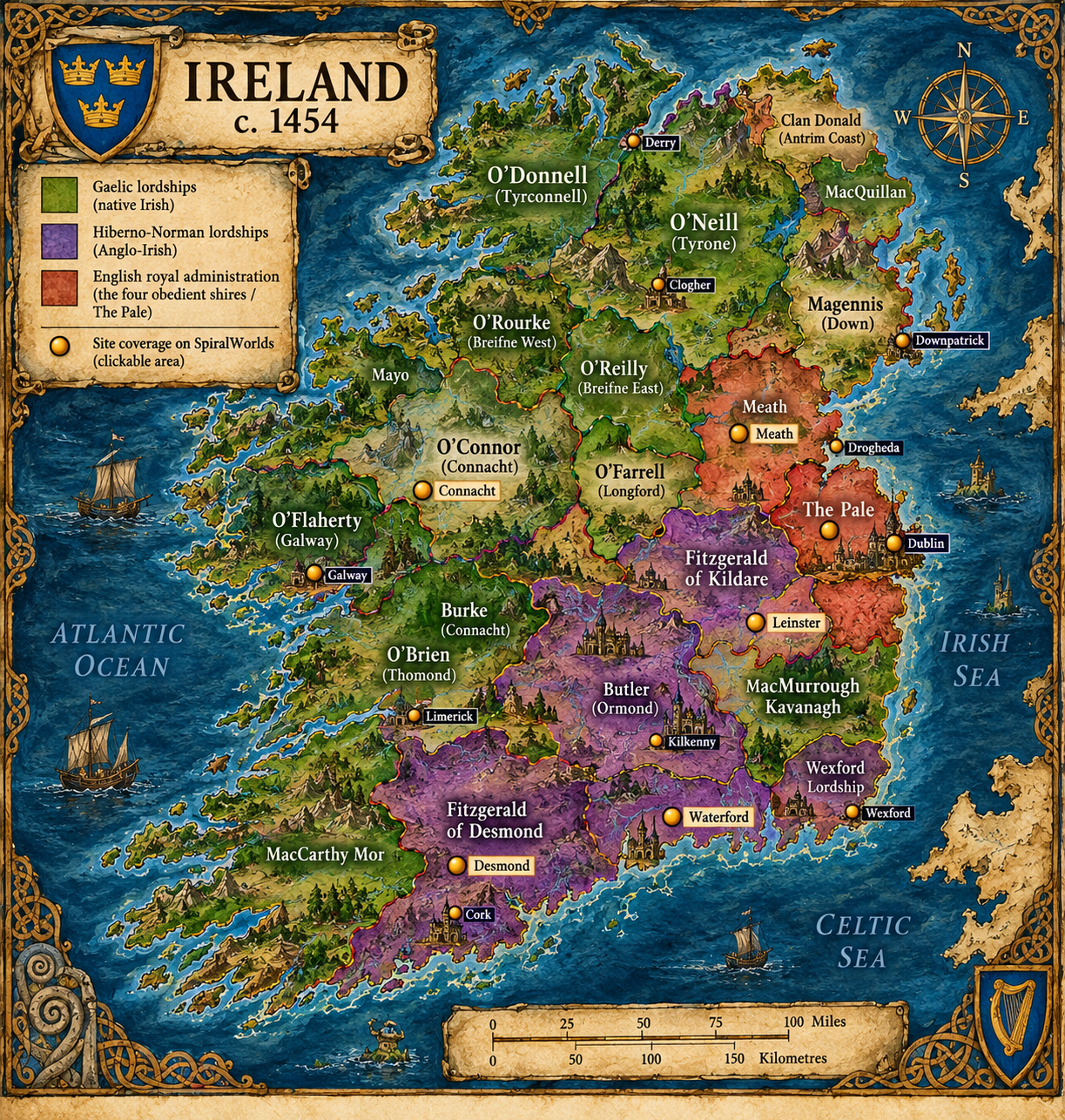
Connacht is not a kingdom with Galway as its capital. It is a competitive western political world in which O’Connor kingship has split into Donn and Ruadh branches, Burke dynasties have become deeply embedded in Gaelic lordship, and merchant Galway operates by its own urban interests. Aodh O’Connor Don is the strongest claimant to provincial kingship, but he rules through power, alliance and tribute rather than a uniform administration.
What Is Happening Right Now?
Aodh O’Connor Don has strengthened his branch of the dynasty around Roscommon and Ballintober. His rivals cannot ignore him, but neither can he abolish the O’Connor Roe line or the other great houses that shape the province.
In Uí Maine, Aodh O’Kelly has been forced to acknowledge O’Connor Don supremacy after civil war within the O’Kelly dynasty. That submission is real but unstable: hostages and rents bind the agreement more securely than affection does.
The Burkes are equally important. Uilleag Ruadh of Clanricard has rebuilt his position in south-east Connacht after defeating the northern Burke pressure, while Edmund na Féasóige remains MacWilliam of Mayo. Both houses use Gaelic forms of lordship while maintaining their own dynastic identity and ambitions.
Galway grows wealthy through Atlantic and European trade. Its merchants want roads and sea lanes kept open, yet the town survives by bargaining with the powerful lordships surrounding it rather than pretending they do not exist.
Run Connacht Tonight
The Ballintober Hostage
A hostage sent to Aodh O’Connor Don disappears from Ballintober Castle. The family that surrendered him assumes murder. Aodh knows the young man fled after hearing a voice beneath the castle well calling him by a dynastic name nobody has used for generations.
The Clanricard Cargo
A Galway ship unloads fine wine, armour and a locked chest for Uilleag Ruadh Burke. A rival merchant claims the chest belongs to the MacWilliam of Mayo. Breaking the seal may begin a Burke war; leaving it closed may deliver a weapon to one side.
The Cattle Road
Three hundred cattle vanish overnight from a lordship whose borders are watched. Tracks enter a bog and never emerge. The owner assumes a raid until cattle bells begin ringing from beneath the ground.
The Island Tribute
An island community refuses its customary payment after boats disappear in calm weather. The lord sends armed collectors. The islanders insist the tribute was already paid—to the people beneath the sea.
The Two O’Connors
Representatives of the Donn and Ruadh branches each produce a genealogical manuscript proving superior right to the provincial kingship. Both manuscripts are authentic. The disagreement lies in which ancestor’s renunciation was magically binding.
The O’Connor Kingship
The old kingship of Connacht has fractured into competing dynastic branches. O’Connor Don and O’Connor Roe each claim legitimacy, cultivate allies and use inauguration, hostages and military success to make that claim real.
Aodh O’Connor Don is the dominant ruler in 1454. His strength reaches beyond his own demesne through pressure on neighbouring dynasties such as the O’Kellys of Uí Maine. Yet his power is not absolute, and rival O’Connor branches remain capable of drawing in Burke and MacDermot support.
This creates excellent campaign politics because a character can serve “the king of Connacht” and still encounter another lord making the same claim with a different legal and genealogical argument.
Clanricard and the MacWilliam Burkes
The descendants of the de Burgh conquerors have become integral to western Ireland rather than remaining a separate colonial layer. Their leading branches compete in Gaelic political terms, maintain learned households and make alliances with O’Connors, O’Briens and other dynasties.
Clanricard
Uilleag Ruadh Burke rules the Clanricard lordship in south-east Connacht. His long reign is comparatively stable and prosperous, giving him enough strength to intervene beyond his own territory and to resist domination by the Mayo Burkes.
MacWilliam of Mayo
Edmund na Féasóige Burke leads the western MacWilliam lordship. Mayo’s Burke power stretches across cattle country and Atlantic routes, with alliances that can pull the lordship into O’Connor succession struggles.
The rivalry between the two Burke spheres is not constant open war. Marriage, fosterage, temporary overlordship and shared enemies create periods of cooperation that can collapse quickly.
Galway Is a Port, Not a Capital
Galway is the great urban exception in Connacht: a walled merchant town tied to English law and Atlantic commerce, surrounded by lordships that operate according to different political customs.
Its merchants trade hides, fish, wine, cloth and other high-value goods. They need relations with Clanricard and other nearby lords because roads, grazing lands and inland markets cannot be secured by city walls alone.
A Galway adventure should therefore feel commercial and diplomatic. The question is often not “who rules Connacht?” but “whose guarantee gets this cargo safely from the gate to its buyer?”
Places That Matter
Galway
The western merchant port, tied into Atlantic trade and surrounded by powerful Gaelicised lordships.
Ballintober
A principal O’Connor Don stronghold in Roscommon and a centre of dynastic power, hostages and political assembly.
Roscommon
A contested castle-and-lordship landscape where English fortification, O’Connor power and regional routes meet.
Uí Maine
The O’Kelly kingdom across east Galway and south Roscommon. Internal rivalry has opened the door to O’Connor Don overlordship without erasing O’Kelly ambitions.
Mayo
The western MacWilliam Burke sphere: cattle, castles, druidic colleges, rugged coast and routes toward Clew Bay and the islands.
Aran Islands
The limestone islands guard approaches to Galway Bay and hold ancient forts, sacred colleges and sea-facing ritual places where human lordship feels provisional.
Sligo and the North-West
O’Connor Sligo power connects Connacht politics to Tír Conaill and the north. Control of castles and routes here can decide whether an Ulster alliance reaches the province.
Landscape and Economy
Cattle are wealth, food, rent and political leverage. A raid can deprive a lord of immediate resources while advertising that he cannot protect his dependants. Recovering cattle is therefore both an economic and reputational necessity.
The landscape makes pursuit difficult. Bog, lake shores, limestone country and mountain passes create routes known intimately by local guides. Coastal lordships add another dimension: a galley can move men around a blocked road or place raiders behind an enemy’s frontier.
Druidic colleges, poetic schools and learned households preserve literacy, genealogy and patronage. Filí and genealogists are politically important because a dynasty’s remembered descent can support claims to tribute and kingship.
Gods, Ancestors and the Western Otherworld
Druidic colleges, household cults and sacred places structure public worship across Connacht. Mounds, wells, lakes, islands and caves preserve agreements with gods, ancestors and Otherworld powers whose claims predate both O’Connor and Burke rule.
The Atlantic edge is especially dangerous because sea and Otherworld routes overlap. Selkies, merfolk and drowned courts should not appear as random monsters; they have territories, debts and knowledge of ships that vanished before current dynasties existed.
Banshee traditions are similarly dynastic. A death-warning attached to a ruling house becomes a political event when several rival branches hear it on the same night.
Dungeon: The Drowned Rath of Lough Ree
Low water reveals the top of an earthwork on an island normally hidden beneath the lake. Both O’Connor branches claim it as an ancestral inauguration site.
The Causeway
A submerged stone road becomes visible only at dawn. Cattle refuse to step onto it, but horses can cross.
The Genealogists’ Chamber
Wooden tablets preserve lines of descent omitted from surviving manuscripts. Reading one aloud causes the named descendants—living or dead—to answer.
The Tribute Store
Bronze, silver, cattle bells and foreign coins have been deposited for centuries. Taking any item transfers the unpaid obligation attached to it.
The Two Thrones
Two stone seats face each other across black water. Each accepts a different O’Connor claimant. The chamber will recognise both but demands that anyone seeking exclusive kingship defeat the other claim under rules older than either dynasty remembers.
Travel and Law
| Zone | What Shapes Travel |
|---|---|
| O’Connor country | Dynastic allegiance, tribute, hostages and local guarantees determine safe passage. |
| Clanricard | Burke lordship is strong; merchant relations with Galway matter greatly. |
| Mayo | MacWilliam power, coastal routes and cattle wealth dominate. |
| Galway | Urban law, guild and merchant interests govern inside the walls. |
| Atlantic islands | Weather, boat skill, local hospitality and supernatural sea claims matter more than formal borders. |
Historical and Mythic Context
By the middle of the fifteenth century Connacht is politically plural. Aodh O’Connor Don remains the senior figure of his branch and will live until 1461. O’Connor Roe rivals, O’Kellys, O’Connor Sligo and other Gaelic houses prevent any easy unification.
The Burke lordships are equally embedded in the province. Uilleag Ruadh has ruled Clanricard since 1430 and maintains a strong south-eastern lordship; Edmund na Féasóige leads the Mayo Burkes until 1458. Their careers show why describing Connacht as simply “Gaelic” or “Anglo-Norman” misses the political reality.
Dictionary of Irish Biography — Aodh O’Connor Don · Dictionary of Irish Biography — Uilleag Ruadh Burke of Clanricard · Dictionary of Irish Biography — MacWilliam Burkes of Mayo
Map of the Political Landscape
Keep this reference growing
If this page helped with your reading or game, you can support its upkeep or explore the curated books.
Explore the Bookshop — epics, classics and stories behind imagined worlds.