
Waterford — Royal Port of the Suir
Ireland · Walled royal city · Viking harbour · Wine trade · Southern sea gate
At a Glance
| Region | South-east Ireland at the head of Waterford Harbour |
|---|---|
| Political status | Chartered royal city with its own mayor, council, courts and trading privileges |
| Key stronghold | Reginald’s Tower, the strongest surviving point of the medieval city defences |
| Trade | Wine, wool, hides, fish, salt, imported goods and traffic through the Suir estuary |
| Best for | Merchant intrigue, harbour law, smuggling, civic politics, sea travel and Viking underlayers |
| Supernatural pressure | Sea-fey, pookas, ancestral dead, tidal passages and powers of mist and harbour water |

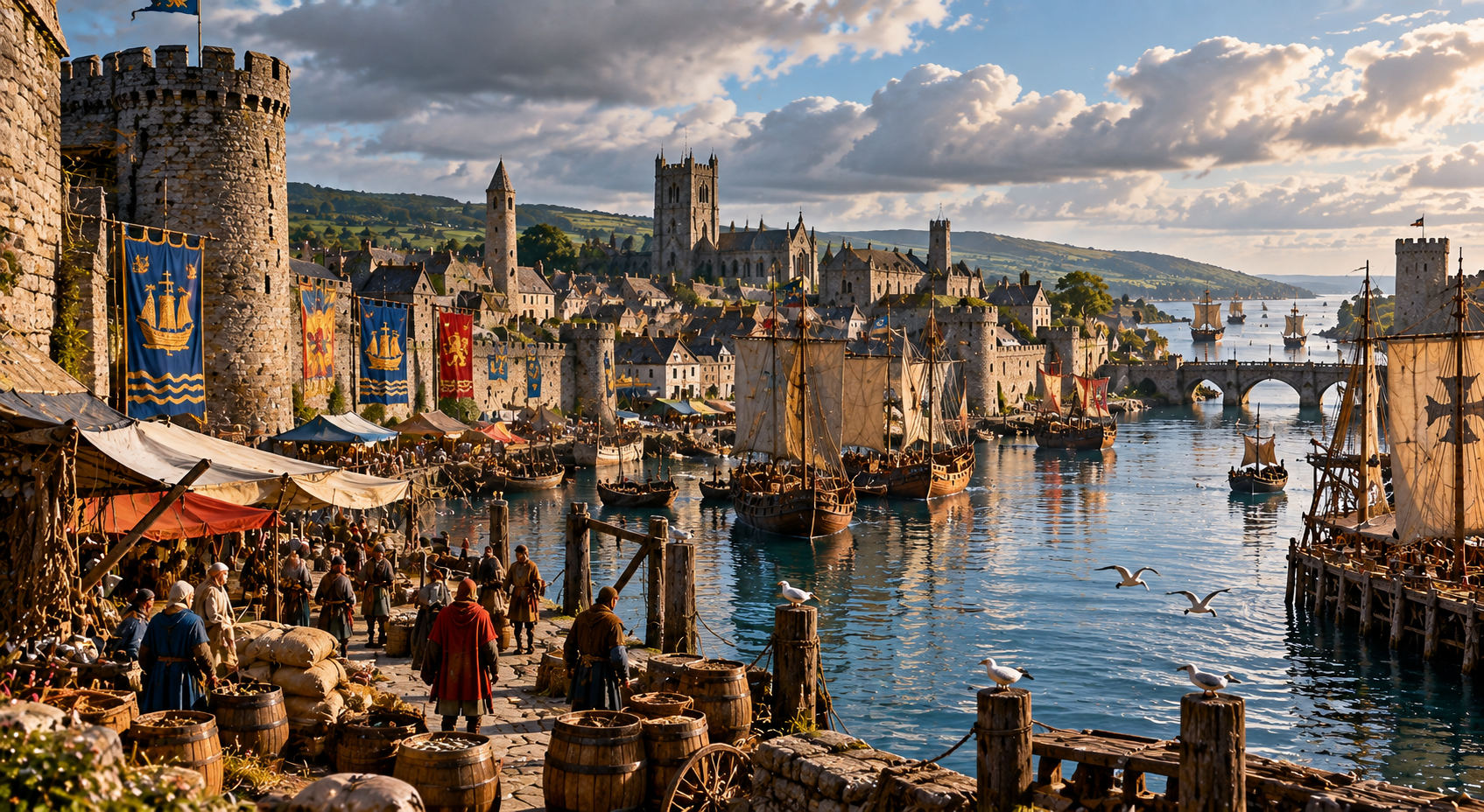
Waterford is a fortified merchant city where river, sea and chartered privilege meet. Founded by Norse rulers and strengthened under Anglo-Norman government, the city guards the head of a deep harbour while its merchants defend trading rights almost as fiercely as its soldiers defend the walls.
What Is Happening Right Now?
Waterford’s council is protecting privileges that generations of kings have confirmed. Foreign ships entering the harbour are expected to respect the city’s trading rights, and merchants who try to buy cargo outside Waterford’s franchise can find themselves before the mayor and bailiffs.
The city stands between powerful regional interests. Butler power to the north and west, Desmond influence farther into Munster, Gaelic lordships inland and Crown administration through Dublin all matter, but none replaces Waterford’s own civic government inside the walls.
Sea trade makes the city richer and more exposed than an inland stronghold. News from Bristol, Wales, France and Iberia arrives with wine and salt. So do fugitives, spies, strange cargoes and sailors who swear that islands appeared where no chart marks land.
Run Waterford Tonight
The Unlicensed Wine
A merchant buys a cargo of Gascon wine outside the city’s recognised harbour rights. The council orders the casks seized. By midnight one barrel is leaking black seawater, and something inside knocks three times whenever the tide turns.
The Tower Ledger
A clerk in Reginald’s Tower finds a customs roll recording a ship that entered Waterford a century ago and has never officially departed. That evening the same ship is reported beyond the harbour mouth.
The Missing Gate
A watch patrol counts one more gate in the city wall than should exist. The extra arch opens only from the inside and leads to a quay where every vessel flies an unfamiliar banner.
The Royal City and Its Privileges
Waterford’s power rests on charters as much as stone. Royal grants protect trading privileges, taxation rights and civic authority. The mayor and council govern a merchant community wealthy enough to argue with neighbouring ports and persistent enough to preserve written evidence when those rights are challenged.
The Great Charter Roll assembled in the previous century records the city’s claims and presents Waterford as one of Ireland’s royal cities. The council’s own records continue to track property, trade, civic offices and offences. For adventurers caught in a commercial dispute, a wax seal can matter more than a sword.
The streets are crowded with warehouses, wine cellars, workshops, counting rooms and lodgings for crews. Merchant families compete through marriage, credit and access to cargo before resorting to violence, though all three can happen in the same dispute.
Reginald’s Tower and the City Walls
Reginald’s Tower stands where the old Viking and later Anglo-Norman defences meet the quay. The first fortification on the site was timber; the stone tower became one of the strongest points in the medieval walls and has remained in continuous use for centuries.
Waterford’s defences extend far beyond one tower. Gates, towers, ditches and walls form a system built and rebuilt around the needs of a prosperous port. A merchant who knows a postern, a quay stair or a warehouse passage can cross the defensive line without approaching the main gates.
The upper stages of Reginald’s Tower are being strengthened as artillery becomes more important. Stone that once stopped arrows must now survive guns.
Landmarks & Places to Know
Reginald’s Tower
The great riverside tower is Waterford’s clearest landmark and a visible statement that the city’s defences face the Suir as much as the roads. It is watchpoint, stronghold and anchor for the walls.
The City Walls and Gates
Waterford’s gates regulate carts, merchants, livestock and armed travellers. They are ideal places for officials to inspect goods and for smugglers to learn which guards can be bribed.
The Suir Quays
The quays are where Waterford becomes an international port. Wine, salt, cloth, fish, timber, news and strangers all arrive here, and every ship creates work for porters, brokers, pilots and thieves.
Taverns, Inns & Lodgings
Quayside Taverns
Sailors and port labourers drink close to the ships, while merchants use better rooms nearby to settle cargo business. These houses are ideal for finding passage, recruiting a crew or tracing goods that disappeared between ship and warehouse.
Gate Inns
Road travellers with horses and carts prefer yards near the city gates, where there is room for animals and an early departure does not require crossing the crowded centre. Drovers, messengers and armed retainers are common guests.
Merchant Wine Houses
Waterford’s overseas trade supports more respectable places where imported wine, contracts and private conversations share the same tables. Prices are high, but so is the quality of information about shipping, credit and foreign buyers.
Dungeon: Beneath Reginald’s Tower
The city’s strongest dungeon lies below one of its busiest defensive structures. Reginald’s Tower is occupied, guarded and tied directly to civic authority. Any hidden passage beneath it is a threat to Waterford’s walls and harbour.
The Mint Store
Old strongrooms preserve traces of the period when coin and royal treasure passed through the tower. One floor stone bears tool marks from repeated lifting, though no current keeper admits knowing what lies beneath it.
The Viking Footing
A narrow shaft descends to the level of the earlier Norse fort. Timber impressions survive in black earth beneath later stonework. At the bottom, a passage follows the line of the old triangular settlement rather than the present walls.
The Tide Chamber
The passage opens into a vaulted room partly flooded at high tide. Mooring rings line one wall despite there being no ordinary route for a boat to reach it. Saltwater rises through cracks even when the river is low.
The Harbour Door
An iron-bound hatch stands below the waterline. When opened during the lowest tide, it reveals a stone quay under a moonless sky. Ships wait there without crews, their cargoes marked with names of merchants not yet born.
A breach beneath Reginald’s Tower immediately becomes a civic crisis. Smugglers can bypass the walls, enemies can enter the city, and anything moving through the hidden harbour can reach the warehouses above before the mayor learns it exists.
The Suir and the Southern Sea Roads
The River Suir carries Waterford’s trade toward the sea and inland toward rich agricultural country. The harbour widens into an estuary where pilots, tides and local knowledge determine whether a ship reaches the city safely.
Waterford’s merchants fight to control where foreign ships may unload because every diverted cargo weakens the city’s privileges. Rivalry with neighbouring ports is therefore economic, legal and occasionally violent.
Manannán mac Lir is respected by sailors who know how quickly a familiar coast can vanish in mist. A ship delayed by supernatural fog may miss a market day, a convoy or a political deadline ashore.
Creatures of Waterford Harbour
Selkies
Selkies move through the outer harbour and southern coast, sometimes trading news or favours with fishing families. Their promises follow kinship and sea-law rather than Waterford’s charters.
Pookas
Pookas haunt roads leading inland from the port. Merchants dislike them less for violence than for making schedules, distances and directions unreliable.
Sea Serpents
Sea serpents occasionally move into the approaches from deeper Atlantic water. A serpent need not attack the city to cause a crisis; simply remaining near the harbour mouth can halt shipping and send prices climbing.
Historical and Mythological Context
Waterford was founded as a Viking settlement in the early tenth century and captured by Anglo-Norman forces in 1170. Reginald’s Tower occupies the site of an earlier wooden Viking fort and became the strongest point in the later medieval defences. Heritage Ireland describes it as Ireland’s oldest civic building and records more than eight centuries of continuous use.
Waterford’s civic records reveal an unusually strong merchant government. Royal charters protected the city’s trading privileges, including claims over foreign shipping in Waterford Harbour, while surviving fifteenth-century records show the mayor and council actively enforcing those rights.
Heritage Ireland — Reginald’s Tower · Waterford City & County Council — Medieval City Records · Waterford Treasures — Great Charter Roll · Waterford Treasures — Fifteenth-Century Civic Records
Keep this reference growing
If this page helped with your reading or game, you can support its upkeep or explore the curated books.
Explore the Bookshop — epics, classics and stories behind imagined worlds.