
Harlech — Castle of Rebellion and the Sea Gate
Wales · Royal castle · Gwynedd coast · Living memory of rebellion
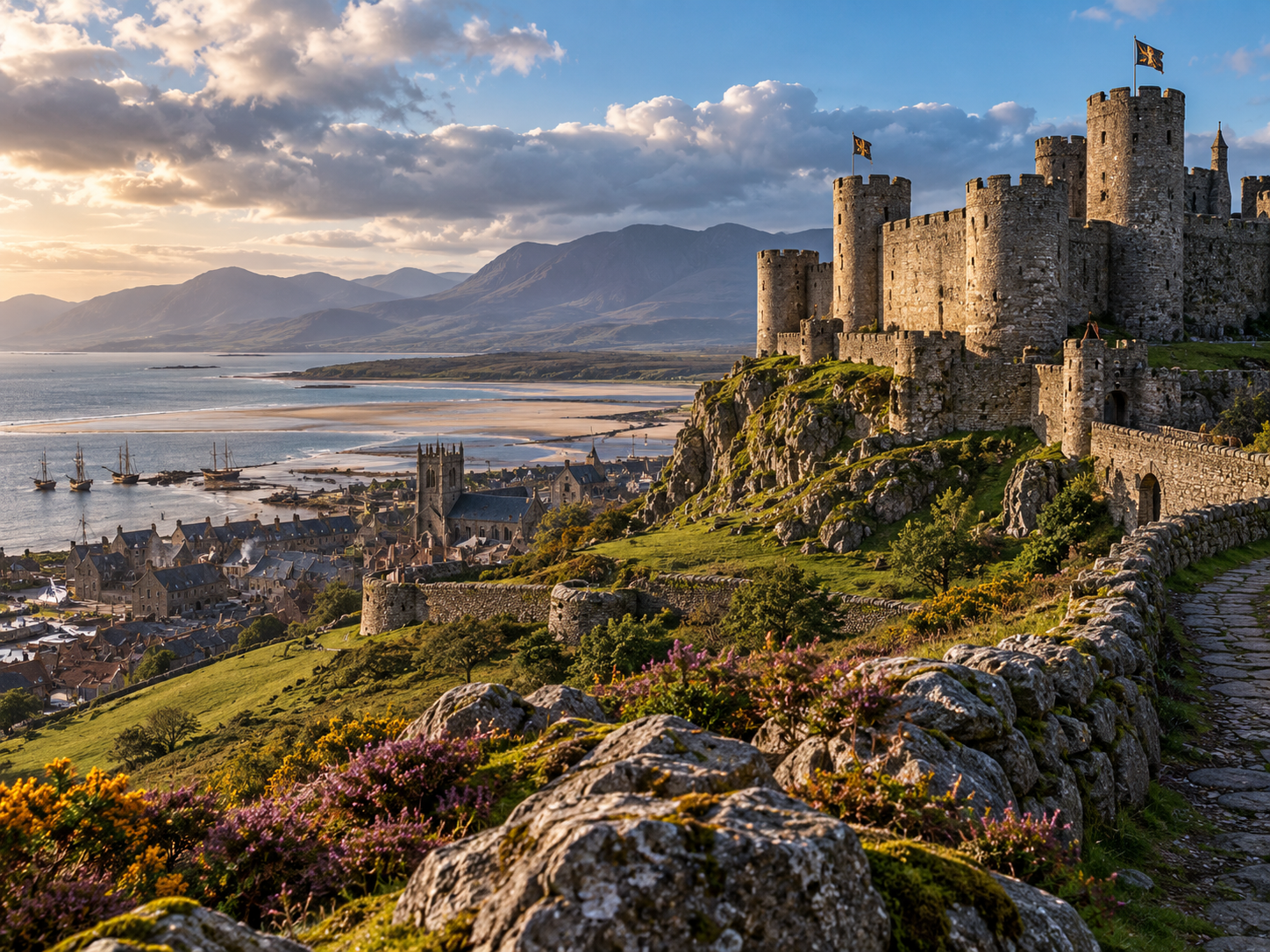
Harlech is one of the strongest castles in Wales and one of the most politically charged. Fifty years have not passed since Owain Glyndŵr seized it, made it his court and used it as a centre of an independent Welsh government. In 1454 the fortress is back under English royal authority, but the memory of that court is still alive.
At a Glance
| Region | Gwynedd, north-west Wales |
|---|---|
| Stronghold | Harlech Castle |
| Current authority | English Crown and royal officers |
| Recent memory | Owain Glyndŵr held Harlech as court and headquarters from 1404 until the castle fell in 1409 |
| Best for | Castle intrigue, secret archives, smuggling, old rebellion networks, sieges and supernatural political memory |
| Strategic feature | The steep sea access once allowed the fortress to be supplied by ship |
What Is Happening Right Now?
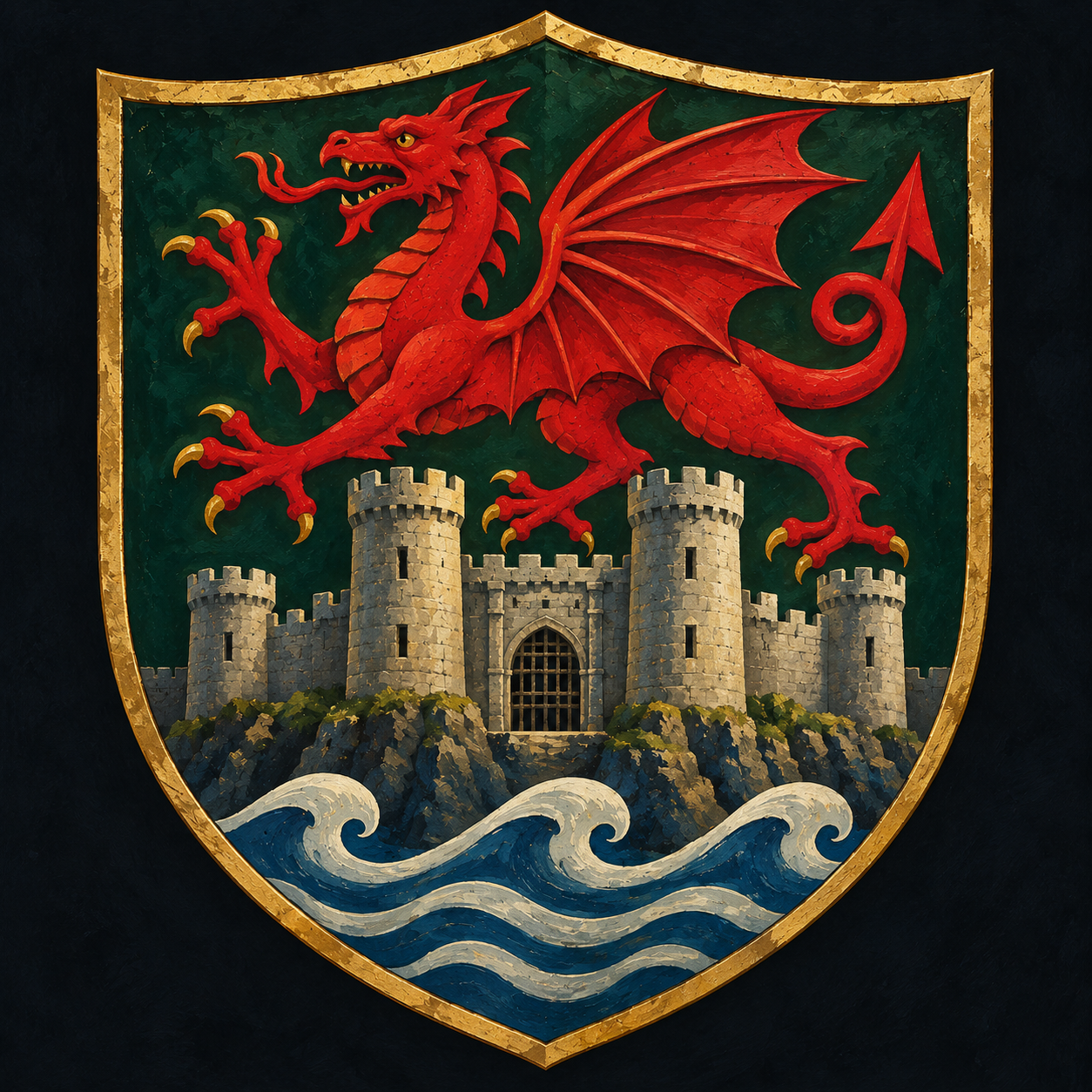
Royal officers control the castle, but they do not control what every nearby family remembers. Some households suffered during the revolt. Others served Glyndŵr. Some changed sides. A generation has grown up hearing incompatible versions of the same events.
Harlech is therefore an excellent place for campaigns about documents, inheritance and loyalty. A chest opened in the castle can contain proof of a confiscated estate. A former rebel can now be a respectable landholder. A royal servant can be descended from somebody who sat in Glyndŵr’s hall.
Run Harlech Tonight
The Parliament Chest
Workmen uncover a sealed chest behind later masonry. Inside are records from Glyndŵr’s court naming supporters, creditors and foreign contacts. Several living families could gain or lose everything if the documents become public.
The Way from the Sea
Smugglers are using the steep sea route below the castle. The cargo is not ordinary contraband but ritual objects removed from a ruined Welsh sanctuary, and something has followed them inland.
The Prince in the Hall
Guards report seeing Owain Glyndŵr seated in an empty chamber after midnight. The apparition speaks only one sentence to each witness, and every sentence concerns a different unresolved oath.
The Castle as a Campaign Engine
Harlech is defensible because architecture and geography work together. Use gates, walls, elevated approaches and the sea route as actual tactical facts. An infiltrator does not simply “enter the castle”; they need a route, disguise, bribed servant, hidden access or supernatural means.
The fortress links naturally to Gwynedd and the mountain country of Eryri. A mission beginning as royal business can therefore become wilderness travel within a day.
Landmarks & Places to Know
Harlech Castle
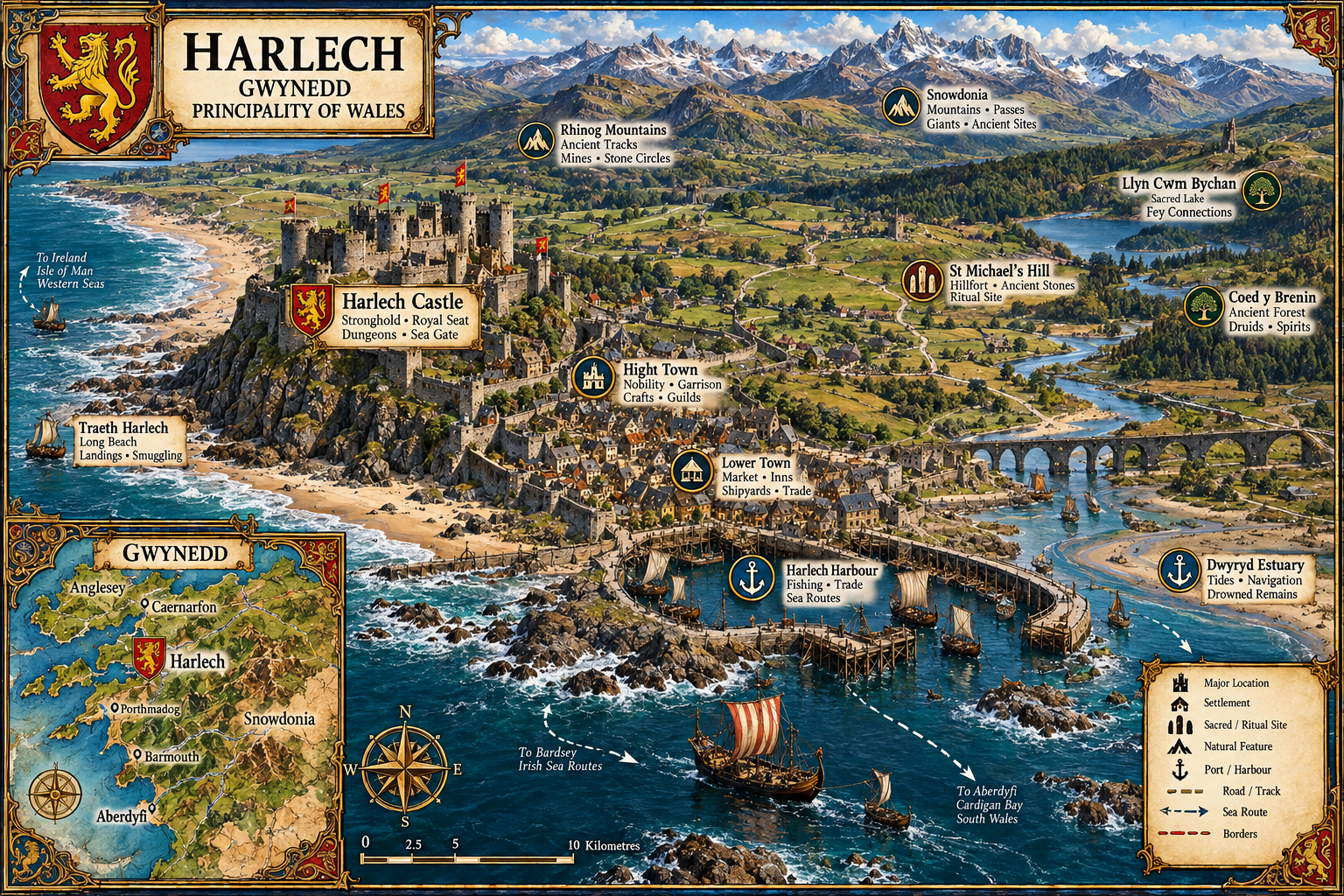
The fortress is the settlement’s defining landmark: a high stone stronghold overlooking the coast and the routes into Ardudwy. Its gates, towers, stores and lower works shape almost every political and military problem in the town.
The Castle Gate and Borough Streets
Markets, messengers, craftsmen and officials gather below the fortress. Anyone watching the gate can learn who is being admitted to the castle, which supplies are running short and whether the garrison expects trouble.
The Sea Approach
Harlech’s coastal access matters even when the shoreline shifts with tide and weather. Boats can bring food, messages, fugitives and weapons around blocked roads, making the seaward route strategically important.
Taverns, Inns & Lodgings
Castle-Gate Alehouses
Guards, craftsmen, messengers and petitioners drink close to the fortress because waiting is part of doing business with a garrison. These rooms are useful for hearing military gossip and dangerous for anyone trying to hide from castle officers.
Market Lodgings
Merchants, drovers and travellers can find simple beds, meals and stabling among the borough streets. Prices rise when troops, officials or noble households fill the town.
Sea-Road Houses
Rougher lodging near the coastal approach caters to boat crews, fishermen, guides and travellers arriving by difficult routes. These are the places to ask about hidden coves, night landings and who has recently come ashore without announcing it.
Dungeon: Beneath Harlech Castle
Harlech is not a hollow ruin waiting for adventurers. It is an occupied royal fortress, so the dungeon begins inside a living military site. The gatehouse, ward buildings, stores, guardrooms and secure chambers above are the first layer: prisoners, confiscated property, sealed records and hidden rebel correspondence can all be kept where soldiers still walk every day.
Beneath those working spaces are older service rooms, cisterns, blocked passages and chambers cut into or against the rock of the crag. Some were known to Glyndŵr’s household and later sealed when the castle changed hands. These are the best places for forgotten archives, caches left during the siege, oath-bound doors and rooms that royal officers have never fully searched.
The Way from the Sea forms the dungeon’s western spine. The steep descent to the old landing is watched from above, but side chambers, storage cuts and concealed openings make it a natural smuggling route. A party can enter from the castle, climb from the shore, or discover a blocked passage connecting the sea stair to the lower rock.
Deeper still, Harlech’s crag contains chambers older than the castle. Standing stones, flooded fissures and Otherworld-thin places lie beneath the medieval foundations. These lowest rooms are where the political dungeon becomes mythic: rebel oaths can still bind, voices from Annwn answer through stone, and a forgotten door can open beneath the mountain rather than into another castle room.
Run Harlech in four layers: occupied fortress → sealed rebel chambers → sea-route underworks → ancient rock and Otherworld depths. Trouble below should always matter to the living garrison and the families around the castle above.
Rebellion, Memory and the Supernatural
Do not treat Glyndŵr’s revolt as dead exposition. In 1454 its participants’ children are adults, confiscations remain family history and the places used by the rebellion still exist. In the supernatural layer, oaths sworn in the castle can retain force even after the government that received them vanished.
That pressure makes Harlech a natural meeting point between political memory and the older Welsh supernatural world. A claimant seeking proof in a rebel archive may also attract powers concerned with sovereignty, oath-breaking, inheritance or the boundary between the mortal coast and Annwn.
Creatures Around Harlech
Cŵn Annwn hunt the lonely mountain roads and misted passes east of Harlech when the boundary with Annwn thins. Their white hounds and red ears are an omen that a quarry has already been chosen.
Blodeuwedds keep to flower-rich uplands, hidden meadows and fey paths beyond the coast. Soldiers cutting new tracks or landlords pressing old boundaries can disturb their territory without knowing it.
Addancs lurk in deep upland lakes, flooded hollows and dangerous waters on the routes into Eryri. Travellers disappearing inland are sometimes taken by the water long before they reach the mountains.
Heroes, Rulers and Otherworld Figures
Gwyn ap Nudd rules Annwn and leads the Wild Hunt. His riders and hounds cross the older roads around Harlech without recognising English or Welsh borders, and they come for the dead, the oath-breaker and the quarry marked for the hunt.
King Gwyddno Garanhir rules drowned Cantre’r Gwaelod beneath the western sea. Sailors still speak of submerged halls, bells under the water and claims to land that vanished beneath the waves.
Taliesin is the legendary Welsh bard and prophet. His songs preserve royal claims, betray old lies and keep names alive long after courts and governments have fallen.
Welsh Powers at Harlech
Math fab Mathonwy holds ancient authority in Gwynedd over court-law, sovereignty, hidden speech, inheritance and oath-breaking. A forged charter or false claim inside Harlech can draw his attention as surely as a broken oath.
Arawn rules Annwn beyond the mortal world. His power touches the old roads, the mountain passes and the deep places beneath Harlech where the boundary between worlds grows thin.
Efnysien remains bound to Harlech through the Branwen tradition. Insult, damaged honour and family grievance are enough to turn a political quarrel into catastrophe when his influence is near.
The Red of Ardudwy
The western mountains and sea-cliffs around Harlech fall within the territory of the Red of Ardudwy, a Chaotic Neutral great red dragon of Wales. Fiercely independent, it remembers loyalty and betrayal longer than mortal governments survive. Its lairs lie among inaccessible crags and coastal caverns rather than inside the castle, but its presence has shaped local tribute, sea routes and the politics of the western coast for generations.
The Red of Ardudwy remembers rulers, rebellions and broken promises longer than mortal governments do. Welsh houses have sought its recognition in times of crisis; others have paid heavily to keep it neutral. Royal officers at Harlech therefore watch dragon signs—smoke on the heights, livestock taken without tracks, scorched stone and sudden silence among coastal birds—as closely as they watch rebel correspondence.
Younger scions sometimes contest the elder dragon’s hunting grounds. Their arrival can turn a political dispute around Harlech into open draconic violence before either side understands what has changed.
Branwen’s Harlech
Long before the present castle, Harlech was already a place of royal story. The old Welsh tales place Bendigeidfran’s court here when Matholwch of Ireland came across the sea seeking Branwen. In this world the tale is not only literature: the older court still leaves marks beneath the later fortress.
On certain feast nights, music and conversation can be heard in chambers that do not exist on the castle plan. A visitor who follows the sound may find a hall laid for guests from Britain and Ireland, with one empty place at the high table. The door closes if anyone insults the absent Branwen.
Cŵn Annwn sometimes run the hills inland from Harlech after storms, and local guides refuse to follow their cries no matter how much silver is offered.
Historical and Mythological Context
Harlech Castle was begun during Edward I’s conquest of Wales and deliberately combines a strong gatehouse, concentric defences and the steep coastal access now known as the Way from the Sea. Cadw records that the sea stair allowed the fortress to be supplied by ship during siege, making geography part of the castle’s military design rather than scenery around it. Cadw — Castell Harlech
The castle’s most important later political layer came with Owain Glyndŵr. Cadw records that he captured Harlech in 1404, established his court there and used the fortress as the centre of his government until its recapture in 1409. In 1454 that history is recent enough to remain family memory rather than remote chronicle. Cadw — More About Castell Harlech
Harlech also stands inside a much older Welsh legendary landscape. The Second Branch of the Mabinogi, the tale of Branwen ferch Llŷr, places the court of Bendigeidfran at Harlech when Matholwch of Ireland arrives seeking Branwen’s hand. The National Library of Wales preserves manuscripts and later transcripts of this tradition, while its Welsh Classical Dictionary records Harlech directly in Branwen’s legendary biography. National Library of Wales — Branwen ferch Llŷr · National Library of Wales — Welsh Classical Dictionary
This makes Harlech more than a castle placed on an old landscape. Royal courts, disputed sovereignty, dangerous hospitality, family grievance and supernatural consequence recur here across both history and myth. The living fortress inherits those patterns without requiring every later tale to be treated as a literal historical record.
Historical Foundation
Cadw records that Glyndŵr captured Harlech in 1404, established his court there and held a parliament before the castle was retaken in 1409. The fortress’s “Way from the Sea” enabled resupply during siege.
Keep this reference growing
If this page helped with your reading or game, you can support its upkeep or explore the curated books.
Explore the Bookshop — epics, classics and stories behind imagined worlds.