
Earldom of Desmond — Geraldine Power in South Munster
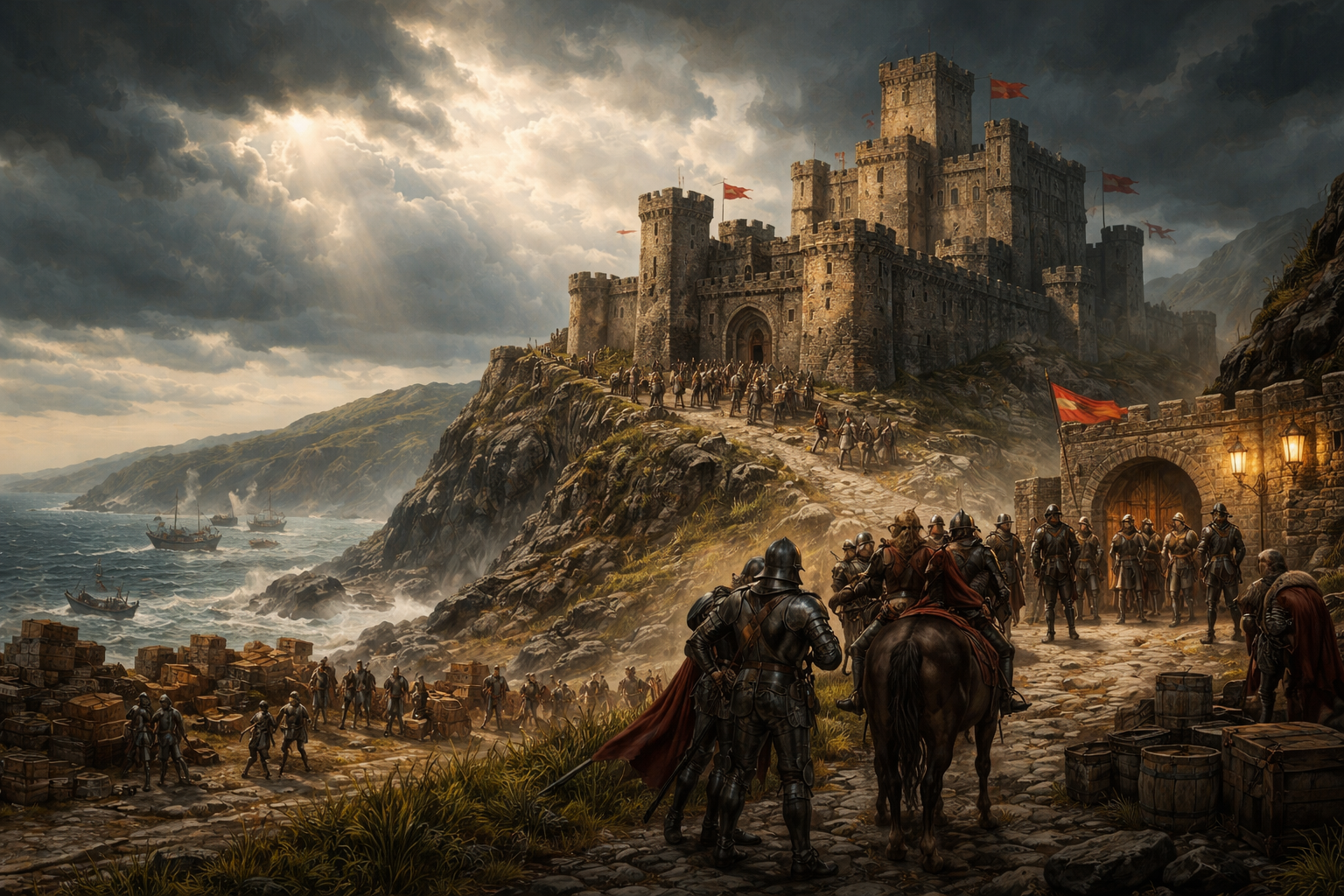
Munster · Geraldine lordship · Askeaton · Atlantic ports · Gaelic alliances · Castle country
At a Glance
| Region | South and south-west Munster, centred on Geraldine lordships across Limerick, Kerry and adjoining lands |
|---|---|
| Ruler | James FitzGerald, Earl of Desmond |
| Principal seat | Askeaton Castle on the River Deel |
| Political character | A powerful, semi-autonomous Geraldine lordship operating through castles, kinship, clients, fosterage and negotiated Gaelic alliances |
| Major neighbours | Butler Ormond, MacCarthy lordships, O’Brien Thomond, urban Cork, Limerick and Waterford |
| Economy | Cattle, hides, grain, fisheries, rents, Atlantic trade and control of roads, rivers and ports |
| Best for | Great-house politics, cattle raids, castle intrigue, fosterage, coastal voyages, disputed lordship and ancient sacred landscapes |
| Immediate pressure | Desmond is strong, but every expansion risks conflict with Ormond, MacCarthy powers or towns determined to protect their own liberties |
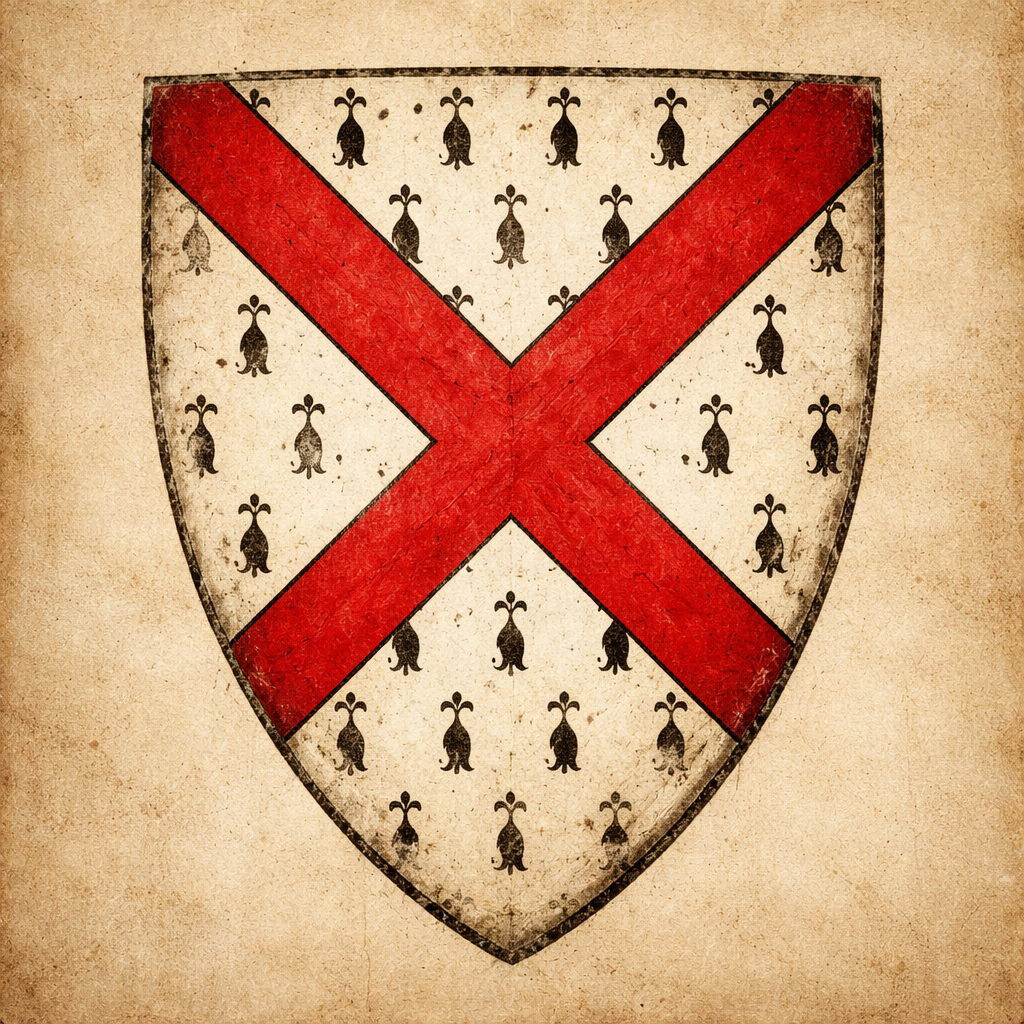
Desmond is not a collapsing frontier state in 1454. James FitzGerald has held the earldom for decades and governs one of the strongest magnate lordships in Ireland. His authority is neither purely English nor purely Gaelic: Geraldine castles, feudal title, Irish language, fosterage, brehon custom and alliances with neighbouring dynasties all operate at once. The result is a durable political machine whose greatest danger is not weakness but the number of powerful neighbours it can afford to offend.
What Is Happening Right Now?
James FitzGerald governs from Askeaton after a long reign that has made his authority familiar rather than provisional. He has fought Ormond, negotiated with royal government and submitted formally to Richard, Duke of York, without surrendering the practical independence on which Desmond power rests.
The great feud with Ormond is quieter than during the destructive raids of the 1440s, but it is not forgotten. Border lords remember burned estates, unpaid compensation and disputed rights. A minor quarrel can still become Geraldine–Butler business remarkably quickly.
South and west of the Geraldine heartland, MacCarthy, O’Sullivan and other Gaelic dynasties remain powers in their own right. Desmond relies on alliance, fosterage and negotiated submission more often than direct administration.
The ports matter increasingly. Cork, Youghal, Dingle and the Shannon routes connect Munster wealth to the wider Atlantic economy. Merchants want predictable roads and tolls even when the nobles controlling them prefer flexibility.
Run Desmond Tonight
The Earl’s Foster-Son
A young noble fostered with a Gaelic ally disappears while travelling toward Askeaton. Returning him alive will preserve two alliances; proving who arranged the disappearance may destroy a third.
The Ormond Boundary
A boundary stone is moved overnight after cattle cross into disputed pasture. Both lordships mobilise retainers before anyone checks whether the stone moved by human hands.
The Dingle Cargo
A merchant vessel unloads fine steel, wine and a sealed chest intended for the Earl. MacCarthy agents claim half the cargo under an older coastal agreement.
The Speaking Harp
A fili performs an old Geraldine praise song at Askeaton. During the final verse the harp begins naming people who will betray the Earl.
The Castle Without Smoke
A Geraldine towerhouse stops sending its customary beacon. Riders arrive to find every inhabitant alive, calm and unable to remember the previous three days.
James FitzGerald and the Geraldine Lordship
James FitzGerald has held Desmond since 1418 and remains its central political figure. His strength comes from longevity, land, armed clients and the ability to operate comfortably inside both English-derived aristocratic structures and Gaelic political custom.
He is not an administrator ruling every village directly. Desmond works through a hierarchy of Geraldine kinsmen, tenants, castle captains, foster relations, Gaelic allies and lesser lords whose loyalty must be maintained.
The Earl’s court at Askeaton therefore functions as a clearing house for disputes, marriages, military service, tribute, hospitality and information. Adventurers useful to the household can move quickly from local trouble to regional politics.
Askeaton
Askeaton Castle on the River Deel is James FitzGerald’s principal seat and one of the defining strongholds of the earldom. Its hall is designed for the politics of hospitality: feasts, negotiations, poetry, judgement and the public display of who sits close to the Earl.
The castle stores more than weapons. Genealogies, debt records, hostage agreements and letters from neighbouring lords can be more dangerous than anything in the armoury.
River access links Askeaton toward the Shannon and Limerick, giving the Geraldines a route for supplies and messages that does not depend entirely on roads.
Geraldine and Gaelic Power
The FitzGeralds of Desmond are deeply Gaelicised without ceasing to be earls. Irish speech, fosterage, poetic patronage, brehon judgement and local military practice are normal parts of lordship.
That does not erase cultural difference. Towns with royal charters, Geraldine tenants, MacCarthy clients and independent dynasties may all understand land and law differently. Desmond succeeds by using several systems rather than forcing one everywhere.
This makes mixed parties particularly useful. A character who understands a town charter, another who can argue before a brehon and another trusted by a Gaelic household may together solve problems no single official can.
Neighbours and Rivals
Ormond
The Butlers remain Desmond’s great aristocratic rivals. Their competition is political, territorial and personal. Even during periods of peace, each house watches the other’s marriages and alliances.
MacCarthy Lordships
The MacCarthys remain powerful across south-west Munster. Some branches cooperate with the Geraldines; others resist expansion. Their own internal divisions mean “the MacCarthys” are never one simple faction.
Thomond
O’Brien power north of the Shannon shapes Desmond’s northern strategy and its relationship with Limerick.
The Merchant Towns
Cork, Limerick, Youghal and other towns value their privileges and trade. They cooperate with Desmond when protection helps commerce and resist when Geraldine demands threaten urban autonomy.
Roads, Cattle and Castles
Desmond wealth is territorial. Cattle, pasture, grain, fisheries and rents matter more than abstract borders. A raid that takes livestock can weaken a household immediately while showing neighbours that its lord cannot protect dependants.
Towerhouses and major castles anchor local power. They control crossings, store food, shelter retainers and give rulers somewhere to hold hostages or await reinforcements.
Roads are political. A route safe for a Geraldine messenger may be dangerous for an Ormond servant. Safe conducts work only where the issuing lord has enough reputation to make people respect them.
Atlantic Desmond
The western coast opens toward the wider Atlantic rather than ending at the edge of the map. Dingle and Kerry routes bring ships, fishermen and foreign merchants into contact with lordships whose inland politics they may barely understand.
Storms, piracy and local tolls make maritime trade risky, but the sea can still move valuable cargo faster than overland roads. A coastal lord able to protect a harbour can gain influence disproportionate to the size of his territory.
Sea caves, islands and headlands are also sacred spaces. Some contain druidic enclosures or offerings maintained by fishing communities long after nearby dynasties change.
People and Factions
| Power | What They Want |
|---|---|
| James FitzGerald, Earl of Desmond | Preserve Geraldine supremacy, manage neighbours and keep royal recognition without accepting close outside control. |
| Geraldine kinsmen | Land, offices, marriage advantage and enough independence to build their own followings. |
| MacCarthy rulers | Protect their own lordships and exploit Geraldine rivalries when useful. |
| Merchant towns | Open roads, predictable tolls and freedom from arbitrary noble interference. |
| Druids, filí and brehons | Preserve sacred obligations, genealogy, law and the social memory rulers need for legitimacy. |
| Castle captains | Hold strategic ground while ensuring their loyalty is rewarded rather than merely assumed. |
Magic and the Land
Desmond’s supernatural politics are tied to sovereignty, hospitality and inherited obligation. A family may hold a castle by Geraldine grant while the hill beneath it still recognises a much older guardian.
Filí can make reputation physically consequential through inspired satire or praise. Geasa imposed during fosterage or marriage may survive political realignments. Coastal beings bargain in safe harbours, weather and drowned treasure rather than coin.
The greatest mistakes occur when a ruler assumes that conquering land automatically transfers every agreement attached to it.
Dungeon: The Hall Beneath Askeaton
Work beneath an older section of Askeaton Castle uncovers a sealed stair descending toward the river.
The Hospitality Hall
A long stone room contains seats marked with family emblems. Anyone sitting in the wrong place hears every insult ever spoken against that lineage.
The Fosterage Vault
Tokens exchanged during generations of foster agreements lie in niches. Removing one ends the associated obligation immediately.
The River Door
A passage opens onto a hidden landing below the castle. Boats can reach it only during a narrow tide.
The Geraldine Stone
The deepest chamber contains a standing stone that predates the castle. It recognises the Earl’s lineage but refuses to recognise ownership of the land.
The Banshee of the MacCarthys
The MacCarthy houses of the south-west have their own banshee tradition. When her cry is heard near a residence, road or river crossing, experienced retainers do not waste time arguing over whether the sound is natural. They identify which branch of the family is present and send riders immediately.
The banshee does not kill. She announces that death has entered the family’s story. That warning can change succession, hostage arrangements, military plans and marriage negotiations before the dying person has drawn a final breath.
Clurichauns and other solitary fey also trouble wealthy Geraldine and MacCarthy cellars, but only the banshee can empty a hall merely by being heard outside it.
Historical and Mythic Context
James FitzGerald’s long rule is a period of substantial Geraldine stability. He administers Desmond from Askeaton, enlarged during his lifetime, and maintains a lordship capable of fighting Ormond, negotiating with royal government and operating through the mixed political culture of Munster.
His submission to Richard, Duke of York, in 1449 does not make Desmond a closely governed royal province. It reflects the normal late-medieval balance between formal allegiance and powerful regional autonomy.
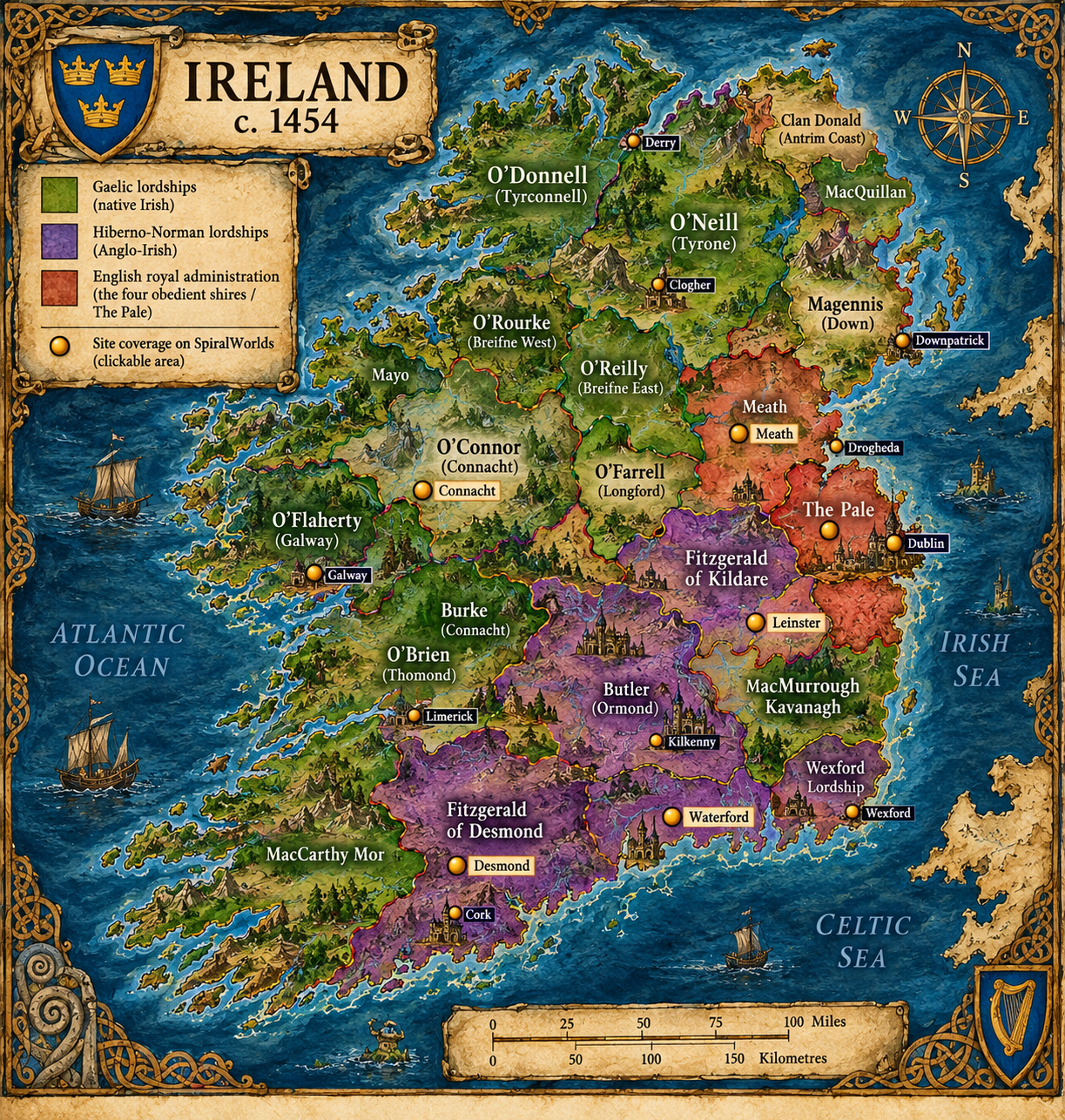
Map of Munster
Keep this reference growing
If this page helped with your reading or game, you can support its upkeep or explore the curated books.
Explore the Bookshop — epics, classics and stories behind imagined worlds.