
At a Glance
- Kind
- A high-sided northern merchant ship, with one square sail and a sternpost rudder.
- Waters
- North Sea and Baltic trade routes, estuaries and deep-water ports; connections to the British Isles.
- Working Crew
- A shipmaster, helmsman, sail handlers and watchkeepers. The representative hull below carries twelve working crew and sixteen passengers.
- Livelihood
- Grain, salt, wax, cloth, timber and other goods that earn their keep by arriving dry.
- Main Risks
- A lee shore, a shifting bar, unsecured cargo, fire below deck and a harbour closed to the master’s employers.
- Game Reference
- One 75-by-25-foot merchant hull: crew, cargo, sailing, component damage and repairs.
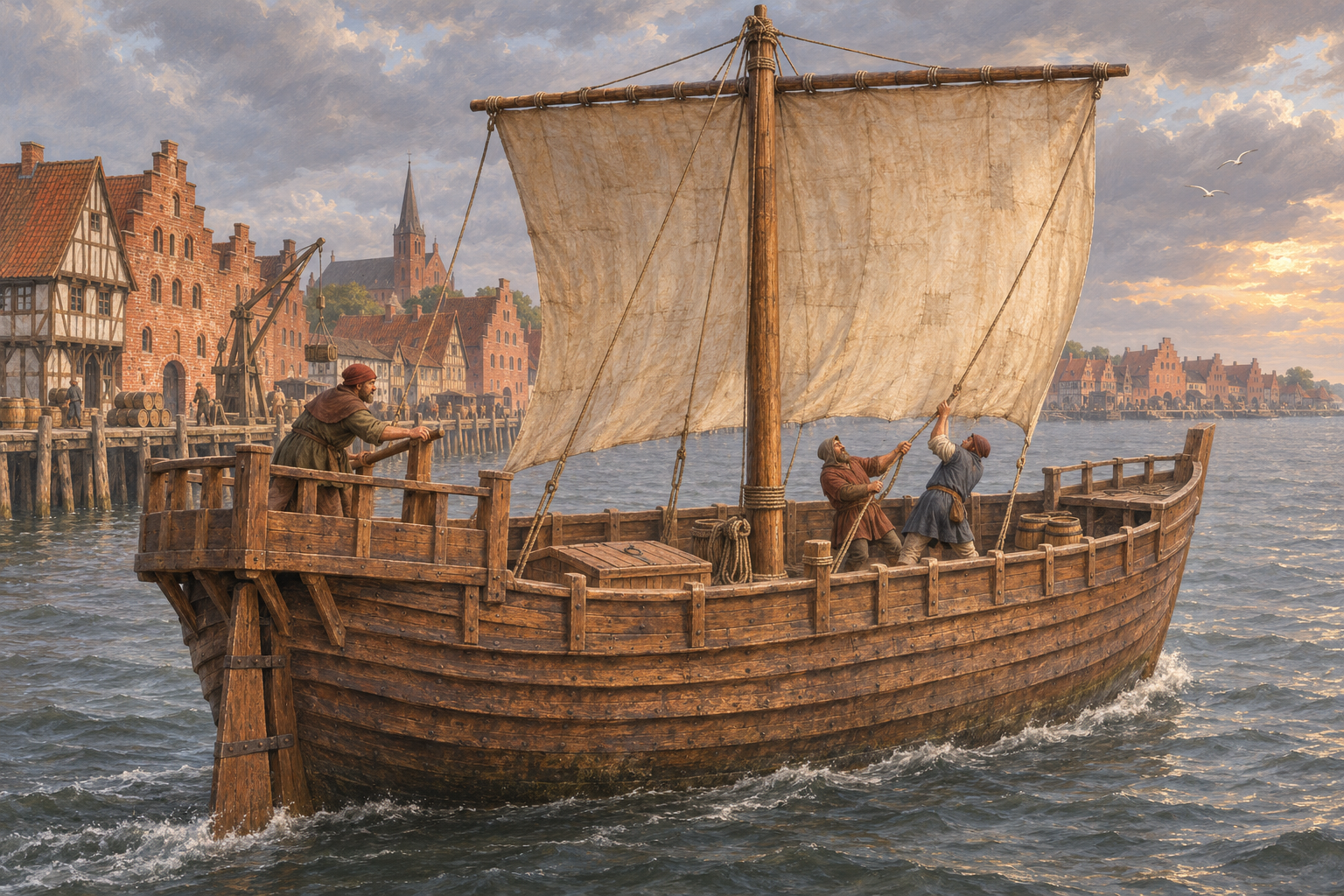
A medieval cog rises above the quay like a timber warehouse afloat. Barrels disappear through the hatch, sailors haul the braces of a single great square sail, and the helmsman takes the tiller. The master needs a workable wind, a pilot who knows the harbour bar, and buyers who will honour their bargain when the cargo arrives.
A Merchant’s Hull
The cog is broad, high-sided and built around the hold. Overlapping side planks give the hull its familiar stepped lines. A central rudder hangs from the sternpost; a tiller turns it from the after part of the vessel. A raised stern platform gives the master a view over the working deck. Some cogs also carry a fighting platform forward, but high timber sides do not turn every merchantman into a warship.
The great square sail rewards a favourable wind. Changing course means working its braces and watching both the canvas and the water ahead. In a narrow approach, a master may wait for the tide, take local help or have boats tow the ship into position. An empty merchant’s hold offers space; it does not give the hull a shallow-water boat’s freedom.
Cogs vary in size, load and fittings. The medieval cog described in the rules is one working example. Its tonnage is a cargo allowance for that hull, not a promise that every northern ship carries the same weight or number of people.
The People Who Bring Her Home
The master answers for the passage and the promises made ashore. The helmsman holds the ordered course. Sail handlers haul, ease and secure the lines; watchkeepers look for traffic, weather and changes in the sea. Near the coast, someone takes soundings. A passenger who interrupts a shouted order can cost more than the price of a berth.
Good captains inspect lashings before leaving sheltered water. Heavy goods belong low and secure, with room to reach the pumps and work the hatch. Loose barrels can shift in a roll, injure a sailor or block the only way to the hold. A merchant who insists on one more wagonload may leave the ship unable to answer the next squall.
A lawful crew keeps an account of freight, wages and goods sacrificed to save the vessel. A compassionate master makes space for people before merchandise; a ruthless one may demand payment while the shore is still in sight. Those choices follow the crew into the next harbour, where former passengers can become witnesses, patrons or enemies.
Working the Northern Seas
The medieval cog links warehouses and market towns across northern waters. Her hold may carry grain on one passage and cloth or salt on the return. Passage is a separate bargain from freight: agree on sleeping space, food, fresh water, weapons and whether the traveller must help during an emergency.
The master promises a destination rather than an exact arrival hour. Bad wind, a closed harbour or a tide missed by minutes can hold the ship outside port. Travellers who need to arrive before a council meets must pay for the risk or find another road. A quiet crossing still has watches, meals, inspections and work; the crew cannot remain at the lines day and night without relief.
A rowboat carries a pilot or passengers between ship and shore. A sailing ship is the broader vessel reference; an armed warship gives its owner different expenses and obligations. A merchant cog earns money by delivering cargo, even when guards stand on her raised deck.
Storm, Shoal and Fire
The dangerous shore is often the one downwind. A sudden shift leaves less room to turn, and a master who waits too long may have to choose between a poor anchorage and a worse landing. A sounding that comes up unexpectedly shallow needs an immediate answer; shouting about the chart does not move the bar.
Fire below deck can be more frightening than arrows. Smoke hides the hatch, cargo blocks access and every person fighting the fire leaves another job undone. Bringing an open flame into the hold is a matter for the master, not a passenger’s convenience. Repair timber, spare cordage, buckets and a ship’s boat can matter more than another chest of weapons.
The Grain or the Passengers
The cog has grounded at the edge of a tidal channel. Water enters the hold around a sprung seam, wetting sacks intended for a hungry port. Frightened passengers crowd the ladder while the falling tide leaves the ship more firmly seated.
The master needs the passengers moved safely, the leak found and weight taken out before the next attempt to float free. A boat can ferry people to the bank. Divers can inspect the grounded side. Volunteers can unload sound grain onto a lighter while the crew protects the hatch. Throwing goods into deep water is quicker, but those sacks still belong to someone.
The choices have witnesses. Save the passengers and the ship may become a friend in later voyages. Keep the grain dry while abandoning people and the same port may refuse the characters a berth. If someone has altered a channel marker, the grounded hull also gives the party a reason to ask who profits from a failed delivery.
Medieval Cog: Crew, Cargo and Handling
Medieval Cog — D&D 2024
Gargantuan Water Vehicle
Cost 10,000 GP; Space 75 by 25 feet; Travel Speed 2 miles per hour; Crew 12, including the helmsman; Passengers 16 Small or Medium creatures in shared berths; Cargo 60 tons (120,000 lb.) beyond crew and passenger gear; Hull AC 15; Hull HP 300; Damage Threshold 15; Immunities Poison and Psychic damage. No shipboard weapons are included.
Control and Movement
The ship moves on the helmsman’s Initiative. With a usable wind and working crew, a creature at the tiller takes the Utilize action to move it up to 20 feet and turn it up to 45 degrees after moving at least 10 feet. Crew assigned to the sail spend their actions working it. Six to eleven working crew halve speed and give Disadvantage on handling checks; fewer than six cannot maintain controlled sailing. Without a helmsman’s action the ship continues straight at its previous speed until the crew reduces sail. It cannot stop instantly.
The sail gives no movement in a dead calm or directly into the wind. A longer course can work round a headwind when there is sea room; allow twice the travel time. A strong adverse wind halves travel speed on a course the sail can hold. Water current adds its own drift. Overloading prevents controlled sailing.
Hazards and Collision
Ordinary fair-weather sailing needs no check. A shoal approach or urgent turn calls for a DC 14 Wisdom (Survival) check from the helmsman as part of control; use DC 18 in a gale. Failure prevents the turn and adds 10 feet of leeward drift. If that movement reaches an obstruction, the ship and the object or vessel struck each take 4d10 Bludgeoning damage. A struck creature instead makes a DC 15 Dexterity saving throw for half that damage. Standing occupants make a DC 12 Dexterity saving throw or have the Prone condition. Apply the hull’s threshold to damage dealt to the hull, not to creatures.
Sail, Rudder and Repair
The sail has AC 11, 60 HP and no threshold; the rudder has AC 15, 40 HP and a threshold of 5. They share the hull’s damage immunities. Damage hits the chosen component only. At half sail HP speed is halved; at 0 sail HP the cog drifts. At half rudder HP handling checks have Disadvantage; at 0 rudder HP it cannot turn. These speed reductions do not multiply. Deck railings give Half Cover against suitable attacks from outside; below deck gives Total Cover when no opening provides a line of effect.
At 0 hull HP the ship begins sinking and founders in 10 minutes. A working crew can bail to gain one further 10-minute interval, once. Full repairs require a berth: each restored hull or component HP costs 20 GP and one day; an equipped city shipyard halves both. Magic restores damage only if its rules permit it to repair that object. Refloating a grounded cog also requires sufficient water and a free hull; restored HP alone does not lift it.
Medieval Cog — D&D 2014
Gargantuan water vehicle
Cost 10,000 gp; Dimensions 75 by 25 feet; Travel Pace 2 miles per hour; Crew 12, including the helmsman; Passengers 16 Small or Medium creatures in shared berths; Cargo 60 tons (120,000 lb.), excluding occupants and their personal gear; Hull AC 15; Hull Hit Points 300; Damage Threshold 15; Damage Immunities poison, psychic. The purchase includes no siege engines.
Helm and Sail
On the helmsman’s initiative, a creature at the tiller uses its action to move the cog up to 20 feet. After at least 10 feet of movement it can turn up to 45 degrees. Sail handlers use their actions for their assigned work. With six to eleven working crew, halve speed and impose disadvantage on handling checks; with fewer than six, the ship cannot maintain controlled sailing. If nobody spends an action at the tiller, it continues straight at its previous speed until the sail is reduced.
A dead calm prevents sailing. The ship cannot sail directly into the wind; sailing round an adverse wind needs room and doubles passage time. Strong headwinds halve travel pace on a viable course. Add water-current drift separately. A load above the stated cargo limit prevents controlled sailing. The sail is not an instant brake.
Handling and Impact
Routine fair-weather travel needs no check. An urgent shoal manoeuvre requires a DC 14 Wisdom check from the helmsman as part of the steering action, or DC 18 in a gale. Proficiency with water vehicles adds the proficiency bonus. Failure loses the intended turn and adds 10 feet of leeward drift. A subsequent collision deals 4d10 bludgeoning damage to the cog and the vessel or object it strikes. A creature struck by the hull makes a DC 15 Dexterity saving throw for half damage. Standing occupants make a DC 12 Dexterity saving throw or fall prone. Damage thresholds protect the relevant object, not the people aboard.
Component Damage
The sail is AC 11 with 60 hit points and no damage threshold. The rudder is AC 15 with 40 hit points and a damage threshold of 5. Both are immune to poison and psychic damage. A targeted hit damages that component instead of the hull. At 30 sail hit points or fewer, halve sailing speed; at 0, sailing stops. At 20 rudder hit points or fewer, impose disadvantage on handling checks; at 0 the ship cannot turn. Speed-halving effects here do not stack. Rails give half cover against appropriate outside attacks; a closed hull blocks attacks that cannot reach through it.
At 0 hull hit points the cog sinks in 10 minutes. Bailing by the working crew grants one extra 10-minute interval, once. At a secure berth, restoring one hull or component hit point takes a day and costs 20 gp; a fully supplied city shipyard halves time and cost. Only magic capable of repairing the object restores its damage. A grounded hull still needs enough water and a clear bottom before it can leave.
Medieval Cog — Pathfinder 1e
Colossal water vehicle
Squares 75 (25 ft. by 75 ft.); Cost 10,000 gp; Decks one working deck, a hold and an after platform; Crew 12 including driver; Passengers 16 Medium or Small creatures; Cargo 60 tons beyond occupants and their personal gear.
Defense
AC 2; Hardness 5; hp 1,125 (broken at 562); Base Save +0. Attacks against occupants use their own defenses and applicable cover.
Offense
Maximum Speed 90 ft. under sail; Acceleration 15 ft.; CMB +8; CMD 18, before the driver’s driving modifier; Ramming Damage 8d8. Travel pace under a workable wind is 2 miles per hour. No ram or siege weapons are fitted.
Propulsion and Driving
Propulsion current (air; one mast, 40 squares of sail, AC 2, hardness 0, hp 200) or current (water); Driving Check Profession (sailor), or Knowledge (nature) at +10 to the DC; a Wisdom check may replace the driving check; Forward Facing the bow; Driving Device tiller; Driving Space the two aft centre squares.
Use the linked vehicle driving actions, movement and collision rules. Driving normally starts at DC 5 outside combat or DC 20 in combat, with the chosen action and conditions modifying it. The driver chooses the driving action before other actions and the vehicle then moves. Working crew cannot also fight or supply unrelated actions. If half or more of the crew are incapacitated or leave their stations, control is lost. The sail cannot propel the hull in a dead calm or straight into the wind; allow sea room and twice the travel time for a course round a headwind. Cargo above capacity prevents controlled movement.
Damage and Repair
The wooden hull uses the vehicle rules: the broken condition imposes its penalties and halves maximum speed and acceleration; at 0 hp it is wrecked and begins sinking. At –75 hp it is destroyed. The sail’s broken condition also halves speed and acceleration; do not halve twice for a broken sail and hull. The tiller is a separate wooden object with AC 5, hardness 5 and 30 hp; a broken tiller increases driving DCs by 10, and its destruction prevents driving. A targeted component hit does not also remove hull hp.
For this hull, a wrecked ship founders after 10 minutes unless salvage intervenes; a working bailing crew buys one additional 10-minute interval, once. At a safe berth, one day, 20 gp of materials and a DC 15 Craft (ships) check restore 10 hp to the hull, tiller or sail. Failure wastes the day, not the materials. A wreck must be recovered before ordinary repair, and sufficient water is still needed to float a grounded ship. Rails give occupants cover when the attack’s line crosses them.
Medieval Cog — D&D 3.5e
Colossal wooden vessel
Cost 10,000 gp; Dimensions 75 by 25 feet; Travel Speed 2 miles per hour; Crew 12 including helmsman; Passengers 16 Small or Medium creatures; Cargo 60 tons (120,000 lb.) beyond occupants and their personal gear; AC –3 (–8 size, –5 Dexterity); Hardness 5; Hull Hit Points 900; Break DC 35. The purchase includes no siege weapons.
Working the Ship
The helmsman spends a standard action each round controlling the tiller, while the working crew spend their standard actions on the sail and necessary shipboard work. On the helmsman’s initiative the vessel moves up to 20 feet and may turn up to 45 degrees after moving at least 10 feet. Six to eleven working crew halve speed and impose a –4 handling penalty; fewer than six cannot maintain controlled sailing. Without a controlling action the ship continues straight at its previous speed until the sail is reduced.
The cog cannot sail in a dead calm or directly into the wind. An indirect course round a headwind requires sea room and doubles passage time; strong adverse wind halves travel speed on a course the sail can hold. Apply water-current drift separately. Overloading prevents controlled sailing.
Seamanship and Collision
Routine fair-weather sailing needs no roll. A sudden shoal or urgent turn requires a DC 15 Profession (sailor) check as part of steering, increasing to DC 20 in a gale. An untrained emergency helmsman instead makes a DC 20 Wisdom check, or DC 25 in a gale. Failure prevents the turn and adds 10 feet of leeward drift. If the resulting movement causes a collision, the cog and the object or vessel struck each take 6d6 damage before hardness. A creature struck by the hull receives a DC 15 Reflex save for half damage. Standing occupants make a DC 12 Reflex save or fall prone.
Objects, Components and Repair
Apply the object damage rules, including object immunities, energy adjustments and the reduction for ordinary ranged weapons. The sail has AC –3, hardness 0 and 80 hit points; the rudder has AC 3, hardness 5 and 60 hit points. Component damage is separate from hull damage. Half sail hit points halve sailing speed; 0 stops sailing. Half rudder hit points impose a –4 handling penalty; 0 prevents turns. Multiple speed-halving effects in this profile do not stack. Deck rails give cover when they intervene; the enclosed hold gives total cover where no opening allows an attack.
At half hull hit points the break DC falls to 33. At 0 the hull is ruined and sinks in 10 minutes; the working crew can bail for one extra 10-minute interval, once. At a secure berth, one day, 20 gp of materials and a DC 15 Craft (shipmaking) check repair 10 hit points of hull, sail or rudder. Failure wastes the day only. Recover a ruined vessel before rebuilding it; repairing timber cannot by itself refloat a stranded hull.
Sources and Licensing
Historical background follows the German Historical Museum’s cog reference and the German Maritime Museum’s Bremen Cog exhibition. The surviving Bremen hull dates to about 1380. Dimensions and capacities reported for a particular wreck or museum model describe that example.
The representative hull, component profiles, handling procedures, repair schedules and grounded-grain incident are original campaign material. Comparative frameworks are D&D 2024 large vehicles, D&D 2014 waterborne equipment, Pathfinder First Edition vehicles and D&D 3.5e objects. These references do not publish this particular cog’s statistics. The painted hero is an original illustration.
Keep this reference growing
If this page helped with your reading or game, you can support its upkeep or explore the curated books.
Explore the Bookshop — epics, classics and stories behind imagined worlds.