
Eon XLI — The Breaking Paths
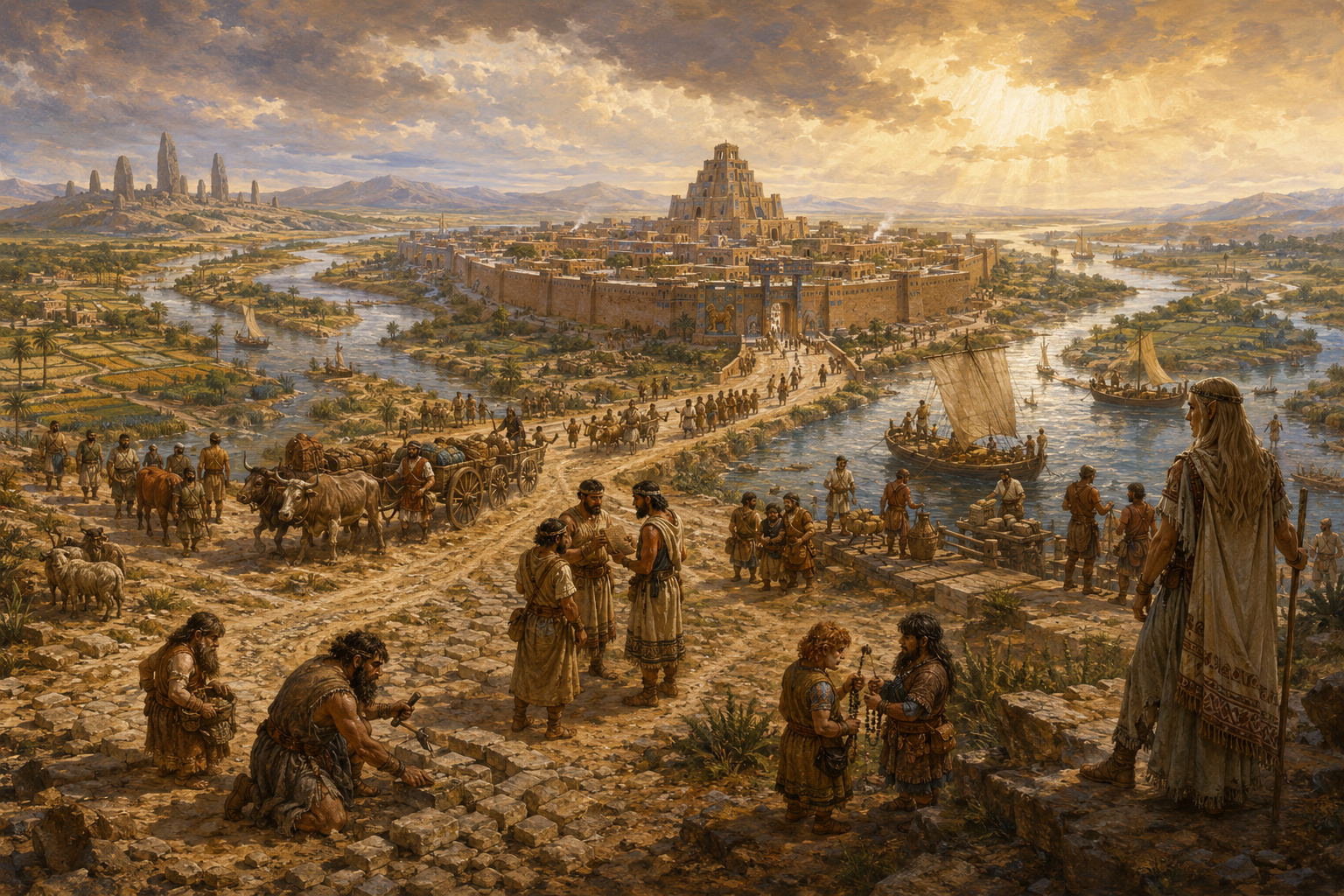
The Breaking Paths begin when cities write their claims, rulers reach beyond their walls and peoples once linked by shared custom follow increasingly separate languages, gods, laws and roads.
Writing, Migration and the First States
Time Frame: c. 3500–2000 BCE
Common Name: The Late Chalcolithic and Early Bronze Age, depending upon the region
Theme: Writing, migration, sacred kingship, territorial states, widening trade, monumental burial and repeated catastrophe divide the city-world into distinct civilisations.
The Breaking Paths inherit the towns, markets, sanctuaries and public institutions of The Blooming Cities. Some settlements are already true cities. Their inhabitants maintain walls, store harvests, judge strangers, organise public labour and wage war beyond the scale of household feud.
During this age, urban authority reaches beyond the city. Rulers demand tribute from surrounding villages. Temples acquire estates, workshops and dependent labourers. Written marks preserve quantities, offices, names and obligations beyond the memory of any living witness. City gods become patrons of territories, dynasties and armies.
The world also becomes more divided. There was never one ordinary language spoken by every mortal people. Human and nonhuman languages were already ancient and diverse. What breaks during this age is the shared sacred bridge-language used by certain temples, divine envoys, portal custodians and long-distance ritual networks. Its collapse makes translation harder, divine names less interchangeable and regional sacred traditions more independent.
Migration intensifies the division. Steppe pastoralists enter farming lands. Traders and settlers cross seas. Refugees abandon failed states. Conquered households are deported. New diseases move through trade and migration networks. Roads that carry bronze, grain and ritual knowledge also carry raiders, slaves and plague.
Different peoples do not enter one shared technological age. Some human regions develop writing and territorial states while others maintain seasonal confederations or independent villages. Some dwarven holds possess advanced metallurgy inherited from far older struggles, while others have lost mines, archives and craft lineages. Elven societies may preserve sophisticated magic and ecological management without adopting dense cities. Gnome enclaves may master portal law and precision craft while remaining small and concealed. Halfling peoples may maintain extensive river, farming and trade networks without building monumental kingdoms.
Mixed settlements exist, especially at ports, markets, border sanctuaries and mining centres, but they are local exceptions created by particular treaties, conquests or migrations. Most peoples retain separate settlements, laws and technological histories.
The Breaking Paths are not an age when communication ends. Trade becomes wider than ever. It is an age when communication no longer implies unity.
The World at the Beginning
- Several regions contain genuine cities, ceremonial centres and fortified production settlements.
- Public sanctuaries, neighbourhood assemblies, storehouses and civic offices already exist.
- Clay tokens, seals and repeated symbols preserve increasingly complex information.
- Copperworking and early bronze experimentation are established in several regions.
- Wagons, carts, boats and managed horses expand local movement without creating later cavalry or chariot armies.
- Slavery, debt bondage, tribute, captive labour and compulsory public service exist in varied local forms.
- Nonhuman peoples possess their own settlements and histories but do not share one technological or political stage.
- Many dwarven societies remain shaped by ancient conquest, slavery and rebellion against giant dominions.
- Serpentfolk and other survivors of prehuman or Hyborian civilisations retain hidden enclaves and forbidden archives.
- Eridu, Uruk, Tell Brak, Susa, Liangzhu and other centres already gather sacred and political authority.
- Regional gods possess recognised sanctuaries, but later pantheon hierarchies are still developing.
- The Dreamlands and older planes remain accessible through guarded routes whose laws are becoming increasingly local.
The age begins with a connected city-world. It ends with kingdoms, territorial states, early empires and written traditions whose rulers increasingly claim that their own order is the rightful pattern for everyone else.
The Breaking Paths Timeline
c. 3500–2800 BCE — Watson Brake and the River Confederation
Communities along the Ouachita waterways of North America construct the great mound-and-ridge complex later known as Watson Brake.
Eleven mounds linked by raised ridges form an extensive ceremonial landscape. The builders are mobile or seasonally settled hunter-fisher-gatherers rather than subjects of an agricultural monarchy.
Binding campaign ruling: Watson Brake is the gathering ground of a river confederation. Its earthworks preserve flood memory, burial rights, marriage agreements, seasonal law and routes between communities occupying different parts of the watershed.
No permanent king commands the work. Construction continues across generations because participating communities recognise the site as neutral ground protected by river powers and ancestral witnesses.
The complex demonstrates that monumental architecture does not require grain agriculture, dense cities, slavery or hereditary monarchy.
c. 3500–3300 BCE — Writing Becomes a Public Instrument
Administrative marks used in southern Mesopotamia develop into an increasingly flexible writing system. Early tablets record grain, animals, labour, containers, offices and distributions from large institutions.
Writing begins as an aid to administration rather than a complete record of speech. It allows stores, debts and obligations to survive the death or removal of the person who first witnessed them.
This changes power. A storehouse keeper can present a tablet against someone who denies an obligation. A temple can claim labour promised generations earlier. A ruler can preserve a list of tribute-paying settlements beyond the range of personal memory.
Scribes become specialists whose interpretations can determine ownership, debt and status. Their work can protect a weak claimant against a powerful liar, but it also creates opportunities for false entries, hidden clauses and records that protect institutions more effectively than the people serving them.
c. 3500–3000 BCE — Wheels, Wagons and New Routes
Wheeled vehicles appear across parts of Eurasia. Heavy carts and wagons carry harvests, timber, stone, pottery and household goods where terrain permits.
The wheel does not make every route easy. Wagons require animals, maintained tracks, replacement parts and communities willing to permit passage.
Steppe pastoralists, farmers, dwarven engineers and urban transport workers adapt wheeled movement independently and through exchange. No one people receives exclusive ownership of the invention.
Mounted travel remains limited. Horses are managed and occasionally ridden, but true cavalry and fast chariot warfare belong principally to later ages.
c. 3500–2500 BCE — Malta’s Temple Civilisation Flourishes
Communities on Malta and Gozo raise increasingly elaborate free-standing stone temples, underground burial complexes and ceremonial gathering places.
The temples require quarrying, transport, skilled construction, food supply and agreements among several settlements.
Binding campaign ruling: the Maltese temples are designed and built by the island communities themselves. Giants, dwarves and other visitors may trade knowledge, assist particular works or later seize monuments, but none replaces the mortal builders responsible for the temple tradition.
The temples are not royal palaces. Authority rests with ritual lineages, builders, landholding households and communities responsible for maintaining the sacred complexes.
c. 3400–3000 BCE — Bronze Experiments Widen
Copperworkers learn that ores, furnace conditions and deliberate mixtures can produce metals with different strengths and colours.
Early arsenical bronzes and other copper alloys appear in several regions. Tin bronze remains limited and does not immediately replace stone, wood or pure copper.
Dwarven holds possess far older and sometimes more advanced traditions of ore selection and controlled furnaces. Their knowledge is divided among rival holds and frequently protected by oath, isolation or force.
Surface metalworking does not arise from one universal dwarven gift. It develops through local discovery, trade, observation, theft and experimentation.
Metal remains expensive. A copper or bronze blade may indicate wealth, office or sacred status without being superior to stone for every task.
c. 3300–2300 BCE — Liangzhu Becomes a Regional State
Liangzhu develops in the lower Yangtze region as a major rice-growing centre with planned settlement, water-control works, socially differentiated burials and an increasingly unified ritual system.
Jade objects mark sacred office, ancestry and access to power. Great waterworks require labour from communities far beyond the urban centre.
Binding campaign ruling: Liangzhu is a true regional state. Its ruler does not possess unrestricted personal ownership of every field and worker. Authority is shared among the ruling house, water engineers, jade-bearing ritual lineages and local communities maintaining the system.
Cong and related jade forms serve as legal as well as sacred objects. They identify recognised offices able to speak for land, water, ancestors and the powers associated with the cardinal directions.
c. 3300–2500 BCE — Early Plague Lineages Spread
Ancient lineages of Yersinia pestis spread through parts of Eurasia.
These early forms are not identical to the later flea-borne plague responsible for the Black Death. Their transmission, symptoms and mortality vary, but some outbreaks destroy households and contribute to the abandonment of settlements.
Dense communities, livestock, trade, migration and captive movement allow disease to cross boundaries that once isolated local populations.
Later communities explain outbreaks through poisoned wells, angry ancestors, foreign curses, giant breath, serpentfolk diseasecraft or divine judgement. Some accusations identify genuine magical interference. Others provide excuses to murder foreigners, enslave survivors or seize abandoned land.
The plague of Partholón later occurs within this wider disease world but carries an additional Fomorian curse that prevents ordinary healing rites from working.
c. 3300–2600 BCE — Early Harappan Towns and Signs
Across the greater Indus region, regional towns expand from older farming and craft traditions. Harappa and other centres develop walls, workshops, pottery traditions, seals and trade connections.
Graphic signs appear upon pottery and other objects before the mature Indus script. Different regions use related symbols without yet forming one fully integrated civilisation.
Trade connects the Indus lands with Baluchistan, Afghanistan, Central Asia, Iran and the Arabian Sea. These routes carry copper, stone, shell, timber, cloth, food, livestock and ritual ideas.
The towns remain politically distinct. Shared craft and symbols do not mean that one king rules the entire region.
c. 3200 BCE — Brú na Bóinne Is Raised
Communities in the Boyne Valley construct the passage tombs later known as Newgrange, Knowth and Dowth.
The monuments gather stone, earth, carved art, ancestral remains and solar observation into a sacred landscape capable of outliving individual households.
Binding campaign ruling: Brú na Bóinne is built by the mortal communities already living in Ireland. It is not raised by the later-arriving Tuatha Dé Danann and does not require giants to explain its construction.
The builders cooperate with local spirits and sky powers, but the labour, planning and legal agreements are their own.
Newgrange’s midwinter alignment establishes a recognised threshold at which the returning sun renews agreements between living households, the dead within the mound and powers travelling through the eastern sky.
c. 3200–2000 BCE — Early Minoan and Cycladic Sea Worlds
Crete and the Cycladic islands develop maritime communities linked by trade, fishing, farming, metalwork and skilled navigation.
Cycladic craftworkers quarry marble and create vessels and figures carried between islands and placed within graves. Early Minoan communities establish increasingly large settlements and extensive overseas contacts.
These are not yet the mature palace centres of Knossos, Phaistos and Malia. The palace civilisation belongs mainly to the following age.
Binding campaign ruling: island sea-law develops through harbour assemblies, ship-owning households, shrine custodians and navigators. No single King Minos yet commands the Aegean.
c. 3100 BCE — Narmer Unites Upper and Lower Kemet
Regional rulers who have competed along the Nile are brought beneath the authority of one crown. Narmer becomes the most widely remembered of the rulers associated with the political unification of Upper and Lower Egypt.
The union creates a state capable of mobilising labour, recording tribute, maintaining distant estates and presenting the ruler as guardian of cosmic order.
The king does not become a god merely because he wins. Sacred kingship develops through coronation, temple recognition, control of the Two Lands and the ruler’s obligation to uphold Ma’at.
The Pharaonic gods recognise the united crown but do not surrender their independent powers or rivalries to it.
c. 3100–3000 BCE — The Tower Crisis and the Breaking of Sacred Speech
A coalition of southern Mesopotamian sanctuaries, rulers, architects and portal specialists begins constructing a monumental gate-tower intended to establish permanent authority between the mortal city-world and the divine roads.
The tower is not simply a tall building. Its foundations combine sacred names, mathematical proportions, planar correspondences and administrative seals gathered from several cities.
The builders intend one system of measure, law and invocation to bind every participating community. Some seek peaceful communication. Others intend to control divine access, trade and kingship.
The work fails. Rival gods, spirits and mortal factions alter the names written into the structure. The tower’s correspondences break, and the shared sacred bridge-language loses its universal force.
Binding campaign ruling: this is the event later remembered as the Tower of Babel. It does not suddenly create every mortal language. Local languages already exist. The crisis destroys the magical and ritual equivalences that once allowed trained speakers to invoke the same sacred names across several cultures.
After the crisis:
- divine titles no longer translate safely without interpretation;
- portal commands work only within particular traditions;
- treaties written through the bridge-language acquire disputed meanings;
- temples increasingly preserve local sacred vocabularies;
- scribes and interpreters become essential to diplomacy;
- later rulers claim that their own language preserves the original truth.
Later priests of Marduk claim that their god judged or mastered the crisis. Babylon is not yet the supreme city, and this later claim does not prove that Marduk alone caused the breaking.
c. 3100–2500 BCE — The Sacred Settlement World of Orkney
Stone-built communities and ceremonial centres flourish across Orkney.
Skara Brae contains tightly clustered stone houses connected by passages. Hearths, beds, storage, stone furniture and work areas reveal a permanent community adapted to severe weather, limited timber and the surrounding sea.
The Stones of Stenness, Maeshowe, Barnhouse and related sites form part of a wider ceremonial and domestic landscape.
Binding campaign ruling: Orkney is a distinct island society governed through households, boat crews, ritual custodians and gatherings associated with the monuments. It is not an elven colony, a dwarf outpost or a lesser copy of Stonehenge.
Visiting elves, dwarves, halflings and other peoples may trade, marry or negotiate passage there, but the island monuments and settlements remain the work of their own communities.
c. 3000 BCE — The First Stonehenge Enclosure
A circular earthwork and timber or stone setting is created at Stonehenge. The enclosure is used for cremation burial and repeated ceremony.
The first monument is not yet the great sarsen circle familiar to later ages.
Binding campaign ruling: Stonehenge begins as a place of the dead, seasonal gathering and negotiated sky-law. Its custodians belong to regional ritual traditions ancestral to later Druidic practice, but they are not yet one organised Druidic order.
Elven communities recognise older sky and land claims within the surrounding landscape. Some participate in particular gatherings; others condemn the enclosure as the permanent seizure of a place previously governed through seasonal use.
c. 3000–1800 BCE — Caral-Supe Develops
Large ceremonial and urban centres arise in the Supe Valley of Peru. Caral combines monumental platforms, sunken circular spaces, residential areas, agriculture, fishing and exchange between coast and inland valleys.
Cotton supports fishing through nets and cordage, linking agricultural communities with coastal food production.
Binding campaign ruling: Caral is a genuine city and centre of regional civilisation. Its rulers are not unrestricted divine monarchs. Authority is divided among ceremonial lineages, irrigation custodians, coastal exchange houses and leaders of surrounding communities.
Public music, calendrical gathering and ritual feasting help coordinate a population spread between valley, coast and upland routes.
c. 3000–2400 BCE — Steppe Migrations Transform Europe
Pastoral communities associated with the Yamnaya horizon expand from the Pontic-Caspian steppe. Related migrations and new social networks contribute to the Corded Ware and other later traditions across much of Europe.
The movements are not one invasion by one united nation. They include families, war bands, herders, traders, clients, captives and communities formed through intermarriage.
Some farming societies are absorbed. Others retreat, resist or survive beside the newcomers. Old megalithic, elven, halfling and woodland claims remain active even where new burial customs and languages become dominant.
Steppe migration spreads:
- new pastoral routes;
- wagon use;
- burial beneath mounds;
- lineage-focused warrior status;
- new language families;
- different relationships between households, herds and land.
It does not instantly replace every people or custom encountered.
2958 BCE — Cessair Reaches Ireland
Cessair leads a fleet towards Ireland while fleeing an approaching catastrophe remembered as a Flood.
Most vessels are lost. Cessair, one hundred and forty-nine women and three men survive the landing.
The newcomers do not find an empty island. Earlier mortal communities, spirits, nonhuman peoples and the builders of Brú na Bóinne already possess land and sacred claims.
Cessair’s followers establish a brief settlement through negotiation, seizure and marriage. Two of the surviving men die, and Fintán becomes unable to bear the obligations placed upon him.
When the regional flood reaches Ireland, Fintán alone survives. He escapes ordinary death by changing successively into salmon, eagle and hawk before returning to human form in a later age.
Binding campaign ruling: Fintán is a genuine shapeshifter and historical witness. His testimony is valuable but not infallible. Animal memory, dream and thousands of years of survival alter how he recounts events.
c. 2900–2350 BCE — The Early Dynastic States
Southern Mesopotamian cities increasingly operate as independent states. Uruk, Ur, Kish, Lagash, Umma and other centres possess rulers, temples, armies, dependent villages and competing territorial claims.
Kingship remains varied. Some rulers emerge from war leadership. Others hold hereditary office, temple authority or recognition granted by civic assemblies.
Written records expand beyond simple accounting. Royal names, land grants, offerings, disputes and military claims become part of institutional memory.
Farther west and north, cities such as Mari and Ebla grow through river trade, palace administration and routes connecting Mesopotamia, Anatolia and the Levant. Elamite states develop independently east of Mesopotamia.
The Near East is therefore never one civilisation moving under a single crown.
c. 2800–2200 BCE — The Bell Beaker Networks
Distinctive bell-shaped vessels, archery equipment, metal objects, drinking customs and burial practices spread through western and central Europe.
The Beaker phenomenon is not one empire or one migrating nation. In some regions the objects and customs spread through exchange and local adoption. In others, substantial population movement transforms existing communities.
Beaker gatherings strengthen long-distance relationships among warriors, craftworkers, maritime travellers and households controlling metal routes.
Binding campaign ruling: Beaker drinking rites serve as recognised ceremonies of hospitality, alliance and compensation. Sharing the vessel establishes temporary peace, but refusing or deliberately breaking it may announce feud.
Elven and halfling communities adopt, reject or alter Beaker customs according to local politics. No Beaker identity automatically makes a settlement human, warlike or culturally uniform.
c. 2800–2600 BCE — The Indus Cities Integrate
Harappa, Mohenjo-daro, Dholavira and other settlements become part of an extensive shared urban civilisation.
Planned streets, wells, drainage, craft districts, weights, seals and trade systems connect communities across a vast region.
The Indus script develops as a distinctive local writing system. It does not descend from Sumerian writing, although the civilisations exchange goods and ideas.
Binding campaign ruling: the Indus cities do not form one empire under a single king. Their integration is maintained through shared measures, merchant and craft institutions, civic water law, ritual symbols and councils linking major centres.
Rulers and elite households exist, but authority is less visibly concentrated in royal palaces and monumental tombs than in Kemet or Mesopotamia.
2680 BCE — Partholón Arrives in Ireland
Partholón, son of Sera, reaches Ireland after fleeing his homeland and travelling through Sicily and Iberia.
His people establish settlements and introduce their own forms of brewing, building, field organisation, livestock management and political authority.
They do not introduce agriculture to an island that has never known it. Farming and settled communities already exist. Later traditions credit Partholón’s people with invention because their descendants preserve the surviving account.
The Muintir Partholóin fight the Fomorian Titans led by Cichol Gricenchos at Magh Ithe.
Binding campaign ruling: the Fomorians are not one mortal ethnicity and not a race of universal demons. They are a shifting alliance of titan-blooded beings, sea powers, monstrous rulers, subject peoples and mortal households bound to older dominions.
The victory gives Partholón’s people control of territory but does not end Fomorian power elsewhere.
2650 BCE — The Plague of Partholón
A devastating plague kills almost the entire Muintir Partholóin within one week.
The infection belongs to the wider family of ancient Eurasian plague lineages, but its speed and resistance to healing are intensified by an unresolved Fomorian curse.
Close settlement, burial contact and contaminated gathering places accelerate the outbreak while ordinary healing rites fail.
The dead are too numerous for normal burial. Improvised graves and abandoned settlements leave a lasting concentration of restless ancestors and failed household claims.
c. 2700 BCE — Gilgamesh Rules Uruk
Gilgamesh becomes king of Uruk during the Early Dynastic period.
He is a powerful mortal ruler of exceptional and partly divine ancestry, not an invulnerable god. His reign combines public building, warfare, personal excess, friendship, grief and the search for escape from death.
Later poems combine several expeditions and political memories into one heroic cycle. The supernatural events remain real even where later scribes alter sequence, names or emphasis.
Gilgamesh’s relationship with Enkidu becomes one of the age’s great challenges to royal isolation. The king learns that civic power cannot protect him from grief or make death unlawful.
c. 2670 BCE — Djoser and the Step Pyramid
King Djoser commissions a vast funerary complex at Saqqara. Imhotep directs the transformation of older tomb traditions into monumental stone architecture.
The Step Pyramid is a royal tomb, ritual machine and public statement that the king’s sacred office can survive bodily death.
Binding campaign ruling: Imhotep is a mortal architect, healer, ritual specialist and administrator during his lifetime. His later divine status develops because his works, teachings and posthumous interventions continue across generations.
The project requires organised quarrying, transport, food supply, specialist labour and compulsory service. Not every worker is enslaved, but royal command can impose severe burdens upon households far from the court.
2613 BCE — Nephren-Ka, the Black Pharaoh
During a period of disputed royal succession, Nephren-Ka seizes power in Kemet.
He obtains the Shining Trapezohedron, an elder object carried through prehuman, serpentfolk, Lemurian, Atlantean and Minoan hands before reaching Egypt.
Nephren-Ka builds a windowless temple and crypt around the object. Through it he communes with Nyarlathotep and other alien powers able to reveal knowledge without mercy or truthful context.
The Black Pharaoh’s court uses prophecy, terror, sacrifice and secret arrest to destroy rivals. Darkness becomes both religious requirement and instrument of state control.
Snefru and allied priesthoods overthrow Nephren-Ka. His public monuments are altered, his name removed and his temple sealed.
Binding campaign ruling: erasing Nephren-Ka from official record prevents his royal office from being inherited lawfully, but it also leaves later generations less capable of identifying his surviving cults.
c. 2600 BCE — The Great Pyramid and the Sealing of the Deep
Khufu’s Great Pyramid is completed at Giza within a wider royal and sacred complex.
It serves as tomb, resurrection structure, statement of royal authority and cosmic instrument aligned with the ordered heavens.
It also serves as a ward.
Binding campaign ruling: chambers and foundations beneath the plateau contain passages associated with Nephren-Ka, older serpentfolk works and a presence reached through the Shining Trapezohedron. The Great Pyramid does not imprison Marduk. Its deeper sacred geometry limits the paths through which the Haunter and related powers can manifest.
The ward is maintained through alignment, sealed chambers, royal names, priestly rites and the continued integrity of the monument.
Grave robbery therefore threatens more than the king’s property. Removing certain objects or names can weaken parts of the sealing system.
c. 2600–1900 BCE — The Mature Indus Civilisation
The Indus urban system reaches its greatest extent. Major cities and smaller settlements share weights, seals, craft practices, drainage traditions and long-distance trade.
Merchants travel through the Arabian Sea and Gulf. Indus goods reach Mesopotamia, while foreign materials and ideas enter the Indus lands.
Urban water management gives wells, drains, reservoirs and bathing places legal and sacred importance.
Foreign and nonhuman visitors may be found in particular ports or trading districts, but most Indus communities remain locally rooted rather than universally mixed.
The script remains closely controlled by merchants, civic offices and ritual specialists. Later ages lose the ability to read it fully.
c. 2500 BCE — Stonehenge Takes Its Monumental Form
Large sarsen stones and bluestones are raised within the earlier enclosure. The design aligns with movements of the sun, especially midsummer sunrise and midwinter sunset.
Communities gather from distant parts of Britain. Durrington Walls supports builders, visitors, feasting and ritual preparation.
Binding campaign ruling: Stonehenge is a mortal-built monument created through alliances among several regional peoples. Giants and dwarves may exchange labour or engineering knowledge in particular episodes, but neither replaces the communities responsible for the work.
The stones establish a stable calendar, funeral route and treaty ground. Violence within the central enclosure is forbidden during recognised gatherings, although political struggle continues beyond it.
c. 2500 BCE — Kerma Becomes the First Great Kingdom of Kush
Upper Nubian communities gather beneath a powerful centre at Kerma.
The kingdom controls cattle wealth, river trade, gold routes and relations with peoples farther south. Monumental mud-brick structures, specialised craft and royal burial establish a political tradition independent of Kemet.
Binding campaign ruling: Kerma is neither an Egyptian colony nor an incomplete imitation of pharaonic civilisation. It is the first great kingdom of Kush, with its own rulers, gods, laws and relationships with desert, river and southern peoples.
Egyptian raids and settlements seek access to Nubian gold, stone and trade. Kerma responds through diplomacy, trade, alliance and war.
Dwarven miners, desert spirits and other nonhuman communities may hold specific rights within the wider region, but they are not automatically subjects of Kerma or Kemet.
c. 2500–2200 BCE — Liangzhu, Longshan and the Walled East
Liangzhu maintains its rice-based state, waterworks and jade offices while Longshan communities develop across parts of northern and eastern China.
Some settlements possess rammed-earth walls, specialised pottery, ranked burial and increasingly concentrated authority.
Competition between centres becomes violent. Walls protect stores and households but also display the ability of leaders to compel labour.
Farther north and west, pastoral and farming communities maintain their own routes and ritual systems. There is no single Chinese kingdom.
2350 BCE — Nemed Reaches Ireland
Nemed leads the Muintir Nemid to Ireland after a long journey associated with the Caspian lands and western seas.
They arrive in an island already layered with ancient monuments, abandoned Partholón settlements, surviving communities and Fomorian claims.
Nemed wins four major battles against Fomorian powers. His victories establish fortified settlements and release some territories from tribute.
Nine years after arrival, plague kills Nemed and thousands of his people.
The remaining Nemedians become divided. Some submit, some flee and others continue resistance under local leaders.
c. 2340 BCE — Sargon Creates the Akkadian Empire
Sargon of Akkad defeats rival city rulers and creates a state extending across much of Mesopotamia and beyond.
The Akkadian Empire does not erase Sumerian cities. It places governors, garrisons, tribute demands and royal officials over existing institutions.
Royal administration uses writing to record rations, labour, land and military obligation across a larger territory than any one city-state.
Sargon’s armies include people from several cities, languages and social conditions. Military service offers advancement to some while imposing forced movement and dependence upon others.
The empire presents conquest as restoration of proper order. Conquered cities often remember it as foreign domination.
c. 2310–2280 BCE — The Revolt against Conand’s Tower
The surviving Muintir Nemid are forced to provide grain, milk, livestock, labour and children to the Fomorian rulers Morc and Conand.
Conand’s Tower stands upon an island off the coast and functions as fortress, tribute store, prison and supernatural lighthouse.
The Nemedians gather a great host and assault the tower by land and sea. Conand falls, and the tribute records are destroyed.
Morc answers with a counterattack. A catastrophic wave destroys most of the Nemedian host and devastates the island fortress.
Binding campaign ruling: the wave is deliberately released through Fomorian sea-magic acting upon unstable natural conditions. It is not proof that every Fomorian controls the ocean.
Only one principal vessel escapes. Survivors scatter into several later peoples and traditions rather than disappearing completely.
c. 2300 BCE — Shimao Rises
A great stone-walled centre develops upon the northern frontier of the Chinese cultural world.
Shimao controls routes between farmers, pastoralists and distant sources of stone and jade. Its walls, elite spaces and ritual deposits reveal concentrated authority.
Binding campaign ruling: Shimao is ruled by a fortified sacred court combining war leadership, ancestor rites and control of exchange. Its human sacrifices are political acts intended to bind conquered lineages and frontier spirits to the city.
The victims remain persons. Their killing is not made lawful merely because priests describe it as necessary.
2291 BCE — Naram-Sin Becomes the Divine King
Naram-Sin extends Akkadian power and adopts open divine honours.
Earlier rulers may possess divine ancestry, sacred offices or posthumous worship. Naram-Sin makes his own living person the centre of imperial divine authority.
Some temples accept his divinity. Others recognise only his royal office or treat the claim as dangerous theft from the gods.
Binding campaign ruling: Naram-Sin acquires genuine divine power through accumulated worship, imperial ritual and supernatural patronage. He does not become equal to the great gods, and his divine status remains dependent upon empire, cult and continued recognition.
His rule establishes a precedent later tyrants, heroes and god-kings repeatedly attempt to imitate.
c. 2200 BCE — Nitocris and the Feast beneath the Nile
During the weakening of Egypt’s Sixth Dynasty, Nitocris rises to royal power.
She avenges the killing of her brother by inviting those responsible to a subterranean feast and opening hidden water channels that drown them.
Her court maintains secret relations with ghouls, tomb communities and surviving cults associated with Nephren-Ka.
Nitocris does not create the ghouls, nor do all ghouls serve her. She bargains with particular communities dwelling beneath cemeteries and desert ruins.
Binding campaign ruling: Nitocris is a real ruler whose reign is deliberately confused in later king lists. Her enemies erase or divide her identity because admitting that a woman held royal power—and successfully destroyed powerful officials—threatens their claims.
The feasts remembered beneath the Great Pyramid belong partly to Nitocris’s mortal court and partly to later ghoul rites using her name.
c. 2200 BCE — The Great Drying
A prolonged climatic disruption affects much of the world. Rainfall fails or changes, rivers become less dependable and harvests collapse in vulnerable regions.
The crisis does not strike everywhere in the same way or in one year. Its consequences include:
- famine;
- abandoned settlements;
- movement towards dependable rivers and wells;
- pastoral migration;
- conflict over water;
- failure of tribute systems;
- the weakening of central rulers;
- increased sale or enslavement of debtors;
- the abandonment of temples unable to provide relief.
Akkadian authority weakens. Egypt’s Old Kingdom fragments. Liangzhu’s water system and political order fail. Communities across Africa, Asia and the Mediterranean alter routes and settlements.
Gods are blamed for the crisis, but no single god causes every drought and collapse.
c. 2150 BCE — Akkad Falls
Rebellion, political fragmentation, environmental stress and external attack break Akkadian imperial authority.
Later accounts blame the Gutians, divine anger, failed kingship or sacrilege. Each preserves part of the truth while serving later political purposes.
Imperial roads and offices do not vanish at once. Governors become local rulers, garrisons become mercenary bands and tribute systems fragment into competing claims.
Enslaved and deported peoples use the collapse to flee, revolt or renegotiate their status.
2104 BCE — The Ogygian Deluge
A destructive cluster of floods, storms, coastal changes and river disasters strikes parts of the eastern Mediterranean and Atlantic-linked world.
Settlements, fields, shrines and boundary markers disappear beneath water and silt. Survivors preserve different names and sequences because they experience different parts of the disaster.
Binding campaign ruling: the Ogygian Deluge is real but regional. It is associated with the broader environmental disruption near the end of the third millennium BCE and with supernatural failures in sea and river law. It is not one flood covering the whole planet.
Some later traditions confuse it with the older floods remembered by Ziusudra, Cessair or other peoples.
c. 2112–2004 BCE — The Third Dynasty of Ur
The kings of Ur reunify much of southern Mesopotamia after the fall of Akkad.
Ur III develops extensive administration, written labour records, taxation, provincial government and state-controlled estates.
The system restores order but places heavy obligations upon workers, farmers, herders and dependent communities.
Large numbers of people are assigned rations and tasks through institutions able to record their work in detail.
Royal law attempts to limit some abuses while preserving hierarchy, forced labour, slavery and the authority of the state.
The dynasty collapses near the age’s end through invasion, rebellion, environmental stress and the inability of central administration to maintain the entire system.
Late Third Millennium BCE — The First Austronesian Sea Roads
Maritime farming communities begin moving south from Taiwan towards the northern Philippines and Island Southeast Asia.
They carry seagoing knowledge, languages, crops, animals, pottery traditions and ritual customs.
The migrants encounter peoples already living throughout the islands. Their expansion includes settlement, exchange, intermarriage, rivalry and local conflict rather than the complete replacement of every earlier population.
Binding campaign ruling: the first Austronesian sea roads form a linked maritime world, not a centralised empire. Navigators, household founders and ritual custodians preserve separate routes whose knowledge is inherited and politically valuable.
The later Lapita expansion into Remote Oceania belongs to subsequent history.
By c. 2000 BCE — The Paths Are Fully Divided
Writing now exists in several independent traditions. Languages, sacred names and legal systems have become more strongly regional.
Egypt, Mesopotamia, Kerma, the Indus world, East Asian states, the Aegean, Caral and many other regions possess histories that can no longer be fitted into one universal mortal sequence.
Long-distance trade continues, but translators, envoys, seals and treaties are essential. Foreigners are no longer assumed to share the same gods or laws.
The first palace kingdoms of the Middle Bronze Age begin emerging. Minoan palace centres, the Egyptian Middle Kingdom, Old Babylonian states and other mature dynastic systems belong principally to the following age.
The Divided World
Mesopotamia, Syria and Iran
Writing, city kingship, temple estates, Akkadian empire and Ur III administration transform the region.
Sumerian, Akkadian, Elamite and other peoples interact through trade, conquest, migration and bilingual institutions. Ebla and Mari connect Mesopotamia with Anatolia and the Levant.
No single language, god or empire erases the others.
Kemet, Nubia and the Nile
Political unification creates the pharaonic state. Royal tombs, writing, administration and monumental stone architecture bind kingship to Ma’at and the afterlife.
Nephren-Ka, the Great Pyramid and Nitocris demonstrate that sacred kingship can protect the world or conceal dangerous cults within its institutions.
Kerma creates an independent Kushite kingdom controlling Upper Nubian trade and territory. Nubia is not merely a southern extension of Kemet.
South Asia
The Indus civilisation creates one of the world’s largest and most interconnected urban systems.
Its cities rely upon water management, standard measures, craft, trade and local writing rather than the monumental royal tombs seen in Kemet.
East Asia
Liangzhu, Longshan, Shimao and other regional traditions develop different forms of state authority, water control, wall-building, ritual and elite rank.
No single dynasty rules all of China during this age.
Europe and the Atlantic
Steppe migrations, Corded Ware and Bell Beaker networks, megalithic traditions, metalwork and expanding maritime routes reshape the continent.
Stonehenge, Brú na Bóinne, Skara Brae, Maeshowe and the Maltese temples remain major sacred and political centres.
Ireland’s mythic settlement cycles unfold upon land already inhabited by mortal communities, nonhuman peoples and spirits.
Africa beyond Kemet and Kerma
The drying Sahara redirects communities towards rivers, lakes, highlands and more dependable pastures.
Pastoral, fishing and farming societies maintain their own histories across Nubia, the Sahara, eastern Africa and the savannahs.
Movement towards the Nile does not make every migrant Egyptian or erase older African civilisations.
The Americas
Caral-Supe becomes a major Andean urban and ceremonial system. Watson Brake demonstrates long-lived North American monument building by seasonal river communities.
Elsewhere, communities deepen horticulture, pottery, mound-building, forest management, river trade and ceremonial gathering without following one common timetable.
Australia and Oceania
Australian communities continue maintaining inherited systems of land, fire, water, seasonal movement and sacred geography.
Island and coastal peoples preserve maritime routes and local law. The first Austronesian sea roads begin connecting Taiwan, the Philippines and Island Southeast Asia near the age’s end.
Peoples beyond One Technological Path
The rise of writing, bronze and territorial states affects nonhuman peoples unevenly. It does not draw every race into the same urban or technological stage.
Some communities trade with the new states. Others become enemies, subjects or victims. Many remain beyond their effective reach.
Dwarves — The Legacy of the Giant Chains
Dwarven history is already ancient when the first human states appear.
During the primordial giant dominions, many ancestral dwarven peoples were conquered and enslaved. Giant rulers forced them to quarry mountains, mine deep ores, cut underground roads, raise cyclopean fortresses and forge weapons for giant wars.
Successive revolts shattered several giant realms and scattered dwarven communities across the world.
Binding campaign ruling: many dwarven ancestors were enslaved, but not all dwarves were captives and not every giant people participated. Dwarven societies descend from several different histories:
- free clans that resisted giant conquest;
- escaped slave communities;
- holds founded after successful rebellions;
- collaborationist houses that gained privileges beneath giant rulers;
- isolated communities that lost contact with wider dwarf society;
- holds that remain enslaved to surviving giant kingdoms;
- liberated states that later enslave their own enemies.
This history explains the wide variation among dwarven societies. Some possess metallurgy and engineering far beyond neighbouring human states. Others have lost furnaces, archives or mine access and survive through stone tools, scavenged metal or guarded fragments of older knowledge.
Some holds prohibit slavery as the greatest violation of dwarven law. Others permit penal labour, debt bondage or the enslavement of peoples they refuse to recognise as lawful persons.
Dwarven hatred of giants is widespread but not universal. Particular holds trade with giant clans, preserve treaties with them or descend from mixed rebel armies.
Most dwarven holds remain politically separate from human kingdoms. Mixed mining towns exist where a specific treaty, conquest or shared danger makes coexistence possible.
Elves — Long Memory without One Elven Age
Elven societies follow several separate paths.
Some maintain managed forests, coastal territories, island settlements and seasonal courts. Others establish ports or fortified refuges. Many deliberately avoid dense cities and royal bureaucracies.
Elven communities may possess highly developed:
- ecological management;
- medicine;
- navigation;
- oral history;
- astronomy;
- spirit negotiation;
- wood, bone and fibre craft;
- ritual and protective magic.
These strengths do not imply advanced mining, mass bronze production or written administration.
Long-lived elven witnesses preserve treaties older than the states now claiming the same land. Human rulers often reject these accounts because they are unwritten or witnessed by spirits rather than scribes.
Some elven communities withdraw deeper into forests, islands and northern territories. Others fight expanding farmers or negotiate limited trade.
Elves are not normally urban minorities inside human cities. Particular ports and treaty settlements may contain recognised elven households, but such arrangements must be maintained locally.
Gnomes — Hidden Knowledge and Broken Doors
Gnome communities remain small, concealed and regionally distinct.
Some maintain farming villages or craft enclaves. Others guard mines, springs, old roads or crossings into the Fey World.
Gnome strengths may include:
- precision craft;
- herbal medicine;
- alchemy;
- illusion;
- seal-cutting;
- measurement;
- traps and concealed architecture;
- portal interpretation.
These abilities do not make gnomes one technologically advanced industrial people.
The breaking of sacred speech damages crossings whose commands once functioned across several traditions. Some doorways close. Others open to the wrong destination or demand words no living custodian remembers.
Rulers value gnome portal and craft knowledge and may attempt to seize it. Several gnome diasporas begin when cities capture workshop families or hereditary portal custodians.
Gnomes rarely inhabit human cities in large numbers. Where gnome quarters exist, they are protected by a named agreement governing secrecy, access and the authority of the crossing beneath or beside the settlement.
Halflings — Dispersed Lands and River Networks
Halfling peoples maintain river, coastal, farming, woodland and mobile societies.
Many rely upon dispersed household networks rather than dense towns. Shared markets, ferries, marriage agreements and seed stores can unite several small communities without creating one capital.
Halfling strengths may include:
- mixed farming;
- seed preservation;
- food storage;
- river and coastal transport;
- fishing;
- horticulture;
- basketry and textiles;
- local trade and intelligence networks.
These systems can be highly effective without monumental architecture, large armies or mass metal production.
New kingdoms impose tolls, taxes and military service upon routes previously governed through household agreements. Some halfling communities accept royal protection. Others turn to hidden ferries, smuggling, resistance or migration.
Mixed halfling-human markets exist where specific rights are recognised. Most halfling communities remain separate and do not become dependants of larger peoples.
Orcs, Goblins, Kobolds and Other Peoples
Orcs, goblins, kobolds, giants, serpentfolk and other recognised peoples possess their own regional histories.
Some maintain pastoral confederacies, fortified villages, underground settlements, forest territories or remnants of older kingdoms. Others live in small bands or under the authority of stronger neighbours.
They do not automatically become minorities within human states and do not develop the same technologies at the same time.
Expanding kingdoms frequently classify hostile communities as monsters to avoid recognising their land rights or admitting that captured persons are being enslaved.
Mixed Settlements
Mixed settlements occur where a particular cause overcomes differences in law, language and custom.
Common causes include:
- a shared mine or water source;
- a port serving several trade networks;
- a sanctuary protecting foreigners;
- refuge after plague, flood or conquest;
- a treaty ending a long war;
- a border fortress facing a common enemy;
- a supernatural crossing requiring several custodial traditions.
Such settlements require explicit agreements governing districts, marriage, burial, personhood, taxation, military service and which authority judges disputes between peoples.
They are not the normal form of settlement during the Breaking Paths.
Gods, Divine Realms and Sacred Kingship
The gods and planes already exist. This age does not create them. It changes how mortal states organise divine patronage.
The Mesopotamian City Gods
The Mesopotamian gods become increasingly associated with particular cities, territories and royal offices.
- Enki remains associated with Eridu, water, craft and cunning law.
- Inanna stands at the centre of Uruk’s ambition, desire, warfare and political transformation.
- Enlil gains authority through Nippur as a power of command, wind and recognised kingship.
- Nanna-Sin is honoured at Ur and becomes increasingly important to royal order, time and night travel.
- Ninurta is invoked in war, agriculture and the defence of ordered land.
A city’s defeat can damage its patron’s mortal cult without destroying the god or divine realm.
The Gods of Kemet
The Pharaonic pantheon becomes closely bound to royal and funerary institutions.
- Horus becomes a principal divine model of living kingship.
- Osiris gains increasing authority over lawful death, resurrection and judgement.
- Ra’s solar order strengthens royal claims to cosmic legitimacy.
- Isis protects lineage, royal continuity and powerful ritual knowledge.
- Set remains a god of desert, violence, necessary disruption and dangerous royal ambition rather than a simple embodiment of all evil.
- Thoth becomes increasingly important to writing, measure, divine record and the interpretation of sacred names.
- Anubis guards embalming, tomb boundaries and the lawful handling of the dead.
Local gods do not vanish when state temples grow. A village, kingdom or nonhuman community may preserve older divine loyalties beneath the formal cult of the crown.
Nyarlathotep and the Black Pharaoh
Nyarlathotep does not require ordinary worship in the manner of a civic god.
Through Nephren-Ka, the Crawling Chaos exploits royal ambition, darkness and the desire for complete knowledge.
The power contacted through the Trapezohedron can reveal real futures while deliberately withholding the interpretation needed to avoid them.
Divine Domains and Mortal Claims
Later pantheons increasingly describe parts of the planes as divine kingdoms, courts or afterlives associated with particular gods.
These realms are not created merely because a mortal temple names them. Mortal worship strengthens access, symbolism and the god’s authority within an existing divine domain.
A royal inscription claiming that one god rules all heavens is political theology, not necessarily a complete map of the planes.
Writing, Language and Memory
Several Inventions of Writing
Writing develops through several regional histories rather than one universal invention.
Mesopotamian cuneiform, Egyptian hieroglyphs, Proto-Elamite records and the Indus script serve different languages, institutions and purposes.
Marks elsewhere may function as identity, ritual notation, accounting, calendars or restricted sacred records without becoming full writing systems.
Writing and Authority
Written records preserve:
- tribute;
- rations;
- labour assignments;
- land transfers;
- offerings;
- royal names;
- military victories;
- genealogies;
- debts;
- slave status;
- temple property;
- legal judgement.
A written record can protect a weak claimant against a powerful liar. It can also preserve an unjust claim long after every original witness is dead.
Translation
The Breaking of Sacred Speech creates demand for interpreters able to move between mortal languages, divine titles, runes, spirit signs and portal commands.
A mistranslated word can alter:
- a treaty boundary;
- a slave’s right to release;
- the identity of a god receiving an offering;
- the destination of a planar crossing;
- whether an outsider is recognised as a person;
- whether surrender has been offered or refused.
Lost and Restricted Scripts
Some scripts remain controlled by temples, merchants or royal offices.
The Indus script later becomes unreadable to most of the world. Proto-Elamite texts are lost to successor traditions. Serpentfolk and Dreamlands records may use symbols dangerous to reproduce without understanding their non-mortal associations.
Travel, Trade and Technology
River and Sea Travel
Boats move grain, stone, timber, pottery, metal, animals and people along rivers and coasts.
Sails become increasingly important, but rowing, poling, towing and favourable currents remain essential.
Ports develop law governing:
- landing rights;
- wrecks;
- pilotage;
- foreign merchants;
- quarantine;
- piracy;
- escaped captives;
- offerings owed to sea and river powers.
Wagons and Roads
Wagons allow communities to move greater loads but also make maintained routes politically valuable.
States demand labour for roads and bridges. Dwarven tunnels, elven woodland paths, halfling ferries and gnome crossings may intersect royal networks without their original owners surrendering every right.
Bronze and Stone
Bronze weapons and tools spread unevenly. Stone remains common and effective.
Metalworking depends upon long supply networks. Copper and tin rarely occur together, making trade, tribute and control of mines central to later Bronze Age power.
A dwarven hold may possess high-quality bronze or other metals while neighbouring surface communities still depend upon stone. Another dwarf community may have no access to its ancestral mines at all.
Horses
Horses are managed, bred and occasionally ridden within several steppe and frontier societies.
They do not yet support the widespread cavalry or fast chariot warfare of later Bronze Age kingdoms.
Camels
Camel domestication does not yet open the deep deserts as a regular caravan world during most of this age.
Local management of wild or early domesticated camel populations may occur near the age’s end, but widespread camel transport belongs later.
Different Technologies, Different Needs
Technological development is not one ladder climbed by every people.
A community may possess advanced astronomy without writing, powerful magic without metallurgy, sophisticated water law without kingship or durable stone construction without wheeled transport.
Technology develops according to environment, available materials, inherited knowledge and political choice.
Law, Status and Personhood
Written Status
Written states increasingly record whether someone is:
- a citizen or recognised household member;
- a dependent;
- a foreign trader;
- a temple worker;
- a debtor;
- a hostage;
- a slave;
- a tribute subject;
- a royal official;
- an outlaw;
- a member of a recognised nonhuman community.
A status recorded by one state may not be recognised elsewhere.
An escaped slave may be property under one city’s law and a free protected person beyond its border.
Royal Law and Older Custom
Kings and states do not create all law. Household, clan, temple, craft, village, river, spirit and nonhuman laws remain active.
A royal decree may conflict with:
- an ancestral burial claim;
- a dwarven mining treaty;
- an elven woodland boundary;
- a gnome portal agreement;
- a halfling ferry right;
- a spirit’s authority over water;
- a sanctuary’s protection of fugitives.
Whether royal law prevails depends upon power, recognition and consequence rather than one universal hierarchy.
Conquest
Conquerors frequently claim land, stores and captives through victory.
Defeated peoples may continue regarding the seizure as unlawful. Their gods, ancestors and descendants may preserve that judgement for thousands of years.
Nonhuman Personhood
No universal law makes humanity the measure of personhood.
Dwarves, elves, gnomes, halflings, orcs, goblins, kobolds, giants, serpentfolk, river persons and other beings may receive recognition through language, conduct, custom, treaty and territorial authority.
Recognition does not make a people peaceful or equal. It makes them answerable under law and capable of possessing claims that cannot be dismissed solely because of species.
War, Empire and Tribute
City Armies
States draw soldiers from citizens, dependent villages, allied peoples, mercenaries and captives.
Armies use:
- spears;
- bows;
- slings;
- axes;
- maces;
- daggers;
- wooden and hide shields;
- limited copper or bronze armour;
- heavy wagons and carts for supplies.
Organised chariot corps belong later. A wagon appearing in battle is not yet the fast chariot of the Middle and Late Bronze Ages.
Siege
Walled cities require attackers to block water, destroy fields, undermine walls, burn gates or betray defenders from within.
Long sieges are difficult because attackers must feed themselves and avoid disease.
Empire
Akkad creates the clearest early empire of the age by placing many cities and peoples beneath one royal order.
Empire differs from ordinary conquest because governors, tribute systems, garrisons and royal ideology attempt to make domination permanent.
Divine War
Rulers claim that patron gods march with their armies. Divine manifestations, temple relics and magical standards can genuinely affect battle.
A god’s support is not proof that every act committed by the army is lawful.
Slavery, Debt and Deportation
The first states increase the scale of bondage, but slavery remains varied between regions and peoples.
Sources of Slaves
- war captivity;
- piracy;
- raiding;
- debt;
- criminal punishment;
- birth to enslaved parents;
- tribute imposed upon defeated communities;
- sale by desperate households during famine;
- kidnapping disguised as lawful capture;
- temple or royal assignment.
State Labour
Not all compulsory labour is legally slavery. States demand corvée for canals, roads, walls, pyramids, temples and royal estates.
The distinction matters to the people imposing the labour but may matter little to a worker unable to refuse, leave or feed their household.
Temple Dependants
Temples employ free workers, dependants, debtors, captives and slaves.
Divine ownership may offer food and protection while denying freedom. A temple can preserve a person from sale or expose them to permanent institutional control.
Deportation
Empires move defeated households to new regions where their labour, knowledge or separation from local allies benefits the state.
Deportees may preserve their gods and language or gradually form new mixed communities.
Famine Bondage
During drought and state collapse, households exchange labour, land rights or family members for food.
Some agreements include release after repayment. Others become hereditary because those controlling the records calculate that the debt never ends.
The Memory of the Giant Chains
Dwarven communities judge slavery through the inherited memory of giant domination.
Some offer sanctuary to escaped slaves regardless of race. Others distinguish between dwarven freedom and the bondage of outsiders. A hold founded by former slaves may become either a defender of liberty or a harsh state determined never again to occupy the weaker position.
No Natural Slave Peoples
No human or nonhuman race is naturally intended for servitude.
Claims that a conquered people is born to labour are political justifications created by those benefiting from bondage.
Magic in the Breaking Paths
Scribal Magic
Names, measures and repeated signs acquire magical power when used within recognised institutions.
A royal name carved upon a boundary may call witnesses from the divine or ancestral world. Erasing it may free land from one claim or release the dead official bound to enforce it.
Funerary Magic
Egyptian tomb and body-preservation rites grow increasingly complex. The aim is not simply to prevent decay but to preserve identity, legal continuity and safe passage into the afterlife.
Failed or corrupted rites create mummies and other dangerous dead.
State Divination
Rulers employ dreamers, astrologers, omen readers and temple specialists to judge war, harvest and succession.
Divination reveals possibilities, signs and divine intentions rather than removing political responsibility.
Planar Language
The Tower Crisis makes planar travel more difficult. Portal commands, divine names and summoning formulae become tied to particular traditions.
Gnomes, serpentfolk, elder cults and Dreamlands travellers preserve fragments of the older bridge-language.
Black Pharaoh Magic
Nephren-Ka’s cult combines royal command, darkness, sacrifice and alien revelation.
The Shining Trapezohedron remains sealed after his fall, but copies of his cryptograms and fragments of his prophecies circulate among hidden cults.
Different Magical Traditions
Magic does not develop uniformly.
- Elven communities may preserve ecological and spirit magic unavailable to neighbouring states.
- Dwarven holds maintain runic, craft and warding traditions tied to particular halls and lineages.
- Gnome magic specialises in concealment, precision, transformation and crossings.
- Halfling traditions often protect food, households, roads, rivers and communal memory.
- Human states increasingly gather magic into temples, courts and written offices.
None of these paths automatically replaces the others.
What Changed During the Breaking Paths
- Writing develops into a tool of administration, law, religion and royal memory.
- Egypt is unified beneath the pharaonic crown.
- Mesopotamian cities become territorial states and later parts of the Akkadian Empire.
- Naram-Sin establishes a precedent for living divine kingship.
- Ur III creates an exceptionally detailed administrative state.
- The Indus civilisation integrates cities across a vast region.
- Liangzhu develops as a rice-based regional state.
- Kerma emerges as the first great kingdom of Kush.
- Caral-Supe becomes a major Andean urban civilisation.
- Watson Brake demonstrates monumental organisation among seasonal river communities.
- Stonehenge, Brú na Bóinne, Neolithic Orkney and Malta reach enduring monumental forms.
- Early Minoan and Cycladic sea networks expand.
- Steppe migrations transform much of Europe.
- Bell Beaker networks spread objects, people and recognised alliance rites.
- The first Austronesian sea roads open between Taiwan, the Philippines and Island Southeast Asia.
- Wagons, sails and wider trade routes increase movement.
- Bronze experimentation widens without immediately replacing stone.
- Early plague lineages spread through parts of Eurasia.
- The sacred bridge-language breaks during the Tower Crisis.
- Translation becomes essential to diplomacy, trade and planar travel.
- Cessair, Partholón and Nemed establish successive mythic settlement traditions in Ireland.
- Fintán becomes a long-lived shapeshifting witness to Irish history.
- Fomorian tribute and sea-power remain active after repeated defeats.
- Nephren-Ka establishes the cult of the Shining Trapezohedron in Kemet.
- The Great Pyramid becomes both royal tomb and ward against elder manifestation.
- Nitocris binds royal vengeance to ghoul and tomb traditions.
- The Great Drying weakens states and redirects populations.
- The Ogygian Deluge becomes one of several major regional flood memories.
- Dwarven societies remain divided by the legacy of giant enslavement and revolt.
- Elven, gnome and halfling histories continue along distinct regional paths rather than one shared Bronze Age development.
- Slavery, debt bondage, deportation and compulsory state labour expand.
- States increasingly claim authority over people who do not share their language, gods or ancestry.
What Survives from the Breaking Paths
- tablets preserving debts whose original parties died thousands of years ago;
- royal boundaries still guarded by ancestral or divine witnesses;
- sealed chambers beneath the Great Pyramid;
- fragments of Nephren-Ka’s cryptograms;
- hidden cults seeking the Shining Trapezohedron;
- Nitocris’s drowned feast chambers;
- Indus seals no later scholar can fully read;
- Liangzhu jade offices claimed by later rulers;
- Caral ceremonial courts preserving forgotten music and law;
- Watson Brake earthworks whose river agreements remain active;
- Newgrange, Stonehenge, Skara Brae and Malta’s temples as active sacred sites;
- Fintán’s memories in human and animal form;
- Partholón plague graves and abandoned settlements;
- the drowned remains of Conand’s Tower;
- Fomorian tribute claims preserved by sea powers;
- Akkadian garrisons beneath later cities;
- Ur III labour records identifying forgotten slave bloodlines;
- Kerma royal graves and disputed gold routes;
- dwarven slave roads and giant fortresses containing forgotten captives;
- free dwarf holds founded through ancient rebellion;
- elven treaties rejected because they were never written in mortal script;
- gnome doors damaged by the breaking of sacred speech;
- halfling ferry and market rights buried beneath later royal tolls;
- steppe burial mounds containing oath-bound warriors and captives;
- Bell Beaker vessels still capable of enforcing hospitality rites;
- early Austronesian route-songs whose full sea roads are now forgotten;
- regional languages preserving pieces of the sacred bridge-language;
- roads, wells and temples abandoned during the Great Drying;
- flooded shrines associated with the Ogygian Deluge;
- divine kingship claims inherited by rulers with no genuine divine power;
- elder urban plans copied into later cities without understanding their purpose.
Campaign Legacies
The Untranslated Treaty
A clay tablet records peace between a human city, a dwarf hold and an elven woodland court. Each surviving language translates the boundary differently, and all three peoples can produce genuine witnesses.
The Last Word of the Tower
A gnome portal custodian discovers one surviving command from the sacred bridge-language. It can open every sealed crossing in a region, but speaking it also restores the authority claimed by the builders of the Tower.
The Black Pharaoh’s Window
A fragment of the Shining Trapezohedron is found inside a later royal tomb. It offers accurate visions of an approaching disaster while concealing which action will cause it.
The Debt of Ur
An Ur III tablet identifies the ancestors of a modern family as state labourers assigned permanently to a temple estate. The temple’s successor claims the obligation remains valid.
The Salmon Witness
Fintán returns to human form and accuses a respected dynasty of descending from oath-breakers who abandoned Cessair’s settlement during the flood. His memory is genuine but incomplete.
The Children of Partholón
A plague grave opens beneath an Irish settlement. The dead demand recognition as lawful owners, while surviving local lineages insist Partholón’s people seized the land from earlier inhabitants.
The Tower beneath the Sea
Parts of Conand’s fortress rise from the water after an earthquake. Fomorian records inside claim that the surrendered children were hostages protected by treaty rather than sacrifices or slaves.
The Empty Indus Seal
An Indus seal opens reservoirs and storehouses in several ruined cities. Its symbols identify an office rather than a person, and using it may appoint the bearer to obligations no one can translate.
The Divine King’s Shadow
A cult restores Naram-Sin’s worship and begins returning genuine divine power to his surviving spirit. Neighbouring rulers must decide whether recognising him as a god would also revive his imperial claims.
The Broken Midwinter Road
A new structure blocks Newgrange’s midwinter light. The dead within the mound cease recognising the current keepers, while an elven court claims the failure ends every treaty renewed through the monument.
The Last Giant Chain
A dwarven hold discovers an unbroken giant slave-road beneath its deepest mines. The road still recognises the authority of the vanished giant king and begins summoning dwarven workers according to an ancient binding.
The Kerma Gold Right
An Egyptian temple and a Kushite royal lineage both claim an ancient gold route. Dwarven miners produce a third agreement proving that neither kingdom originally owned the mountain beneath it.
The Beaker Peace
Two communities begin a feud after an ancient hospitality vessel is broken during negotiation. The spirit bound to the cup insists that the truce remains active until every surviving shard is recovered.
The First Sea Road
An inherited Austronesian route-song names an island that does not appear on any modern chart. Completing the song causes the lost island and its waiting inhabitants to return to the mortal sea.
Ending State and Transition
By c. 2000 BCE, the city-world has become a kingdom-world in preparation.
Writing preserves law, tribute, dynastic memory and sacred office. Rulers govern territories extending far beyond their capitals. Temples possess estates, workers and political influence. Armies, governors and tax systems can survive the death of one king.
The cost is division. Languages, scripts and divine orders have become regional. Migration has transformed populations and borders. The Tower Crisis has made sacred translation dangerous. Trade connects societies that no longer assume shared custom or common ancestry.
Different peoples remain at very different technological and political levels. Human states do not define the progress of dwarves, elves, gnomes, halflings or other peoples. Some nonhuman societies possess knowledge beyond contemporary human kingdoms; others remain intentionally small, isolated or materially simple.
Several early states have already risen and fallen. Their collapse teaches later rulers that dynasties, archives, palaces and professional armies are needed if authority is to endure.
The first great palace cultures and mature Bronze Age kingdoms now begin forming. Minoan palaces, Old Babylonian law, the Egyptian Middle Kingdom, expanded Anatolian states, later Indus transformations and the wider horse-and-chariot world belong principally to the next age.
The Breaking Paths therefore pass into The Rise of Kingdoms.
Historic and Mythic Context
The Breaking Paths cover c. 3500–2000 BCE rather than 3500–2000 years before the present. The former page wording placed events such as Egyptian unification, the pyramids and Naram-Sin thousands of years too late.
This age combines the archaeological Late Chalcolithic and Early Bronze Age with binding myth-history.
Writing emerges through several regional traditions. Mesopotamian, Egyptian, Proto-Elamite and Indus systems are not treated as copies of one universal script.
The world’s ordinary languages are never one single tongue. The Tower Crisis breaks a sacred bridge-language used in divine, magical and long-distance ritual communication. This preserves the language-confusion tradition without erasing the genuine antiquity of regional languages.
SpiralWorlds makes the following binding campaign rulings:
- Watson Brake is the ceremonial centre of a seasonal river confederation rather than a monarchy.
- The Tower of Babel is a real Mesopotamian planar and political crisis around c. 3100–3000 BCE.
- The crisis fractures sacred equivalence and magical translation rather than creating every mortal language at once.
- Babylon and Marduk do not yet possess the supremacy they gain in later ages.
- Brú na Bóinne, Stonehenge, Neolithic Orkney and Malta’s temples are built by organised local communities rather than requiring gods or giants to replace their labour.
- The ritual custodians of British and Irish monuments are ancestors of later Druidic traditions, not members of one fully formed Druidic order.
- Cessair, Partholón and Nemed are genuine historical arrivals, but Ireland is already inhabited before each reaches it.
- Partholón’s people introduce new agricultural and political practices rather than farming itself.
- The Fomorians are an alliance of titan-blooded powers, sea rulers, monsters and subject peoples rather than one uniformly evil race.
- Fintán genuinely survives through transformation into several animal forms.
- Nephren-Ka is a real usurping pharaoh whose name is erased after the destruction of his cult.
- The Shining Trapezohedron is part of maintained setting canon.
- The Great Pyramid is both Khufu’s royal monument and a ward restricting manifestations linked to Nephren-Ka’s cult.
- The Great Pyramid does not imprison Marduk.
- Nitocris is a real ruler whose historical identity is deliberately obscured by later king lists.
- Naram-Sin gains limited genuine divine power through living imperial worship without becoming equal to the great gods.
- Kerma is an independent Kushite kingdom rather than an Egyptian colony.
- The Ogygian Deluge is a regional disaster associated with the broader environmental crisis near 2200 BCE, not a universal flood.
- Caral-Supe, Liangzhu, Kerma and the Indus civilisation are independent centres of political development.
- The Indus civilisation is not one empire ruled by a single king.
- Bell Beaker practices spread through both movement and adoption rather than one united invasion.
- Early plague lineages contribute to population disruption but are not identical to the later Black Death.
- The first Austronesian sea roads open near the age’s end without creating a maritime empire or immediately settling Remote Oceania.
- Early managed horses and wagons exist, but mature cavalry and chariot warfare belong later.
- Widespread camel caravan transport does not belong in this age.
- Many ancestral dwarves were enslaved by giant rulers during far older dominions, but not all dwarves were slaves and not every giant people participated.
- Dwarven technological differences reflect free clans, lost holds, escaped slaves, giant-trained communities and continuing isolation.
- Elves, gnomes, halflings and other peoples follow separate technological and political histories.
- Mixed settlements are specific local exceptions rather than the normal relationship between races.
- The mature Minoan palace world begins near the c. 2000 BCE boundary and belongs mainly to The Rise of Kingdoms.
These rulings establish campaign truth. Mortal scholars, priesthoods and rulers in 1454 CE do not necessarily know or accept them.
Continue the Timeline
- SpiralWorlds Master Timeline
- Previous Age — The Blooming Cities
- Next Age — The Rise of Kingdoms
- Dwarves
- Elves
- Gnomes
- Halflings
- Mesopotamian Pantheon
- Pharaonic Pantheon
- Great Old Ones
- World Bestiary
- The Planes
Selected Historical and Literary References
- The Metropolitan Museum of Art — Mesopotamia, 8000–2000 BCE
- The Metropolitan Museum of Art — Early Cuneiform Administrative Tablet
- The Metropolitan Museum of Art — Sudan, Nubia and Kerma, 8000–2000 BCE
- British Museum — Early Egypt
- British Museum — Timeline of Ancient Egypt
- English Heritage — Stonehenge Timeline
- English Heritage — Building Stonehenge
- Heritage Ireland — Brú na Bóinne
- UNESCO — Heart of Neolithic Orkney
- UNESCO — Megalithic Temples of Malta
- 64 Parishes — Watson Brake Archaeological Site
- Harappa Archaeological Research Project — The Indus Civilisation
- Jonathan Mark Kenoyer — Origin and Development of the Indus Script
- UNESCO — Archaeological Ruins of Liangzhu City
- UNESCO — Sacred City of Caral-Supe
- The Metropolitan Museum of Art — Early Cycladic Art and Culture
- Scientific Reports — Corded Ware, Steppe Ancestry and Bell Beaker Change
- Communications Biology — Neolithic Plague Infections
- Nature Communications — Austronesian Population History in Island Southeast Asia
- H. P. Lovecraft — The Haunter of the Dark
Keep this reference growing
If this page helped with your reading or game, you can support its upkeep or explore the curated books.
Explore the Bookshop — epics, classics and stories behind imagined worlds.