
London (Capital City)
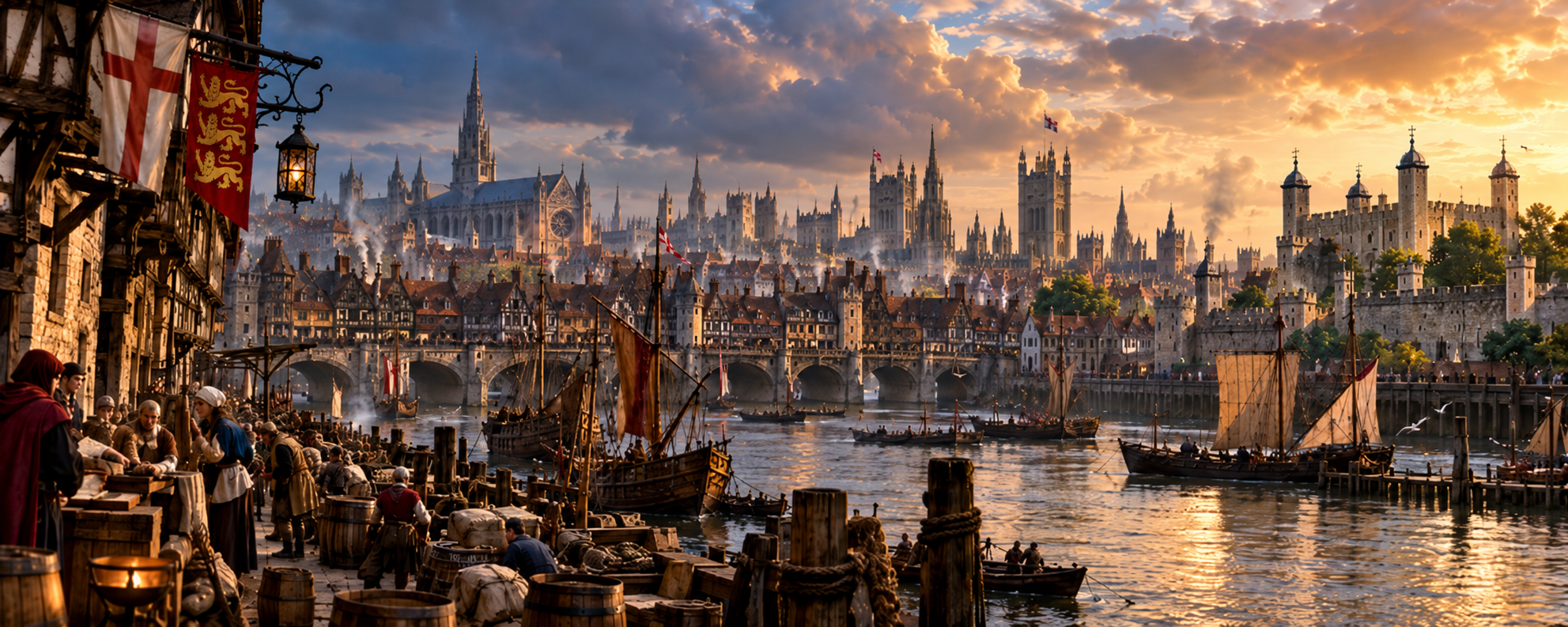
England · Capital · City and royal court · Thames port · Guilds and underworld
At a Glance
| Realm | Kingdom of England |
|---|---|
| Political Reality | The self-governing City of London beside the separate royal and administrative centre at Westminster |
| King | Henry VI |
| Protector | Richard, Duke of York, during the king’s incapacity |
| Mayor | Stephen Forster, Fishmonger |
| Population | About 50,000 across late-medieval London |
| Character | England’s largest city, principal market, Thames port, financial centre, royal capital and criminal crossroads |
| Best For | Court intrigue, organised crime, investigations, gang wars, guild politics, blackmail, prison breaks, supernatural conspiracies and Thames mysteries |
| Immediate Pressure | A weakened Crown, York’s protectorate, Somerset in the Tower, memories of Jack Cade and criminal networks powerful enough to bargain with the law |

London is three cities occupying the same streets: the Crown at Westminster, the merchant government of the City, and an underworld with laws of its own. Inside and around the old Roman walls, aldermen, guild masters and merchants govern markets, workshops and civic courts. Upstream, Westminster holds the king, Parliament and royal government. Beneath both runs another network of financiers, criminal masterminds, fences, thief-takers, gang leaders, blackmailers, informants and gaolers who know that almost anything in London can be bought if the right person names the price.
What Is Happening Right Now?
The king’s authority is dangerously uncertain. Henry VI fell into a profound incapacity in 1453. Government could not simply stop, and Richard, Duke of York, was appointed Protector and chief councillor during the crisis.
The change places London at the centre of a struggle that has not yet become open civil war.
Edmund Beaufort, Duke of Somerset, has been confined in the Tower of London. York’s allies hold influence in government. Queen Margaret of Anjou protects the interests of her husband and infant son.
That son, Edward, is formally created Prince of Wales in March, making the royal succession visible at precisely the moment the king cannot effectively rule.
Only four years ago Jack Cade and his followers entered the city during the rebellion of 1450. Cade struck London Stone with his sword and proclaimed himself lord of the city before the alliance between rebels and Londoners collapsed into violence and looting.
Shopkeepers, aldermen, prisoners, apprentices, gang leaders and householders remember those days personally.
The City wants trade, order and the defence of its privileges. Westminster wants a functioning realm. Great nobles want influence over the king. Merchants want debts honoured regardless of who controls the council.
Meanwhile, London’s criminal networks understand that political uncertainty is good for business.
Run London Tonight
Moriarty’s Missing Piece
A minor robbery makes no sense until Sherlock Holmes realises it is one move in a much larger scheme.
The stolen object is almost worthless. The person who possessed it is not.
Wild Wants His Property Back
A merchant hires the adventurers to recover a stolen silver reliquary.
Jonathan Wild offers to return it within a day—for a fee—and becomes openly hostile when the party continues investigating how he knows where it is.
Mother Cresswell’s Ledger
Someone has stolen a book belonging to Mother Cresswell.
The book contains no money. It contains names.
A judge, two merchants, a noble household and one senior civic officer are suddenly desperate to recover it before she does.
Fagin’s Missing Boy
A young thief belonging to Ikey “Fagin” Solomon steals a sealed letter from the wrong noble household and disappears.
Fagin wants the boy back. The noble wants the letter. Wild wants both.
Moll Cutpurse Has the Ledger
Moll Cutpurse steals an account book showing that a respected alderman has been paying Charles Hitchen for protection.
Hitchen wants the ledger destroyed. Wild wants a copy. Moll wants to know which side will pay most before either discovers she made two copies already.
The Newgate Escape
Jack Sheppard escapes from Newgate and vanishes into the city.
The sheriffs offer a reward. Poor Londoners hide him. Wild offers twice as much for information delivered privately.
The House of Eternal Beauty
A noblewoman disappears after visiting Madame Rachel.
Rachel insists her client left alive. Her locked cabinet contains the woman’s jewellery, several signed promises and a bottle that should not contain anything capable of whispering.
Two Londons: The City and Westminster
The City
The City of London is a political community in its own right. Ancient liberties allow its citizens to elect their mayor and sheriffs and regulate trade through civic institutions.
Twenty-five wards divide the urban core, each under an alderman. The Court of Aldermen and Common Council govern alongside the mayor, while the livery companies shape commerce and political life.
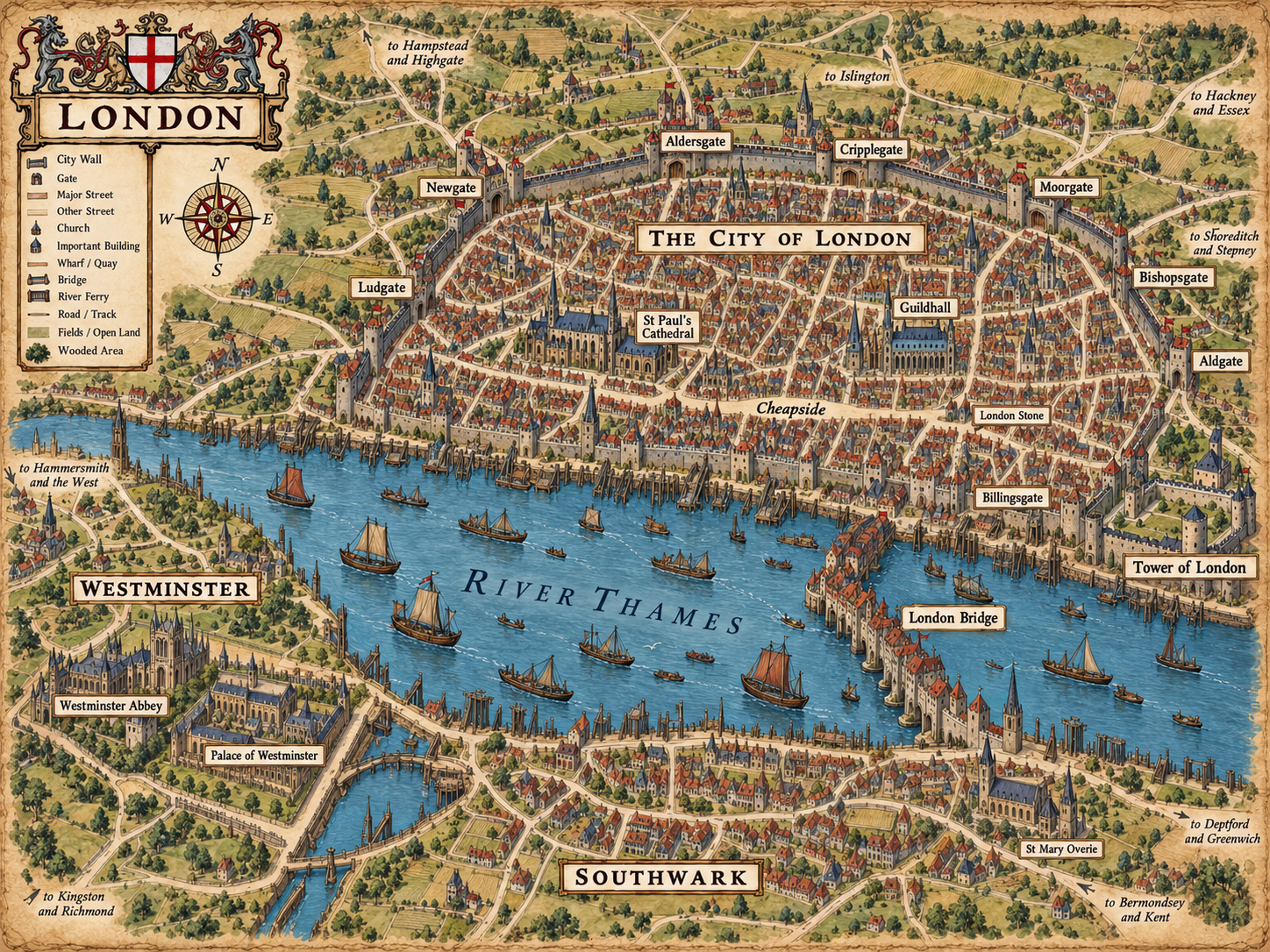
The City is dense, loud and commercial. Cheapside is one of its great market streets. Thames Street and the riverside wharves carry imported goods.
Parish churches stand close enough for bells to overlap. Guild halls, shops, houses, inns and workshops crowd the same streets.
Westminster
Westminster is the royal and administrative centre: the Palace of Westminster, Westminster Hall, the abbey and the machinery that follows the Crown.
Parliament meets when summoned. Petitioners, clerks, lawyers, nobles, servants and royal officers move through a political landscape very different from the merchant City downstream.
Travel between City and Westminster is common by road and river. A person can leave a guild dispute at Guildhall, reach the royal court at Westminster and return by barge before the same quarrel has finished spreading through Cheapside.
Guildhall and Civic Power
Guildhall is one of the clearest statements of London’s confidence.
Its great hall was rebuilt between 1411 and 1440 and is therefore a comparatively new monument to civic authority. Here London’s ruling merchant class conducts business, hears disputes and governs a city wealthy enough to bargain with kings.
Stephen Forster, a member of the Fishmongers’ Company, takes the mayoralty in 1454.
The office is elected annually and carries immense prestige, but the mayor is not a prince ruling London alone. Aldermen, common councillors, wealthy citizens and the great companies all matter.
Mercers, Grocers, Drapers, Fishmongers and other major companies can put money, information and organised manpower behind their interests.
For wider organisations and campaign factions, continue to Guilds, Factions & Organisations.
Who Really Runs London?
Nobody.
That is what makes the city dangerous.
The Crown controls royal authority. Guildhall controls civic government. Merchant companies control trade. Great households control retainers. Criminal leaders control pieces of the street economy. Moneylenders control debts. Investigators know things none of those groups want known.
Behind the most complicated crimes stands another possibility: Professor James Moriarty.
Moriarty does not need to own every gang.
He needs to know which gang to hire, which merchant to bribe, which clerk to compromise, which thief to sacrifice and which apparently unrelated crimes must happen in precisely the right order.
Jonathan Wild dominates the visible criminal economy.
Moriarty prefers not to be visible at all.
The London Underworld
| Figure | Power in London |
|---|---|
| Professor James Moriarty | Hidden strategist connecting crimes, respectable institutions and criminal specialists into larger schemes |
| Jonathan Wild | Crime boss, thief-taker, blackmailer and broker between criminals and authorities |
| Charles Hitchen | Corrupt civic officer who sells protection, information, arrests and access to prisoners |
| Elizabeth “Mother” Cresswell | Underworld matriarch, fixer, political financier, brothel keeper, scandal broker and blackmailer |
| Damaris Page | Property broker and keeper of houses, safe rooms, secrets and wealthy clients |
| Ikey “Fagin” Solomon | Fence and receiver who turns stolen goods into money and trains younger thieves |
| Mary Frith, “Moll Cutpurse” | Independent thief, fence and criminal intermediary |
| Jenny Diver | Master pickpocket and confidence thief |
| Jack Dawkins, “The Artful Dodger” | Street-gang leader and specialist pickpocket |
| Jack Sheppard | Burglar and escape artist whose prison breaks humiliate authorities and crime bosses alike |
Moriarty’s Web
Professor Moriarty is not a tavern gang leader.
His organisation is a network of compartments. A burglar may never know who commissioned the theft. A clerk copying a document may not know why it matters. A killer may believe his target was chosen for personal reasons.
Only Moriarty sees the whole board.
Jonathan Wild’s Machine
Jonathan Wild is the closest thing London’s visible criminals have to a prince.
A merchant whose silver vanishes can pay Wild and see it miraculously recovered. A thief who obeys Wild may avoid arrest. A thief who refuses him can suddenly find constables interested in his whereabouts.
Wild’s most valuable commodity is control over who gets punished.
Charles Hitchen: The Law for Sale
Charles Hitchen occupies the rotten ground between official authority and organised crime.
A warrant in his hands is leverage. An arrest can be delayed. A prisoner can be moved. Evidence can vanish.
Hitchen and Wild cooperate when profit requires it and undermine one another whenever either becomes too powerful.
Mother Cresswell
Elizabeth “Mother” Cresswell controls something more durable than a gang.
She controls rooms, debts, servants, introductions, frightened witnesses, discreet messengers and knowledge of where powerful people go when they think nobody important is watching.
She can hide a fugitive, arrange a meeting, ruin a reputation or tell an adventurer which respectable household secretly employs the criminal they are hunting.
Wild has thieves.
Cresswell has clients.
Damaris Page
Damaris Page competes in the same world of houses, property and secrets without simply becoming Cresswell’s subordinate.
Damaris is strongest where property, shelter and information meet. A wanted criminal may need her rooms. A noble may need her discretion. A merchant may need a meeting that officially never happened.
Fagin’s Market
Ikey “Fagin” Solomon sits at the point where theft becomes commerce.
Purses, jewellery, plate, cloth, weapons and household goods are useless to most thieves unless somebody can hide, alter or resell them.
Fagin provides that service.
His network also shelters and trains young thieves, including Jack Dawkins.
Moll Cutpurse and Jenny Diver
Moll Cutpurse moves between thieves, fences, taverns and respectable clients without surrendering her independence.
Jenny Diver is quieter and more precise. A purse, key, sealed letter or ring can disappear in a crowd before its owner knows anyone came near.
Money, Debt and Respectable Predators
Not every dangerous Londoner carries a knife.
Ebenezer Scrooge is one of the city’s wealthiest private lenders and landlords.
His power comes from contracts, rents, mortgages and desperate borrowers. A criminal can take a purse once. A lender can take a household a little at a time.
Scrooge’s former partner Jacob Marley still casts a shadow over his affairs, and not merely in ledgers.
Scrooge therefore occupies an uncomfortable position between respectable commerce and predation. Guild masters may dislike him, criminals may borrow from him, and desperate families may fear him more than either.
High Society Has Its Monsters Too
Dorian Gray
Dorian Gray moves through wealthy London with beauty, money and a reputation that never seems to age in the same way as everyone else.
He knows aristocrats, artists, collectors and people whose appetites are too dangerous for respectable daylight.
A scandal attached to Dorian can connect a drawing room in Westminster to an opium den, forbidden relic dealer or corpse in an alley without Dorian appearing visibly disturbed by any of it.
Madame Rachel
Madame Rachel sells beauty, confidence and promises to people wealthy enough to believe they can purchase both.
Her treatments mix genuine alchemy, fraud, cosmetics, charms and blackmail.
Her clients reveal fears they would never confess to a priest, physician or spouse.
Those confessions become assets.
The People Hunting the Underworld
London’s criminals do not operate without opposition.
Sherlock Holmes
Sherlock Holmes is a private consulting investigator whose value lies precisely in being outside ordinary civic chains of command.
He follows physical evidence, contradictions and patterns that constables dismiss as coincidence.
Moriarty is the opponent who understands the same city as a system.
Dr John Watson
Dr John Watson is physician, veteran, witness and Holmes’s most reliable companion.
Watson understands wounds, poisons, frightened witnesses and the difference between a clever theory and a dying person who needs help immediately.
Frederick Abberline
Frederick Abberline works closer to official civic authority.
Where Holmes follows a case wherever it leads, Abberline must still deal with warrants, civic officers, hostile aldermen, frightened witnesses and superiors who sometimes prefer a convenient answer.
That makes him particularly dangerous to Hitchen and Wild.
Landmarks & Places to Know
The Tower of London
The Tower is fortress, armoury, treasury, royal residence and prison.
Somerset is confined there during York’s protectorate. A person sent to the Tower has entered national politics whether they intended to or not.
Guildhall
The newly rebuilt Great Hall is the centre of City government.
Civic trials, assemblies, feasts, petitions and disputes pass through an institution designed to display London’s wealth and independence.
St Paul’s Cathedral
Old St Paul’s dominates the western City.
Clergy, lawyers, merchants, messengers, thieves and informants use its precinct as meeting place as well as sacred ground.
London Bridge
The bridge is the principal fixed Thames crossing and a settlement in its own right.
It carries merchants, pilgrims, livestock, carts, royal traffic and gangs of pickpockets between the City and Southwark.
Newgate
Newgate Prison has recently undergone major rebuilding funded from the bequest of Richard Whittington.
The sheriffs bear responsibility for prisoners awaiting justice, but money, connections and criminal influence affect confinement as much as walls do.
Bethlem Hospital
Bethlem is a small charitable religious hospital caring for poor and disturbed people on the edge of respectable urban society.
London Stone
London Stone is already ancient and mysterious.
Jack Cade’s claim over the city has given the stone fresh political meaning without explaining its true origin.
Southwark
Across London Bridge lies Southwark, outside the City’s ordinary jurisdiction and shaped by inns, markets, religious houses and the Bishop of Winchester’s liberties.
A thief, outlaw or wanted adventurer who reaches the south bank has not become safe, but the rules have changed.
Taverns, Inns & Lodgings
The Tabard, Southwark
Across London Bridge in Southwark, the Tabard is one of the city’s best-known traveller’s inns: a busy courtyard house with food, ale, beds, stabling and a constant traffic of merchants, messengers, carriers, hired blades and strangers. It is an excellent place to hear road news, find transport, lose a pursuer in a crowded yard or meet someone who does not wish to enter the City proper.
Bridge-Foot Inns
The approaches to London Bridge are thick with lodging houses and alehouses serving travellers who arrive after the gates close, drovers who need space for animals and poorer visitors who cannot afford prestigious quarters. Rooms are cramped, locks are unreliable and information travels quickly.
Thames-Side Taverns
Near the wharves, drink is sold wherever boatmen, sailors, porters and factors gather. These houses range from respectable rooms used to settle cargo business to dangerous riverside dens where stolen goods change hands before dawn. Adventurers looking for a crew, contraband, river passage or dockside gossip start here.
Merchants, Crafts and the Thames
London is England’s largest market and its greatest concentration of money, credit and skilled labour.
Wool and cloth remain central, but the city handles wine, fish, grain, spices, metals, dyestuffs, luxury goods and countless smaller trades.
The Thames is the city’s main road. Barges move people between Westminster, the City and the Tower. Lighters shift cargo from larger vessels.
Wharves and warehouses create a waterfront where legitimate commerce and theft are often separated only by paperwork.
A stolen crate can be hidden beside lawful cargo. A customs clerk can be bribed. A lighterman can unload at the wrong stair. A warehouse keeper can discover that half his stock has changed ownership without a lock being broken.
Law, Crime and Punishment
London contains overlapping jurisdictions rather than one uniform police system.
The City’s mayor, sheriffs, aldermen, ward officers and courts enforce civic law. Royal officers exercise authority on behalf of the Crown. Westminster has its own institutions. Church courts govern matters within ecclesiastical jurisdiction.
Constables and watchmen deal with immediate disorder; sheriffs and courts pursue offenders; gaolers keep prisoners; private thief-takers hunt criminals for reward.
That fragmented system creates the space in which men such as Jonathan Wild and Charles Hitchen thrive.
Serious crime can move a character rapidly from a ward street to Newgate or the Tower.
For everyday enforcement, Parish Constables provide a useful street-level NPC framework.
Magic and the Supernatural City
London’s magic grows from density, age and authority.
Roman masonry lies beneath medieval streets. Parish boundaries overlap older routes. Oaths are sworn in halls used by generations of citizens. The river carries offerings, bodies, stolen goods and secrets toward the sea.
Gargoyles fit towers, churches, gatehouses and wealthy stone buildings.
Urban haunts belong in prisons, execution sites, plague burial grounds, abandoned cellars and houses where violent deaths were never properly resolved.
The supernatural also moves through people.
Dorian Gray’s ageless appearance, Madame Rachel’s alchemical promises, Marley’s shadow over Scrooge and whatever truly lies beneath London Stone all remind investigators that some crimes cannot be explained by greed alone.
Most fraud is fraud, most illness is illness and most crime is human.
The supernatural becomes frightening because it is difficult to distinguish from ordinary urban misery until the evidence becomes undeniable.
Services and What Adventurers Can Find
Almost every ordinary service available in England can be found somewhere in London.
Armourers, weapon smiths, saddlers, scribes, lawyers, money-changers, physicians, apothecaries, book dealers, shipmasters, translators, jewellers and specialised craftsmen work within the city or its suburbs.
The underworld offers another set of services.
Fences buy stolen goods. Forgers alter documents. Informants follow targets. Smugglers move objects past officials. Safe houses hide wanted people. Corrupt gaolers carry messages into prisons.
Rare magic moves through private households, clerical treasuries, foreign merchants, specialist craftsmen, inherited collections and discreet brokers.
A buyer who asks openly for a cursed relic may attract civic authorities.
A buyer who asks Fagin may receive three offers before sunset.
For wider settlement mechanics, use Fantasy Settlements.
Rumours and Street Talk
- “Moriarty does not commit crimes. He arranges them.” Anyone repeating this loudly usually stops repeating it.
- “Mother Cresswell knows which noble slept where last night.” She usually knows who paid for the room as well.
- “Wild stole half the property he recovered last month.” The people saying it quietly are probably right.
- “Holmes can tell where you slept by looking at your boots.” The Dodger has started cleaning his.
- “Scrooge owns more poor men than some barons own tenants.” The contracts are perfectly lawful.
- “Fagin knows every boy who can cross London without being noticed.” Not every boy. Enough of them.
- “Moll Cutpurse has an alderman’s seal.” She denies it while wearing an unusually expensive new coat.
- “Jack Sheppard will be out of Newgate before Sunday.” The gaolers are taking bets.
- “Dorian Gray looked exactly the same twenty years ago.” The servant who says so is old enough to remember.
- “Madame Rachel can make anyone beautiful.” Her former clients disagree about the price.
- “Cade’s men buried silver beneath London Stone.” Probably false; people are digging anyway.
- “A gargoyle moved on St Paul’s after compline.” The witness was sober and refuses payment for the story.
Travel Through London
| Route | What It Means in Play |
|---|---|
| City to Westminster | Political traffic along the Strand or by Thames barge; merchants, criminals and royal government intersect here. |
| City to the Tower | Short eastern journey from commercial streets into royal military authority. |
| London Bridge to Southwark | The main fixed river crossing; crowded, strategic and valuable to smugglers, thieves and pursuers. |
| York | The great road north carries royal orders, merchants, pilgrims, noble retainers and highwaymen. |
| Bristol | Overland connection to England’s great western port and an important route for goods London thieves cannot easily sell locally. |
| Thames downstream | Access toward the estuary, continental shipping, smuggling routes and the wider North Sea world. |
Southwark Inns, Storytellers and Urban Fey
The White Hart
South of London Bridge, the White Hart receives merchants, messengers, drovers, servants and travellers who want to enter or leave the City without paying City prices for a bed. Its yard is busy enough that a wagon, prisoner or fugitive can disappear among horses and hired men if someone has prepared the route.
Only a few years ago Jack Cade made the White Hart his headquarters during the Kentish rising. Its yard still draws men seeking former comrades, missing goods and witnesses who would rather not be found. A room here can provide shelter, paid protection or the dangerous chance to be recognised by the wrong person.
The Tabard
The Tabard is one of Southwark’s great gathering places for travellers. Stories, gossip, boasts and lies cross its tables faster than ale. A person heading south can find guides, hired guards, pack animals and companions here before committing to the road.
At the Tabard, strangers leave London in uneasy company. A singer can earn a meal for a story, a courier can hire armed escorts, and a traveller carrying an unfamiliar letter may find a reader willing to decipher it for the price of a bed. The same crowded room offers a place to make promises, overhear a dangerous name, or discover who has already sold news of the journey.
Boggarts and House-Fey
Boggarts thrive in London’s attics, workshops, yards and warehouses. Some households also tolerate helpful fey that mend, clean or guard property when treated with respect. The danger comes when a family assumes every unseen servant is harmless.
The Old Roads Beneath the City
Roman London has not vanished; much of it lies underneath later streets. Some ghosts repeat the routes they knew in life, and some doors in cellar walls open only when the modern street above follows the same line as the Roman road below.
Deeper History
Roman Londinium established the walled urban core and river crossing. Medieval London reused, repaired and built beyond that inheritance.
After the Norman Conquest, William I secured the city while ordering the fortress that became the Tower of London.
The City won and defended extensive liberties from the Crown.
Its citizens gained the right to elect sheriffs and mayor, and its wealth made London indispensable to royal government.
The Black Death shattered the population in the fourteenth century.
London remains far below its earlier medieval peak, with roughly 50,000 people in the fifteenth century, but no English city approaches its economic and political weight.
The rebuilding of Guildhall between 1411 and 1440, the reconstruction of Newgate between 1423 and 1432 and the recent violence of Jack Cade’s rebellion remain visible in the physical and political city.
Adventure Pressure
- Royal pressure: Henry VI cannot reliably govern, while the realm still requires government every day.
- Faction pressure: York, Somerset, the queen and their allies compete for influence.
- Civic pressure: London protects trade and its privileges before it protects any noble faction.
- Criminal pressure: Moriarty, Wild, Hitchen, Cresswell, Damaris and Fagin control different parts of a criminal economy no single authority understands.
- Investigative pressure: Holmes, Watson and Abberline keep uncovering connections powerful people would rather leave buried.
- Financial pressure: Scrooge and other lenders can destroy a household without ever breaking the law.
- Prison pressure: Newgate and the Tower hold people whose release or death could change national events.
- Supernatural pressure: ancient stone, prisons, hidden magic, cursed wealth and impossible people blur the boundary between urban crime and genuine horror.
Sources and Historical Grounding
The historical city rests on surviving civic institutions, archaeological research and records of Henry VI’s reign.
City of London material documents the medieval government, livery companies and Guildhall; London Museum records London Stone and Jack Cade’s use of it; the Royal Family records Henry VI’s incapacity and Richard of York’s protectorate; and University of London research places fifteenth-century London at roughly 50,000 inhabitants.
City of London — The City’s Government · City of London — Livery Companies · Guildhall — The Many Lives of Guildhall · London Museum — London Stone · The Royal Family — Henry VI · University of London Press — Late Medieval London
Continue Exploring
Kingdom of England · The British Isles · Tower of London · Newgate Prison · Bethlem Hospital · British Isles NPCs · Factions
Keep this reference growing
If this page helped with your reading or game, you can support its upkeep or explore the curated books.
Explore the Bookshop — epics, classics and stories behind imagined worlds.