
The Pale — Four Counties on a Living Frontier
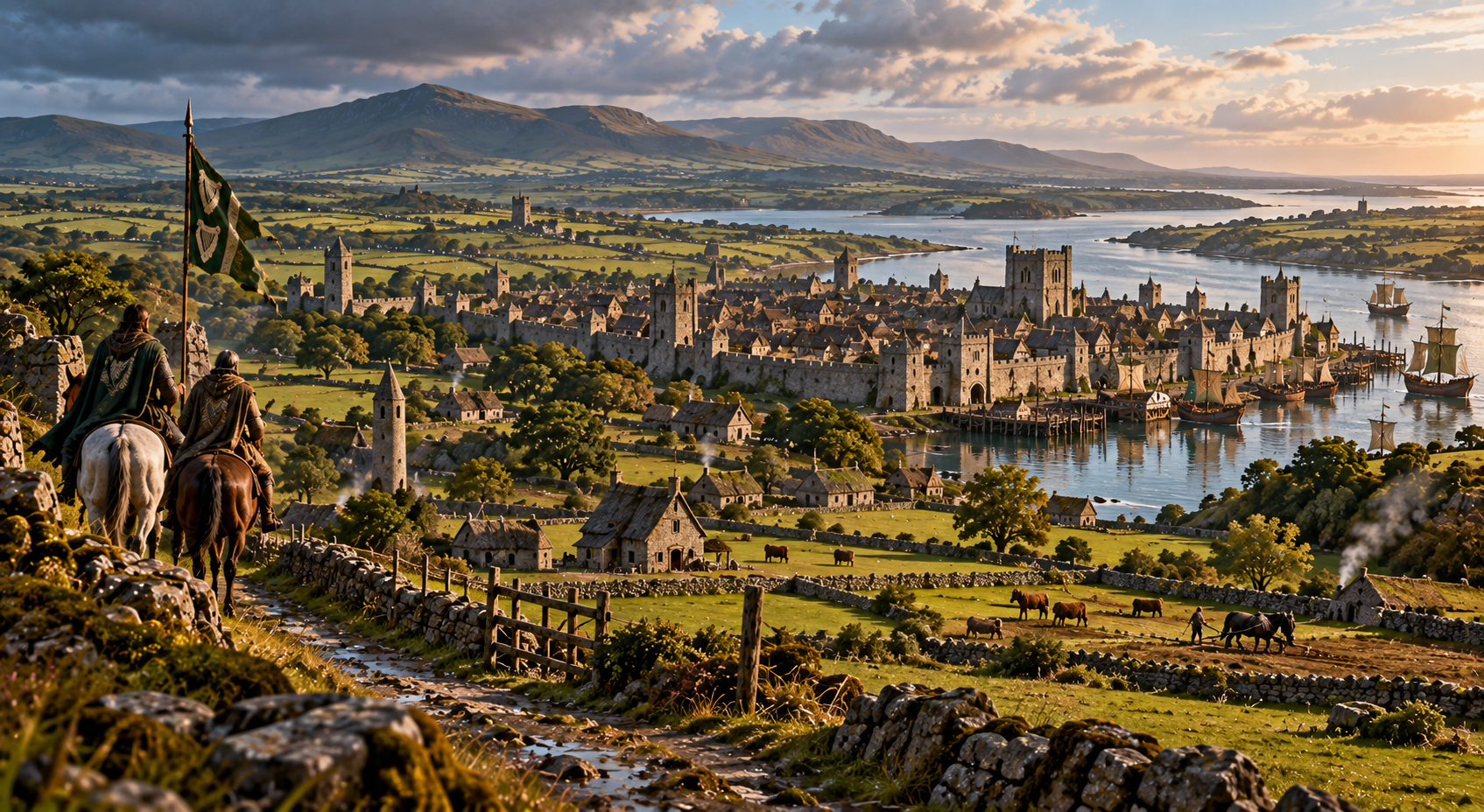
Ireland · Dublin frontier · Four counties · Tower houses · Patrol roads · Contested law
At a Glance
| Core territory | Dublin and the most secure parts of Meath, Kildare and Louth |
|---|---|
| Political character | The strongest zone of direct government from Dublin, surrounded by powerful Gaelic and Anglo-Irish lordships |
| 1454 reality | Known increasingly as a distinct four-county frontier; its effective boundary is shifting rather than a single continuous wall |
| Defences | Castles, tower houses, local ditches, hedges, beacons, patrols and guarded roads |
| Best for | Warrants, cattle raids, escorts, safe-conducts, disputed estates, spies and frontier diplomacy |
| Supernatural pressure | Pookas, banshees, dullahan, old raths and roads whose older owners ignore county boundaries |

The Pale is not a neat wall drawn across Ireland. It is the defended heartland around Dublin where royal writs, sheriffs, markets and castle garrisons operate most reliably. Beyond the safest roads, authority becomes a negotiation between Dublin officials, the great Anglo-Irish houses, Gaelic lords and communities whose loyalties cross every administrative line.
What Is Happening Right Now?
Richard, Duke of York, holds the lieutenancy of Ireland, but the frontier is governed by people who can make an order real on the ground. Deputies in Dublin rely on the FitzGeralds of Kildare, local sheriffs, castle officers, town governments and armed households to keep roads open and answer raids.
The four counties of Dublin, Meath, Kildare and Louth form the recognised core of this directly governed world, but their old county boundaries extend far beyond the territory where Dublin can enforce a writ safely. A road may be legally inside Meath and practically outside government control by nightfall.
Cattle are the frontier’s most portable wealth. Raids therefore matter as much as formal battles. A stolen herd can ruin an estate, fund a war-band, break a marriage agreement or provoke retaliatory violence across three lordships before any judge hears the first complaint.
Run the Pale Tonight
The Safe-Conduct
A Gaelic lord sends three riders toward Dublin under a sealed safe-conduct. One is killed inside supposedly secure territory. The surviving envoys refuse to move until the killer is found, while the local sheriff insists the attack happened beyond his jurisdiction.
The Beacon That Burns Twice
A frontier beacon is lit at midnight, extinguished, then lit again from inside a locked tower. Patrols find no raiders nearby. By dawn every horse within a mile has broken its tether and fled west.
The Missing Herd
Two hundred cattle vanish from a defended estate without crossing any watched road. Tracks lead into an old rath and stop. The landholder blames raiders; the oldest tenant says the herd followed music.
The Four Counties
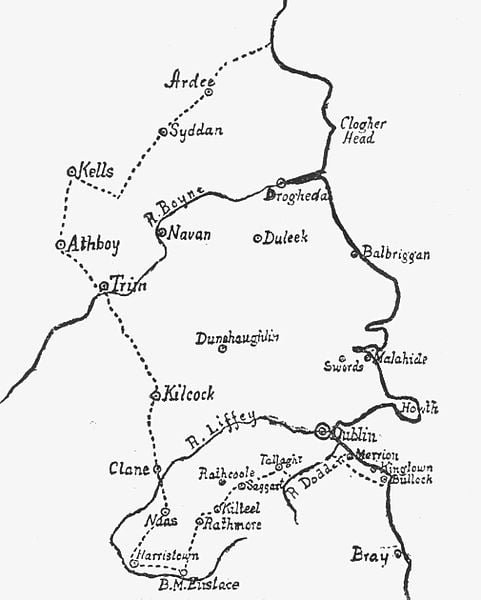
Dublin is the administrative centre and safest concentration of royal government. Meath carries the weight of Trim, Tara and the Boyne valley while also holding estates tied to powerful Anglo-Irish dynasties. Kildare is dominated by the FitzGerald interest and forms one of the essential western shields of Dublin. Louth extends the defended coastal corridor north toward Dundalk.
The old shire boundaries are larger than the territory actually controlled. That mismatch is the Pale’s defining fact. Officials think in counties; patrols think in roads, bridges, strong houses and how long reinforcement will take to arrive.
Ditches, Hedges and Tower Houses
The frontier is defended in pieces. Some estates maintain banks and thorn hedges. Others rely on ditches, watch posts, fortified houses and beacon chains. Strongpoints guard river crossings and roads rather than attempting to create one continuous barrier across eastern Ireland.
A tower house can protect a family, serve as a local prison, shelter cattle during a raid and signal neighbouring estates. It can also become a private checkpoint where a lord decides that royal law means whatever his armed men can enforce until someone stronger arrives.
Beacon systems make distance political. One fire can summon riders from several estates; a false alarm can strip another district of defenders. Sabotaging a beacon may be more effective than attacking a castle.
Dungeon: The March Tower and the Black Ditch
A fortified tower house on the Kildare road stands beside an old bank-and-ditch frontier work. The household above remains active: guards watch the road, cattle are brought inside during alarms, travellers show passes and messengers change horses in the yard.
The Guard Cellar
Below the tower are food stores, weapons and a holding cell for suspicious travellers. A collapsed wall reveals a narrow drainage passage running toward the ditch outside.
The Black Ditch
The drain opens into a buried section of the frontier earthwork. Roots from the thorn hedge above have woven through the ceiling, but the tunnel is older than the current defences and continues in both directions beyond the estate boundary.
The Rath Below
One branch descends into an earlier circular enclosure buried beneath the frontier bank. A standing stone lies flat across its centre. Names spoken here are answered from beyond the wall in the voice of the person’s oldest living enemy.
The Westward Road
Beyond the stone is a path that should emerge outside the tower but instead crosses open country under a different sky. Hoofprints show that somebody has already been using it to move cattle around the patrol roads.
The consequences remain above ground. If raiders learn the route, the frontier collapses locally. If officials seal it, the old rath’s inhabitants may begin opening other paths. If the tower’s lord controls it, he possesses a smuggling road that bypasses every neighbouring toll and checkpoint.
Creatures of the Pale Roads
Pookas
Pookas thrive on roads where travellers already expect uncertainty. They borrow the shapes of animals, offer rides, alter direction and make a two-mile journey end beyond a jurisdiction the traveller never meant to enter.
Dullahan
Dullahan ride routes that gates and hedges cannot reliably block. A watchman may close a frontier post against mortal raiders and discover that the headless rider has already passed through the locked gate.
Banshees
Banshees follow families across county lines. On a frontier where marriage and kinship bind rival political worlds together, their cries can reveal an approaching death before either side of a feud knows who has been marked.
Law, Bargain and Frontier Survival
A Dublin warrant is powerful inside the core of the Pale, but paper still requires people willing to enforce it. Sheriffs bargain with great households, towns defend their privileges and local landholders maintain armed followers because waiting for distant help can mean losing a herd before dawn.
Gaelic lords are not simply external enemies. They trade, negotiate safe-conducts, foster children, arrange marriages and enter alliances with Pale families. The same household can raid one neighbour and escort another merchant convoy under oath.
The Morrígan is felt where sovereignty becomes inseparable from violence and possession. An estate taken by force is not automatically accepted by the land, however convincing the new owner’s parchment appears.
Historical and Mythological Context
The four counties of Dublin, Meath, Kildare and Louth were increasingly treated as the secure core of English government during the fifteenth century. A complaint from the Irish council in 1435 claimed that only a small connected area of these counties remained safe enough for travellers answering the king’s writs. The language was politically exaggerated, but it shows how sharply the directly governed territory had contracted.
In 1450 contemporary records already refer collectively to the “four counties.” The familiar term “English Pale” becomes explicit in later fifteenth-century legislation, and the famous statute ordering ditches around the marches belongs to 1495. In 1454 the frontier is therefore real but still fluid: a network of controlled roads, strongholds and estates rather than one completed continuous barrier.
Keep this reference growing
If this page helped with your reading or game, you can support its upkeep or explore the curated books.
Explore the Bookshop — epics, classics and stories behind imagined worlds.