
Leinster — The Pale, Kildare and the MacMurrough Kings
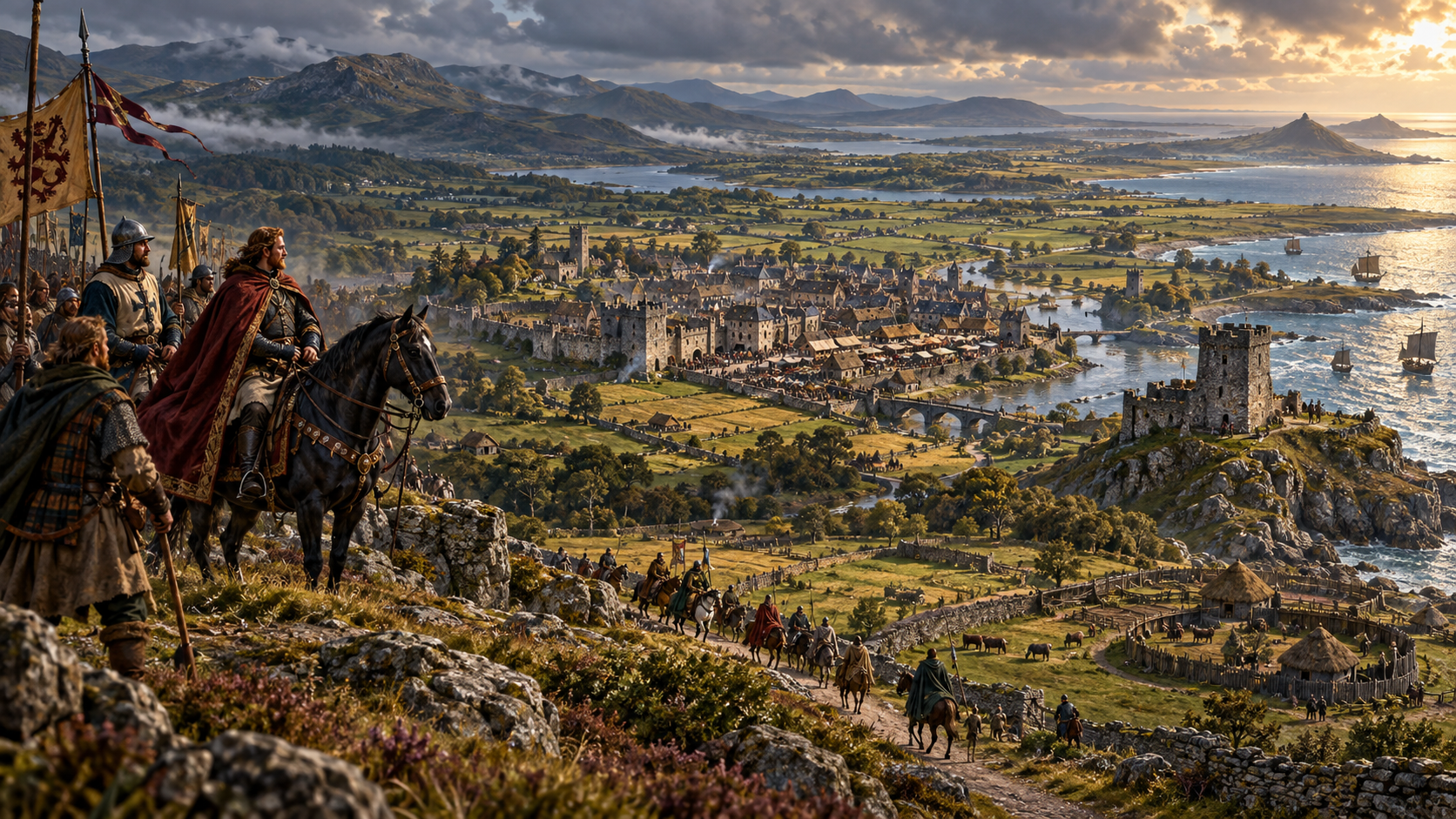
Ireland · Eastern province · The Pale · Gaelic Leinster · Kildare · Wicklow Mountains · Wexford coast
At a Glance
| Political reality | No single government rules all Leinster; Gaelic kings, Old English earls, liberties, towns and the Dublin administration overlap |
|---|---|
| Gaelic king | Donnchadh mac Airt Mhóir MacMurrough, with Domhnall Riabhach recognised as his successor |
| Major powers | MacMurrough Kavanaghs, FitzGeralds of Kildare, Butlers of Ormond, O’Byrnes, O’Tooles, Dublin administration and Wexford interests |
| Key places | Dublin, the Pale, Kildare, Naas, Carlow, Ferns, Wexford, Wicklow and Glendalough |
| Languages | Irish and English, with Latin used in diplomacy and manuscript scholarship beside native learned traditions |
| Faith | Druidic colleges, local gods, ancestor cults and sacred landscapes shape public ritual and law |
| Best for | Border lordships, political escorts, mountain warfare, contested law, trade, sacred valleys and factional intrigue |
| Immediate danger | A local raid can draw in Kildare, Ormond, MacMurrough, Wexford or Dublin before anyone agrees whose law was broken |
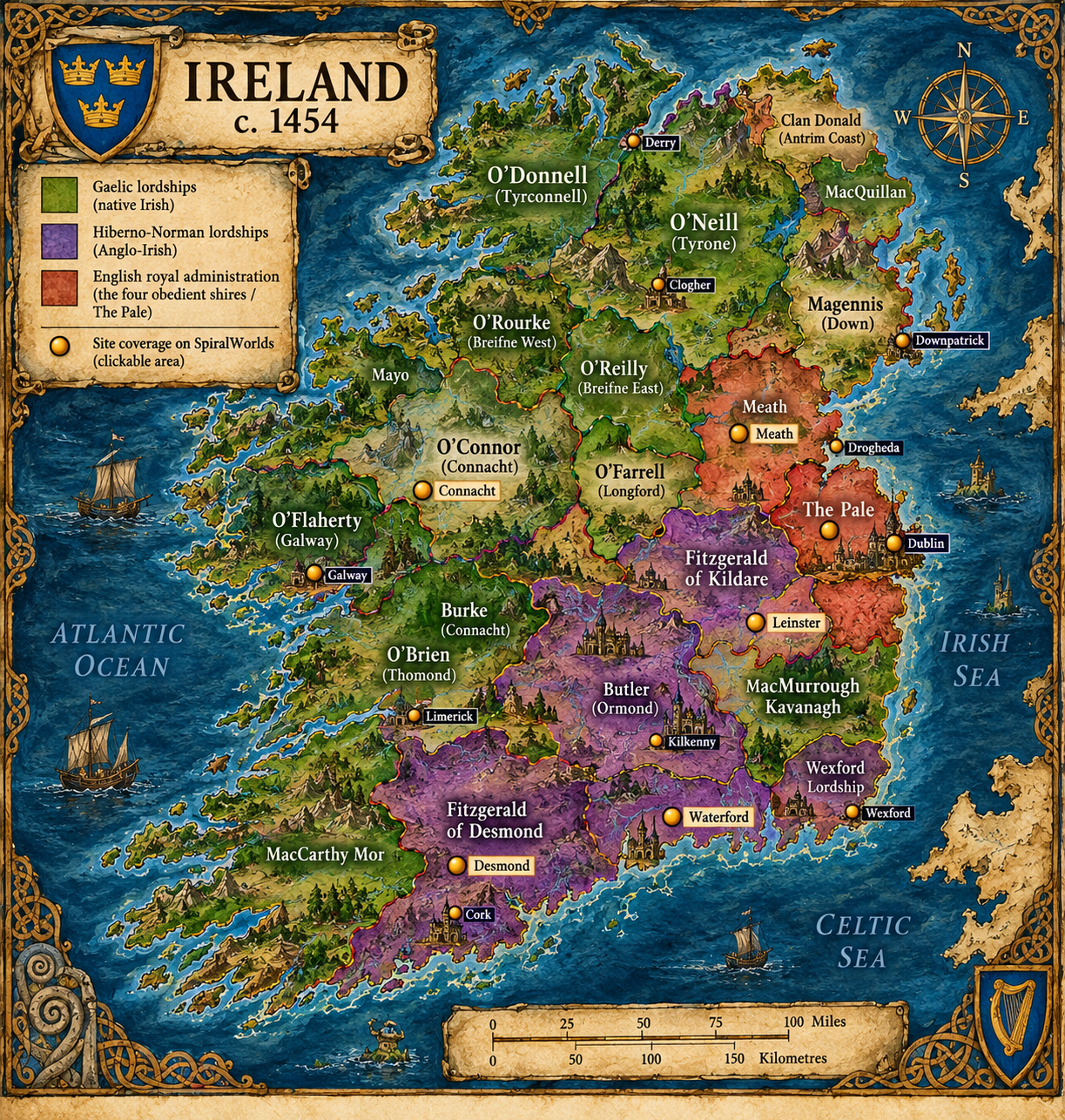
Leinster is where the political map of Ireland becomes impossible to simplify. Dublin and the Pale form the strongest concentration of English royal administration, but beyond and even beside them lie the great FitzGerald and Butler interests, the mountain territories of the O’Byrnes and O’Tooles, and the MacMurrough Kavanagh kingship of Gaelic Leinster. Roads, rents and loyalties cross political boundaries more easily than armies do.
What Is Happening Right Now?
Donnchadh MacMurrough remains king among the MacMurrough Kavanaghs, but Domhnall Riabhach has already emerged as his accepted successor and acts with increasing independence. Their position is strengthened by alliances with the Butlers and by the weakness of any attempt to impose one authority across eastern Leinster.
The year is already violent. Domhnall Riabhach and Butler allies are involved in attacks on the liberty of Wexford, while O’Byrne interests oppose them. The struggle is not a simple Gaelic-versus-English war: Gaelic and Old English houses cooperate or fight according to lordship, kinship, inheritance and immediate advantage.
The FitzGerald earldom of Kildare is again a major force after Thomas FitzGerald recovered his position. That makes the corridor west and south of the Pale politically charged. A convoy carrying money, hostages or letters can be more dangerous than an army because its contents may decide which lord joins which side.
Meanwhile the Dublin administration wants roads, courts and revenues to function. It can project force strongly close to the capital and much less reliably in the mountains and disputed lordships beyond.
Run Leinster Tonight
The Wexford Retaliation
A merchant convoy is seized after a raid on the Wexford liberty. Both sides insist the merchants financed the enemy. The cargo includes sacred regalia, wine, military crossbows and a sealed letter that would embarrass three great houses if opened.
The Pass Above Glendalough
An O’Byrne guide offers to lead the party through a mountain route that avoids official roads. At sunset the guide refuses to cross a standing stone because the boundary belongs to an older power than either Dublin or the mountain clans.
The Kildare Heir
A young FitzGerald relative disappears between Naas and Carlow. MacMurrough riders are blamed immediately. The only witness claims the escort willingly followed a woman in green into a ruined stone sanctuary.
The King’s Blind Side
Donnchadh’s failing sight has become politically dangerous. A forged message can now be presented to him as genuine unless somebody he trusts reads it aloud. Domhnall Riabhach wants the forger alive; another faction needs the deception to stand.
The Pale Boundary Stone
A boundary marker is moved during the night, changing which lord can collect rent from an entire settlement. The villagers know who moved it but are more frightened by what was found beneath the original stone.
Leinster Is Not One Kingdom
The ancient provincial name survives, but power is divided. The north-east contains the English administrative heartland around Dublin and the Pale. The FitzGerald earldom of Kildare controls great estates and retinues inland. Butler power reaches from Ormond and Kilkenny into the south-west. Gaelic lordships dominate much of the mountains and south-eastern interior.
The MacMurrough Kavanaghs claim the kingship of Leinster and remain the principal Gaelic dynasty of the south-east. Their power is strongest where castles, woods, river valleys and uplands make direct control from Dublin difficult.
The Pale and Dublin
The Pale is not a sealed country behind one perfect wall. It is a defended zone of counties, settlements, roads, ditches, castles and communities surrounding the strongest English institutions in Ireland. Its boundary changes according to military strength and local allegiance.
Dublin is the principal royal city, legal centre and port. Parliament, courts, merchants and officials give it influence far beyond what its troops can continuously occupy. The closer a dispute lies to Dublin, the more likely written law and royal administration are to matter; farther away, negotiated lordship matters just as much.
The MacMurrough Kavanaghs
Donnchadh mac Airt Mhóir inherits the prestige built by his father Art Mór MacMurrough Kavanagh, who repeatedly resisted English intervention. Donnchadh’s reign is less secure. Rival branches, O’Byrne relations and Butler alliances force constant calculation.
Domhnall Riabhach, Donnchadh’s nephew and recognised successor, is already acting as a major war leader. He represented Donnchadh during the submission to Richard, Duke of York, in 1449 and now participates directly in the violent politics of Wexford and the south-east.
For adventurers, the important fact is that “the king of Leinster” does not mean an uncontested monarch over the whole province. It means a prestigious Gaelic kingship with real military power operating among other lords who recognise very different sources of authority.
Kildare, Ormond and the Old English Lordships
The FitzGeralds of Kildare are among the strongest magnates of the lordship. Their lands sit between the Pale and Gaelic territories, making them indispensable to both government and private warfare. Their castles and affinities provide a second network of authority beside the Crown’s officials.
The Butlers of Ormond dominate farther south and west but intervene repeatedly in Leinster. In the present crisis Butler clients cooperate with MacMurrough forces in attacks on Wexford. Kinship and fosterage cross the cultural boundary that statutes attempt to keep clear.
Wexford and its liberty form another distinctive zone: port, farmland, castles and older Anglo-Norman settlement pressed by Gaelic lordships from inland. Every raid there has diplomatic consequences.
Places That Matter
Dublin
The great administrative city, port and fortress of the English lordship. Use it for courts, political missions, merchant finance, prisoners and conflicts between royal policy and local reality.
Naas and Kildare
These towns sit within the Fitzgerald heartland and on the approaches to the Pale. They are natural gathering points for retainers, horsemen, messengers and parliamentary politics.
Carlow and the Barrow
The Barrow corridor is a route, frontier and invasion road. Castles and river crossings make Carlow country central to conflict between MacMurrough, Butler and English interests.
Ferns
Ferns carries old royal and ecclesiastical prestige in the MacMurrough country. A claim made here can invoke ancestral patrons, kingship and land rights older than many Anglo-Norman charters.
Glendalough and the Wicklow Mountains
Mountain valleys shelter ancient sacred enclosures, learned communities and the territories of the O’Byrnes and O’Tooles. Roads narrow into passes where a small force or supernatural warning can stop a much larger army.
Wexford
A maritime town and liberty exposed to pressure from inland. Merchants and landholders need trade to continue even while neighbouring powers raid one another.
Magic and the Sacred Landscape
Druidic colleges, sacred groves, divine cults and ancestor rites shape public sacred life. Holy wells, raths, burial mounds and mountain passes carry obligations that local people observe whether or not a Dublin lawyer recognises them.
Leinster’s supernatural conflicts work best when they mirror the province’s political ones: two authorities can both possess a genuine claim. A druidic college may hold a written judgement while a hill spirit remembers the oath made before the college existed.
Dungeon: The Sealed Road Beneath the Barrow
Flooding exposes a worked arch beneath a riverbank south of Carlow. The passage is older than the nearby castle but contains recent boot prints.
The Toll Chamber
Stone sockets show where a gate once barred the route. Coins from several centuries lie in cracks in the floor, each paid to a different ruler.
The Charter Vault
Wax-sealed documents hang dry inside a room that should be underwater. Some record grants that contradict current estates; one names a non-human witness still alive.
The King’s Ford
The final chamber opens onto an underground river crossing guarded by an oath-bound warrior who recognises the MacMurrough kingship but not English feudal title.
Travel, Law and Language
| Zone | What Travellers Need to Know |
|---|---|
| The Pale | Royal writs, borough privileges and English common law carry the greatest practical force. |
| Kildare lordship | FitzGerald affinity and local lordship can matter more immediately than distant officials. |
| MacMurrough country | Irish law, kinship, tribute and military reputation structure agreements. |
| Wicklow uplands | Guides, hostages and negotiated passage are safer than assuming a road is neutral ground. |
| Ports and market towns | English, Irish and merchant networks overlap; interpreters and letters of credit can be as valuable as weapons. |
The Kildare Pooka and Leinster’s Old Roads
Leinster’s most famous road-trickster is the Pooka. In Kildare and the neighbouring countryside it may appear as a dark horse, goat or other animal and carry an unwary rider across ditches, streams and boundaries that were never on the traveller’s map.
Some pookas are malicious; others answer questions or punish arrogance. A household that leaves a regular gift at an old hill may be maintaining a bargain older than the current lordship.
Because the Pale and Gaelic Leinster overlap so closely, a pooka ride can become a political problem: a traveller may begin on one lord’s road and be thrown down before dawn inside another jurisdiction entirely.
Historical and Mythic Context
Late-medieval Leinster is defined by overlapping jurisdictions rather than a simple ethnic frontier. Dublin and the Pale preserve the institutional centre of the English lordship while Kildare, Ormond, MacMurrough, O’Byrne, O’Toole and Wexford interests compete across the province.
Donnchadh MacMurrough remains king of Leinster, but his nephew Domhnall Riabhach is already the recognised successor and a major political actor. In 1454 MacMurrough and Butler forces are actively involved in warfare against the Wexford liberty, demonstrating how unstable alliances can be.
Dictionary of Irish Biography — Domhnall Riabhach MacMurrough · Dictionary of Irish Biography — MacMurrough dynasty context
Map of the Political Landscape
Keep this reference growing
If this page helped with your reading or game, you can support its upkeep or explore the curated books.
Explore the Bookshop — epics, classics and stories behind imagined worlds.