
Anglesey — Granary of Gwynedd and Island of Arianrhod
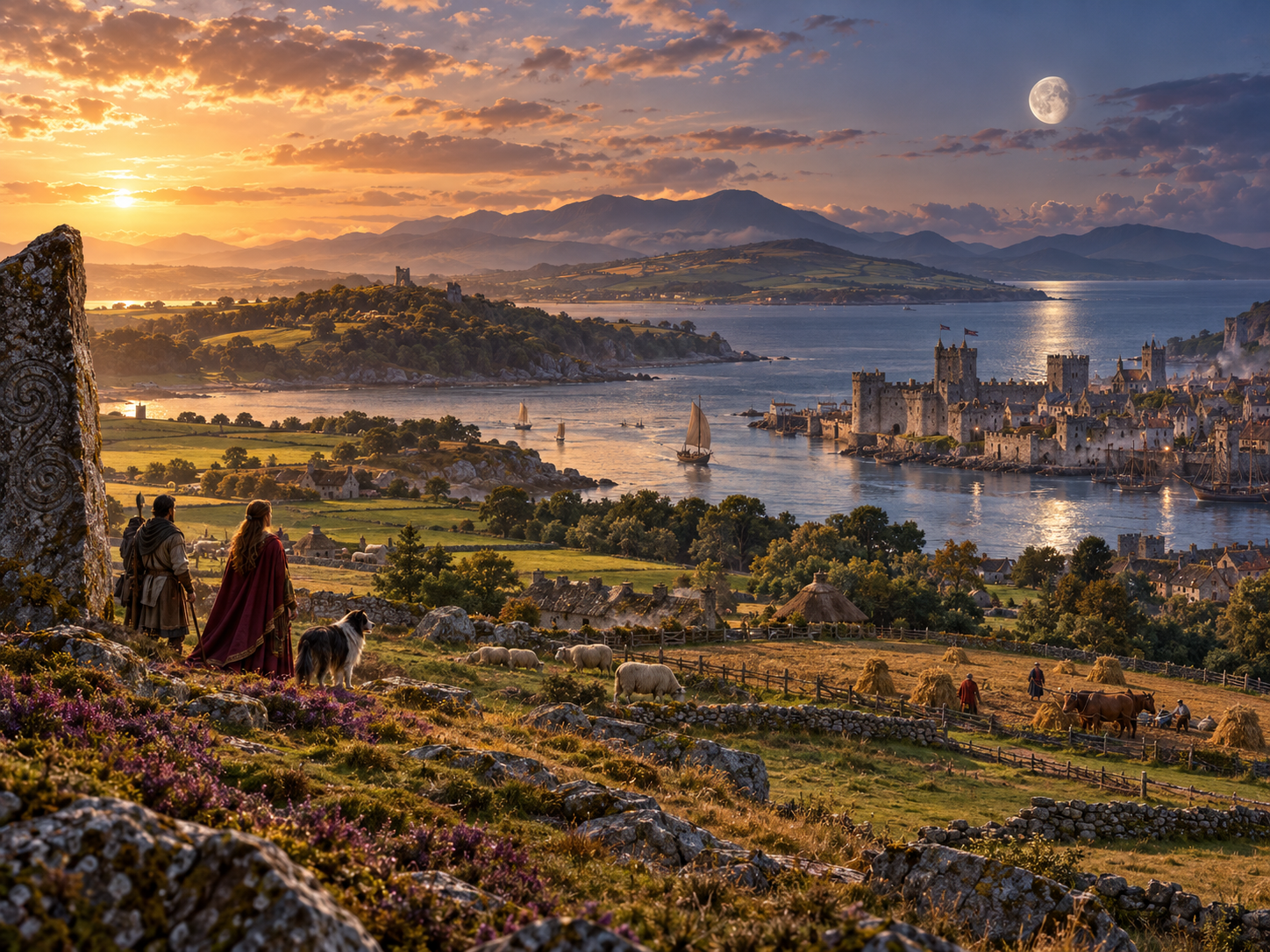
Wales · Ynys Môn · Fertile estates · Menai crossings · Ancient sacred landscape
At a Glance
| Welsh name | Ynys Môn |
|---|---|
| Region | North-west Wales, across the Menai Strait from Gwynedd |
| Historic role | Fertile heartland and royal estate country supporting the princes of Gwynedd |
| Important places | Beaumaris, Newborough, Llys Rhosyr, Bryn Celli Ddu, Barclodiad y Gawres and the Menai crossings |
| Best for | Island travel, lost courts, dynastic claims, sea crossings, prehistoric chambers and divine encounters |
| Great powers | Arianrhod and the Chaotic Evil Red of Môn |
Anglesey—Ynys Môn—is the fertile island that helped sustain the princes of Gwynedd. Grain, cattle, coastal trade and the Menai crossings give it mortal importance; buried princely courts, passage tombs and old divine claims make its deeper ownership far harder to define.
What Is Happening Right Now?
Royal administration and Beaumaris Castle are firmly established, but the island still carries the memory of the princes of Gwynedd in landholding, family claims and place. Llys Rhosyr lies buried beneath windblown sand, while Newborough is populated by descendants of people displaced from Llanfaes when Beaumaris was created. A boundary dispute can therefore become an argument about conquest within a single generation’s family memory.
Anglesey is also a practical prize. Fertile estates produce grain and livestock for the mainland. Ferries and pilots control movement across the Menai Strait. A poor harvest, dragon demand or blocked crossing can raise prices in Gwynedd without a single army marching.
The Red of Môn watches those movements closely. Tribute, cargo and wealthy travellers all cross water the dragon considers part of its domain.
Run Anglesey Tonight
The Court Beneath the Sand
A storm strips sand from Llys Rhosyr and exposes a doorway no living resident has seen. Inside, a sealed court chest contains a pedigree and land grant naming a family still farming nearby. Beaumaris officers want the documents seized before anyone can read them publicly.
The Moon Road
At an extreme low tide, a silver path appears beyond the ordinary shore toward the waters associated with Caer Arianrhod. Those who step onto it cast shadows toward the moon rather than away from it. By dawn the tide will return, whether the travellers have found the road home or not.
The Beaumaris Grain
Storehouses are full but bread prices climb. Merchants blame weather and transport. The grain is sound until it crosses one ancient boundary, where every sack begins to blacken. The stone marking that boundary was moved three nights ago.
Old Courts and New Authority
Llys Rhosyr was an undefended royal court of the princes of Gwynedd, centred on hall, chamber, estate and administration rather than a castle wall. Its authority came from the ruler’s household and the business carried out there. Beneath the sand, that older political landscape is physically present even when its buildings are no longer visible.
Beaumaris embodies the later conquest order. Its massive concentric defences, dock and planned town impose a different idea of power on the island. The displacement of Llanfaes to create the new settlement still matters because land, memory and trade routes changed hands together.
Dungeon: Bryn Celli Ddu
Bryn Celli Ddu is a true ancient chamber, not a castle ruin pressed into dungeon service. A long stone passage enters a mound raised over an even older ritual enclosure, and at midsummer sunrise light reaches deep into the inner chamber. The visible monument is only the threshold.
The Sun Passage
The known corridor narrows toward the central chamber. On the longest day, sunrise illuminates marks invisible during the rest of the year: a sequence of cuts that point toward a sealed side wall rather than the tomb’s centre.
The Ancestor Chamber
Behind the wall lies a lower room where bones, stone beads and offerings have never been disturbed. The dead do not rise merely because the chamber is entered. They wake when a visitor lies about ancestry, steals an offering or claims land in the name of a bloodline the chamber does not recognise.
The Dark Grove Below
A descending cleft opens beneath the burial floor into roots and black earth that should not exist under the stone mound. This is the surviving heart of the older sacred enclosure. Here the island remembers families and promises older than any royal court.
The Living Consequence
A relic removed from Bryn Celli Ddu can validate or destroy a genealogy at Llys Rhosyr. A broken solar seal can alter the rites of nearby households. If the Red of Môn learns that treasure has emerged from the mound, it may declare the find part of its island hoard. The tomb is tied directly to the island’s living politics.
Creatures of Môn
Bendith y Mamau
Bendith y Mamau live close to old farms, field boundaries and hidden hollows. The island’s dense pattern of productive estates gives them endless opportunities to reward courtesy, punish arrogance or interfere when a new owner ignores a household bargain that predates his title.
Black Dogs
Black dogs appear on lonely coastal roads and beside prehistoric sites after dark. Some warn travellers away from danger; others mark people already claimed by it. Island folk judge them by behaviour, not colour alone.
Sea Serpents
Sea serpents hunt in the deeper Irish Sea and around dangerous approaches. A serpent near the Menai Strait can disrupt ferry traffic, strand officials and drive merchant vessels into waters watched by the Red of Môn.
The Red of Môn
Ynys Môn has its own great red dragon: the Red of Môn, Chaotic Evil and fiercely possessive of the island. Its territory follows sea-cliffs, hidden caverns and the approaches across the Menai Strait. It watches ships, tribute and the movement of wealth between Anglesey and Gwynedd because it regards them as traffic through its domain.
The Red of Môn has old agreements with island households and sacred powers. Grain, livestock, worked metal and rare objects have all served as tribute at different times. It does not regard mortal rulers as owners of Môn; at most they are neighbouring powers permitted to govern within territory it considers ultimately its own.
Younger reds sometimes shelter on remote cliffs or skerries under the elder dragon’s sufferance. Others are driven away and become raiders along the Irish Sea, forcing pilots and coastal communities to distinguish tolerated scions from hungry exiles.
Arianrhod and the Island’s Sacred Landscape
Arianrhod governs fate, stars, lunar power, curses and dynastic magic. Her strongest northern associations lie across the waters of Arfon and Caer Arianrhod, but her influence reaches Môn through sea, lineage and the shared mythic world of Gwynedd.
Math fab Mathonwy belongs to the same dynastic cycle. Oaths, naming, legitimacy and magical transformation carry particular weight when disputes cross between Anglesey’s old princely estates and the mainland.
Neither power owns every ancient monument. Bryn Celli Ddu, Barclodiad y Gawres, standing stones and local sanctuaries possess histories and spirits of their own. The island’s sacred landscape is layered, not centrally administered.
Travel and the Menai Strait
Crossing the strait is never merely a short boat journey. Tide, wind, pilotage and politics determine which passage is safe. Ferrymen know where currents turn; smugglers know unrecorded landing places; dragon-watchers know when a red shape above the water means a distant patrol and when it means the crossing should be abandoned.
Once ashore, roads connect Beaumaris, Newborough, fertile estates, prehistoric sites and coastal settlements. The island is compact enough for consequences to travel quickly: a supernatural event at a tomb can affect grain prices or ferry traffic before officials understand what happened.
Branwen’s Grave and the Fair Folk
Near the Alaw stands the grave associated with Branwen, daughter of Llŷr. The mound is not treated as an ordinary burial. Travellers leave small gifts nearby, and arguments between Britain and Ireland are sometimes taken there because Branwen’s story belongs to both islands.
At dusk, the Bendith y Mamau move through old field boundaries and abandoned enclosures. They are not enemies merely because they are fey, but they punish broken hospitality and careless trespass with ruthless precision.
Fishermen also know that a seal watching from the same rock for three nights may be a selkie waiting for someone ashore.
Historical and Mythological Context
Anglesey’s reputation as Môn mam Cymru—Môn, mother of Wales—reflects its fertile land and importance as a food-producing heartland. Llys Rhosyr was one of the courts of the princes of Gwynedd, while Beaumaris and Newborough preserve the political consequences of conquest and the displacement of Llanfaes.
The island’s history reaches vastly farther back. Bryn Celli Ddu began as a Neolithic ritual enclosure before becoming a passage tomb aligned so that midsummer sunrise shines into its chamber. Barclodiad y Gawres preserves another major passage tomb with rare carved stones on the western coast. These are not vague symbols of an ancient past; they are surviving monumental places built for the dead, the ancestors and ritual memory.
Cadw — Llys Rhosyr and the Princes of Gwynedd · Cadw — Beaumaris and Llanfaes · Cadw — Bryn Celli Ddu · Cadw — Barclodiad y Gawres
Keep this reference growing
If this page helped with your reading or game, you can support its upkeep or explore the curated books.
Explore the Bookshop — epics, classics and stories behind imagined worlds.