
Stonehenge — The Sun Gate of Salisbury Plain
England · Salisbury Plain · Prehistoric ritual complex · Solstice gate · Giant and Merlin lore
At a Glance
| Region | Salisbury Plain, Wiltshire |
|---|---|
| Age | The first earthwork began around 3000 BC; the great stone settings were raised in later phases |
| Alignment | Summer sunrise and winter sunset define the monument’s principal axis |
| Wider landscape | The Avenue, cursus monuments, Durrington Walls, Woodhenge and hundreds of burial mounds |
| Best for | Ritual mysteries, prophecy, buried chambers, giant lore, temporal crossings and ancient oaths |
| Living powers | Druids, local land spirits, ancestral dead and powers associated with Merlin and the Giants’ Dance |
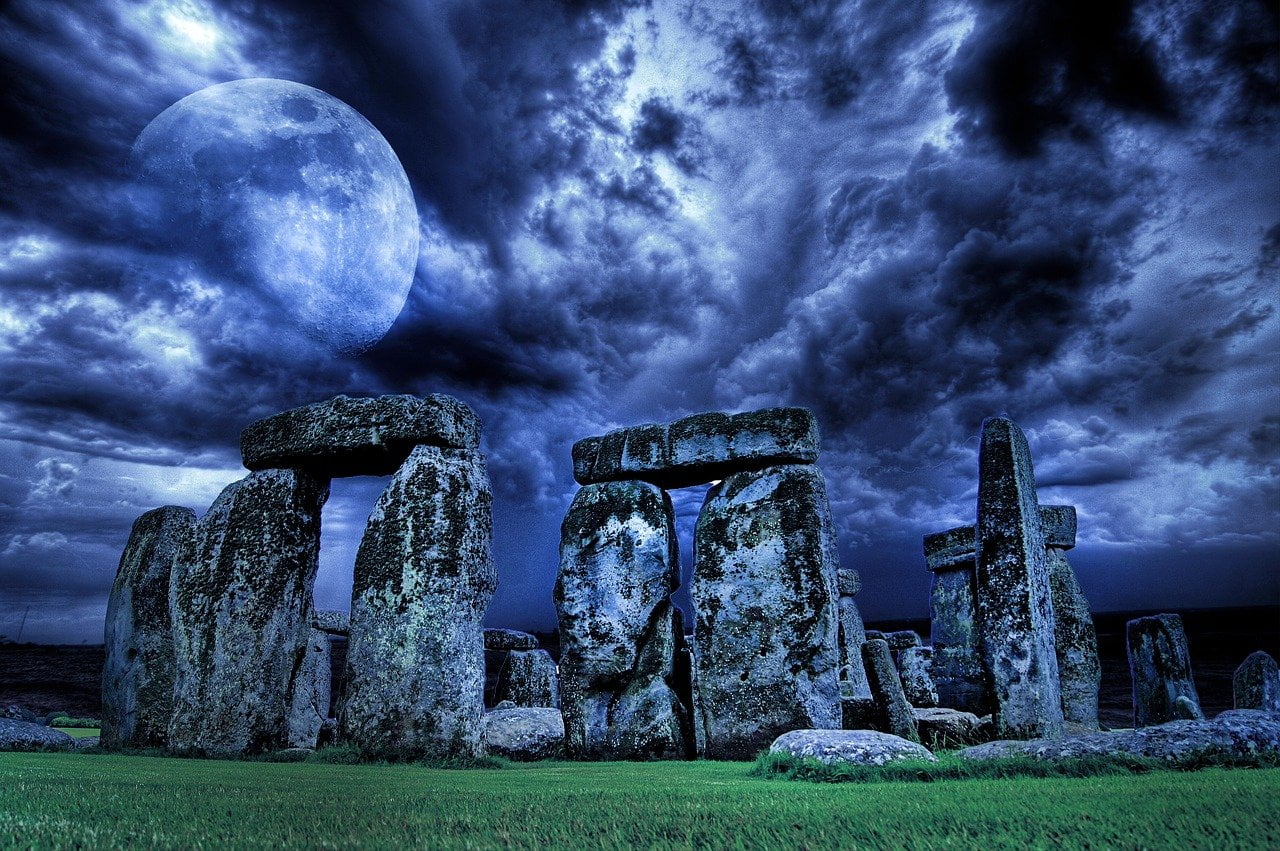
Stonehenge is not a lonely circle of stones. It is the surviving heart of a ritual landscape spread across Salisbury Plain, joined to burial grounds, ancient avenues, timber monuments and earthworks older than any kingdom in Britain. The stones still mark the turning of the sun, and the ground around them remembers every procession that has crossed it.
What Is Happening Right Now?
Stonehenge remains active. Travellers come for solstice rites, oath-taking, divination and the settlement of disputes whose roots are older than written charters. No single priesthood controls the plain. Druids maintain some observances, local households keep others, and certain rites are performed only by people whose families claim to remember the old processional roads.
The danger lies in timing. A ceremony performed at the wrong sunrise may open a route meant for another season. A burial mound disturbed before midwinter can call its dead toward the stone circle. A traveller who crosses the Avenue during a night of alignment may arrive at Stonehenge before he left it.
Royal officers tolerate the gatherings so long as no rebellion, private army or illicit claim hides behind them. They are less comfortable with the number of nobles who still seek omens at the stones before making political decisions.
Run Stonehenge Tonight
The Missing Shadow
At sunset every stone casts a shadow except one. The missing shadow appears instead on a nearby barrow, pointing toward an entrance that has been sealed since the Bronze Age.
The Giant’s Measure
A mason discovers that several stones carry shallow marks matching no known tool. At midnight the marks glow and form a scale for measuring something far larger than a human body. A nearby hill giant arrives demanding that the measurements be destroyed.
Merlin’s Second Arrangement
A set of smaller stones shifts during the night without leaving drag marks. Merlin arrives before dawn and insists that somebody has begun reversing a repair he made centuries ago.
The Stones and the Sun
The first great earthwork at Stonehenge was cut around 3000 BC. The central stone settings belong to later phases, with the great sarsens and smaller bluestones raised around 2500 BC and rearranged afterward. The work required generations of planning, transport and ritual labour.
The principal axis follows the solstices. At midsummer the sun rises near the Heel Stone; at midwinter it sets through the great stone arrangement in the opposite direction. The alignment is not decorative. It governs when certain paths, oaths and divinations become active.
The bluestones came from western Britain, while the larger sarsens came from much nearer the plain. Their different origins matter to ritual specialists: the circle joins distant landscapes into one constructed place.
The Giants’ Dance
Giants did not raise the whole monument in a single age. The oldest banks, burials and processional ground were created by human communities long before Merlin’s time. Giant knowledge entered later, when powerful stone-workers taught techniques for lifting, joining and moving blocks beyond ordinary mortal practice.
The tradition of the Giants’ Dance preserves part of that history. In Ireland an older circle of enchanted stones was associated with giants and healing waters. Merlin later drew on that tradition when restoring and reordering Stonehenge after a massacre of Britons. Bards compressed centuries of construction and restoration into a single impossible feat, but the giant-work remains visible in a handful of joints and stones that answer to spoken names.
Arthur treats Stonehenge as older than kingship itself. Royal authority can guard the road to the monument, but no crown owns the solstice.
The Sacred Landscape
The stone circle is one part of a much wider complex. The Avenue connects Stonehenge toward the River Avon. The great cursus earthworks run across the chalk. Durrington Walls and Woodhenge preserve the memory of timber circles and large gatherings. Hundreds of round barrows rise on the surrounding ridges.
These places are linked. A procession beginning at the river can change the behaviour of the stones. A fire lit at Durrington can answer one at Stonehenge. A barrow opened on the wrong day can interrupt rites miles away.
The plain therefore behaves less like a single shrine and more like a machine built across the landscape, with earthworks, stones, burial grounds and sight-lines acting as separate parts.
Dungeon: The Barrow Roads of Normanton Down
The best dungeon near Stonehenge lies beneath the burial mounds rather than under the stone circle itself. Normanton Down contains a dense group of Bronze Age barrows positioned where their ridges remain visible from the stones. Several contain chambers whose entrances have been hidden by later collapse.
The Outer Mound
A robber’s cut opens one barrow and reveals a narrow stone-lined passage. Grave goods have already been disturbed, but the body at the centre is missing. Fresh footprints lead deeper into a wall that should be solid chalk.
The Processional Tunnel
Behind the burial chamber runs a low passage connecting two neighbouring mounds. Its walls carry repeated carvings of suns, axes and human figures walking in opposite directions. The passage becomes longer at night than by day.
The Hall of Winter
A larger underground chamber lies where several barrow alignments intersect. Here the dead sit upright around an empty stone seat facing southwest. At midwinter sunset, light travels through a narrow shaft and strikes the seat.
The Road Back to Stonehenge
The deepest tunnel does not end beneath the barrows. It rises toward the Avenue and opens inside the sacred landscape beyond ordinary sight. Those who follow it may emerge at Stonehenge during another season, or during a procession that happened centuries earlier.
Anything disturbed below affects the monument above. A missing grave gift can break a solstice rite. An awakened ancestor can claim a living descendant. A blocked tunnel can change where the sun’s power gathers at the stones.
Creatures of Salisbury Plain
Hill Giants
Hill giants rarely approach the stones openly, but old giant families know more about their construction than most human scholars. Some guard forgotten quarries or ancient lifting sites; others resent the use of giant craft in mortal monuments.
Black Dogs
Black dogs appear on the old roads and beside barrows after dark. Some turn travellers away from dangerous ground. Others follow those whose death has already been noticed by the land.
Boggarts
Boggarts inhabit farmsteads, boundary banks and neglected structures around the plain. They are most troublesome when new landholders move old stones, clear hedges or disturb places that local families have deliberately left alone.
Historical and Mythological Context
Stonehenge developed over many centuries. English Heritage dates the first major earthwork to about 3000 BC and the central stone settings to around 2500 BC. The wider landscape includes the Avenue, cursus monuments, Durrington Walls, Woodhenge and more than 350 burial mounds. The stones’ principal axis aligns with midsummer sunrise and midwinter sunset.
The giant and Merlin tradition is itself medieval. Geoffrey of Monmouth wrote in the twelfth century that Merlin moved a monument known as the Giant’s Round from Ireland to Salisbury Plain. By the fifteenth century that story is already centuries old, making it part of the living medieval understanding of Stonehenge rather than a later invention.
English Heritage — Stonehenge History and Stories · English Heritage — Building Stonehenge · English Heritage — Stonehenge Landscape · English Heritage — Medieval Myths of Stonehenge
Keep this reference growing
If this page helped with your reading or game, you can support its upkeep or explore the curated books.
Explore the Bookshop — epics, classics and stories behind imagined worlds.