
Nottingham — Royal Castle, Market and Outlaw War
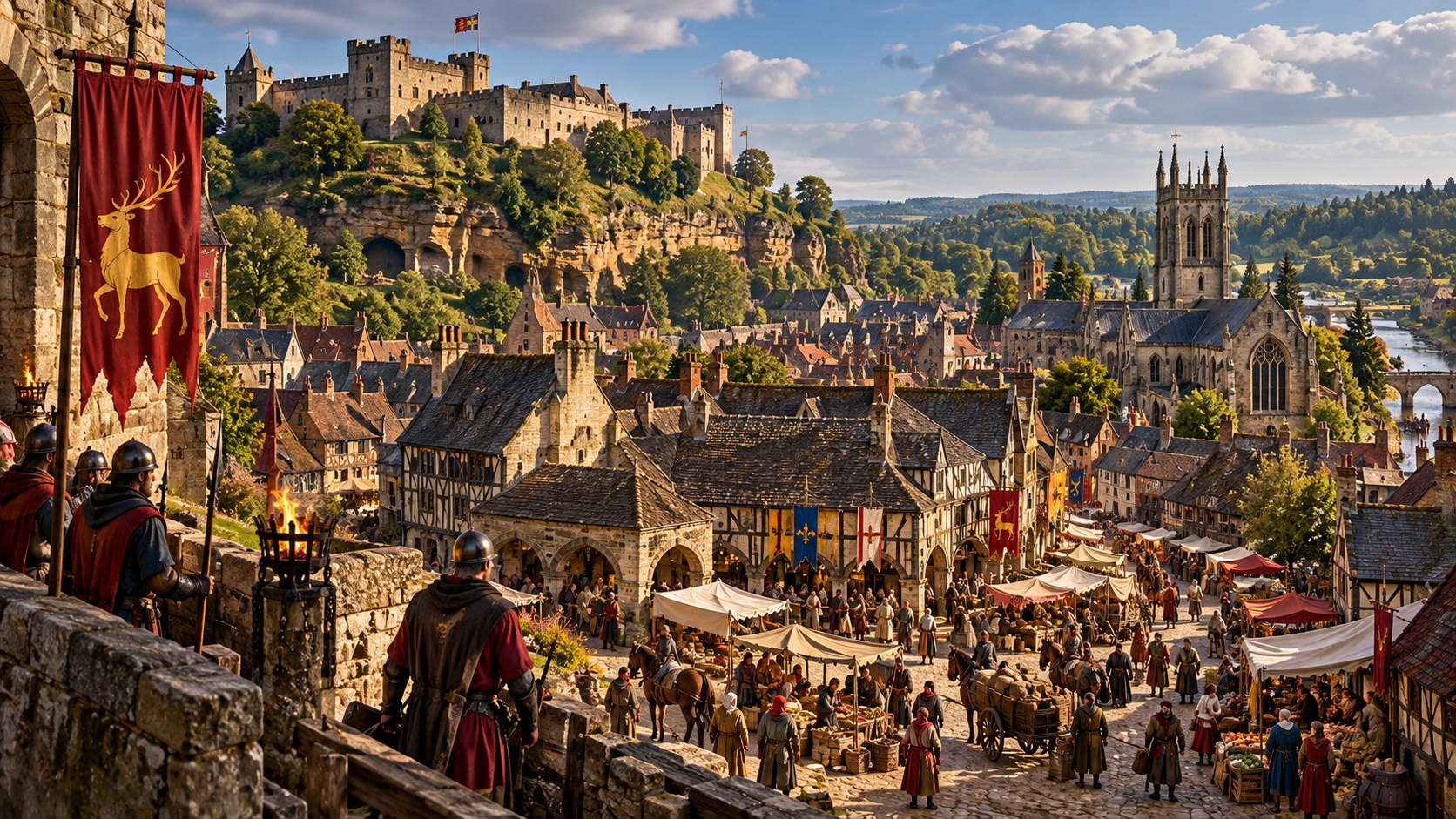
England · Royal castle · Great market · Sherwood frontier · Outlaw war
At a Glance
| Realm | Kingdom of England |
|---|---|
| Status | Royal borough, major Midlands market and gateway to Sherwood |
| Mayor | John Plumptre, merchant |
| Civic Sheriffs | Thomas Lovatt and Robert Sherwood |
| High Sheriff of the Shire | Sir John Gresley |
| Character | Royal castle town, enormous market, cave-cut settlement, cloth centre and urban stronghold against the Sherwood outlaws |
| Best For | Robin Hood adventures, forest law, corruption, castle intrigue, chases through caves, market crime and outlaw politics |
| Immediate Pressure | Robin Hood’s network is attacking royal forest enforcement while the authorities tighten roads, markets and access to the town |
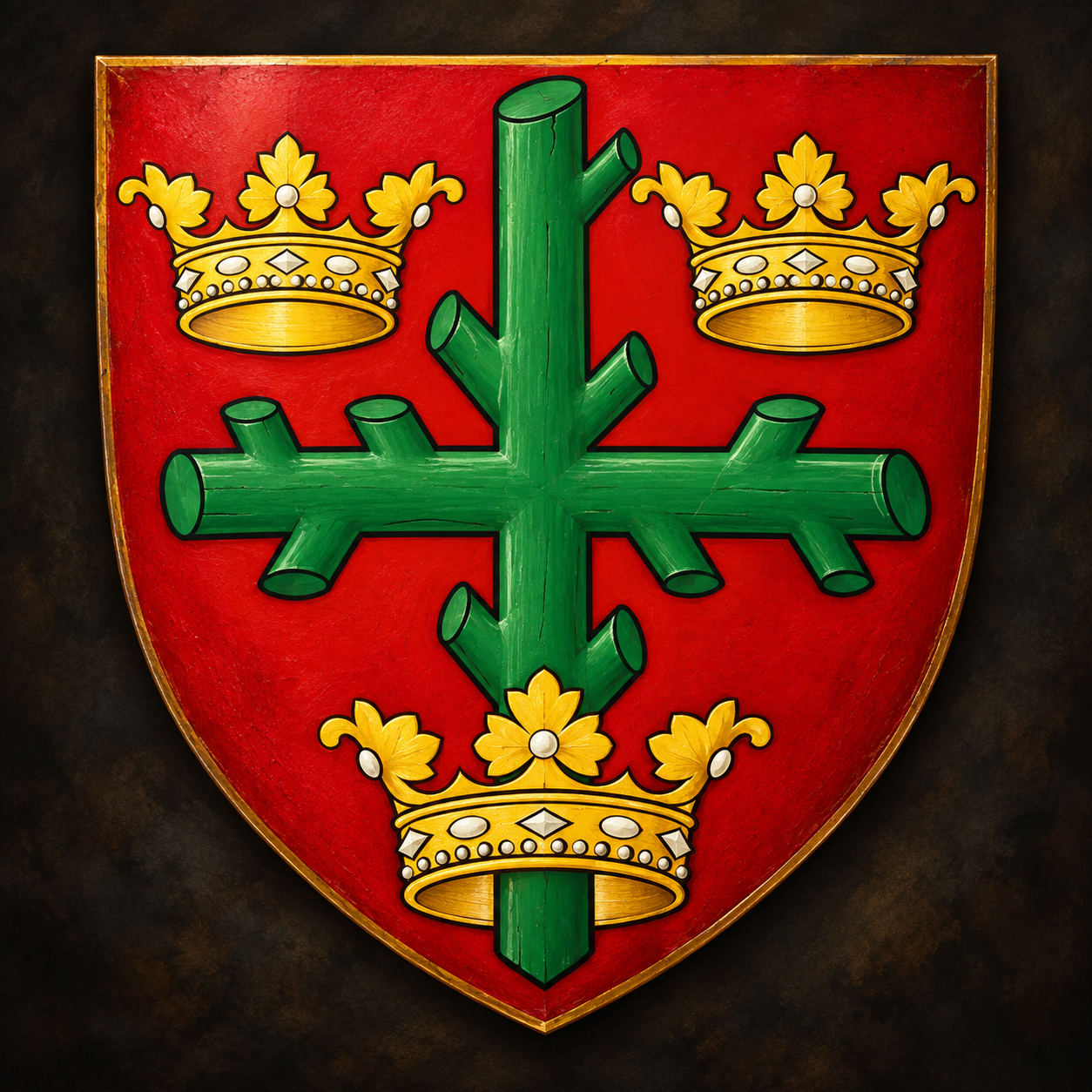
Nottingham is where the king’s law meets Sherwood’s outlaws. A royal castle dominates the sandstone heights above the town. Below it spreads one of England’s great markets, wealthy merchants, workshops, taverns and houses built over cellars cut directly into the rock. Beyond the gates begins the wider world of Sherwood, where forest law protects the king’s deer and timber while Robin Hood and his allies make royal officers pay for every mile they attempt to control.
What Is Happening Right Now?
Nottingham is fighting a war that neither side formally calls a war.
Robin Hood and the Merry Men operate from Sherwood Forest, attacking officials, intercepting money, protecting allies and making the king’s forest increasingly difficult to govern.
The authorities answer with warrants, informants, patrols, rewards and armed expeditions.
The formal machinery of government is complicated.
Mayor John Plumptre governs alongside Nottingham’s civic sheriffs, Thomas Lovatt and Robert Sherwood. Sir John Gresley holds the wider royal shrievalty of Nottinghamshire, Derbyshire and the royal forests.
But the man most ordinary people call simply the Sheriff of Nottingham is William de Wendenal.
Wendenal directs the Crown’s most aggressive campaign against Robin Hood. He commands forest officers, informants, hired swords and men whose authority becomes deliberately difficult to distinguish from extortion.
His principal field enforcer, Sir Guy of Gisbourne, is considerably more dangerous with a sword than Wendenal is.
The result is a town in which an ordinary commercial dispute can become political as soon as somebody claims the missing money was intended for Robin Hood.
Run Nottingham Tonight
The Sheriff’s Silver
A chest of collected royal money disappears between the market and Nottingham Castle.
Wendenal immediately blames Robin Hood.
Robin sends word that he did not take it.
Both men want the adventurers to find the real thief before the other side does.
Gisbourne’s Prisoner
Guy of Gisbourne drags a wounded outlaw into Nottingham and announces that the prisoner will identify Robin Hood’s informants at dawn.
The outlaw claims he has never met Robin.
Maid Marian says he is telling the truth.
The Cave Beneath the Market
A brewer cutting into an existing cellar opens a passage into an older chamber beneath the town.
The chamber contains barrels, human bones and a door blocked from the other side.
Someone has recently been using it.
Robin Hood Comes to Market
Robin intends to enter Nottingham disguised during market day.
He needs one object from a merchant’s locked strongroom.
The Sheriff has received the same information and has doubled the watch.
The Castle Tunnel
A prisoner disappears from Nottingham Castle without passing a gate.
The constable assumes bribery.
The adventurers find fresh footprints leading toward Mortimer’s Hole.
The Wrong Deer
A butcher is arrested for selling venison supposedly taken from the king’s forest.
He insists it came from private land.
A forest officer insists that the distinction no longer matters.
Robin Hood has already decided that it does.
Three Powers in Nottingham
Nottingham cannot be understood as a town ruled by one sheriff.
The Borough
Mayor John Plumptre and the town’s leading merchants are concerned first with trade, property, markets, civic order and Nottingham’s privileges.
They do not want outlaws robbing merchants.
They also do not want royal officers turning Nottingham into an armed camp.
The Crown
Nottingham Castle, the wider shrievalty and the royal forest administration represent powers that reach far beyond the borough.
Forest law exists to protect royal rights over deer, timber and the land classified as forest.
Those rights bring officials, fines, licences and opportunities for abuse.
The Greenwood
Robin Hood possesses no charter, court or lawful office.
What he has is information, reputation and people.
A forester may secretly warn him about a patrol. A miller may hide supplies. A merchant may buy stolen royal goods while publicly demanding that the Sheriff capture him.
The outlaw network therefore reaches into Nottingham even when Robin himself is miles away.
The Sheriff of Nottingham
William de Wendenal has turned forest enforcement into a personal war against Robin Hood.
He does not need everyone in Nottingham to love him.
He needs them to fear the cost of helping the outlaws.
Wendenal uses rewards, informants, fines, seizures and selective mercy.
A captured poacher who gives him a useful name may walk free.
A merchant suspected of financing Robin can lose goods worth far more than any formal fine.
He is most dangerous when he can make private vengeance resemble lawful enforcement.
Sir Guy of Gisbourne
Sir Guy of Gisbourne is the Sheriff’s answer when threats and warrants are no longer enough.
Guy tracks people.
He follows trails into Sherwood, questions frightened villagers and understands that capturing Robin Hood requires breaking the network around him one connection at a time.
He and Robin are personal enemies.
Robin Hood’s Nottingham Network
Robin’s band does not simply sit beneath an oak waiting for rich travellers.
It is a functioning intelligence network reaching between Sherwood, Nottingham and surrounding communities.
| Figure | Role Around Nottingham |
|---|---|
| Robin Hood | Outlaw leader, strategist and symbolic centre of resistance to corrupt forest authority |
| Maid Marian | Political contact, infiltrator and bridge between respectable society and the greenwood |
| Little John | Robin’s principal lieutenant and the man trusted to hold a road, bridge or retreat route |
| Friar Tuck | Clerical contact, fighter, negotiator and connection to villages and religious communities |
| Will Scarlet | Fast-moving fighter used when Robin needs aggression rather than patience |
| Much the Miller’s Son | Local intelligence, food, mills, messengers and working-community contacts |
| Alan-a-Dale | Messenger, performer and traveller able to move information through inns and gatherings |
| Arthur a Bland | Tanner, staff fighter and link to tradespeople who know the forest economy |
| Gilbert Whitehand | Archer and woodland fighter trusted with dangerous ambushes |
| Richard at the Lee | Gentle-born ally demonstrating that Robin’s support does not stop with peasants |
Nottingham Castle
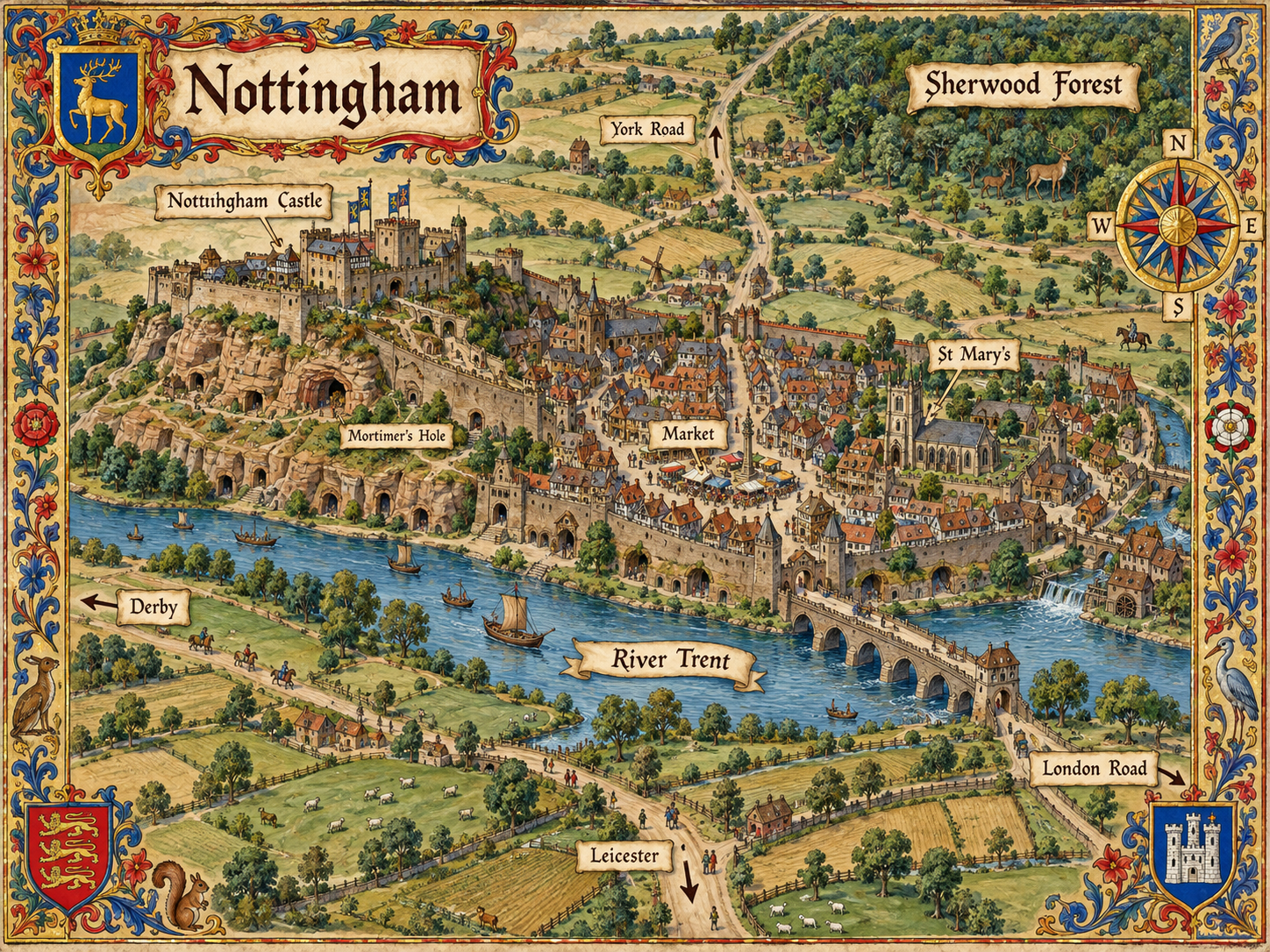
The royal castle stands on its sandstone rock above the western side of Nottingham.
It is one of the strongest symbols of Crown authority in the Midlands.
The fortress contains royal apartments, defensive works, stores, administrative spaces and secure places for prisoners.
It is also riddled with the consequences of building on sandstone.
Rock-cut spaces and passages lie beneath the castle.
The most notorious is Mortimer’s Hole.
In 1330 men loyal to Edward III used the hidden approach to enter the castle and seize Roger Mortimer.
Everyone responsible for the castle’s security knows that story.
That does not mean they know every hole in the rock.
The City Beneath the City
Nottingham is built not only on sandstone but into it.
Cellars, storage rooms and industrial chambers have been cut directly beneath buildings and cliffs.
Some hold food and drink at stable temperatures.
Others serve brewers, maltsters and leather workers.
The caves create possibilities unavailable in an ordinary town.
A smuggler can move goods beneath a house. A tavern can possess rooms that do not appear on any street plan. A fugitive can hide directly beneath the people searching for him.
Most caves are individual working spaces rather than parts of one enormous secret tunnel network.
That makes the rare passage that really does connect two important places much more valuable.
The Great Market
Nottingham’s huge market sits between the older eastern settlement around St Mary’s and the castle-dominated western town.
It is the commercial heart that joins those two histories together.
Traders bring cloth, wool, leather, food, livestock, tools and imported goods.
News arrives with them.
So do thieves, informants and outlaw sympathisers.
On busy days the market becomes one of Robin Hood’s greatest advantages inside Nottingham.
One hooded man can disappear among hundreds.
The Old Sacred Hall and Merchant Nottingham
The Old Sacred Hall dominates the oldest part of Nottingham.
The great sacred hall is still a work shaped by generations of rebuilding, with wealthy merchants contributing heavily to the structure.
The district around it represents a different source of power from the castle.
Royal officers possess warrants.
Merchants possess money, credit, workshops, employees and the ability to decide whether Nottingham’s economy cooperates willingly with enforcement.
Robin Hood survives partly because these worlds are not identical.
Sherwood Is Not Just Woodland
Sherwood Forest is a legal landscape as much as a physical one.
The royal forest includes oak and birch woodland, but also heath, pasture, settlements, farms and roads.
Forest law protects the king’s rights over the vert and venison: the vegetation and game considered essential to the royal hunting landscape.
Foresters, verderers, rangers and other officers enforce those rights.
That gives Robin Hood something much more substantial to fight than a single unpleasant sheriff.
A farmer can be punished for taking resources from land his family has used for generations.
A starving household can watch deer eat crops it cannot legally kill.
A corrupt officer can turn legitimate forest law into extortion.
Robin’s power comes from understanding exactly where law ends and abuse begins.
Major Oak and the Deep Greenwood
Robin’s principal refuge lies deeper inside Sherwood.
The enormous oak at its centre is not merely old.
It is an Elder Treant.
Major Oak tolerates Robin’s people because they defend the forest against destructive exploitation and understand that the greenwood is not their property.
Its roots, hollows and enormous limbs help conceal a settlement of platforms, shelters and watch positions.
Nottingham’s officials know Robin has a permanent refuge.
They do not know how much of that refuge is capable of moving.
Landmarks & Places to Know
Nottingham Castle
The castle dominates the western side of the town as fortress, prison, administrative centre and symbol of royal authority. Characters seeking officials, prisoners, records or trouble with the sheriff eventually pass beneath its walls.
The Great Market
The market is Nottingham’s loudest public stage. Traders, servants, foresters, messengers and strangers mingle here, making it the best place to buy ordinary supplies, hear a rumour quickly or be noticed by someone who matters.
The Caves Beneath the Town
Cellars, cut chambers and older passages run through the sandstone below streets and houses. Some are ordinary storage; others connect properties in ways their owners prefer not to advertise.
Taverns, Inns & Lodgings
Market-Square Alehouses
Busy drinking houses around the market serve craftsmen, traders, servants and visiting merchants. They are crowded enough for discreet meetings and public enough that a foolish quarrel can become city business within minutes.
Castle-Road Inns
Travellers with legal business, horses or armed retainers prefer the approaches between the town and castle. The better inns provide secure yards and private rooms; the rougher ones are used by messengers, hired blades and men who do not want to explain why they are waiting for nightfall.
Forest-Road Lodgings
On the roads toward Sherwood, lodging becomes cheaper and less supervised. Foresters, woodcutters, hunters, outlaws’ contacts and royal officers may all drink under the same roof without admitting they know one another.
Law, Crime and Forest Justice
Nottingham has overlapping kinds of law.
The mayor and civic sheriffs deal with the borough.
The shire sheriff represents wider royal authority.
Forest officers enforce specialised forest law.
The castle has its own royal significance.
Sacred estates and learned institutions possess further privileges.
An adventurer who asks, “Is this legal?” may therefore receive several different answers.
Robin Hood exploits those boundaries.
So does the Sheriff.
The difference is that one of them has paperwork.
Magic and Folklore
Nottingham’s supernatural pressure comes from two directions.
Beneath the town are sandstone chambers, hidden wells, ancient passages and spaces whose original purpose has been forgotten.
Beyond the town lies Sherwood, where old fey agreements and living trees are considerably harder to regulate than deer.
Boggarts fit farms, mills, workshops and houses around the forest edge.
The deepest greenwood belongs to older powers.
Robin Hood survives because he knows when an apparently empty clearing is occupied.
The Sheriff’s men tend to learn that lesson later.
Services and What Adventurers Can Find
Nottingham can outfit travellers heading north, south or into Sherwood.
Weapons, bows, armour, leather goods, horses, pack animals, rope, tools, provisions and ordinary medicines are readily available.
The market provides access to merchants and craftsmen from across the Midlands.
The caves provide another economy.
Stolen goods, untaxed venison, hidden weapons and people who do not wish to be found can all disappear below street level.
For wider settlement mechanics, use Fantasy Settlements.
Rumours and Street Talk
- “Robin Hood sleeps inside Nottingham every Thursday.” The Sheriff has arrested six different men trying to prove it.
- “Guy of Gisbourne knows where the outlaw camp is.” If he did, he would already be there.
- “Robert Sherwood is Robin’s man.” Having Sherwood as a surname is apparently enough evidence for some people.
- “There is a tunnel from the market to the castle.” There are many caves. That does not make every story true.
- “Marian dined with the mayor last week.” She certainly dined with somebody important.
- “Major Oak eats foresters.” Robin says this is ridiculous and refuses to clarify further.
- “The Sheriff is paying double for Little John.” Little John is considering asking for half.
- “Someone beneath St Mary’s is buying royal venison.” Several butchers suddenly become very interested in the floor.
Travel from Nottingham
| Route | What It Means in Play |
|---|---|
| Sherwood Forest | Immediate northern hinterland of forest law, royal deer, villages, outlaw camps and hidden roads. |
| York | The road north enters increasingly powerful northern territory and carries merchants, nobles and royal messages. |
| London | The road south carries royal business, trade and news from the capital. |
| Derby | Western route toward Derbyshire and the uplands beyond. |
| Leicester | Southern Midlands route linking Nottingham to another important market and road network. |
| River Trent | Trade artery connecting Nottingham with settlements and routes farther east. |
Inns, Caves and the Unquiet Castle
The Trip Beneath Castle Rock
An old alehouse occupies caves cut into the sandstone below Nottingham Castle. Travellers call it the Trip because men bound for the road, forest or royal service often drink there before departure. The rooms are low, cool and full of people who know the castle, the caves and the roads into Sherwood better than they admit.
Outlaws use the place cautiously. Forest officers use it loudly. Smugglers use the caves behind it only when they are certain the landlord is being paid by the right side.
Mortimer’s Hole
The tunnel below Nottingham Castle is more than a military passage. Roger Mortimer was seized through the castle’s cave network in 1330 and dragged away to his death. He never entirely left it.
His ghost appears where torchlight fails, walking uphill when living men are descending and downhill when they climb. At times Queen Isabella’s cries echo through the sandstone from chambers that cannot be reached. Anyone who follows the voice may discover passages that were sealed before their grandparents were born.
Boggarts in the Sandstone
Boggarts nest in abandoned cellars, blocked cave mouths and storerooms beneath the town. They steal keys, move barrels and imitate the voices of watchmen. The caves let them cross Nottingham without using the streets, which makes a clever boggart more useful to an outlaw than an armed scout.
Deeper History
Nottingham began long before the Norman castle.
The Anglo-Saxon settlement developed on the sandstone heights and became one of the fortified boroughs associated with the Danelaw.
After the Norman Conquest, a new fortified settlement grew around the castle to the west.
For generations the town therefore possessed two distinct centres: the older eastern community around St Mary’s and the newer castle settlement.
The great market between them eventually bound those worlds together.
The castle became a favourite royal stronghold and repeatedly entered national politics.
In 1330 Edward III’s supporters entered through the rock beneath it and seized Roger Mortimer.
Beneath the streets, generations of inhabitants continued cutting cellars and industrial spaces into the sandstone.
Nottingham therefore has two histories visible at once.
One rises above the town in castle walls.
The other disappears beneath it.
Adventure Pressure
- Outlaw pressure: Robin Hood’s network reaches from Sherwood into markets, mills, inns and respectable Nottingham households.
- Royal pressure: the castle and forest administration must demonstrate that the king’s law still means something.
- Civic pressure: Mayor John Plumptre needs commerce to continue regardless of whether Robin or the Sheriff currently has the upper hand.
- Forest pressure: poaching, timber rights, grazing and forest law make ordinary survival political.
- Underground pressure: the caves allow goods, criminals and supernatural dangers to move beneath the town.
- Road pressure: merchants and travellers crossing Sherwood must choose between paying lawful officers, unlawful robbers or both.
- Supernatural pressure: Major Oak and the older powers of Sherwood make the forest more than a battlefield between human factions.
Sources and Historical Grounding
Nottingham’s civic records identify John Plumptre as mayor and Thomas Lovatt and Robert Sherwood as the city’s sheriffs.
The wider royal shrievalty is held by Sir John Gresley. Historic England records Nottingham’s medieval structure as the castle settlement to the west and older Anglo-Danish settlement around St Mary’s to the east, joined by the great market.
Nottingham City Council’s archaeological guidance documents the medieval use of sandstone caves for storage, malting and tanning. Nottinghamshire County Council records Sherwood as a royal forest governed by specialised law protecting vert and venison.
Nottingham City Council — Historic Mayors · Nottingham City Council — Historic Sheriffs · Nottingham Castle — Castle History · Nottinghamshire County Council — Sherwood Forest · Historic England — Medieval Nottingham
Continue Exploring
Sherwood Forest · Robin Hood · Sheriff of Nottingham · Guy of Gisbourne · Maid Marian · Little John · Friar Tuck · York · London · British Isles NPCs
Keep this reference growing
If this page helped with your reading or game, you can support its upkeep or explore the curated books.
Explore the Bookshop — epics, classics and stories behind imagined worlds.