
Wales — Princes, Marcher Lordships and the Dragon Lands
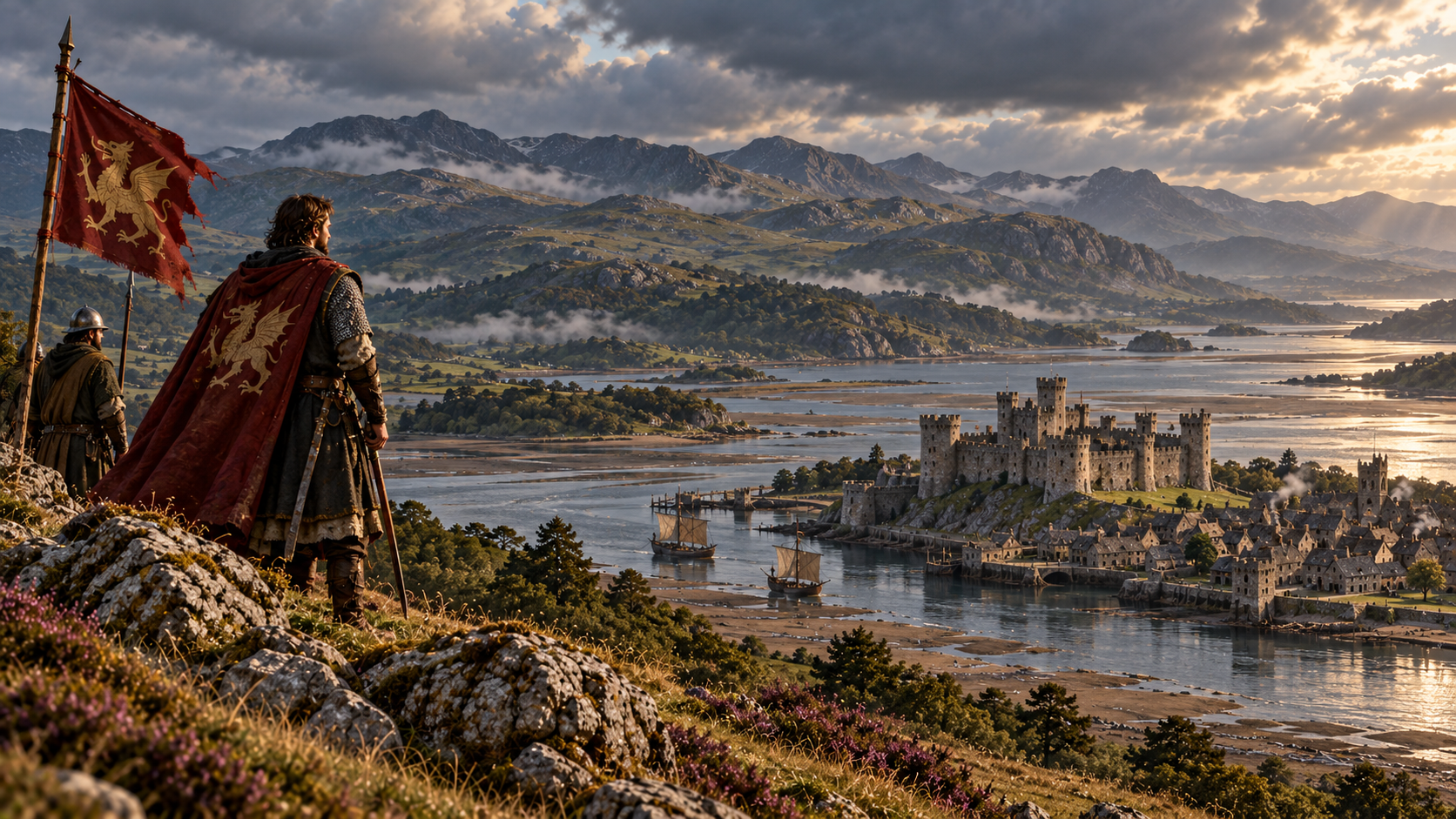
British Isles · Welsh heartlands · Marcher lordships · Ancient courts · Dragon sovereignties
At a Glance
| Political reality | Crown-administered Welsh shires, the estates attached to the Prince of Wales and powerful marcher lordships with separate privileges |
|---|---|
| Prince of Wales | Edward of Westminster, created Prince of Wales in March 1454 and invested in June |
| Languages | Welsh throughout most communities; English and French in many courts, castles, ports and marcher households |
| Key regions | Gwynedd, Eryri, Ynys Môn, Ardudwy and Harlech, Glamorgan and Cardiff, the Welsh Marches and the central uplands |
| Sacred powers | Welsh and Brittonic gods, Annwn courts, river and land spirits, household rites and ancient sacred places |
| Great dangers | Six sovereign red dragons, divided jurisdictions, rebellion memories, fey roads and ancient places beneath occupied strongholds |

Wales is a country of overlapping sovereignties rather than a single neat frontier. Crown castles dominate strategic towns and routes; marcher lords exercise extraordinary powers along the border and in the south; Welsh households preserve older rights and dynastic memory; Annwn opens onto mortal roads; and six great red dragons hold territories that no mortal charter can erase.
What Is Happening Right Now?
The rising of Owain Glyndŵr has failed, but it is not remote history. Men and women who carried messages, hid rebels, besieged castles or changed sides are still alive. Confiscated estates, pardons, family feuds and remembered betrayals keep the rebellion politically active long after its armies have disappeared.
Edward of Westminster, the infant son of Henry VI, has been created Prince of Wales. His title gives a personal focus to Crown authority in the principality, but it does not turn Wales into one centrally governed province. The shires created after Edward I’s conquest operate beside marcher lordships whose rulers retain extensive judicial, military and fiscal privileges.
The dragons care even less for mortal administrative lines. A road can leave one lordship, enter a Crown shire and remain inside the territory of the same red dragon throughout. Mortal rulers bargain with one another over law; they bargain with dragons over survival.
The Living Regions of Wales
Gwynedd
Gwynedd remains the strongest landscape of native princely memory. Genealogy, royal courts, conquest castles and the Red of Gwynedd make inheritance disputes dangerous far beyond the value of the land involved.
Eryri
Eryri is the mountain heartland where Penddraig of Dinas Emrys holds draconic sovereignty and paths into Annwn appear beside roads no mortal authority can fully secure.
Ynys Môn
Anglesey, Ynys Môn, feeds the north through grain and livestock while the Red of Môn watches the Menai crossings, ancient tombs and island treasure.
Ardudwy and Harlech
Harlech still carries the memory of Glyndŵr’s court and siege. The Red of Ardudwy rules the mountains and coast beyond the castle’s walls with a fiercely independent Chaotic Neutral sovereignty.
Glamorgan and Cardiff
Cardiff joins castle power, marcher law, the River Taff and Bristol Channel trade. Northward, the Chaotic Evil Red of Bannau Brycheiniog turns every upland caravan and tribute demand into a market concern on the coast.
The Welsh Marches
The Welsh Marches are a chain of privileged lordships rather than a single border zone. Warrants, tolls, feuds and fugitives cross jurisdictions faster than officials can agree whose law applies.
The Red Dragons of Wales
Six great red dragons dominate the present draconic hierarchy. They are not one symbolic beast and they are not servants of a mortal ruler. Each possesses territory, treasure, memory and its own relationship with Welsh blood-right.
| Great Red | Alignment | Territory and Character |
|---|---|---|
| Penddraig of Dinas Emrys | Chaotic Neutral | Eryri; ancient sovereign, pre-eminent among Welsh reds and defender of old draconic compacts. |
| Red of Ardudwy | Chaotic Neutral | Ardudwy and the western coast; fierce, independent and hostile to outside control. |
| Red of Bannau Brycheiniog | Chaotic Evil | Southern mountains north of Cardiff; predatory tribute-taker whose pressure reaches Glamorgan. |
| Red of Gwynedd | Chaotic Evil | Northern heartland; dynastic manipulator of succession, bloodline and oath. |
| Red of Môn | Chaotic Evil | Ynys Môn and its sea approaches; possessive island tyrant and maritime hoard-lord. |
| Red of the Central Uplands | Chaotic Evil | Remote interior; reclusive hunter and hoard-lord that destroys trespassers without distinction. |
Penddraig is the eldest and pre-eminent Welsh red, but the others are not its subjects. They bargain, feud, recognise mortal claimants, demand tribute and defend ancestral rights according to draconic law. Younger scions, exiles and wandering reds move between their territories looking for places of their own.
Creatures Across Wales
Gwyllion haunt mountain roads and misted passes. Cŵn Annwn cross ridges, burial grounds and lonely roads when the Wild Hunt rides. Addanc lurk in deep lakes and flooded hollows. Bendith y Mamau keep old customs around farms and hidden boundaries, while black dogs appear at roads, fords and ancient places where a traveller should think twice before continuing.
None of these creatures belong everywhere. Eryri’s high roads, Môn’s farms, the Marches’ boundaries and Glamorgan’s river country each produce different encounters because the land itself determines which powers are close.
Gods, Annwn and Living Myth
Math fab Mathonwy is inseparable from the dynastic and magical traditions of Gwynedd. Arianrhod governs fate, stars and lineage in the northern mythic landscape. Arawn rules Annwn, whose roads touch Wales through mist, cave, lake and burial ground. Ceridwen binds transformation, inspiration and dangerous knowledge to the southern reaches of the northern mountains.
Arthur, Merlin, Taliesin and Gwyn ap Nudd are living figures in the same landscape. Their deeds are not safely confined to old stories: courts still seek their counsel, rivals invoke their names and roads associated with them still lead somewhere.
Dungeon Landscapes of Wales
Wales contains dungeons because centuries of settlement, conquest and sacred use occupy the same ground. The most dangerous sites are rarely isolated holes in the wilderness; they sit beneath castles, courts, roads and working communities.
Cardiff Castle Underfort
Beneath occupied Cardiff Castle, medieval prisons and stores descend into Roman foundations, blocked waterworks and an older sacred chamber whose spring still feeds the living stronghold.
Dinas Emrys
In Eryri, galleries cut by Vortigern’s builders descend toward underground water and the sovereign thresholds of Penddraig. The deeper chambers are not abandoned ruins but the territory of a living great red dragon.
Bryn Celli Ddu
On Môn, the passage tomb at Bryn Celli Ddu opens onto ancestor chambers and older sacred ground where lineage can be judged by powers predating every princely court.
The Buried Llys of Gwynedd
At Abergwyngregyn, later occupation covers the foundations of a princely llys where sealed oath-rolls and an older covenant chamber can still alter inheritance and draconic claims in Gwynedd.
The Wye Vaults
At Chepstow in the Marches, occupied castle undercrofts descend into limestone passages above the Wye and an older threshold whose toll-law belongs to neither England nor Wales.
Historical and Mythological Context
The political map of Wales is the result of conquest layered over older Welsh realms. The Statute of Rhuddlan established Crown administration in the conquered principality after the fall of Llywelyn ap Gruffudd and created the shires of Flint, Caernarfon, Anglesey, Merioneth, Cardigan and Carmarthen. Alongside them, marcher lordships retained wide privileges over law, taxation, castles and military power.
In 1454 Edward of Westminster, the infant son of Henry VI, was created Prince of Wales on 15 March and invested on 9 June. His title sits over a country whose local realities remain sharply divided between Crown lands, marcher jurisdictions, Welsh households and the recent memories of Glyndŵr’s revolt.
Welsh myth is equally regional. The Mabinogi ties Math, Arianrhod, Gwydion, Lleu and Blodeuwedd to Gwynedd and Arfon; Dinas Emrys carries the story of Myrddin and the two dragons; Caerleon anchors Arthurian memory in the south-east; the Book of Taliesin preserves poems of Arthur, Annwn and early Brittonic tradition. The result is not one generic Celtic mythology but a network of named landscapes with their own powers and stories.
Cadw — Rhuddlan and the Statute of 1284 · Cadw — Lords of the Southern March · Royal Family — Princes of Wales · National Library of Wales — Book of Taliesin
Keep this reference growing
If this page helped with your reading or game, you can support its upkeep or explore the curated books.
Explore the Bookshop — epics, classics and stories behind imagined worlds.