
William de Wendenal — Sheriff of Nottingham
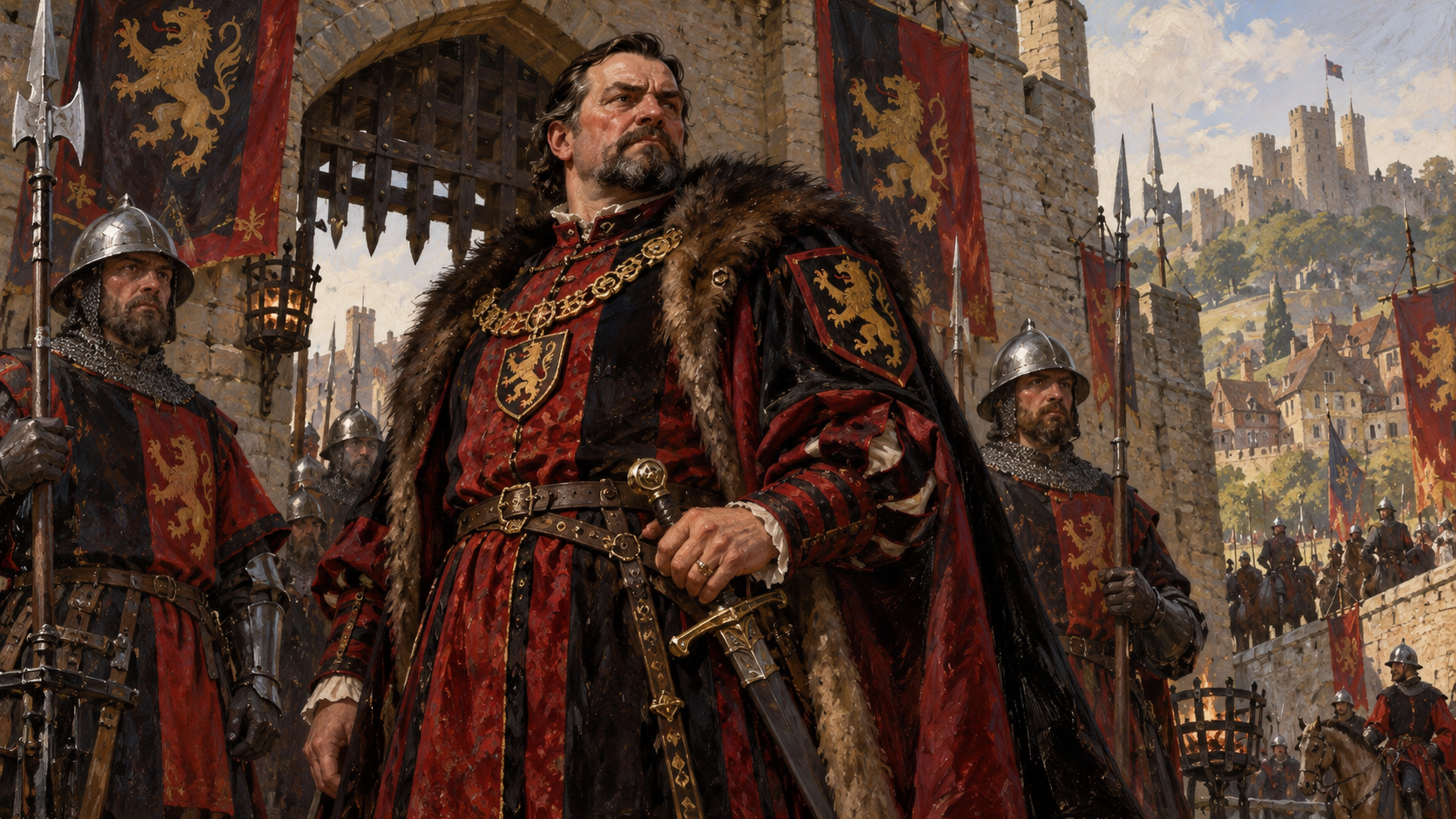
At a Glance
- Name: William de Wendenal
- Role: Sheriff, administrator, magistrate and commander of local enforcement
- Race: Human
- Age: Unknown; adult
- Base: Nottingham, with authority extending into the shire and the approaches to Sherwood Forest
- Status: Alive and active
- Current problem: Forged confiscation orders, Robin Hood’s support network and officers who may be abusing the Sheriff’s authority for private gain
- Campaign use: Employer, antagonist, lawful rival, investigator or uneasy ally
The Sheriff is dangerous not because he is the finest swordsman in Nottingham, but because he can turn parchment, patrols, fines, gaols and armed men into one coordinated machine.
William de Wendenal holds the office that makes Robin Hood a political problem rather than a local outlaw. He must keep roads open, collect revenues, enforce forest law, suppress armed bands and prove that royal authority still reaches beyond Nottingham’s gates. He is neither a pantomime villain nor a harmless bureaucrat: William can enforce legitimate law, expose genuine criminals and still defend a cruel confiscation if he believes yielding would weaken the office itself.
Game Statistics
5.5e / 2024
William de Wendenal
Medium Humanoid (Human)
Armour Class 18 (mail-and-plate harness, shield)
Initiative +2
Hit Points 82 (11d8 + 33)
Speed 30 ft.
Proficiency Bonus +3
Saving Throws Wis +5, Cha +6
Skills History +6, Insight +5, Intimidation +6, Investigation +6, Perception +5, Persuasion +6
Senses passive Perception 15
Languages English
Challenge 4 (1,100 XP)
| STR | DEX | CON | INT | WIS | CHA |
|---|---|---|---|---|---|
| 15 (+2) | 14 (+2) | 16 (+3) | 16 (+3) | 14 (+2) | 17 (+3) |
Official Warrant. William has Advantage on Charisma checks made to direct recognised officers, demand records, obtain lawful entry or compel cooperation within his jurisdiction.
Measured Pursuit. William has Advantage on Wisdom (Survival) and Intelligence (Investigation) checks made to trace fugitives through settled country, roads, forest edges and known outlaw supply routes.
Commanding Presence. Allied guards and city guards within 30 feet of William have Advantage on saving throws against being Frightened while he is conscious.
Actions
Multiattack. William makes two longsword attacks, or he makes one heavy crossbow attack.
Longsword. Melee Weapon Attack: +5 to hit, reach 5 ft., one target. Hit: 6 (1d8 + 2) slashing damage, or 7 (1d10 + 2) slashing damage if used with two hands.
Heavy Crossbow. Ranged Weapon Attack: +5 to hit, range 100/400 ft., one target. Hit: 7 (1d10 + 2) piercing damage.
Commanding Order. William chooses one allied guard or officer within 30 feet who can hear him. That creature may use its Reaction to move up to half its Speed or make one weapon attack.
Reaction
Parry. William adds 2 to his AC against one melee attack that would hit him, provided he can see the attacker and is wielding a melee weapon.
Authority in Nottingham
William’s Challenge rating measures him as an individual. Inside Nottingham, a courthouse, a gatehouse or a prepared roadblock, he rarely stands alone. Use Courthouse Guards, City Guards or Guards for his ordinary officers.
William de Wendenal, Sheriff of Nottingham — 5e / 2014
Medium humanoid (human), lawful neutral
Armor Class 18 (mail-and-plate harness and shield); Hit Points 82 (11d8 + 33); Speed 30 ft.; Challenge 4 (1,100 XP; proficiency bonus +2)
STR 15 (+2), DEX 14 (+2), CON 16 (+3), INT 16 (+3), WIS 14 (+2), CHA 17 (+3)
Saving Throws Wis +4, Cha +5; Skills History +5, Insight +4, Intimidation +5, Investigation +5, Perception +4, Persuasion +5; Senses passive Perception 14; Languages English, French
Traits
Official Warrant. William has advantage on Charisma checks to direct recognised officers, demand records or obtain lawful entry in his jurisdiction.
Measured Pursuit. William has advantage on Wisdom (Survival) and Intelligence (Investigation) checks to track fugitives through roads, settlements and forest margins.
Commanding Presence. Allied guards within 30 feet of William have advantage on saving throws against being frightened while he is conscious.
Actions
Multiattack. William makes two longsword attacks, or one heavy crossbow attack.
Longsword. Melee Weapon Attack: +4 to hit, reach 5 ft., one target. Hit: 6 (1d8 + 2) slashing damage, or 7 (1d10 + 2) if wielded with two hands.
Heavy Crossbow. Ranged Weapon Attack: +4 to hit, range 100/400 ft., one target. Hit: 7 (1d10 + 2) piercing damage. The weapon’s loading property prevents more than one attack with it in a single action.
Commanding Order. William chooses one allied guard or officer within 30 feet who can hear him. That creature may use its reaction to move up to half its speed or make one weapon attack.
Reaction
Parry. William adds 2 to his AC against one melee attack that would hit him, if he sees the attacker and is wielding a melee weapon.
Original 5e/2014 NPC conversion. Use the linked guard NPCs as separate combatants; the sheriff’s CR assumes an individual opponent.
Pathfinder 1e
William de Wendenal CR 7; XP 3,200
Male human aristocrat 4/fighter 4; Medium humanoid (human)
Init +6; Senses Perception +12
AC 20, touch 12, flat-footed 18; hp 66
Fort +7, Ref +4, Will +9
Speed 30 ft.
Melee masterwork longsword +11/+6 (1d8+3/19–20)
Ranged heavy crossbow +9 (1d10/19–20)
Str 16, Dex 14, Con 14, Int 16, Wis 14, Cha 17
Base Atk +7; CMB +10; CMD 22
Feats Combat Expertise, Improved Initiative, Iron Will, Leadership, Persuasive, Power Attack, Toughness, Weapon Focus (longsword)
Skills Diplomacy +16, Intimidate +16, Knowledge (history) +12, Knowledge (local) +14, Perception +12, Sense Motive +13, Survival +11
Languages English
Authority of Office (Ex). William gains a +4 circumstance bonus on Diplomacy and Intimidate checks against recognised local officers, clerks and officials when acting under a lawful warrant.
Coordinated Arrest (Ex). As a standard action, William designates one creature he can see within 30 feet. Until the start of his next turn, allied guards gain a +2 circumstance bonus on attack rolls made to disarm, grapple or otherwise subdue that creature.
Retinue. In Nottingham or at an organised checkpoint, William is normally accompanied by guards, clerks or mounted messengers rather than encountered as a lone combatant.
D&D 3.5e
William de Wendenal CR 7
Male human aristocrat 4/fighter 4; Medium humanoid (human)
Init +6; AC 20, touch 12, flat-footed 18; hp 62
Fort +7, Ref +4, Will +9
Speed 30 ft.; Base Attack +7; Grapple +10
Attack masterwork longsword +11 melee (1d8+3/19–20), or heavy crossbow +9 ranged (1d10/19–20)
Full Attack masterwork longsword +11/+6 melee (1d8+3/19–20)
Abilities Str 16, Dex 14, Con 14, Int 16, Wis 14, Cha 17
Feats Combat Expertise, Improved Initiative, Iron Will, Leadership, Negotiator, Power Attack, Toughness, Weapon Focus (longsword)
Skills Diplomacy +15, Gather Information +12, Intimidate +15, Knowledge (local) +14, Listen +9, Sense Motive +13, Spot +9, Survival +10
Authority of Office (Ex). William gains a +4 circumstance bonus on Diplomacy and Intimidate checks involving officers and officials who recognise his jurisdiction and warrant.
Coordinated Arrest (Ex). William can direct nearby guards to seize rather than slaughter a suspect. Allies who can hear him gain a +2 circumstance bonus on opposed checks made to disarm, grapple or overrun one creature he designates until his next turn.
What Is the Sheriff of Nottingham Doing Right Now?
William is investigating a string of confiscation orders bearing marks that should belong to his office. Some are genuine. Some are crude copies. At least one appears to have been produced by someone with access to the Sheriff’s own clerks, seals or warrant books. A forged order embarrasses him; an authentic order altered after sealing could destroy careers throughout Nottingham.
At the same time he is tightening pressure around Sherwood Forest. He has stopped sending patrols blindly into the greenwood. Instead, he is mapping food, arrows, horses, ferries, sympathetic inns and villages that keep Robin Hood informed and supplied. William intends to make outlawry expensive without giving Robin a glorious battle.
He is also watching his own men. Every extortionate collector, drunken serjeant or violent forester creates another household willing to hide an outlaw. William does not need his officers to be loved, but he needs them to be predictable enough that the population still fears the law more than it trusts the forest.
Encounters
- Royal Evidence: William possesses proof that a supposed friend of Robin is murdering travellers for profit. He wants outsiders to retrieve the evidence before the suspect learns that the Sheriff has it.
- The False Warrant: Two confiscation orders bear Nottingham’s authority. One is forged; the other may have been altered after sealing.
- The Prisoner Transfer: The party is hired to escort a prisoner between a courthouse guard detail and the castle gaol. Robin’s people insist the prisoner is being framed.
- The Muster: A village refuses to identify an outlaw messenger. William wants to know whether fear, loyalty or an abusive local officer is keeping everyone silent.
- The Road Court: The party arrives as goods are being seized beside the highway. The warrant is legal, but the collector’s interpretation of it may not be.
Personality, Appearance and Manner
William is controlled, proud and intensely conscious of office. He does not need to shout when a clerk, warrant and six armed men are standing behind him. He prefers evidence, leverage and procedure to theatrical cruelty because those tools survive after a frightened prisoner stops talking.
He can bargain when bargaining reinforces authority and becomes stubborn when concession would make him appear weak. He dislikes disorder more than he dislikes any particular outlaw. A murderer wearing the Sheriff’s badge can anger him as much as a forest bandit because both prove that the law is no longer doing what he says it does.
William dresses as a wealthy official and fighting gentleman. He carries a sword and the visible signs of office, travels on a good horse and is usually accompanied by clerks, messengers or armed officers rather than wandering alone in search of personal duels.
Relationships and Influence
Robin Hood: William’s most public opponent. Robin makes every failed arrest and abusive levy visible, turning administrative mistakes into stories that travel faster than official proclamations.
Sir Guy of Gisbourne: A useful hunter when William needs pursuit carried into country where ordinary officers are ineffective. Guy’s appetite for violence can also create precisely the grievances William is trying to contain.
Marian Fitzwalter: A noblewoman William must treat with courtesy even when he suspects that information, money or influence is passing through her household toward the greenwood.
Henry VI and the royal government: The ultimate source of William’s authority. With the king incapacitated, every local official must pay closer attention to whose instructions are lawful, whose seals are current and which orders may be challenged later.
Nottingham officers: William’s network includes city guards, armed guards, courthouse officers, clerks, messengers and local collectors. Their competence and honesty vary considerably.
Adventure Hooks
- The Forged Seal: Someone is issuing confiscations in William’s name using a seal good enough to fool experienced clerks.
- The Missing Prisoner: A prisoner disappears during transfer. Both Robin’s people and William’s officers insist the other side took him.
- Gisbourne Unleashed: Guy of Gisbourne has gone beyond his instructions, and William needs the problem contained without publicly admitting that his own hunter is out of control.
- The Royal Audit: Outside officials arrive to inspect Nottingham’s revenues while someone quietly removes the records they most need to see.
- The Forest Truce: A threat from deeper in Sherwood forces William and Robin to consider a temporary agreement neither side can safely acknowledge.
Equipment and Resources
William’s personal equipment is respectable rather than fantastical: good armour, longsword, heavy crossbow, riding horse, travelling cloak and enough coin for official journeys. His important possessions are administrative—his seal, warrant chest, revenue ledgers, prison and gatehouse keys, lists of wanted men, maps of roads and forest boundaries, and the correspondence needed to prove that an order is genuine.
His greatest weapon is institutional reach. A word from the Sheriff can close a gate, delay a ferry, search an inn, seize a wagon, call a city guard patrol or place a courthouse guard between an adventurer and the records they need.
Using William at the Table
William works best when the party cannot solve the problem merely by deciding that “the Sheriff is the villain.” He may have the lawful warrant, the accurate witness and the prisoner who genuinely deserves to be held. In the next scene, one of his collectors may be using that same authority to ruin a household that has done nothing wrong. His office should make the law feel powerful enough that opposing him has consequences even when the characters are morally certain.
Related Places and People
- British Isles NPCs
- Nottingham
- Sherwood Forest
- Robin Hood
- Sir Guy of Gisbourne
- Marian Fitzwalter
- Henry VI
Mythical and Historical Context
The historical William de Wendenal served as Sheriff of Nottinghamshire, Derbyshire and the Royal Forests around 1191–1194, more than two centuries before this campaign’s 1454 present. The character in this entry is a fictional 1454 namesake, occupying the legendary sheriff’s role in Nottingham; he is not the same documented twelfth-century official or evidence of an impossibly long life. The civic office of Sheriff of Nottingham and the county shrievalty were distinct, so his campaign jurisdiction and powers are deliberately fictionalised. See the history of Nottingham’s shrievalty and the historical William de Wendenal.
Sources and Licensing
The office, outlaw relationships and Nottingham material draw on the public-domain Robin Hood tradition and the historical powers associated with English sheriffs. William de Wendenal is adapted here as a fictional living namesake in 1454. The game statistics, present circumstances, encounters and adventure hooks are original adaptations for the stated rules editions.
Keep this reference growing
If this page helped with your reading or game, you can support its upkeep or explore the curated books.
Explore the Bookshop — epics, classics and stories behind imagined worlds.