
Liverpool — Castle Port on the Mersey
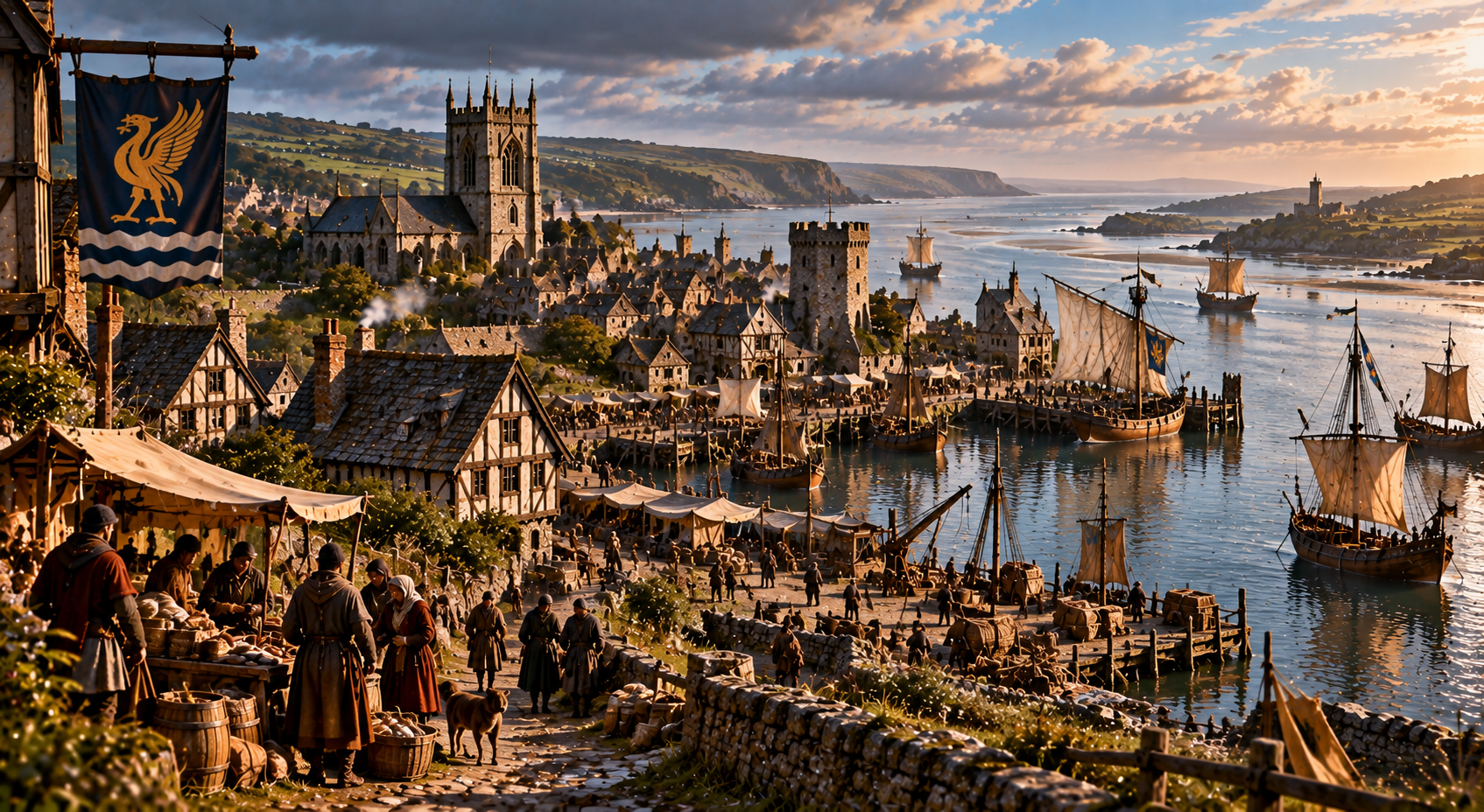
England · Small royal borough · Mersey harbour · Castle road · Irish Sea crossing
At a Glance
| Realm | Kingdom of England |
|---|---|
| Settlement | Small borough of fewer than a thousand people |
| Character | Farming and fishing town with a sheltered harbour, castle and modest coastal trade |
| Key places | Liverpool Castle, the Pool, Castle Street, Dale Street, the market and the Mersey shore |
| Strategic role | Embarkation point and supply harbour for traffic toward Ireland and the Irish Sea |
| Best for | Small-town intrigue, castle duty, coastal smuggling, missing boats and journeys to Ireland |
Liverpool is a small borough gathered around seven streets, a castle and the sheltered inlet known simply as the Pool. Most households still live by farming, fishing or practical trades, yet the Mersey gives the town a strategic importance far greater than its size. Ships bound for Ireland can shelter here, soldiers can embark from here, and news from across the Irish Sea reaches the market before it reaches many richer inland towns.
What Is Happening Right Now?
Liverpool’s value lies in movement rather than wealth. The harbour is useful for small coastal vessels, fishing boats and traffic crossing toward Ireland. A ship delayed here can alter the timing of a military message or private agreement far beyond Lancashire.
The castle watches the borough from its rocky position above the Pool. Its garrison is modest compared with the great royal fortresses, but in a town this small the castle dominates every dispute involving weapons, prisoners or suspicious strangers.
Political tension elsewhere in England reaches Liverpool as rumour before army. Merchants hear about trouble in York; sailors bring news from Dublin; local landholders watch which noble households are buying horses, grain and weapons. Nobody expects Liverpool to decide the kingdom’s future, but it is exactly the kind of harbour through which men can leave quietly before a crisis becomes public.
Run Liverpool Tonight
The Boat from Dublin
A small vessel enters the Pool before dawn with no mast-light and no crew visible on deck. The hold contains sealed letters, three frightened horses and wet footprints leading toward the castle.
The Missing Fishermen
Two boats fail to return with the tide. One is found grounded across the Mersey without damage or catch. A black dog sits beside it and refuses to let anyone approach the stern.
The Castle Well
During repairs, a bucket strikes stone far below the normal waterline. When raised, the rope is tied around an iron key that no one lowered into the well.
The Seven-Street Borough
Liverpool began as a deliberately planned borough. Castle Street, Dale Street and the other early streets form a compact settlement that can be crossed in minutes. That intimacy makes secrecy difficult. A stranger asking questions is noticed; a family feud becomes market gossip; a horse leaving after midnight is remembered.
Most residents are not merchants of great wealth. They farm surrounding land, fish the Mersey, bake, brew, butcher, work timber and iron, maintain boats and serve the castle. The market ties these households together more effectively than any formal civic bureaucracy.
The borough’s small size makes adventurers conspicuous. A heavily armed party cannot hide among thousands of strangers because there are not thousands of strangers.
The Pool and the Mersey
The Pool is the feature that made Liverpool worth founding: a tidal inlet providing shelter from the exposed Mersey. Boats can beach or anchor in calmer water while crews unload supplies, repair rigging or wait for a favourable tide.
The harbour is also dangerous. Mud flats shift, storms drive water into the inlet and fog can close the river in minutes. Local pilots are worth more than maps when weather turns.
Across the Irish Sea lies a wider political world. Liverpool’s road to Dublin is water. Messages, soldiers, horses and private cargo can all pass through a town too small to attract the attention given to Bristol or London.
Dungeon: Beneath Liverpool Castle
Liverpool Castle is a working fortress rather than a romantic ruin. Its walls overlook the Pool and the Mersey, its gate controls access to the stronghold and its lower rooms hold stores, weapons and prisoners. Any hidden route beneath it matters immediately to the garrison above.
The Rock Cellars
Storage chambers are cut partly into the sandstone beneath the castle. Damp seeps through the lower walls. One cellar contains a blocked arch faced with masonry older than the current fortress.
The Moat Drain
Behind the arch, a steep passage descends toward the castle ditch and the Pool. It was once used to drain water away from the defences, but collapse has opened the channel into a natural sandstone fissure.
The Pool Chamber
The fissure reaches a flooded cavern where tidal water rises beneath the town. Mooring posts stand in the darkness, far older than Liverpool’s charter. A small boat could reach the chamber from the Mersey at the lowest tide if someone knew the entrance.
The Westward Door
A carved stone door stands above the high-water mark. Opening it reveals the sound of surf from a coast that is not Lancashire. The air beyond smells of peat smoke and Atlantic salt, and every compass points west.
If the passage becomes known, Liverpool’s usefulness changes overnight. Smugglers gain a route beneath the castle, prisoners gain an escape and anyone controlling the westward door gains a road toward Ireland that ignores wind and tide.
Creatures of the Mersey Shore
Black Dogs
Black dogs appear on lonely shore roads and mud-flat tracks after dark. Some warn fishermen away from dangerous water; others follow travellers whose journeys are already ending badly.
Boggarts
Boggarts infest barns, workshops and neglected storehouses. In a town where every household depends on practical work, one angry boggart can ruin nets, sour ale, scatter livestock and make an ordinary week disastrous.
Sea Serpents
Sea serpents remain uncommon inside the Mersey but are known in deeper Irish Sea waters. A frightened coastal crew can bring credible warning of one long before Liverpool ever sees the creature itself.
Historical and Mythological Context
King John created the borough of Liverpool in 1207 and laid out the early street plan beside the Pool. National Museums Liverpool records the settlement as a deliberately founded embarkation point for Ireland. By the 1230s a castle stood on the rocky ground overlooking the harbour.
Medieval Liverpool remained small. Farming, fishing, food production and modest coastal trade supported a population that never rose much above a thousand during the period. Its later fame should not obscure what makes the fifteenth-century settlement interesting: a tiny borough with a useful harbour, a castle and direct access to the Irish Sea.
National Museums Liverpool — History of the City · National Museums Liverpool — Medieval Merseyside
Keep this reference growing
If this page helped with your reading or game, you can support its upkeep or explore the curated books.
Explore the Bookshop — epics, classics and stories behind imagined worlds.