
England — Crown, Parliament and a Kingdom Under Strain
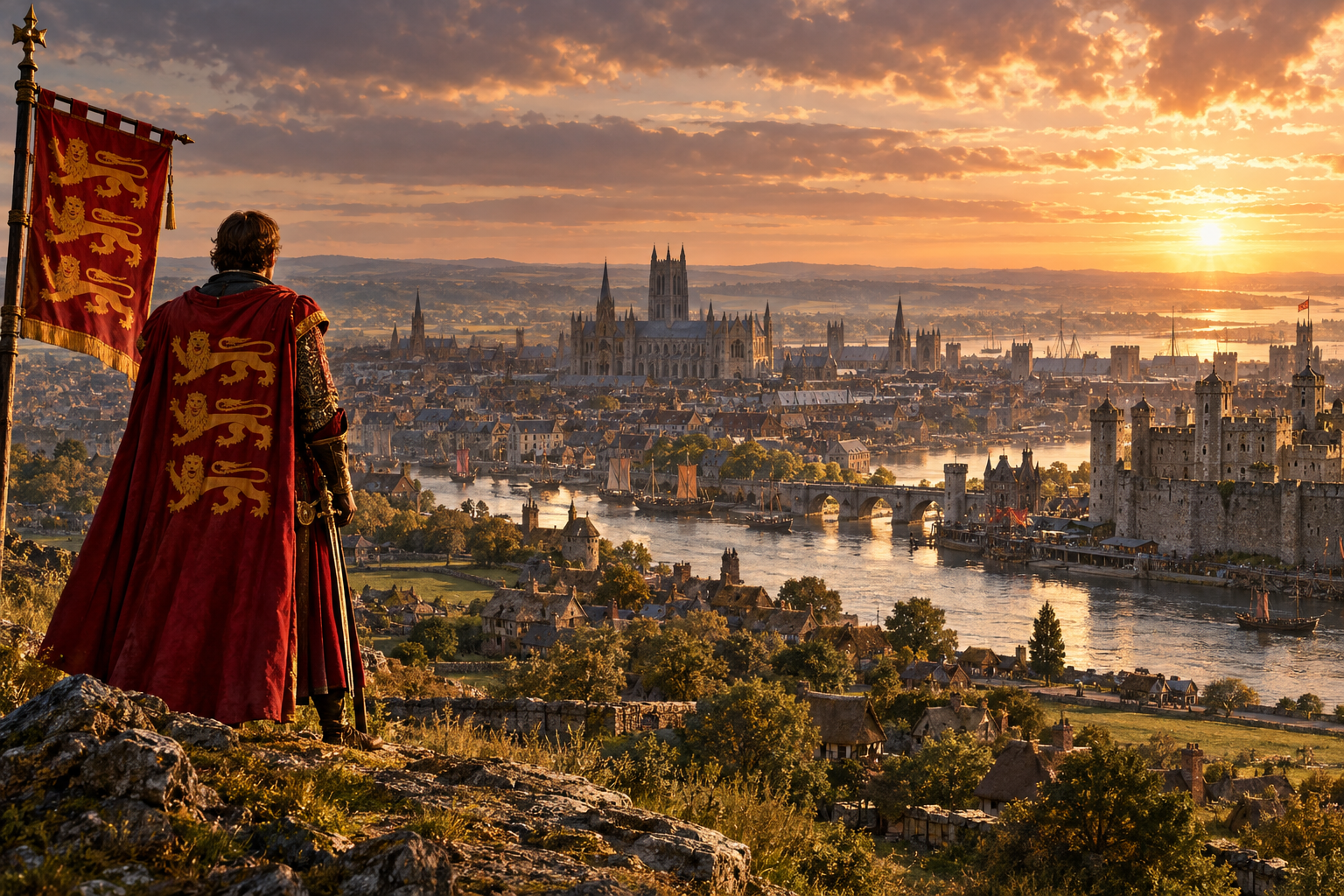
British Isles · Royal kingdom · Great cities · Forest law · Border wars · Ancient sacred landscapes
At a Glance
| Realm | Kingdom of England |
|---|---|
| King | Henry VI |
| Government now | Richard, Duke of York, serves as Protector while royal government is carried through Parliament and council |
| Capital | London |
| Major centres | London, York, Bristol, Nottingham and the great county towns, ports and royal castles |
| Languages | English across most of the realm; Welsh and Cornish in western regions; French and Latin remain important in courtly and learned use |
| Supernatural character | Ancient stones, haunted forests, household fey, black dogs, barghests and roads still claimed by older powers |
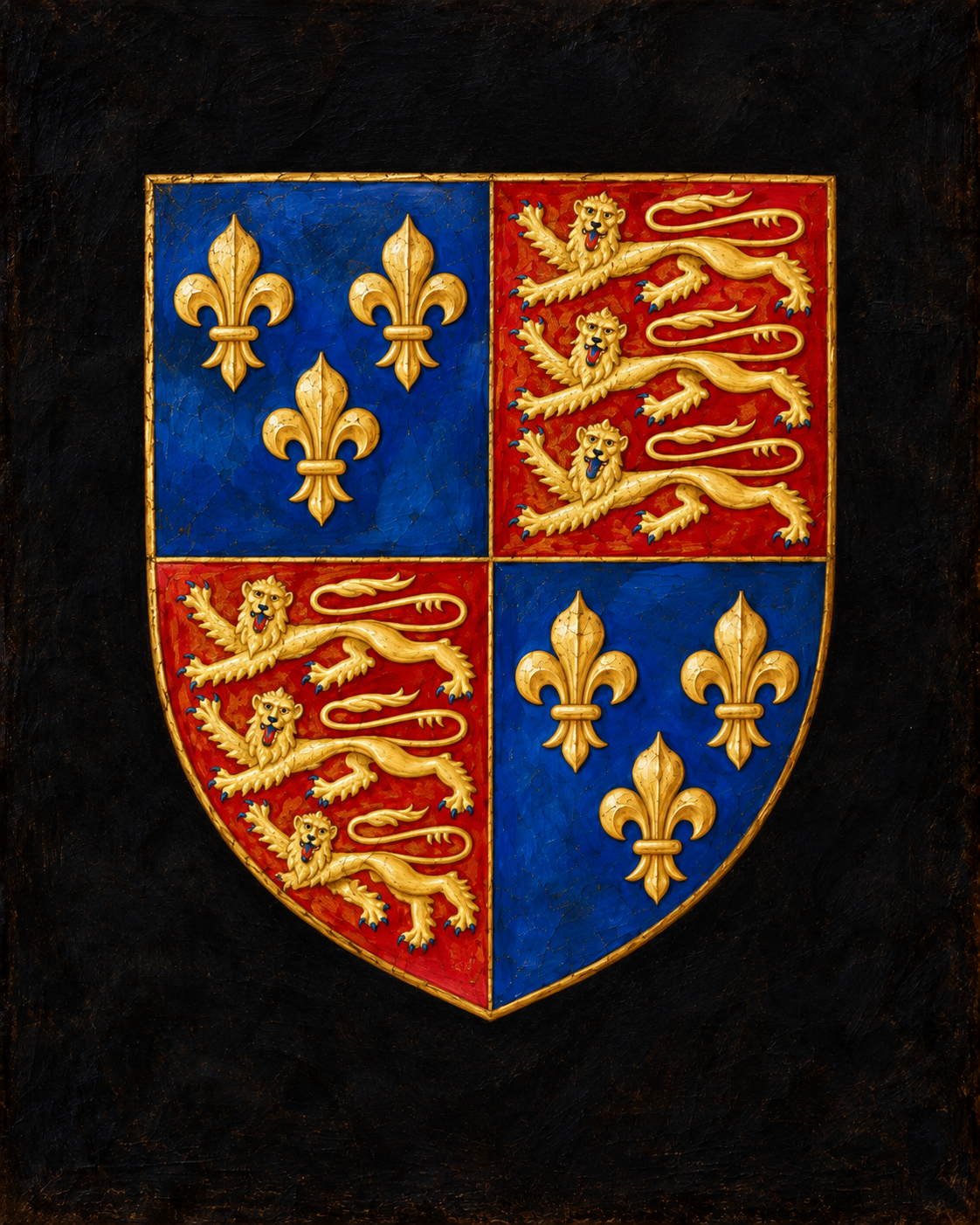
England is a wealthy and heavily governed kingdom whose institutions are stronger than its political peace. Royal law, Parliament, county administration, great noble affinities and prosperous towns bind the realm together, yet disputes among the highest houses are hardening into factions. The civil war that later generations will name has not begun, but the men who will fight it already command castles, retainers and rival claims.
South-east to France: the Channel Road
Follow the road from London through Kent to Dover. Sailing to English-held Calais depends on the wind; beyond its garrison, the journey continues through coast towns and the Somme markets before reaching Paris. Each destination now has its own location entry:
The full journey: London → Rochester → Canterbury → Dover → Calais → Boulogne → Montreuil → Abbeville → Amiens → Beauvais → Paris.
The Northern Road: Nottingham to Durham
Travel north by a series of towns rather than jumping from one large city to the next. The principal journey passes through Nottingham, Blyth, Doncaster, York, Northallerton, Darlington and Durham. Each stop has food, roads, authority and its own problems. Travellers continuing north-east can reach the Lower Wear and Worm Hill.
These are playable gazetteer stops, not a claim that every mile of the historical road was identical to a modern route. A party can turn aside, join a merchant convoy, avoid tolls at a cost or find its journey changed by local politics.
The Western Road: London to Nottingham
London → St Albans → Dunstable → Stony Stratford → Towcester → Northampton → Market Harborough → Leicester → Loughborough → Nottingham.
These links join playable town entries through Watling Street, the Northampton branch and the trading routes of Leicestershire. They are waypoints on connected roads, not a claim that a traveller follows one road without a turn.
What Is Happening Right Now?
Henry VI remains king, but active government has passed into a protectorate. Richard, Duke of York, was appointed Protector in March after the Crown could no longer conduct normal business through the king. The Duke of Somerset is out of power, the Nevilles are close to York, and the Percy-Neville feud in the north is feeding directly into national politics.
No Wars of the Roses have begun yet. That makes the present moment more useful and more dangerous: rival households are still negotiating, threatening, arming, suing, marrying and positioning themselves while every side insists that it serves lawful government.
The loss of English possessions in France has damaged confidence at court and sharpened arguments over money, command and responsibility. Merchants care about trade; nobles care about honour and patronage; towns care whether armed retainers will turn a dynastic quarrel into violence in their streets.
Run England Tonight
The Letter from the Protector
A royal messenger reaches a market town carrying orders under the Protector’s seal. A second courier arrives an hour later with different instructions issued through the king’s household. Both documents are genuine. The local sheriff must act before sunset, and either choice will make an enemy of someone powerful.
The Hound at the Crossroads
A black dog appears each night where three county roads meet. Travellers who turn away live; travellers who pass it disappear. The road is important enough that merchants demand action, but the oldest villagers insist the hound is guarding something worse.
The Forest Charter
A noble house produces a charter granting hunting rights in part of Sherwood. The foresters say the parchment is valid. The boggarts living in the boundary oaks say the grant was made after their own compact and have begun driving every hunter from the wood.
London and the Machinery of Rule
London is the kingdom’s greatest city, financial centre and political pressure point. Westminster, the royal household, Parliament, law courts, merchants and guilds place national power within a short ride of crowded streets, river traffic and private interests.
The Tower of London is fortress, royal palace, armoury, treasury, mint and prison. Whoever controls access to the Tower can protect royal treasure, confine a magnate or turn a rumour into a political fact simply by deciding who is allowed through a gate.
North, Midlands and West
Beside the River Wear in County Durham, Lower Wear faces the legendary Lambton Worm. Its farms, ferries and threatened milk route offer a very different northern adventure from the court intrigues of York.
York anchors royal and noble power in the north while Percy and Neville interests contest the wider region. Beyond them lies the Scottish frontier, where raids, wardens and local feuds can ignore political restraint imposed from London.
Nottingham sits beside castle power, royal forest and the outlaw traditions of Sherwood. In the south-west, Bristol is one of the kingdom’s great ports, connecting England with Wales, Ireland, Iberia and Atlantic routes.
Dartmoor and the western uplands remain landscapes where royal authority thins quickly outside roads, boroughs and fortified centres. Ancient stones, tin workings and dangerous weather make the moor its own jurisdiction after dark.
Dungeon: The Lower Tower of London
The Tower is not a ruined castle. It is one of the most secure, busy and politically sensitive places in England. Guards, armourers, mint workers, prisoners, royal servants and officials occupy the fortress, so every descent below its working levels risks creating a national incident.
The Working Undercrofts
Stores, armouries, treasury spaces and service passages run beneath occupied buildings. Some doors are sealed because their rooms are unsafe; others because nobody wants to explain what is behind them to a new constable.
The Mint Vaults
Coin, dies and precious metal are guarded inside a fortress where counterfeiting is treason. A cracked wall behind one locked store reveals an older passage that does not appear on any mint inventory. Even finding it creates suspicion of theft.
The River Passages
Culverts and riverside access points connect the fortress to the Thames. Some were built for drainage or supply; others have been blocked for generations. At low tide one flooded stair descends below the expected river level into stonework older than the White Tower.
The Conqueror’s Foundation
The deepest chamber sits beneath the Norman fortress on ground once belonging to Roman Londinium. A section of ancient wall forms one side of the room. Set into it is a sealed niche containing a bronze standard that causes every oath sworn nearby to echo in the voice of the person to whom the oath is truly owed.
The consequences are immediate. A prisoner could expose an ally. A royal officer could discover that his own guards are loyal elsewhere. The Mint could be compromised. Whoever controls the chamber gains a weapon against the entire politics of the realm.
Creatures of England
Boggarts
Boggarts haunt farms, old houses, woods and boundary places. They thrive where routine and ownership are taken for granted, turning a household’s smallest neglected custom into months of trouble.
Black Dogs and Black Shuck
Black dogs appear on roads, moors and burial routes across the country. In the eastern counties, Black Shuck is feared as something more specific: a vast spectral hound whose appearance can mark death, danger or a boundary no traveller should cross.
Barghests
Barghests belong to the darker northern roads and settlements, where stories of monstrous hounds overlap with feuds, executions and lonely travel. Their shape-changing makes every report harder to trust.
Old Powers and Sacred Landscapes
England’s sacred geography is layered. Brittonic powers survive in western landscapes; Roman cult places remain under towns and forts; Germanic and Norse traditions endure in names, households and northern custom; local fey and land spirits answer to none of these systems cleanly.
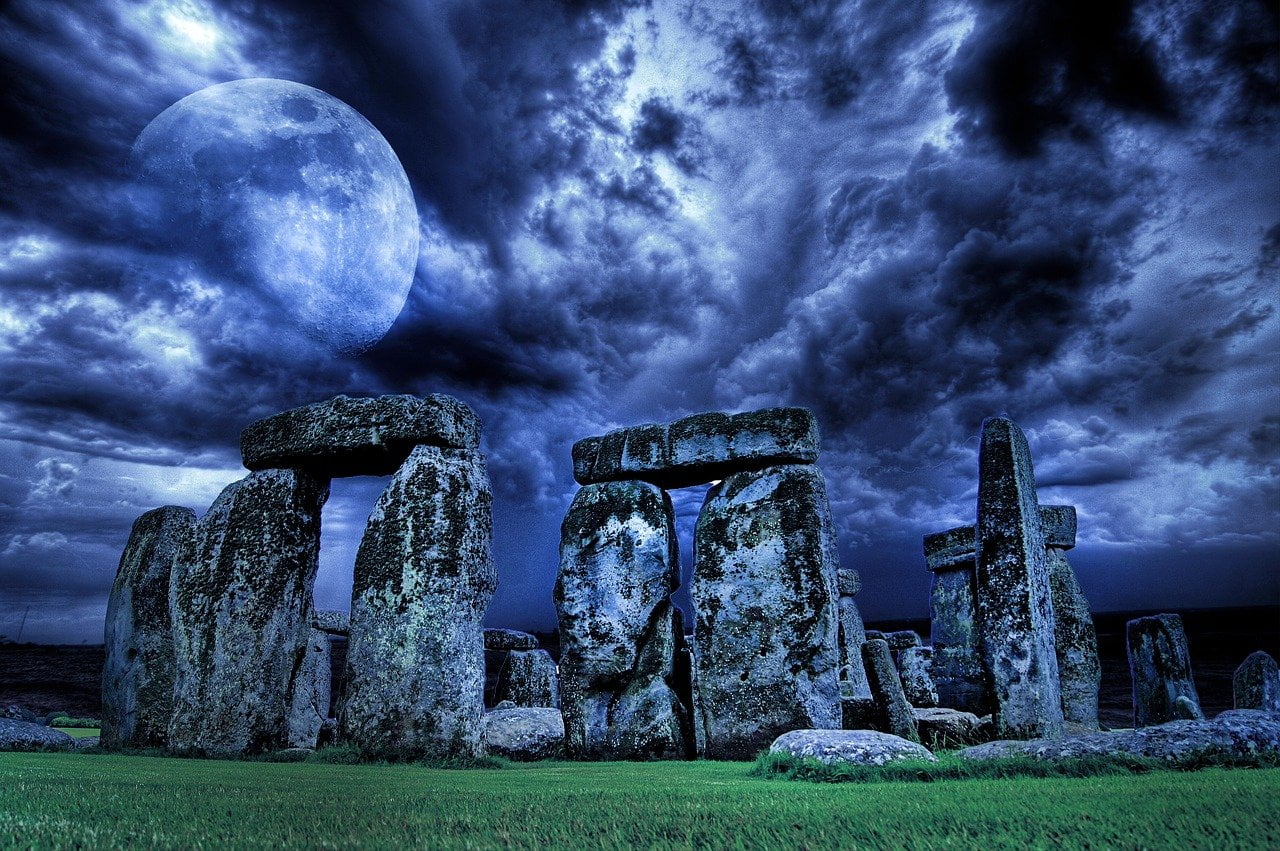
Stonehenge is the clearest proof that the land remembers far older obligations. The stones stand inside a ritual landscape of barrows, avenues and earthworks whose alignments still govern certain nights and seasons. Medieval tales connect Merlin to the monument, while older powers care little which mortal story is currently fashionable.
People in England’s Wider World
Mother Shipton is known in the north for prophecy that arrives wrapped in riddles, weather and political unease. In a realm already divided by rumours of succession and noble conspiracy, even an ambiguous prediction can move armed men.
King Arthur remains a living British sovereign presence whose memory and authority cross modern political boundaries. Merlin is especially tied to the older sacred landscapes where Roman roads, Brittonic memory and prehistoric monuments intersect.
Historical and Mythological Context
Henry VI remains king, but Richard, Duke of York, was appointed Protector in March after royal government could no longer proceed normally through the king. The first open battle between the rival factions will not occur until St Albans the following year. England is therefore still in the phase of councils, affinities, private armed followings and political manoeuvre rather than declared dynastic war.
The Tower of London embodies royal power in physical form. Built after the Norman Conquest and expanded by later kings, it functions as fortress, palace, prison, treasury, armoury and mint. Its ability to secure both people and royal possessions makes it central to any crisis at the top of government.
Stonehenge is far older. The main stone settings date to the late Neolithic, and the monument sits within a vast landscape of burial mounds and ceremonial earthworks. Medieval tradition already links the stones to Merlin and a monument brought from Ireland, ensuring that archaeology and living legend occupy the same ground.
The Royal Family — Henry VI · Historic Royal Palaces — Tower of London · English Heritage — Stonehenge
Keep this reference growing
If this page helped with your reading or game, you can support its upkeep or explore the curated books.
Explore the Bookshop — epics, classics and stories behind imagined worlds.