
Edinburgh — Royal Burgh Beneath Castle Rock
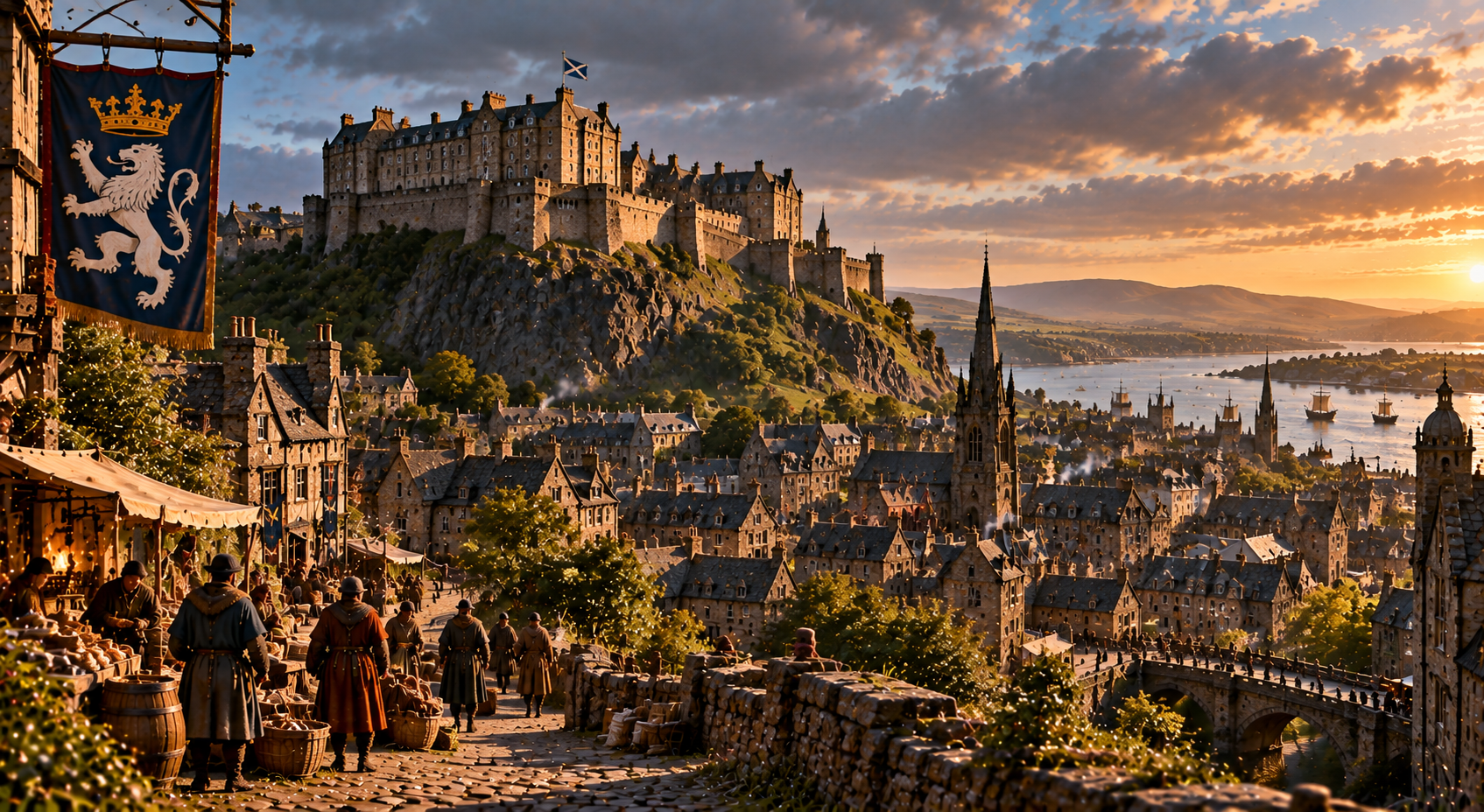
Scotland · Royal burgh · Castle city · Court politics · Closes, markets and old stone
At a Glance
| Realm | Kingdom of Scotland |
|---|---|
| Royal authority | King James II and Queen Mary of Guelders |
| Character | Principal royal burgh, castle stronghold, market town and political centre |
| Key places | Edinburgh Castle, Castlehill, the High Street, the Netherbow, Canongate and the royal residence at the eastern end of the ridge |
| Best for | Court intrigue, urban investigation, noble feuds, castle expeditions, hidden closes and old fortifications |
| Supernatural pressure | Household fey, spectral hounds, ancient hill powers and sealed chambers inside Castle Rock |
Edinburgh climbs a narrow volcanic ridge below one of Scotland’s greatest royal castles. The burgh is compact, crowded and politically exposed: merchants, craftsmen, royal officers, visiting nobles, messengers and armed retainers all use the same steep street between Castle Rock and the eastern royal precinct. A quarrel at court can be in the market before the castle gate closes.
What Is Happening Right Now?
James II’s struggle with the Black Douglases dominates political conversation. William, eighth Earl of Douglas, was killed at Stirling two years ago, but Douglas power is not yet broken. Edinburgh receives messengers, petitions and rumours from both Crown and magnate households while merchants quietly calculate which roads may become unsafe if the quarrel turns into open war.
The royal court moves between major residences, but Edinburgh’s castle, burgh and markets make the city one of the places where national politics becomes visible. A noble who arrives with fifty armed followers changes the mood of an entire street. A sealed letter can alter grain prices before its contents become public.
Queen Mary of Guelders gives the court strong ties to the Burgundian world. Fine goods, weapons, craftsmen and foreign news arrive through the same trade routes that bring ordinary cargo into the Forth.
Run Edinburgh Tonight
The Black Dinner Ledger
A clerk claims to have found an old household account connected to the execution of the young Douglas brothers in Edinburgh Castle in 1440. The document names people still powerful enough to kill for it. Before the party can inspect the ledger, the clerk disappears into the closes below Castlehill.
The Door in the Rock
Repairs beneath a royal store uncover a narrow stair cut directly into Castle Rock. The passage predates the present castle. A guard sent below returns after three hours convinced he has been gone for three days.
The Retainer’s Knife
A Douglas retainer is found dead near the High Street with a royal household token in his hand. Crown officers call it proof of conspiracy. His companions insist the token was planted. The victim’s ghost keeps appearing beside the wrong doorway.
The Castle and the Royal Burgh
Edinburgh Castle stands on a volcanic plug that has been occupied since prehistoric times. By the fifteenth century it is one of Scotland’s chief royal residences and one of the safest places in the kingdom for treasure, prisoners and the royal household. Its position above the burgh makes the castle both protector and threat: the city lives in the shadow of a fortress whose politics can change overnight.
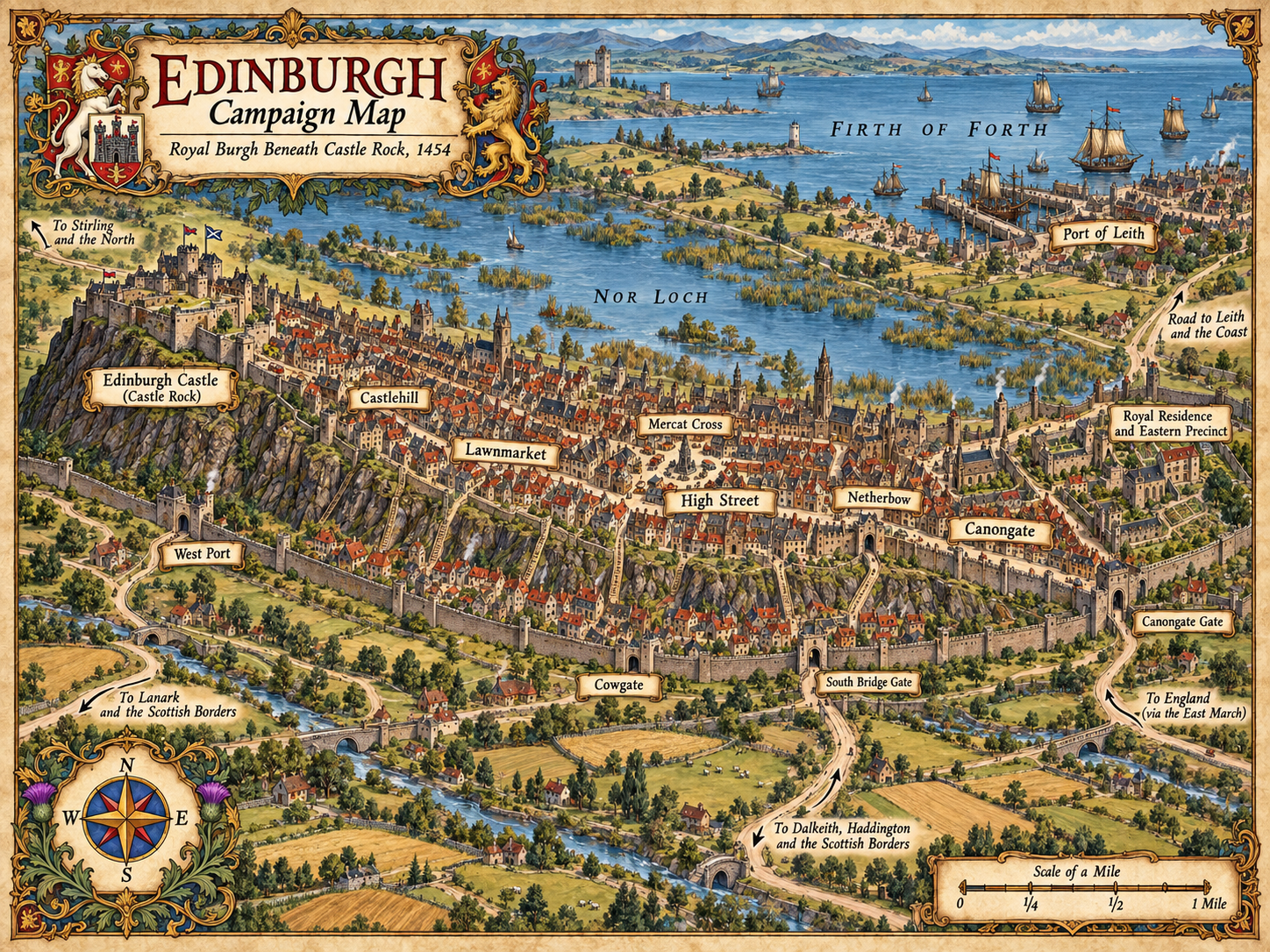
The main burgh street runs east from Castle Rock along Castlehill, Lawnmarket and High Street toward the Netherbow. Narrow closes and wynds descend from the ridge into densely occupied ground. Shops, workshops, taverns, lodgings and yards compete for limited space, making the city ideal for pursuit, surveillance and sudden disappearance.
Edinburgh’s civic authority matters in its own right. Burgesses control trade privileges, markets and urban administration, while royal officers and noble households bring another layer of jurisdiction into the same streets.
Court, Parliament and Noble Power
Scotland’s Parliament does not yet possess a permanent purpose-built hall in the city. It meets where royal business requires, and burgesses already have an established voice alongside the great nobles and other recognised estates of the realm. Edinburgh’s importance comes from proximity: the castle, royal household, burgh officers and merchants place national government inside a dense urban network.
The Douglas crisis gives every appointment political meaning. A keeper of a gate, a messenger, a merchant extending credit or a host providing rooms to a noble household can become part of the struggle without intending to. Neutrality is easiest to claim before someone asks a direct question.
Landmarks & Places to Know
Castle Rock
The volcanic rock dominates every approach to Edinburgh. Its fortress is a royal residence, arsenal, prison and final refuge; anyone entering the burgh lives under its shadow.
The High Street and Mercat Cross
The ridge running east from the castle is the city’s great public spine. Markets, proclamations, guild business, legal notices and public quarrels all converge here, making the cross and surrounding street one of the best places to hear what Edinburgh believes is happening.
West Bow and the Roads to Leith
Steep closes and the West Bow channel movement around the castle side of the burgh, while the road north-east ties Edinburgh to the port of Leith. Goods, wine, weapons, visitors and rumours move along these routes every day.
Taverns, Inns & Lodgings
High Street Alehouses
These houses serve burgesses, craftsmen, servants, retainers and visiting petitioners. The respectable rooms are useful for quiet meetings; the crowded ones are better for overhearing arguments about court, trade and clan politics.
West Bow Lodgings
Cheaper beds and rougher drinking rooms gather around the steep western approaches. Packmen, drovers, hired swords and travellers arriving late can disappear into common rooms where few questions are asked.
Leith Wine Houses
At the port, imported wine and sea news arrive together. Merchants, sailors and factors drink close to warehouses and landing places, making Leith the better choice for anyone seeking a ship, a foreign contact or a cargo that should not appear in a burgh ledger.
Hauntings and Old Edinburgh
The Piper Beneath the Rock
Music is sometimes heard beneath Edinburgh Castle where no passage is known. The piper who makes it never appears at a door or stair. Those who follow the sound find it moving through the rock itself, always a little farther ahead.
Castle servants treat the tune as a warning that an old passage has opened. Soldiers treat it as bad luck. Fey listeners say the piper is not lost at all—he is walking a road between the mortal hill and another place.
The Headless Drummer
A headless drummer appears on the ramparts before danger to the fortress. He does not attack and cannot be detained. His drumbeat is heard first inside the stone and only afterwards in the air.
The Wandering Dog
A spectral dog crosses courtyards and stairways after dark, ignoring closed doors. It sometimes stops beside a person who will be dead before the next moon, though whether it predicts death or merely recognises it is disputed.
Fey in the Burgh
Brownies still attach themselves to a few prosperous households and workshops. Bogles haunt closes and neglected yards, while Redcaps are a danger around violent ruins and blood-soaked border roads rather than ordinary tavern guests.
Dungeon: The Rock Beneath Edinburgh Castle
The most dangerous dungeon in Edinburgh begins inside an occupied royal fortress. Servants, guards, clerks, armourers and members of the household work above the lower passages every day. Anything discovered beneath the castle immediately becomes a matter of royal security.
The Royal Stores
Cellars and storage chambers occupy the lowest routinely used spaces. Wine, grain, weapons and valuables are counted carefully. One wall contains a blocked arch whose masonry does not match the surrounding work.
The Rebuilt Fortress
Behind the arch lie foundations from earlier phases of the castle: ruined stairs, sealed wall lines and chambers abandoned after previous sieges and rebuilding. Some were filled deliberately after the fortress changed hands during the wars with England.
The Hill-Fort Passages
Farther down, dressed masonry gives way to rough cuts in volcanic rock and older earthworks. The passages follow the shape of the hill rather than the plan of the castle above. Charcoal, broken weapon fittings and carved stones point to occupation long before the Stewart kings.
The Chamber of Din Eidyn
At the deepest accessible point stands a chamber built around a natural fissure. The old name Din Eidyn is carved repeatedly into later stone by different hands. Spoken promises echo from the fissure in voices older than Scots or English, and oath-breakers hear their own names answered from below.
The dungeon cannot be isolated from the city. A hidden escape route threatens the castle. An ancient oath can alter a noble claim. A breach in the rock can release something into the royal stores. Every discovery below the fortress changes life above it.
Creatures in and Around Edinburgh
Brownies
Brownies attach themselves to busy households, workshops and stores. In a crowded burgh, a helpful brownie can keep an entire kitchen or stable functioning. Insult one and the same household may discover that every small failure happens at once.
Boggarts
Boggarts thrive in neglected rooms, abandoned yards and old closes where ownership is disputed. Renovation often makes them worse: the surest way to discover a boggart is to move the object it believes marks its territory.
Black Dogs
Black dogs appear on roads beyond the walls and at lonely gates after dark. Some warn travellers away from violence; others follow men already marked by it. Edinburgh’s politics generate enough frightened witnesses that not every reported hound is believed until someone fails to return.
The Forth and the Road Beyond the Walls
Edinburgh looks inland to royal politics and outward toward the Firth of Forth. Coastal traffic brings fish, timber, grain, wine, weapons and foreign news. Roads west lead toward Stirling and the central kingdom; roads south and east run toward the Scottish Borders and England.
The city’s strength is therefore also its vulnerability. Messages from every direction arrive quickly, but so do fugitives, spies, armed retainers and rumours of war.
Campaign Map
Historical and Mythological Context
Edinburgh Castle is a multi-period stronghold whose rock was occupied long before the medieval kingdom existed. Historic Environment Scotland records prehistoric and Iron Age occupation, later royal use and the castle’s position as one of Scotland’s chief royal residences during the fifteenth and sixteenth centuries. The Old Town grew along the ridge below the fortress, producing the narrow closes and linear street pattern that still define the medieval city.
The castle is also inseparable from the struggle over noble power. In 1440 the young Douglas brothers were seized during the episode remembered as the Black Dinner and executed near the castle after a mock trial. James II’s later conflict with the Black Douglases gives that memory immediate political force rather than antiquarian interest.
Historic Environment Scotland — Edinburgh Castle · Historic Environment Scotland — Edinburgh Castle Designation · Historic Environment Scotland — James II and the Black Douglases · National Records of Scotland — Scottish Parliament Records
Keep this reference growing
If this page helped with your reading or game, you can support its upkeep or explore the curated books.
Explore the Bookshop — epics, classics and stories behind imagined worlds.