
York — Northern Capital and Walled City
England · Northern capital · Walled city · Guild power · Noble feud
At a Glance
| Realm | Kingdom of England |
|---|---|
| Status | Self-governing city and county in its own right |
| Mayor | Thomas Neleson, merchant |
| Minster Prelate | William Booth |
| Population | Roughly 10,000–15,000 inhabitants |
| Character | Walled northern capital, ecclesiastical centre, guild city, inland trading hub and political pressure point |
| Trade | Cloth, wool, leather, metalwork, foodstuffs, imported goods and regional commerce |
| Best For | Noble feuds, guild politics, urban investigations, religious intrigue, northern travel, siege tension and folklore |
| Immediate Danger | The Percy–Neville feud, armed retainers, factional violence, road ambushes and supernatural trouble entering through a city already expecting bloodshed |
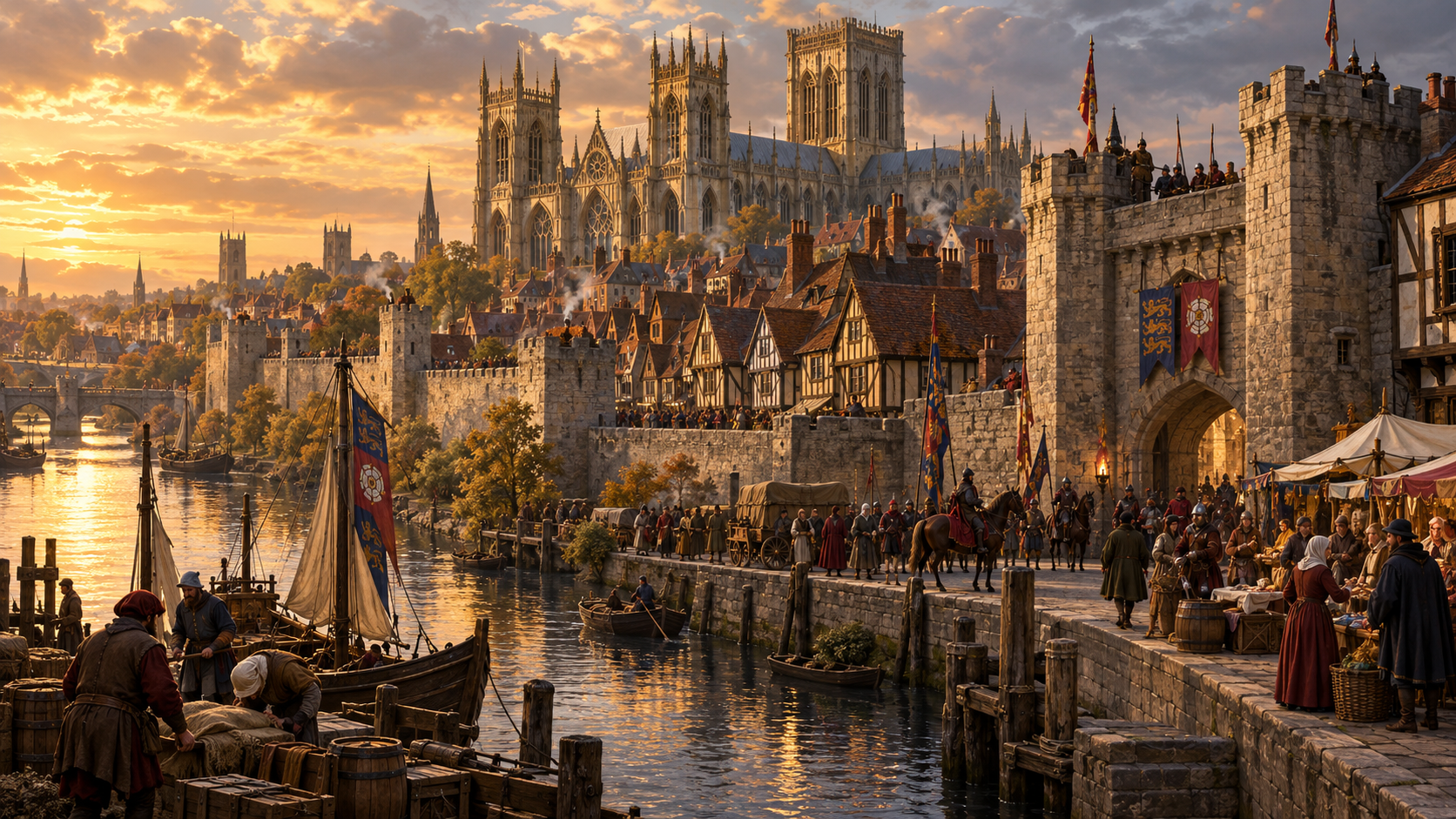
York is the great city of northern England: walled, wealthy, governed by formidable guilds and temple households, and surrounded by armed noble factions that are beginning to behave as though royal law no longer applies to them. The Minster towers above a maze of guild streets and neighbourhood shrines. Merchants govern through civic institutions older than many kingdoms. The Ouse carries goods into the city while the roads bring pilgrims, clerics, retainers, merchants and men wearing another lord’s badge. Outside the walls, the Percys and Nevilles are turning private rivalry into organised violence.
What Is Happening Right Now?
The city is living inside a noble feud.
The Percy and Neville families are competing for power across northern England. Their rivalry is no longer confined to legal claims, marriages and court influence. Armed retainers move openly through Yorkshire.
The attack on the Neville wedding party at Heworth Moor, immediately outside York, is recent memory. Lord Egremont and Percy supporters attempted to intercept the party of Thomas Neville and Maud Stanhope as it travelled from York toward Sheriff Hutton.
That confrontation did not end the feud.
Neville property and supporters inside York have since been attacked. Men connected to the dispute are gathering weapons, servants and allies. Houses that normally belong to wealthy citizens are becoming fortified political positions.
The Crown is poorly placed to impose peace. Henry VI’s incapacity has placed Richard, Duke of York, at the centre of national government, while Richard Neville, Earl of Salisbury, is one of York’s principal allies.
For the Percys, that makes local rivalry inseparable from national politics.
Mayor Thomas Neleson and York’s civic elite have a different priority.
They want armed nobles to keep their private wars outside the city walls.
Run York Tonight
The House on Coney Street
A Neville supporter’s house is attacked shortly before dawn.
The attackers wear no badges, but one dead man carries Percy household coin and a gate token issued at Walmgate Bar.
The mayor wants the killers identified without turning the investigation into an accusation capable of bringing hundreds of retainers into York.
The Merchant’s Missing Bale
A valuable cloth shipment disappears from a warehouse controlled by the mercers.
The theft appears ordinary until the missing cloth is found cut into liveries for armed retainers.
Someone is equipping a private force inside the city.
The Locked Room at the Guildhall
Workmen building the new Guildhall break through into an older chamber beneath the site.
Inside are civic documents, Roman masonry and a corpse that cannot have been placed there recently.
The body is wearing the badge of a living noble family.
The Pageant Wagon
During preparations for the Guild Pageant Cycle, one guild’s pageant wagon begins moving after the craftsmen have gone home.
The actors blame rivals.
The wagon disagrees.
The Prophetess from Knaresborough
Mother Shipton arrives in York and refuses to explain why she has come.
She asks the adventurers to stop a man from entering Micklegate Bar before sunset.
She will not tell them who the man is.
The Prisoner at the Castle
A captured retainer held at York Castle claims he can prove that neither Percy nor Neville men ordered the raid for which he has been arrested.
Someone is using the feud as cover.
He expects to be dead before morning.
York Governs Itself
York is not merely a northern town administered from somewhere else.
Its citizens have exercised substantial self-government for centuries, and the city possesses county status in its own right. The mayor, sheriffs, aldermen and common council defend civic liberties vigorously.
Royal officers therefore cannot treat York exactly as they would an ordinary borough.
Nor can noble retainers assume that a powerful family name excuses violence inside the walls.
Thomas Neleson, merchant and mayor, sits at the centre of a civic government that must balance local law, royal demands, guild interests and the dangerous presence of northern magnates.
He does not possess an army capable of defeating the Percys or Nevilles in the field.
He does possess gates, courts, civic officers, money, merchants and a population deeply invested in keeping noble warfare from destroying trade.
The New Guildhall
York is building a civic monument to itself.
The new Guildhall rises beside the Ouse. Construction has been underway for several years and will continue for several more.
Stone, timber, skilled labour and civic money are flowing into a building intended to embody the authority of the mayor and commonalty.
That makes the unfinished hall an excellent campaign location.
Scaffolding creates hidden access. Building materials disappear. Guild disputes become construction delays. A mason who sees something beneath the foundations can vanish before anyone realises his absence matters.
The Guildhall is not simply architecture.
It is York announcing that civic power intends to survive kings, temple lords and barons alike.
The Merchant Adventurers
The merchants who gather at Trinity Hall are among the strongest organised interests in the city.
The hall has stood since the fourteenth century. The fraternity that built it combines religion, charity and commerce, and its mercers exercise substantial control over York’s trade.
Cloth is central to their business.
Their interests reach beyond York into Hull, the northern counties and overseas markets.
Merchants need information as much as coin. They care about road safety, tolls, shipping, cloth quality, debts, foreign traders and political disorder.
A merchant whose wagon is robbed by retainers does not care whether the men serve Percy or Neville.
He cares that somebody pays.
The fraternity also maintains charitable functions through its hospital and religious obligations.
This makes Trinity Hall simultaneously a commercial headquarters, meeting place, charitable institution and source of patronage for adventurers.
York Minster — The Court of Prelate William Booth
The Minster is not yet the completely finished monument later generations will know.
Its immense Gothic rebuilding has continued for generations. The nave, east end and quire already dominate the city, while work associated with the central tower continues.
Construction, maintenance and worship occur around one another.
William Booth, the Minster’s high prelate, presides over the temple houses, sanctuary wards and sacred courts of northern England. His office is separate from Lancelot Blackburne’s civic hierophancy. His authority rests upon temple stewards, oath-keepers, healers, scribes, land grants and the patronage of powerful households.
Novices and veteran initiates travel to York to swear service to the gods, learn healing and law, and receive the seals that permit them to serve distant temples.
The temple establishment is therefore not background scenery.
It is one of the city’s largest employers, landholders, legal authorities and political powers.
The Minster Close, the prelate’s household, temple residences and sacred jurisdictions create districts where civic authority overlaps with temple privilege.
Lancelot Blackburne — York’s Pirate Hierophant
Lancelot Blackburne is a high hierophant of York’s civic cults, with ritual authority, dockside contacts and a disputed maritime past. He does not hold William Booth’s office as Minster Prelate.
Blackburne has travelled with sailors, mercenaries and sea-raiders; he now performs important public rites while his old companions continue to call at his door. Other ritual officers question his judgement, but few dispute his knowledge of northern waters.
He drinks too freely, knows too much about foreign ports and occasionally produces information no respectable priest should possess.
Some temple elders consider his seafaring loyalties dangerous.
Some merchants consider him extremely useful.
Blackburne insists that both opinions can be correct.
Landmarks & Places to Know
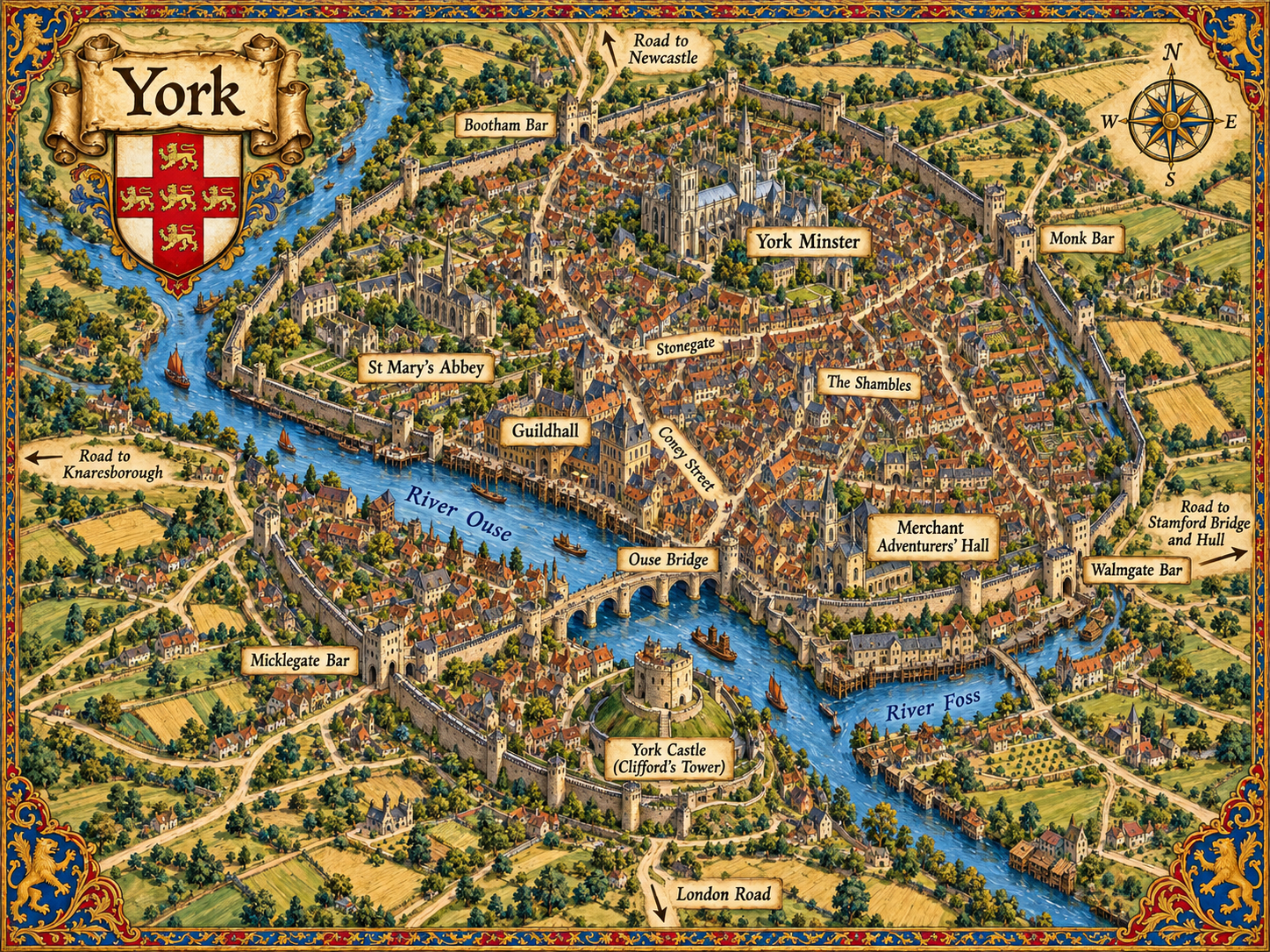
Micklegate Bar
Micklegate is the ceremonial entrance used by monarchs approaching York from the south.
It is also a fortress gate with a darker civic function: the heads of traitors and rebels can be displayed above it.
A royal arrival transforms Micklegate into theatre.
A severed head transforms it into a warning.
Bootham Bar
Bootham Bar stands on ancient foundations near the Minster and the road north.
Travellers entering here move directly toward one of York’s most politically sensitive districts.
Monk Bar
Monk Bar is built as a defensible gatehouse whose floors can resist attack separately.
In a city worried about armed retainers, its military usefulness is obvious.
Walmgate Bar
Walmgate Bar guards the eastern approaches and retains a formidable barbican.
Traffic coming from roads toward the East Riding and Stamford Bridge passes through a district increasingly sensitive to the Percy–Neville struggle.
York Castle
The royal castle remains a centre of government, justice and imprisonment.
The great stone tower later called Clifford’s Tower dominates the complex, but parts of the castle are already showing serious decay.
The fortress is more useful as gaol, treasury, judicial centre and symbol of royal authority than as a comfortable royal residence.
The Shambles and Market Streets
Butchers, traders, craftsmen, servants and customers fill narrow streets where workshops and homes stand close together.
Anyone fleeing pursuit can disappear quickly.
Anyone carrying a drawn sword can also find the street blocked just as quickly.
Trinity Hall
The Merchant Adventurers’ Hall is where commercial wealth becomes organised influence.
A player character who needs credit, transport, an overseas contact or information about stolen cargo is more likely to find a useful patron here than at a noble court.
Taverns, Inns & Lodgings
Micklegate Inns
Travellers arriving from the south and west find beds, stables and hot food around Micklegate. The better houses serve merchants and retainers with money to spend; the cheaper yards take drovers, labourers and armed men who would rather not answer many questions.
Ouse Bridge Taverns
The bridge and riverside are natural meeting places for bargemen, traders, porters and messengers. Tavern rooms here are noisy, crowded and useful: cargoes are discussed over ale, boat passage can be arranged quickly and a stranger can learn which merchant is buying, which quay is watched and which road is unsafe.
Stonegate and Petergate Alehouses
Closer to the city’s wealthier heart, drink houses cater to craftsmen, clerks, guildsmen and visitors with business in York. Prices rise with proximity to power, but so does the quality of rumour. A discreet table can be more valuable than a private room.
York’s Guild Pageant Cycle
York’s crafts do not merely work together.
They perform together.
The great Guild Pageant Cycle fills York’s streets with wagons bearing scenes of ancient heroes, divine quarrels, founding oaths and monstrous trials. Guilds and crafts are responsible for individual pageants, performed on wagons that travel through the city.
The plays bind civic identity and professional pride to the city’s living gods and shared legends.
They also create enormous opportunities for adventures.
Crowds hide thieves. Noble agents exchange messages. Rival guilds sabotage props. Actors disappear. A supposedly theatrical demon may refuse to remove its costume because it is not wearing one.
The Merchant Adventurers sponsor the final Trial of the Oath-Breakers, a pageant in which kings, merchants and commoners must answer before the gods.
Everyone in York understands the irony when merchants decide whose promises deserve punishment.
Trade, Crafts and a Changing Economy
York remains one of England’s greatest cities, but its economic position is changing.
The wool and cloth industries that helped make it wealthy are increasingly strong in other Yorkshire towns. Hull competes for overseas trade.
That does not make York poor.
It makes York competitive.
More than a hundred crafts and trades support the city’s economy. Mercers, drapers, leather workers, metalworkers, butchers, bakers, brewers, carpenters, masons, armourers and countless specialists depend upon urban customers and regional markets.
Craft membership controls access to work, training and civic status.
Arguments over quality, prices and who is permitted to sell within the city can become as serious as disputes over land.
Law, Gates and Armed Retainers
The walls do more than defend York from armies.
They allow the civic government to control entry.
Goods can be inspected. Tolls can be collected. Suspicious travellers can be questioned. Gates can be closed.
That matters when noble households are moving armed men around Yorkshire.
A retainer wearing Percy or Neville colours may consider himself protected by his lord.
The mayor may consider him an armed stranger inside York.
Both positions can be true until somebody draws steel.
Mother Shipton and the Roads West
Ursula Southill, Mother Shipton, lives at Knaresborough rather than inside York.
That does not keep York away from her.
Merchants, soldiers, widows, priests and nervous retainers travel to seek her predictions. Some return convinced she is a fraud.
Others alter marriages, journeys and political plans because of something she told them.
Her husband Toby Shipton has York connections, and Ursula herself appears in the city whenever prophecy places her there.
When Mother Shipton voluntarily enters York, somebody should worry.
Magic and Northern Folklore
York is old enough for different supernatural landscapes to occupy the same ground.
Roman foundations lie beneath shrines and temple precincts. Scandinavian names survive beside Norman stonework. Ancient roads pass through medieval gates. Wells, cellars, crypts and riverbanks preserve stories older than the buildings above them.
Boggarts belong in houses, barns, workshops and rural holdings around York where a troublesome household spirit can begin as nuisance and become genuinely dangerous.
Jack-in-Irons and other northern giants belong farther from the crowded city, on lonely roads, moors and wild country where travellers can disappear without witnesses.
The city itself should remain mostly human.
Its supernatural threats work best when they hide inside real civic tensions: a spirit blamed for guild sabotage, a prophecy influencing noble politics, or an ancient thing discovered because builders are digging foundations for the new Guildhall.
Services and What Adventurers Can Find
York can equip almost any expedition into northern England.
Weapons, armour, horses, carts, rope, tools, winter clothing, preserved food, writing materials and ordinary medicines are readily available.
Specialists include armourers, scribes, clerks, lawyers, physicians, apothecaries, translators, merchants, guides and craftsmen capable of repairing unusual equipment.
The Merchant Adventurers can arrange introductions and commercial transport.
The temples can provide healing, sanctuary, scholarship and access to oath-bound networks.
Rare magic moves quietly through wealthy households, clerical collections, travelling merchants and people with contacts outside respectable trade.
For wider settlement mechanics, use Fantasy Settlements.
Rumours and Street Talk
- “Percy men are already inside the walls.” Of course they are. The real question is how many.
- “Salisbury has marked every man who attacked his house.” Neville servants are certainly asking names.
- “The new Guildhall foundations broke into Roman tunnels.” The masons deny this too quickly.
- “Mother Shipton says one of York’s gates will close on a king.” Nobody agrees which gate.
- “The Minster tower moves when the bells ring.” The master masons do not appreciate the joke.
- “A boggart has joined the Bakers’ pageant.” The Bakers insist it belongs to the Butchers.
- “Blackburne knows pirates who will buy anything.” He says he knows sailors, which is apparently different.
- “There will be blood at Stamford Bridge before winter.” Almost everyone in York believes this.
Travel from York
| Route | What It Means in Play |
|---|---|
| London | The great road south carries royal orders, merchants, lawyers and political news. |
| Stamford Bridge | Eastern road through territory increasingly entangled in Percy–Neville violence. |
| Knaresborough | Western route toward Mother Shipton, castles, river crossings and the wider Yorkshire road network. |
| Hull | Route toward the Humber and overseas trade; commercially vital and increasingly competitive with York. |
| Newcastle and the North | Merchants, soldiers and border news move toward Northumberland and the Scottish frontier. |
| Nottingham | Southern road into the Midlands, royal forests and outlaw country. |
Inns, Hauntings and Old York
The Red Lion on Walmgate
The Red Lion stands on Walmgate close to the eastern approaches, a timber-framed house of drink, food, beds and information. Merchants, retainers, drovers and messengers use its rooms and yard, making it one of the quickest places in York to learn who has entered through Walmgate Bar and which lord’s men are drinking together tonight.
Rooms are dearer when noble households crowd the city. A traveller without coin can sometimes trade news, guard work or a useful introduction for a place near the kitchen fire.
The Roman March Beneath the Minster Precinct
Beneath the streets around the Minster precinct lies the buried road of Roman Eboracum. The dead still walk it. On certain nights a file of Roman soldiers passes through cellar walls at the old ground level, so that later floors hide their legs below the knee.
The soldiers do not wander. They follow the road. Anyone who blocks the column is pushed aside by cold, solid shields. Anyone who follows too far can emerge onto a Roman street that no longer exists on the surface, with torchlight ahead and modern York gone behind.
Boggarts Behind the Walls
Boggarts thrive in crowded yards, lofts, workshops and neglected corners of old houses. Most begin as nuisances—moving tools, souring milk or frightening apprentices—but repeated cruelty can turn household mischief into a dangerous feud.
Deeper History
York has been a centre of power for far longer than the Kingdom of England has existed.
Roman Eboracum established the military and urban foundations of the city. Anglian York became an ecclesiastical and political centre. Scandinavian Jórvík connected the city to the wider northern world.
The Norman conquest added castles, monasteries and another layer of government.
Medieval merchants then won increasing control over their own affairs.
By the fourteenth century York had become a county in its own right, governed through its own mayor and sheriffs.
The walls were rebuilt in stone. The four great bars became both fortifications and statements of civic prestige.
The Minster expanded toward its present form. Merchant wealth built guild halls, temples, shrines and charitable houses.
Yet York’s position is changing.
Trade is shifting. Other Yorkshire towns are growing. Hull controls more overseas traffic. Population has declined from earlier peaks.
York is therefore not a dying city.
It is a powerful city that knows it must fight to remain powerful.
Adventure Pressure
- Noble pressure: Percy and Neville retainers are turning Yorkshire into a private battlefield.
- Civic pressure: Mayor Thomas Neleson must preserve York’s independence and commerce while stronger military powers quarrel around him.
- Religious pressure: Prelate William Booth and the Minster command enormous authority alongside civic government.
- Commercial pressure: merchants face changing trade routes, competition from Hull and disruption on the roads.
- Construction pressure: the Guildhall and Minster works create contracts, labour disputes, theft and opportunities to uncover older York beneath the city.
- Road pressure: armed retainers, highwaymen and isolated supernatural threats make travel beyond the walls increasingly dangerous.
- Prophetic pressure: Mother Shipton’s predictions can influence people powerful enough to make the prophecy come true themselves.
- Supernatural pressure: ancient foundations, household fey and northern folklore sit beneath a city already distracted by very human violence.
Sources and Historical Grounding
The historical framework uses York civic, archaeological, ecclesiastical and mercantile records.
York’s surviving Bridgemasters’ Accounts identify Thomas Neleson as mayor. The Borthwick Institute preserves Archbishop William Booth’s register and records ordinations held throughout the city. York’s Historic Environment Record documents the medieval walls, bars and Guildhall, while York Minster records the continuing fifteenth-century rebuilding of the central tower.
The Merchant Adventurers’ archives preserve the history of Trinity Hall, the mercers and their involvement in York’s Corpus Christi cycle.
York Historic Environment Record — Medieval York · York Historic Environment Record — Guildhall · York Minster — Building the Medieval Minster · Merchant Adventurers’ Hall — History · Merchant Adventurers Archive — Social History · English Heritage — York Castle and Clifford’s Tower
Continue Exploring
Kingdom of England · The British Isles · London · Bristol · Nottingham · Mother Shipton · Boggart · British Isles NPCs
Keep this reference growing
If this page helped with your reading or game, you can support its upkeep or explore the curated books.
Explore the Bookshop — epics, classics and stories behind imagined worlds.