
The Wars of Dominion
Imperial Fracture, Sacred Kingdoms and the Fortified World
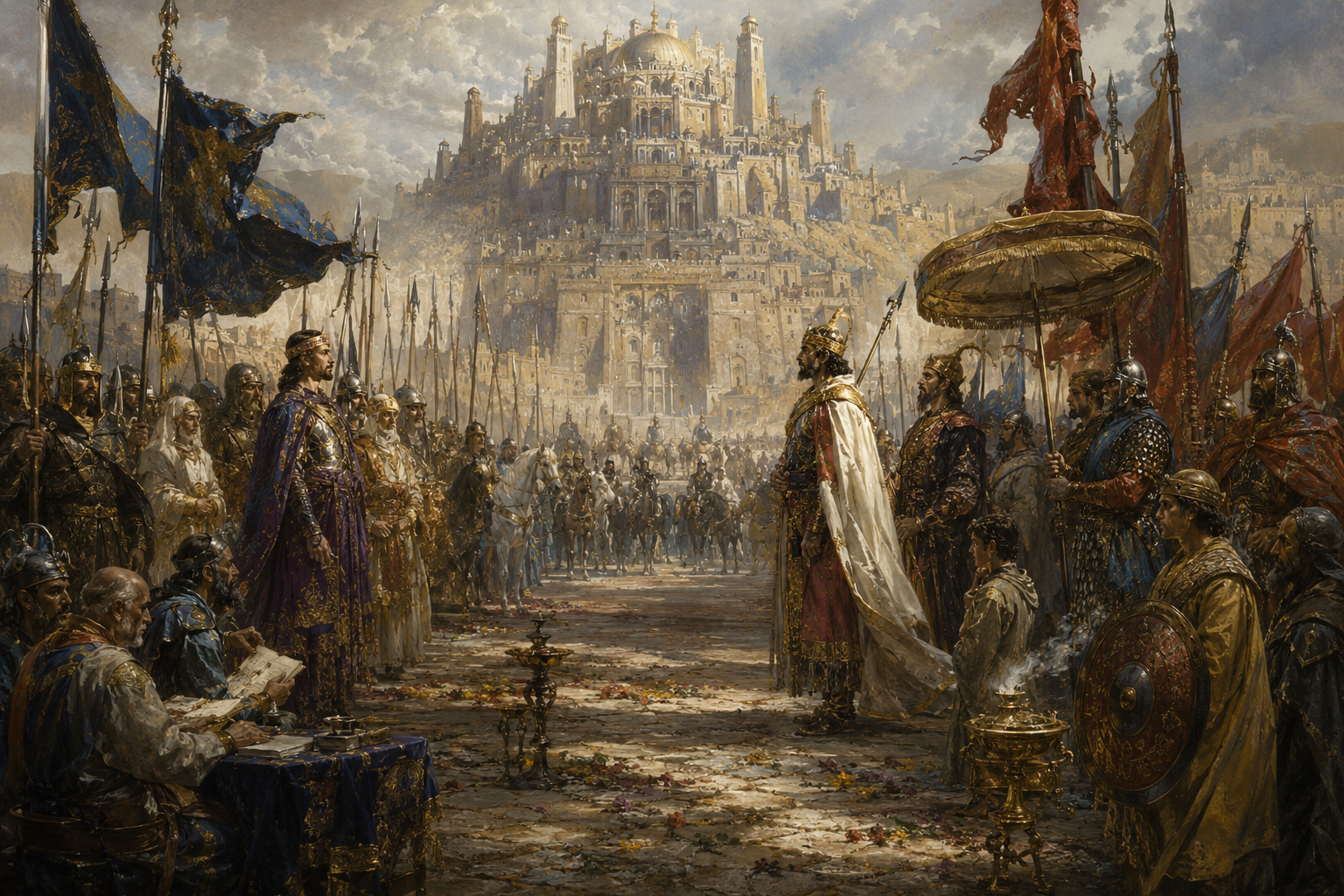
The Wars of Dominion begin with immense imperial systems discovering that roads, law, taxation and armies can survive the governments that built them. They end nine centuries later in a world crowded with castles, walled cities, temple estates, cavalry confederacies, merchant networks, hereditary warrior houses and rival sacred claims.
The age follows The Iron Ascendancies. Rome divides and loses its western imperial succession. Sasanian Persia rises, exhausts itself against the Eastern Roman state and disappears as an imperial dynasty. Gupta authority fragments. Chinese dynasties divide, reunify and divide again. Aksum, Nubian kingdoms, Sahelian powers, Tang and Song China, Turkic khaganates, Maya courts, Andean states, Angkor, Pagan, Srivijaya, Norse settlements and Polynesian voyaging societies build their own forms of order.
Sacred authority is equally diverse. Gods, ancestors, kami, divine courts, sacred mountains, shrine custodians, philosophical schools, river powers, temple estates, jinn-bound territories and sovereignty pacts remain real. No single institution becomes the universal spiritual government of the world.
The struggle for dominion therefore concerns more than territory. Rulers seek the authority to decide who belongs, whose law applies, what land can be taxed, which sacred claims deserve protection and which peoples may be conquered, enslaved, expelled or classified as monsters.
Nonhuman peoples participate as political actors rather than fading relics. Dwarven holds protect mines and deep roads. Elven courts negotiate, withdraw or intervene. Gnome enclaves become valuable for engineering, medicine and record-craft. Halfling leagues hold food routes, ferries and markets. Orc, hobgoblin, goblin and kobold communities form states, military colonies and fortified settlements. Giants, Fey powers and serpentfolk maintain older claims through treaty, secrecy or force.
By 1200 CE the systems created during this age are formidable, but brittle. They will pass directly into The Age of Severed Crowns, where conquest, dynastic fracture, plague and gunpowder begin testing every confidence inherited from the fortified world.
The World at the Beginning
- The Roman Empire still controls most Mediterranean shores, although its administration is divided among competing courts and military commands.
- The Sasanian Empire remains the great Iranian rival of Rome across Mesopotamia, Armenia and the Caucasus.
- Gupta rulers are consolidating power in northern India.
- China remains politically divided after Han rule, with rival northern and southern courts maintaining competing claims to legitimate succession.
- Aksum commands highland and Red Sea routes linking northeastern Africa with Arabia, the Nile world and the Indian Ocean.
- Teotihuacan stands among the largest cities in the Americas.
- Classic Maya dynasties are developing monumental courts, written records and competitive city-state systems.
- Moche, Nazca and other Andean societies expand irrigation, specialist craft and ceremonial landscapes.
- Roman, Celtic, Germanic, Slavic, Iranian, Indian, Chinese, African, American, Shinto and Oceanic divine powers remain active regional forces.
- The Asgardian gods influence northern kingship, oath, seafaring, feud and war without creating a single Scandinavian sacred state.
- Dwarven, elven, giant and Fey territories remain embedded within and beside expanding mortal jurisdictions.
The age opens with imperial systems under severe strain. It closes with fortified kingdoms, trading cities, temple capitals, assemblies and cavalry confederacies pressed closely against one another across an increasingly connected world.
Imperial Fracture
Old imperial machinery still works, but increasingly serves rival courts, frontier commanders and successor rulers. Migration, civil war and political improvisation redraw the western Roman world without erasing Roman law, cities or identity.
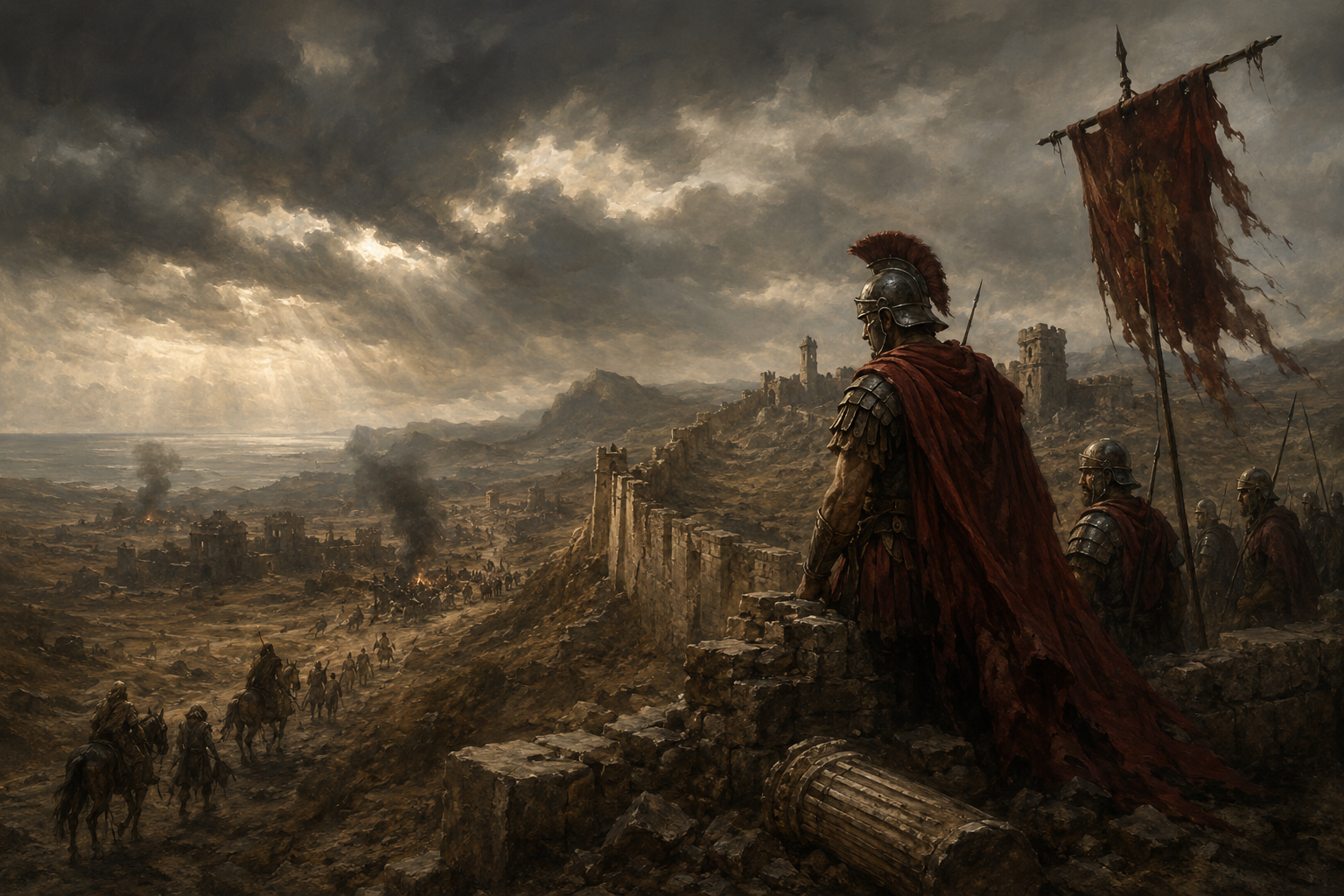
300–375 CE — The Great Imperial Systems Divide
The Roman, Sasanian, Gupta and post-Han worlds enter the age as powerful but fundamentally different political systems. Roman power rests on taxation, armies, provincial cities and roads; the Sasanians combine monarchy, great noble houses, cavalry and fortified frontiers; Gupta rulers expand through alliances, tribute and courtly prestige; Chinese courts compete while preserving the political idea that legitimate unity can be restored.
Political division does not divide the divine realms. Roman rulers may fight over taxation or imperial ceremony while Jupiter, Mars, Minerva, Vesta and Janus retain independent divine domains.
c. 300–550 CE — Aksum Commands the Red Sea Heights
Aksum reaches imperial prominence in northeastern Africa. Highland agriculture, cattle, tribute, coinage and Red Sea commerce connect its rulers with Arabia, Kemet, Mediterranean markets and the Indian Ocean.
Royal stelae, tombs and sacred precincts express an indigenous highland kingship. Aksum expands through campaigns, alliances and command of routes rather than by directly administering every surrounding community.
Highland gods, royal ancestors, celestial powers and regional cults remain central to sacred authority, while foreign merchants bring additional rites into ports and court districts.
c. 320–550 CE — Gupta Courts and Regional India
Gupta rulers dominate large portions of northern India through warfare, political marriage, tribute and negotiated regional power. Their courts support Sanskrit literature, mathematics, astronomy, medicine, philosophy, sculpture and temple building.
The subcontinent does not become a single uniform administration. Guilds, villages, local rulers, forest peoples and sacred institutions preserve considerable autonomy, while southern India, Sri Lanka, the Deccan, Himalayan regions and northwestern frontiers maintain separate histories.
Vishnu, Shiva, Devi, Skanda, river powers, yakshas, nagas, ancestors and innumerable local beings remain active within overlapping sacred geographies.
330 CE — Constantinople Becomes the Eastern Imperial Capital
Constantinople rises at the Bosporus as the principal eastern capital of the Roman Empire, commanding the connection between European and Asian provinces and becoming a centre of taxation, grain distribution, law, military planning and imperial ceremony.
c. 350–500 CE — Migrations Break the Old Frontier Map
Gothic, Alan, Vandal, Suebi, Burgundian, Frankish, Hunnic and other groups cross and reshape imperial frontiers. These movements are not one migration by one “barbarian” people. Some groups flee stronger enemies, some enter as military allies, some seize territory, and some serve Rome before becoming independent.
Migration brings households, livestock, captives, priests, smiths, laws and sacred objects as well as warriors. Human authorities sometimes exploit the label of “monster” to deny nonhuman migrants recognised claims to land, ransom or lawful surrender.
c. 370 CE — Hunnic Confederations Enter the Western Steppe
Hunnic forces overthrow or displace Alan and Gothic powers north of the Black Sea. Their political strength comes from cavalry, tribute, personal allegiance, hostage exchange and the ability of successful rulers to redistribute wealth.
Hunnic weather-working, ancestor rites and steppe-spirit traditions are genuine, but the confederations themselves remain mortal political constructions dependent upon leadership and negotiated loyalty.
376–378 CE — The Danube Crisis and Adrianople
Large Gothic communities cross the Danube under pressure from the Huns. Roman corruption, extortion and abuse turn a refugee settlement into rebellion. At Adrianople in 378, Emperor Valens is killed and a major eastern Roman field army is destroyed.
The disaster demonstrates that imperial mistreatment can turn recognised refugees and military recruits into a formidable enemy.
395 CE — The Roman Courts Divide Permanently
After the death of Theodosius I, Arcadius rules in the east and Honorius in the west. The division is dynastic and administrative rather than the sudden creation of two unrelated civilisations. Roman law, diplomatic titles, trade and the language of universal empire continue to cross the political boundary.
406–407 CE — The Rhine Frontier Fails
Vandals, Alans, Suebi and other groups move into Gaul while western Roman forces are divided by rebellion and civil war. Cities bargain for protection, armies defect, local landholders gather troops and communities choose among competing authorities.
The event begins a long transfer of land and military power rather than an instantaneous disappearance of government.
410 CE — Alaric Sacks Rome
Alaric’s Gothic army enters Rome after years of failed negotiation, broken military settlements and political crisis. The event shocks the Mediterranean because the city is assumed to stand beneath exceptional ancestral and divine protection.
The gods remain real, but several public wards fail after competing governments neglect ritual obligations, redirect temple property and undermine the officials responsible for maintaining them.
c. 400–650 CE — Teotihuacan, Maya Courts and the American City Worlds
Teotihuacan remains an immense ceremonial and urban centre whose influence reaches far beyond the Basin of Mexico. Classic Maya kingdoms expand dynastic writing, diplomacy, calendrical record, monument building and warfare. Tikal, Calakmul, Copán and Palenque belong to competing networks rather than one Maya empire.
In the Andes, Moche polities command irrigated valleys while Nazca traditions remain influential farther south. North American Hopewell exchange routes connect distant communities without requiring a single sovereign or capital.
American gods, ancestors and transformed rulers possess independent histories and territorial claims.
c. 440–500 CE — Brittonic Kingdoms and Saxon Settlements
Roman state administration has withdrawn from Britain, but roads, towns, forts, military traditions and Brittonic kingdoms remain. Vortigern and other rulers employ Germanic mercenaries; Hengist, Horsa and later leaders establish territories that become permanent.
Britons, Saxons, Angles, Jutes, Picts, Irish settlers, Roman-descended communities and nonhuman peoples contest the island through changing alliances. The Arthurian courts emerge from this fractured political landscape.
451 CE — Attila Is Checked in Gaul
A Roman-led coalition meets Attila’s army at the Catalaunian Plains. Romans, Visigoths, Alans, Franks, Burgundians and other peoples fight on both sides, making the battle a contest among political coalitions rather than a simple division between civilisation and barbarism.
Attila dies in 453. His confederation fragments rapidly as succession and tribute relationships collapse.
455 CE — The Vandals Sack Rome
Vandal forces based in North Africa enter Rome during another western succession crisis. Their kingdom is a powerful maritime state with grain lands, ports and a fleet, not a temporary band of raiders. Control of African resources makes Vandal rulers major competitors in the western Mediterranean.
476 CE — The Western Imperial Succession Ends
Odoacer removes Romulus Augustulus and governs Italy without installing another western emperor. The date marks the end of one imperial succession, not the disappearance of Roman people, law, cities or political identity.
Eastern emperors retain Roman universal claims. Western successor kings preserve Roman taxation, offices and legal forms where those instruments strengthen their own rule.
Successor Crowns and the Dimmed World
Successor kingdoms build legitimacy from Roman inheritance, regional law, sacred authority and military possession. In the sixth century the world is struck by climatic disruption, plague and wars of restoration, while Arthurian Britain, Beowulf’s north and the first great Turkic confederations enter the chronicle.
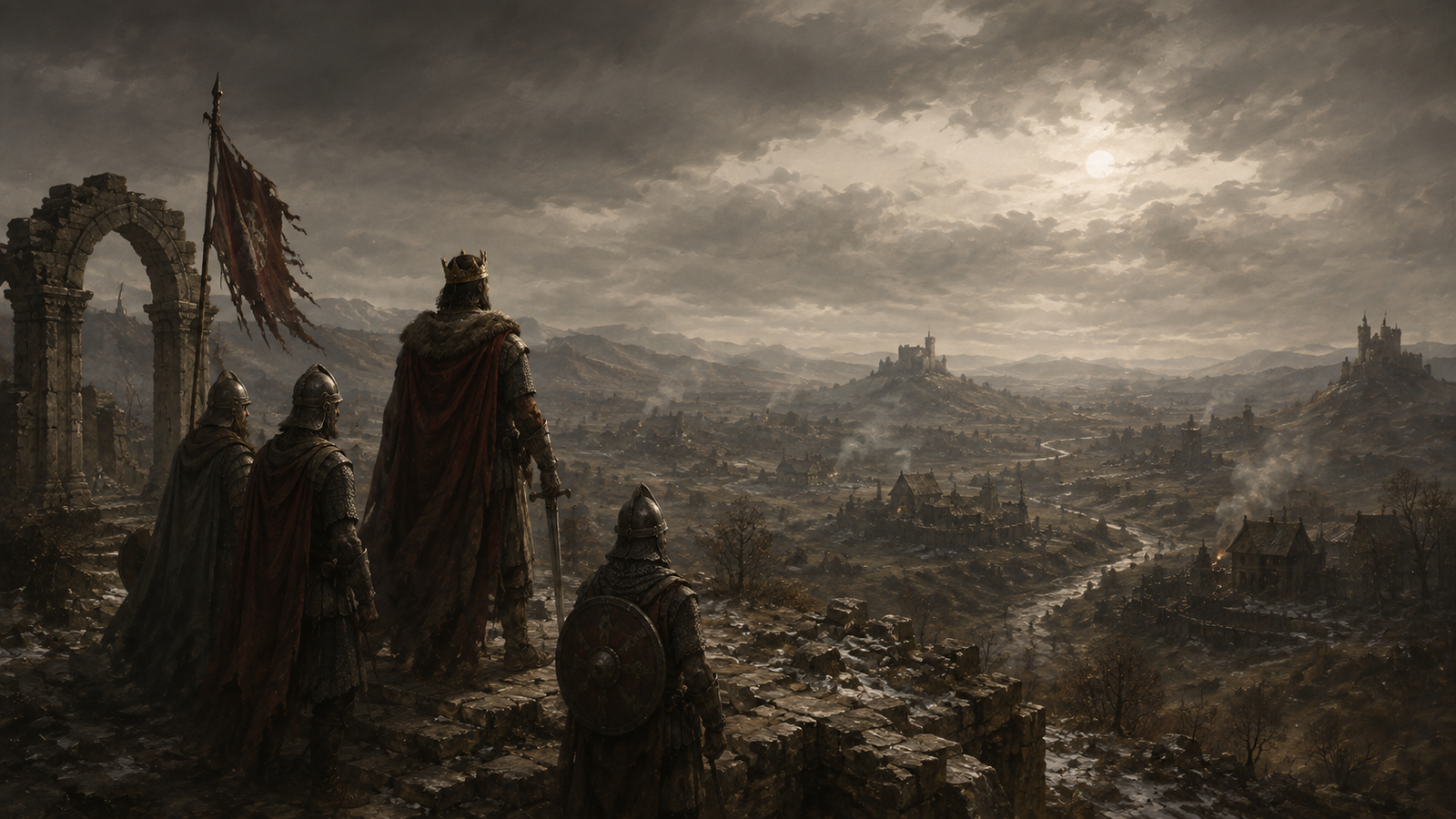
493–553 CE — Ostrogothic Italy and the Wars of Restoration
Theodoric establishes an Ostrogothic kingdom in Italy that preserves significant Roman administration while maintaining a Gothic military elite. Justinian later attempts to restore direct eastern imperial government across North Africa, Italy and part of Iberia.
The reconquests regain territory but devastate farms, towns and tax systems. Restoration proves capable of destroying the very provinces it claims to save.
c. 500–515 CE — Mons Badonicus
Arthur’s coalition defeats a major West Saxon advance at Mons Badonicus, preserving several Brittonic kingdoms and providing the political space in which Camelot’s wider authority develops.
Merlin acts as seer, counsellor and dangerous guardian of ancient pacts. Gawain embodies an older sovereignty tradition within the developing Round Table.
c. 500–700 CE — Nobadia, Makuria and Alodia Guard the Middle Nile
Nubian successor kingdoms consolidate between Kemet and the upper Nile. Their rulers command cataracts, agricultural lands, caravan roads and fortified river settlements while negotiating with Eastern Rome, Aksum, desert peoples and Arabian governments.
Kushite inheritance, Nile powers, royal ancestors and locally rooted cults remain important foundations of authority.
529–534 CE — Justinian’s Legal Codification
Justinian’s government gathers and systematises centuries of Roman legal material. The resulting collections survive far beyond the territories the emperor can effectively control and become authoritative sources for later courts.
A preserved judgement gains power through continued recognition, but preservation does not make every inherited law just.
536–660 CE — The Dimmed Summers
A sequence of major volcanic events beginning in 536 darkens skies and contributes to prolonged cooling across substantial portions of the Northern Hemisphere. Harvest failures, livestock losses and disruption to exchange intensify existing political pressures. Further eruptions prolong the crisis.
Communities respond with migration, emergency grain controls, changed planting, charity, raiding, hoarding and sacrifice. The effects vary sharply by place and year.
537 CE — Camlann and the Passing of Camelot
Arthur and Medraut fall at Camlann after treason, factional war and the collapse of trust within the Round Table. Arthur is carried to Avalon rather than conclusively dying.
Camelot’s central court withdraws from ordinary geography and becomes reachable only through unstable crossings into the Fey World.
541–542 CE — The First Great Plague Pandemic
Plague reaches Constantinople and moves through Mediterranean, Near Eastern and connected regions in repeated waves. Death damages labour, recruitment, burial, taxation and food distribution. In some places the people responsible for canals, granaries, wards and ancestral rites disappear faster than institutions can replace them.
The disease is natural and transmissible. Supernatural consequences arise when mass death, abandoned ritual and deliberate exploitation tear local boundaries.
c. 500–900 CE — Madagascar and the East African Sea Roads
Austronesian-speaking voyagers, African communities and Indian Ocean traders contribute to Madagascar’s settlement and developing exchange networks. Crops, cattle, language and boat traditions preserve links both westward into Africa and eastward across the ocean.
East African coastal communities connect inland resources with sea trade while retaining local authority over islands, harbours and river mouths.
c. 550 CE — Silk Cultivation Reaches the Eastern Roman Empire
Silkworm eggs and specialist knowledge reach imperial workshops, reducing dependence on imported finished silk. Production remains controlled by expertise, mulberry cultivation and court regulation. The episode illustrates that technology travels through skilled people and supporting institutions rather than through possession of a single secret object.
c. 550–750 CE — Harsha, Pallava and Chalukya Worlds
Following Gupta fragmentation, Harsha builds a strong but temporary northern realm. Pallava rulers develop powerful southeastern centres while Chalukya dynasties dominate much of the western Deccan. Their competition shapes roads, ports, temple patronage and the movement of soldiers, scholars and artisans.
Buddhist, Jain, Shaiva, Vaishnava and local institutions maintain estates, schools, hospitals and pilgrimage networks without representing all of India.
Sixth Century — The Age of Beowulf
Beowulf of the Geats travels to the Danish court and kills Grendel, whose attacks have made Heorot unusable. Grendel’s mother seeks vengeance and is defeated in her lake hall. Many years later Beowulf dies as a king while fighting a dragon awakened by disturbance of its hoard.
The Midgard Bestiary preserves the wider creature traditions associated with the northern courts, forests, wilderness and sea roads of this era.
552–744 CE — The Turkic Khaganates Command the Inner Roads
Göktürk rulers establish enormous steppe empires across Inner Asia. The First Turkic Khaganate divides into eastern and western spheres commanding pasture, tribute and important stretches of the overland routes linking China, Iran, India and the western steppe.
Sogdian merchants and scribes become essential intermediaries. Turkic rulers negotiate with Tang China, Persia, Roman courts and oasis states while preserving sky, ancestor and territorial rites.
568 CE Onward — Lombard Kingdoms in Italy
Lombard groups establish duchies and kingdoms through much of Italy after the imperial restoration wars have weakened local defence. Eastern Roman enclaves, independent rulers, Roman cities and rural communities create a fragmented political landscape in which law changes according to place, ancestry, status and lordship.
589–618 CE — Sui Reunification and the Road to Tang
The Sui reunify China after centuries of division. Canal building and other vast public works strengthen taxation and transport while imposing immense labour burdens. Military failure and compulsory service undermine the dynasty, leaving Tang rulers both a reunited imperial framework and the resentments created by its construction.
c. 500–1000 CE — Wari and Tiwanaku Reshape the Andes
Wari and Tiwanaku develop powerful but different systems in the central and southern Andes. Wari authority spreads through roads, planned centres and regional relationships; Tiwanaku flourishes around Lake Titicaca through monumental construction, raised-field agriculture, pilgrimage and exchange.
Local farming communities, caravan peoples and regional lords remain active participants rather than becoming subjects of a modern territorial state.
602–628 CE — The Final Roman–Sasanian War
Eastern Rome and Sasanian Persia wage a devastating war across Anatolia, the Levant, Kemet, Mesopotamia and the Caucasus. Cities change hands, sacred objects are captured, populations are displaced and tax systems collapse.
Heraclius eventually recovers Roman territory, but both empires emerge badly exhausted. Sacred objects taken during the fighting can strengthen ritual and legitimacy, but they cannot compensate indefinitely for military and administrative failure.
Seven Wells and the Khaganates
A new Arabian legal order rises from sanctuary agreements rather than religious uniformity. Across Inner Asia, steppe empires command the great roads. Tang China, Tibet, Srivijaya, Maya courts and regional Southeast Asian states deepen the age’s intercontinental connections.
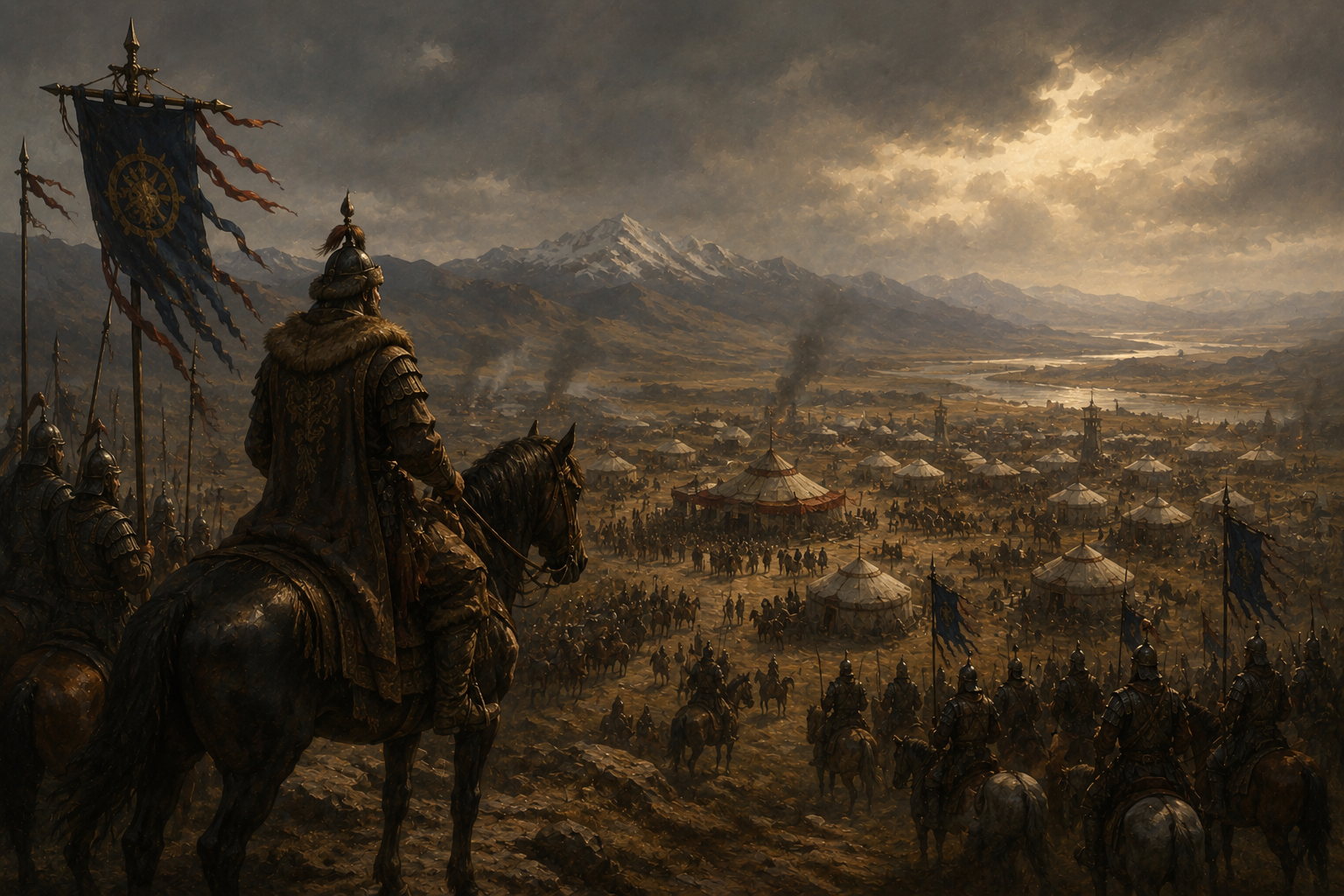
603–632 CE — The Seven Wells Compact
Arabian sanctuary cities, caravan houses, oasis assemblies and jinn-bound territories seek to restrain cycles of feud that have made pilgrimage and long-distance exchange increasingly dangerous.
Delegations meet through seven successive seasons at protected wells associated with Shams, al-Lat, al-Uzza, Manat, Hubal, ancestral judges and the Unbound Wind. Human law-speakers and recognised jinn witnesses establish the Seven Wells Compact.
The Compact protects routes and designated months, grants immunity to envoys, standardises important weights, establishes shared blood-price procedures, regulates the return of captives and forbids the poisoning of wells. Signatories keep their own gods and household laws while accepting rotating sanctuary courts for disputes crossing communal boundaries.
Three Political Traditions
- The Open Sanctuary defends the independence of participating cities and cults.
- The Banner Houses argue that the peace requires a unified military command capable of defending and expanding it.
- The Keepers of Measure seek common contracts, taxation procedures and administrative standards.
618–842 CE — The Tibetan Empire Commands the High Routes
Tibetan rulers build an empire across the plateau and contest Central Asian corridors with Tang China, oasis states and steppe powers. Mounted armies, fortified valleys, tribute and command of high passes sustain expansion.
The court adopts foreign writing and learning without abandoning mountain gods, royal ancestors and local territorial rites.
629–645 CE — Xuanzang’s Western Journey
Xuanzang travels from Tang China through Central Asia to India in search of manuscripts, teaching and learned authorities. His route crosses Chinese jurisdictions, Turkic domains, oasis kingdoms and Indian states.
His return strengthens the movement of texts, languages, artistic forms and geographical knowledge across Asia.
632–700 CE — The Banner Conquests and the Persian Settlement
After the Roman–Sasanian exhaustion, Banner House armies and allied peoples expand through Syria, Mesopotamia, Kemet, Iran and neighbouring regions. Cavalry, weakened opponents, negotiated surrender and promises of local legal survival allow rapid conquest.
Some commanders honour existing agreements; others seize land and sacred wealth, producing resistance lasting generations. Sasanian monarchy ends, but Persian scribes, nobles, farmers, cavalry houses, literature and court practice profoundly reshape the new imperial system.
The resulting order becomes a contested combination of sanctuary law, dynastic military command, provincial custom and inherited imperial administration.
618–907 CE — Tang China
Tang China becomes one of the age’s greatest imperial systems. Chang’an gathers officials, merchants, envoys, scholars, artisans and travellers from across East and Central Asia. Law, taxation, military colonies and an expanding administrative culture sustain the dynasty.
Korea, Japan, Tibet, Southeast Asian states, steppe confederacies and oasis kingdoms adopt selected Tang practices without becoming culturally identical or permanently subordinate.
c. 600–900 CE — Classic Maya Kingdoms Flourish
Maya rulers record marriages, dynastic successions, captives, wars, rites and calendrical events in inscriptions and monuments. Tikal and Calakmul lead competing networks, but no single capital rules the entire Maya world.
Political authority depends upon agriculture, water, tribute, warfare and continuing relationships with gods and ancestors. The weakening of some southern lowland courts is gradual and regional, not the disappearance of Maya peoples.
c. 600–800 CE — Chenla, Champa and the Maritime Southeast
Mainland and maritime Southeast Asian states expand through rivers, ports, temple foundations and alliances among local rulers. Chenla succeeds earlier Funan-linked systems in parts of the Mekong region, while Champa develops along the central Vietnamese coast and maritime communities command the straits farther south.
Indian religious and artistic influences are translated into local languages, ancestral practices and spirit landscapes rather than copied unchanged.
668 CE — Silla Unifies Most of the Korean Peninsula
Silla defeats Baekje and Goguryeo with Tang assistance and then resists direct Tang control. Balhae later rises in the north from former Goguryeo and neighbouring peoples.
Korean courts retain distinct languages, aristocratic systems, ancestral traditions and sacred mountains despite sustained exchange with China and Japan.
c. 670–1025 CE — Srivijaya and the Straits
Srivijaya becomes a major maritime power centred on Sumatra and the strategic sea passages of island Southeast Asia. Ports, ships, tribute, diplomacy and the ability to protect or obstruct maritime traffic sustain its influence.
c. 650–970 CE — Khazar, Bulgar and Avar Frontier States
Khazar, Bulgar, Avar and neighbouring powers control shifting zones between the Black Sea, Caspian, Danube and forest worlds. Their wealth comes from livestock, tribute, trade, military service and command of river or steppe crossings.
Foreign court traditions may be adopted for diplomatic reasons while local sky, hearth, ancestor and river powers continue to operate.
c. 700–900 CE — Paper and Woodblock Printing Multiply Records
Paper production travels through East and Central Asian networks and into western imperial worlds. Woodblock printing allows calendars, charms, administrative forms, images and books to circulate in far greater numbers.
The same technologies that strengthen government and sacred institutions also accelerate forged decrees, unauthorised teaching and political prophecy.
711 CE — The Western Banner Crosses into Iberia
A force composed largely of Berber troops under Arabian commanders crosses from North Africa and defeats the Visigothic monarchy. New provincial governments, treaties, refugee movements and fortified northern resistance develop from the conquest.
Roman civic practice, Iberian sacred landscapes, Berber ancestors, household gods and Seven Wells law persist beneath changing political rulers. Conflict concerns land, tax, dynasty, sanctuary and control of cities as much as sacred allegiance.
732 CE — Frankish Forces Check the Loire Expedition
Frankish forces under Charles Martel defeat a western Banner expedition operating beyond secure Iberian bases. The battle strengthens Frankish authority but neither removes the western Arabian dynasties from Iberia nor ends Mediterranean exchange.
Merchants, mercenaries, scholars, captives and diplomats continue crossing the political divide.
744–840 CE — The Uyghur Khaganate
The Uyghurs replace the Second Turkic Khaganate across much of Mongolia and the eastern steppe. Their power combines cavalry, cities, tribute, diplomacy and strong relationships with Sogdian commercial networks.
Uyghur troops assist Tang rulers during the An Lushan crisis and gain substantial wealth and leverage in return.
Fortified Kingdoms and the Northern Seas
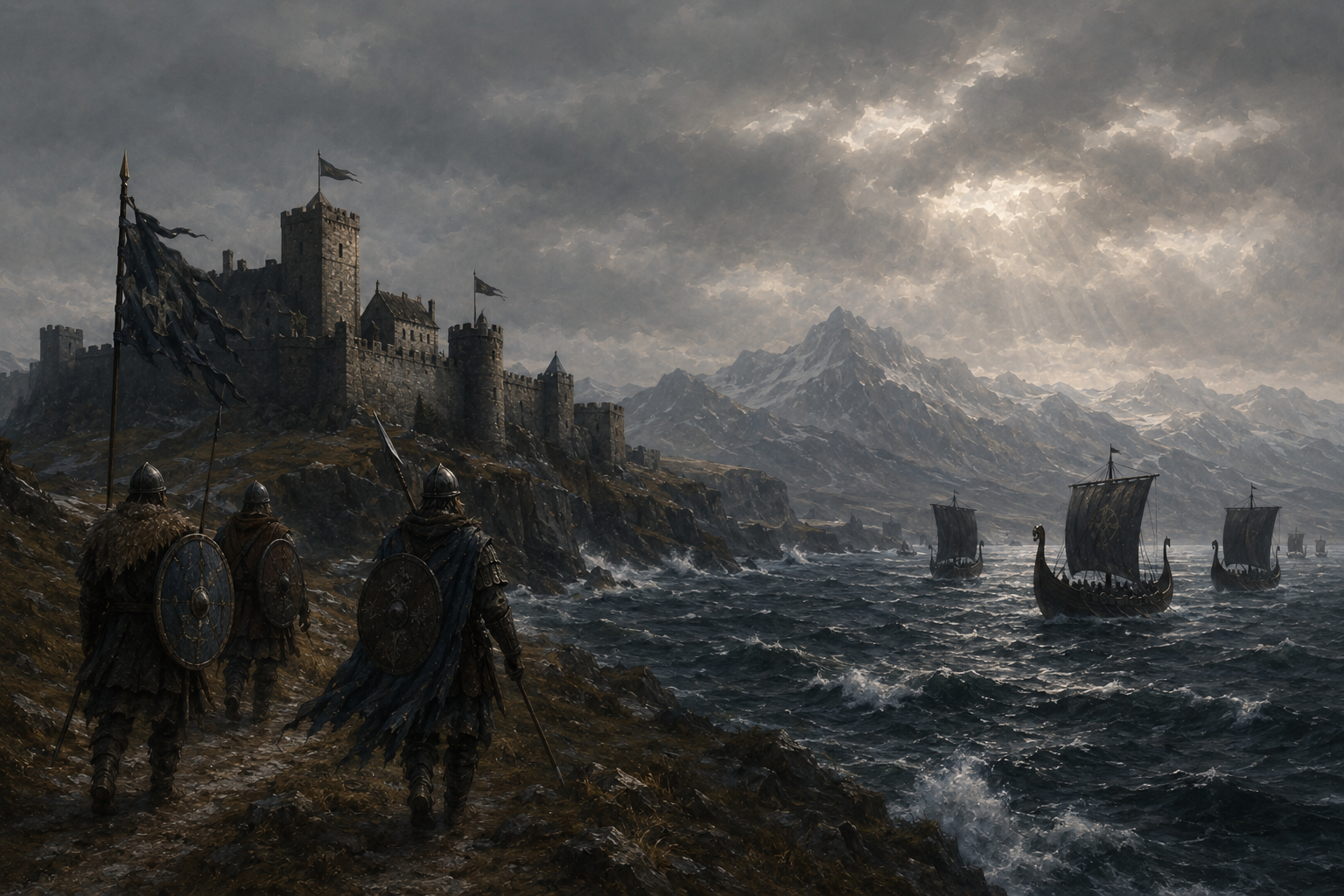
Imperial capitals remain important, but power increasingly belongs to regional armies, fortified courts, sea-roads and inherited military households. Norse expansion transforms the North Atlantic while Frankish, Arabian, African and Asian states redefine dominion through new combinations of law, trade and fortification.
750 CE — The Abbasid Revolution Re-centres the Compact
The Abbasid house removes the Umayyad ruling dynasty with powerful support from eastern provinces, Persian networks and factions opposed to hereditary Banner dominance.
The new court claims to restore equilibrium among the traditions of the Seven Wells Compact but develops an increasingly sophisticated imperial bureaucracy reliant on Persian administrators, scholars, merchants and military households.
Baghdad becomes a major centre of government, translation, craft and exchange. Its courts attempt to reconcile Compact law, provincial sacred jurisdiction and royal decree without ever eliminating tension among them.
756 CE — The Umayyad Banner Survives in Córdoba
An Umayyad prince establishes an independent dynasty in Iberia. Córdoba grows into a wealthy urban and courtly centre tied to North Africa, the Mediterranean and wider scholarly networks.
The western Umayyads present themselves as guardians of the older Banner tradition while retaining elements of Roman administration, Berber military settlement and negotiated sanctuary privileges.
755–763 CE — The An Lushan Rebellion Breaks Tang Confidence
An Lushan’s rebellion captures major capitals and forces the Tang court into flight. The dynasty survives through provincial forces, allied cavalry and costly concessions, but military governors acquire power the central court cannot easily reclaim.
Foreign troops and frontier peoples fight for several factions; ancestry alone never determines allegiance.
c. 750–1200 CE — Pala, Pratihara and Rashtrakuta Worlds
Northern and central India remain divided among major regional powers. Pala rulers support eastern centres of learning; Gurjara-Pratihara kings compete for northern and western routes; Rashtrakuta dynasties dominate much of the Deccan while contesting both northern and southern rivals.
Temple estates, universities, village assemblies, guilds and warrior households exercise power beside royal courts.
768–814 CE — Charlemagne’s Dominion
Charlemagne expands Frankish rule across large areas of western and central Europe. His armies conquer Lombard lands, fight Saxon resistance and intervene on Iberian and Danubian frontiers.
Royal estates, assemblies, counts, written capitularies and sacred institutions extend government beyond the king’s immediate household.
793 CE Onward — The Norse Raiding Age
Northern fleets attack wealthy coastal estates, ports, sacred houses and undefended settlements. Raiding is only one part of Scandinavian expansion: Norse communities also trade, migrate, explore, settle, enter foreign service and create states.
The Asgardian pantheon shapes oath, kingship, feud, seafaring and battle, but cult practice differs from region to region. Odin, Thor and other powers do not impose one common political programme upon all northern rulers.
Slavery is a major part of raiding and long-distance commerce. Captives remain persons under the laws of their home communities even when raiders treat them as property.
794 CE — The Heian Court Is Established
The Japanese imperial court establishes its capital at Heian-kyō. Court families, provincial governors, shrine networks and landed estates compete and cooperate within a layered political system.
Chinese writing, administration and philosophy influence elite life, while Japanese poetry, language and aesthetics develop distinct forms.
Early Ninth Century — Gunpowder Is Discovered in China
Alchemical experiments using saltpetre, sulphur and combustible materials produce early gunpowder. The first applications include signals, fire effects, incendiaries and dangerous laboratory work.
The discovery does not immediately produce cannon armies. Ingredient purity, containers, recipes and delivery systems require centuries of improvement.
c. 800–950 CE — Angkor and the Khmer Imperial System
Khmer rulers establish capitals around Angkor and link temples, reservoirs, canals, rice production, roads, urban settlement and royal ritual into an immense regional system.
Indian-derived gods coexist with local spirits and ancestors. Angkor is neither merely a hydraulic machine nor merely a ceremonial centre: water, labour, sacred geography and political authority are inseparable.
843 CE — The Frankish Empire Is Divided
The Treaty of Verdun divides Charlemagne’s inheritance among his grandsons. Rival kingdoms preserve Frankish and Roman claims while counts, sacred colleges, temple estates and military households gain greater independence.
c. 849–1200 CE — Pagan and the Irrawaddy Sacred Plain
Pagan grows beside the Irrawaddy into the centre of an expanding kingdom. By the eleventh century royal patronage, irrigation, taxation and temple foundations more tightly connect surrounding regions with the capital.
Pyu inheritance, Mon influence, imported learning and local spirit traditions coexist rather than replacing one another.
865–886 CE — The Great Army and the Danelaw
A large Scandinavian army campaigns through England and conquers several kingdoms. Alfred of Wessex survives, reorganises defence and ultimately negotiates a recognised boundary with Danish rulers.
The Danelaw contains English, Brittonic, Scandinavian and other populations living beneath varying combinations of local and Danish law. It is not empty territory occupied by one foreign people.
882 CE — Kiev Becomes a Rus Centre
Oleg takes Kiev and joins northern and southern river routes into a growing political and commercial network. Norse, Slavic, Finnic, Baltic and steppe communities participate through tribute, trade, warfare and settlement.
The Rus system is not yet a single uniform nation. River towns and subject peoples preserve different laws, gods and political identities.
c. 895–955 CE — Magyar Settlement and Western Raids
Magyar confederations enter the Carpathian Basin and establish a durable base. Mounted war bands raid widely through central and western Europe before military defeats and changing priorities encourage more settled political structures.
The confederation contains several clans, allies and subject peoples joined by steppe sky, ancestor and territorial traditions.
c. 900 CE — Tang Authority Collapses
Rebellion, regional military power, fiscal pressure and court conflict end the Tang dynasty. China enters a period of competing states, yet Tang law, administration, literature and international connections survive the rulers who created them.
c. 900–1150 CE — Ghana, Kanem and the Sahelian Kingdoms
West African states grow through gold, salt, agriculture, tribute and caravan exchange. Ghana refers to a historical kingdom rather than the boundaries of the modern country. Kanem develops around Lake Chad through interactions among pastoral, agricultural and trading communities.
Desert merchants, oasis settlements and Sahelian courts depend upon one another without sharing one sacred system. African gods, ancestors, royal ritual and territorial powers remain foundations of local authority even where foreign merchants and jurists gain influence.
c. 900–1200 CE — Toltec, Maya and North American Transformations
Tula becomes a major centre in central Mexico while Maya successor cities continue after the weakening of many southern lowland courts. Later traditions remember Ce Acatl Topiltzin Quetzalcoatl as ruler, priest and exile within Tula’s sacred order.
Mississippian societies develop major mound centres; Cahokia grows rapidly after about 1050. Chaco Canyon connects great houses, roads, ritual landscapes and exchange across the ancestral Pueblo world. These are separate regional developments rather than components of one American civilisation.
909–1171 CE — The Fatimid House and the Western Wells
The Fatimid house rises in North Africa and later takes Kemet, establishing Cairo as an imperial capital.
In SpiralWorlds history the dynasty traces its name to Fatima of the Western Well, an ancestral law-speaker whose descendants claim a privileged interpretation of the Seven Wells Compact. Fatimid rulers challenge Abbasid authority while controlling important Mediterranean and Red Sea routes.
911 CE — Normandy Is Founded
Rollo receives territory from the Frankish king in exchange for defence and recognised loyalty. Norse settlers, neighbouring Breton communities and local Frankish populations gradually create a new Norman identity.
The settlement demonstrates how raiders can become hereditary rulers while preserving relationships beyond their new lands.
916–1125 CE — Liao, Western Xia and the Northern Frontier
The Khitan-led Liao state commands broad northern territories and forces Song China to negotiate tribute, military limits and borders. Western Xia later controls strategic corridors between China, Tibet and Central Asia.
Both combine mobile military traditions with cities, agriculture, writing and administration.
918 CE — Goryeo Is Founded
Wang Geon establishes Goryeo amid the fragmentation of Later Silla. The new kingdom works to unify the peninsula while incorporating regional elites and managing northern relations. Korean traditions remain distinct even where Chinese technologies and ceremonial forms are adopted.
930 CE — The Alþingi Is Established
Icelandic chieftains establish a national assembly at Þingvellir. Law-speaking, judgement, alliance and feud settlement operate without a king, palace bureaucracy or standing royal army.
Protection is not equal: enslaved people, outlaws and those without powerful kin possess fewer practical remedies than recognised householders.
The Connected Dominion
By the eleventh century archives, caravans, ships, diplomatic courts and fortified roads bind distant regions more tightly than ever. Song China, Chola fleets, Seljuk cavalry, Norse Atlantic voyagers and restored western imperial authority all operate inside a world where knowledge and political consequences travel far beyond local frontiers.

955–962 CE — Otto I and the Restored Western Empire
Otto I defeats a major Magyar force at Lechfeld in 955, strengthening his position among the German duchies. He then intervenes in Italy, takes the Lombard crown and receives the western imperial title in Rome in 962.
The restored imperial system joins the German kingdom and northern Italy beneath a disputed Roman claim. It becomes the restored western Empire of later centuries without ever creating uniform control over every prince, city, sacred college or Italian territory.
c. 960–970 CE — Gudit’s War in the Aksumite Highlands
Later Ethiopian highland traditions remember a destructive queen under names including Gudit and Yodit. Her campaigns break royal centres, destroy sacred estates and accelerate the decline of older Aksumite authority.
960 CE Onward — Song China
The Song reunify much of China and develop strong civil administration, cities, markets, printing, engineering and scholarship. Powerful northern rivals—including Liao, Western Xia and eventually Jin—force the court to combine diplomacy, tribute and war.
Economic and administrative sophistication does not guarantee military invulnerability.
977–1010 CE — Ferdowsi Preserves the Iranian Heroic Kings
Ferdowsi composes the Shahnameh from older written and oral traditions concerning Iranian kings, heroes and monsters. Zal, Rostam, Sohrab, Siyavash, Zahhak and many others gain an enduring literary centre in New Persian.
c. 985–1070 CE — Chola Maritime Power
Chola rulers expand across southern India and project naval power into Sri Lanka and Southeast Asian trade networks. Temples operate as major centres of employment, landholding, craft and record, while local administration and maritime connections support royal armies.
c. 1000 CE — Norse Voyages Reach North America
Voyagers from Greenland travel west across the Atlantic and enter territories whose Indigenous peoples already possess their own law, political relationships and environmental knowledge.
1021 CE — L’Anse aux Meadows Is Active
A Norse site operates at L’Anse aux Meadows in Newfoundland, supporting repair, exploration and resource gathering. It never develops into a permanent conquering colony.
Distance, supply, Indigenous resistance and competing Scandinavian priorities prevent an Atlantic dominion from forming.
Eleventh Century — Government Paper Money Develops in Song China
Commercial notes and state-backed paper currency expand within a highly monetised economy. Paper money depends upon taxation, redemption and public confidence rather than creating wealth by itself.
Counterfeiting, inflation and state abuse emerge as new dangers alongside the advantages of lighter long-distance payment.
c. 1000–1200 CE — Polynesian Voyages Reach Distant Islands
Polynesian navigators continue maintaining and extending routes across immense distances. Stars, swells, winds, birds, clouds, memory and inherited teaching guide independent voyaging communities.
The Polynesian gods, ancestors and sea powers enter renewed relationships with each community as voyagers establish new settlements and move through unfamiliar waters.
1037–1092 CE — The Great Seljuk Ascendancy
Seljuk rulers build an extensive imperial system through Iran, Iraq and neighbouring regions. Turkic cavalry households, Persian administrators, Seven Wells jurists, urban elites and regional sacred institutions cooperate while competing for influence.
The Seljuks enter Baghdad as protectors and masters of the Abbasid court and expand toward Anatolia and Central Asia.
c. 1040 CE — Bi Sheng Develops Movable Type
Bi Sheng develops movable ceramic type under the Northern Song. The system is technically important without replacing efficient woodblock printing.
Eleventh–Twelfth Centuries — The Compass Enters Maritime Navigation
Chinese knowledge of magnetism develops into increasingly practical directional instruments. Mariners combine compasses with stars, winds, currents, soundings, coastal knowledge and written sailing directions.
The compass extends established navigational skill; it does not replace experienced pilots, nor does it appear across every maritime culture at once.
1066 CE — The Norman Conquest of England
William of Normandy defeats Harold at Hastings and establishes a new ruling dynasty. The conquest redistributes land, castles, offices and military obligations.
Earlier English administration and law survive but are increasingly controlled by a foreign-speaking aristocracy ruling English, Danish and Brittonic communities.
The Fortified World Before the Severed Crowns
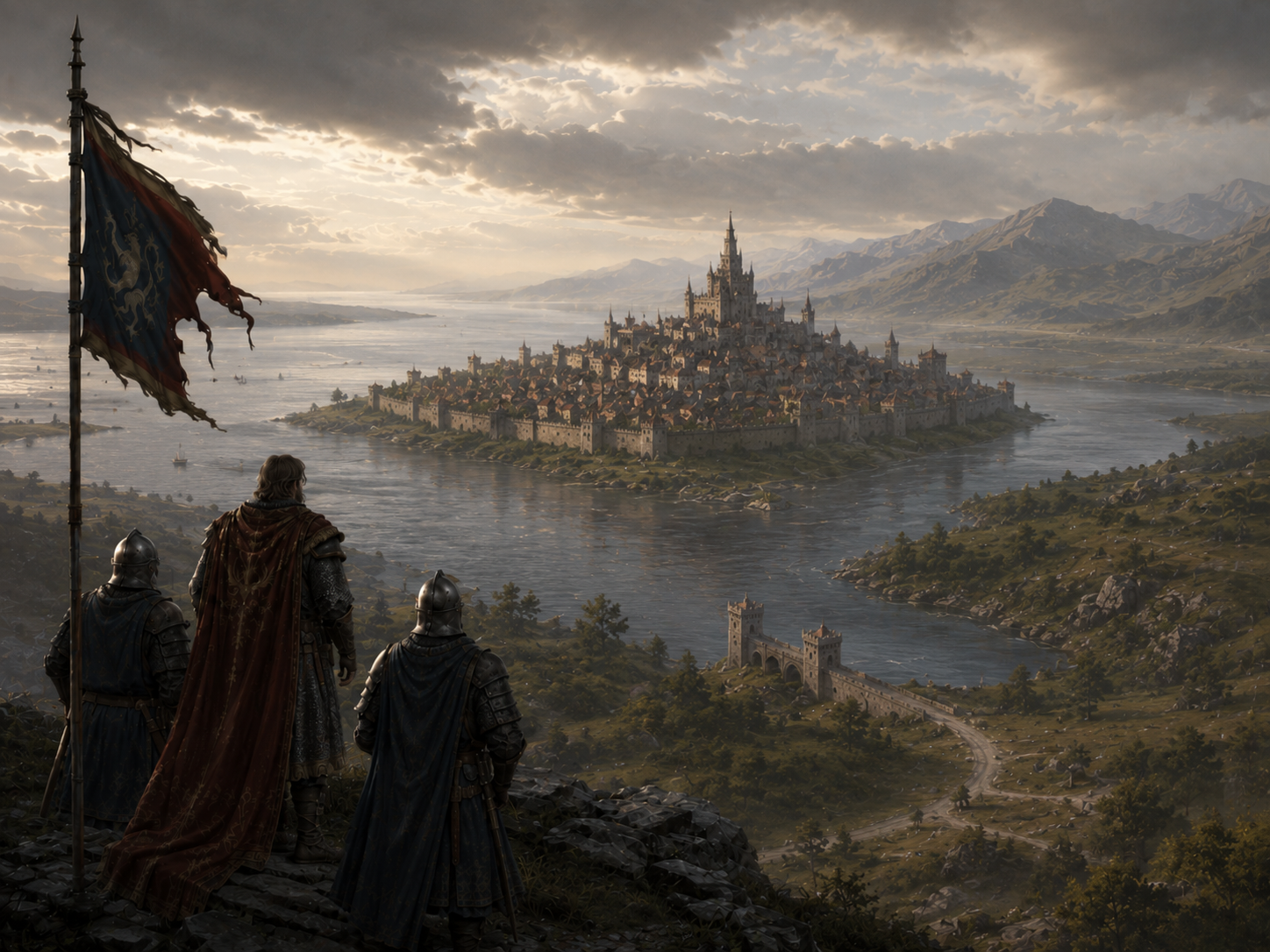
The final movement hardens the world into defended jurisdictions. Castles, legal surveys, frontier principalities, shrine estates, military households and rival dynasties multiply. By 1200 the political map is dense with powers whose impressive defences conceal growing structural weakness.
1071–1200 CE — The Eastern March Wars
Following the Roman defeat at Manzikert, Turkic powers spread through much of Anatolia. Eastern emperors employ mercenaries and seek military assistance from western rulers. Frankish, Norman and other armed hosts enter Anatolia and the Levant in pursuit of territory, wealth, relics and control of sacred routes.
Imperial interventions, armed pilgrimages, dynastic conquests and disputes over Roman, Hellenic, Anatolian, Arabian and local sanctuaries create frontier principalities and military orders.
1075–1122 CE — The Investiture Struggle
Imperial rulers and the Roman College of Custodians contest control of high custodianships, temple rectorates and other sacred offices holding land, courts and political influence.
Imperial rulers argue that officials exercising temporal power must answer to the crown. Sacred colleges argue that royal appointment converts divine trusts into political rewards. Princes and cities exploit the conflict for their own advantage.
The settlement at Worms in 1122 separates aspects of sacred installation from the grant of temporal authority without resolving the deeper contest.
1086 CE — The Great Survey
The Norman crown records landholders, resources, taxable value and obligations in the survey later known as Domesday Book. Administrative knowledge strengthens the monarchy and preserves conquest inside an official archive.
c. 1100 CE Onward — Great Zimbabwe Grows
Stone architecture, cattle wealth, specialist craft and long-distance exchange support the growth of Great Zimbabwe. Inland rulers connect regional resources with Indian Ocean trade through African-controlled networks.
1127 CE — Northern Song Falls
Jin armies capture Kaifeng and drive the Song court south. Southern Song China remains wealthy, urban and administratively sophisticated while losing large northern territories.
The new strategic position encourages stronger naval forces, frontier fortification and increasingly complex diplomacy.
1185–1192 CE — Warrior Government Emerges in Japan
The Genpei War ends Taira dominance and brings Minamoto military leadership to power. The Kamakura shogunate establishes a durable warrior government while the imperial court and shrine systems remain significant.
Japan now contains overlapping court, military, estate and sacred jurisdictions.
c. 1150–1200 CE — Dominion Reaches Exhaustion
Fortified kingdoms, cavalry confederacies, maritime states, temple powers and armed households press against one another across Eurasia. Liao inheritances, Western Xia, Jin, Song, Cuman and Kipchak confederacies, Rus states, Khwarazmian powers, Frankish realms, Roman provinces, Seljuk territories, Chola domains and many others inhabit a dense world of raid, tribute, diplomacy and dynastic competition.
Castles, walls and defended passes multiply. Archives become deeper and more authoritative. Land, tax and service obligations are more precisely recorded. Warrior elites become increasingly hereditary in many regions.
The system appears formidable, but much of its strength depends upon enemies moving at familiar speeds, fortifications remaining decisive and tribute or sacred legitimacy continuing to function. Those assumptions will not survive the next age.
The World at 1200 CE
The Mediterranean and West Asia
The Eastern Roman Empire survives but has lost much of Anatolia. Persian court culture continues within successor powers. The Seven Wells imperial system is divided among rival dynasties, provincial rulers and frontier states.
Europe and the North Atlantic
Frankish successor kingdoms, Norman principalities, English and Scandinavian monarchies, Rus states, assemblies and armed lordships occupy a landscape of fortified towns, castles and disputed Roman inheritance. Arthurian and older Celtic claims remain active beneath later borders.
Africa
Nubian kingdoms still defend the Middle Nile. Sahelian powers command gold, salt and caravan networks. East African ports connect inland regions with the Indian Ocean. Great Zimbabwe is emerging as a major southern political and trading centre.
South and Central Asia
Regional Indian kingdoms, temple estates, guilds and warrior houses rule different territories. Central Asian roads are contested by settled states, cavalry powers and oasis cities. No single ruler controls the whole exchange network.
East Asia
Southern Song wealth faces Jin power to the north, while Western Xia and the inheritance of Liao remain important. Goryeo governs Korea. Japan’s warrior administration operates beside the imperial court and Shinto sacred order.
Southeast Asia
Angkor, Pagan, Champa and maritime states command river plains, temples, ports and straits. Waterworks, harbour compacts and local sacred obligations remain essential to political authority.
The Americas
Maya successor states, Toltec inheritances, Cahokia, Chacoan networks and Andean polities occupy separate worlds. Some great centres have declined, but their peoples, roads, monuments and ritual obligations endure.
Oceania and Australia
Polynesian communities maintain far-reaching voyaging networks. Australian peoples continue governing land through kinship, fire, water and sacred custodianship beyond the state structures dominant in many other regions.
Peoples beyond One Dominion Model
Dwarves — Fortified Holds and Deep-Road Law
Dwarven societies remain politically divided. Some prosper through iron, silver, salt, stone and weapon craft; others seal themselves after giant wars, plague or human encroachment.
Deep roads frequently cross beneath mortal borders. Surface conquest does not automatically transfer rights to the underworld territory below it.
Elves — Courts of Treaty and Withdrawal
Elven courts do not undertake one collective retreat. Some negotiate protected forests and harbours, some withdraw into Britain, Scandinavia or hidden territories, and others intervene through fosterage, marriage, diplomacy or assassination.
Because rulers can live for centuries, ancient treaties may still have living witnesses.
Gnomes — Engineers, Healers and Captive Specialists
Gnome enclaves develop expertise in surveying, medicine, water engineering, alchemy, seals and portal law. Courts recruit, purchase or abduct specialists whose knowledge can make entire settlements vulnerable.
Halflings — Food, Ferry and Market Leagues
Halfling communities frequently organise river markets, ferry systems, farming villages and leagues instead of territorial kingdoms. Their grain and transport networks become strategically crucial during siege and famine.
Orcs and Hobgoblins
Orc and hobgoblin peoples remain distinct. Some form cavalry confederacies, military colonies or fortified border states while others maintain pastoral, mountain and forest communities outside large kingdoms.
Human chronicles often describe organised nonhuman powers as “hordes” while calling comparable human systems kingdoms or empires.
Goblins and Kobolds
Goblin and kobold societies occupy mines, forest margins, ruined forts and urban underworks. Some raid; others become scouts, metalworkers, toll-keepers and subject communities. Cities may rely upon kobold labour below their walls while denying kobolds legal personhood above ground.
Giants
Giant rulers survive in islands, mountain valleys and inherited titan fortresses. Some maintain enslaved populations, while others negotiate with mortal states or serve as recognised frontier powers.
Heroic giant-slaying traditions do not make every giant household the same legal or moral category.
Serpentfolk and Hidden Dynasties
Serpentfolk exploit the age’s dependence upon genealogy, archives and sacred legitimacy. Some enter courts as physicians, astrologers and genealogists; others alter bloodlines, falsify records or search beneath new capitals for prehuman sites.
Mixed Settlements
Mixed settlements remain products of particular conditions: treaty ports, mines, sanctuaries, refugee towns, royal marriages, frontier forts or supernatural crossings. Their survival requires explicit rules governing tax, burial, marriage, military service, enslavement and jurisdiction. Without enforceable law, coexistence usually becomes domination by the strongest group.
Gods, Ancestors and Sacred Dominion
Mortal rulers can close temples, confiscate estates, outlaw rites and kill custodians. They cannot make a divine realm cease to exist by issuing a decree.
Roman and Hellenic Powers
The Roman pantheon remains closely tied to oath, war, household, city protection and imperial identity. Janus gains particular significance during divisions, restorations and disputed successions.
Celtic and Arthurian Britain
The Celtic gods, Otherworld courts and sovereignty powers remain central to Arthurian Britain. Arthur’s kingship depends upon mortal government and supernatural obligation together.
The Asgardian Gods
The Asgardian pantheon influences kings, sailors, warriors, merchants and poets. Odin may support a ruler’s ambition while Thor protects households resisting that same ruler.
Iranian Sacred Law
Fire temples, priestly houses, purity laws, Ahura Mazda, yazatas, ancestral powers and hostile spirits remain active within Iranian sacred history. The end of Sasanian political rule does not invalidate locally maintained fires and contracts.
Indian Gods and Philosophical Traditions
Shaiva, Vaishnava, Shakta and other traditions maintain temples, devotion, philosophy and pilgrimage around active gods. Buddhist and Jain schools establish monasteries, hospitals, learned communities and merchant networks without making local nagas, yakshas, ancestors or gods unreal.
Chinese Ancestors, Daoist Orders and Confucian Schools
The Chinese Pantheon includes celestial powers, territorial gods and deified ancestors. Daoist orders preserve ritual, healing and alchemy; Confucian schools influence education, administration and public ethics.
Shinto Japan
Kami, ancestors, sacred landscapes and shrine law remain the public sacred foundation of Japan. Continental philosophy, writing, medicine and contemplative disciplines enter Japanese institutions without merging distinct kami or transferring the authority of sacred mountains to the capital.
African, American and Oceanic Powers
African, Mesoamerican, North American and Polynesian sacred traditions remain regionally distinct. Similar divine portfolios do not imply that different peoples are worshipping the same being under different names.
Arabian Sanctuary Powers
The Seven Wells Compact recognises many gods, ancestors, stars and jinn-bound places. Imperial rulers repeatedly attempt to standardise the law governing them, but no dynasty succeeds in forcing every oasis, lineage, city and sanctuary into one permanent hierarchy.
Law, War and Labour
Citizen, Subject and Foreigner
Law increasingly classifies people through citizenship, ancestry, lordship, tribute status and recognised household. A person may be free in one jurisdiction, a subject in another and outlawed or enslaved in a third.
Sanctuary and Surrender
Temples, sacred houses, assemblies and royal halls may provide sanctuary, but only where their protection is recognised. Foreigners and creatures labelled monsters can be denied ransom or lawful trial even when capable of negotiation.
Feud, Compensation and Outlawry
Many societies use kin responsibility, compensation and oath to restrain cycles of violence. Outlawry removes legal protection and may amount to social death; it does not make every act committed against the outlaw morally legitimate.
Land Grants and Military Service
Rulers distribute estates, tax rights and offices in return for service. Such grants repeatedly ignore tenants, communal rights, nonhuman ownership and sacred boundaries.
Slavery
Slavery remains widespread through war, debt, birth, piracy, punishment and commerce. Norse, Mediterranean, Arabian, African and Asian systems differ significantly. No people possesses a monopoly on either enslavement or resistance.
Fortification
Castles, walls, citadels, defended towns and fortified sacred estates spread. Defences protect populations while strengthening rulers who control wells, granaries and gates.
Warrior Households
Military service increasingly concentrates around mounted elites, retainers, hereditary officers and household troops in many regions. The process is neither universal nor uniform: communal militia, infantry armies, naval forces and steppe levies remain decisive.
Magic in the Wars of Dominion
Archive Magic
Charters, genealogies, tax registers and land books can acquire supernatural authority alongside administrative authority. A forged genealogy may redirect an ancestor ward or succession oath if enough recognised institutions accept it.
Fortress Wards
Stonework, measured foundations, buried offerings, guardian images and bound spirits become integrated into fortification. A ward may outlive its dynasty and continue enforcing rules its later inhabitants no longer understand.
Sacred Houses and Schools
Temple colleges, shrine estates and philosophical schools preserve medicine, books, astronomy and ritual. Such institutions can protect knowledge or monopolise it; sacred status never guarantees political neutrality.
Plague Magic
Plague produces purification rites, quarantine wards, healing magic, divination and exploitation. Effective magic may reduce supernatural consequences and aid individual patients, but no widely available rite ends the pandemic.
Relics and Royal Objects
Crowns, thrones, swords, seals, banners, stones and ancestral remains become instruments of legitimacy. Some recognise conduct, office or oath rather than bloodline, so possession alone does not necessarily confer authority.
Gunpowder and Alchemy
Early gunpowder develops from alchemical experimentation rather than replacing magic. Its effects are material and repeatable. Magical fire may enhance or destabilise it, but correct ingredients and handling remain essential.
Knowledge and Technologies of Dominion
Paper, Printing and Archives
Paper reduces the cost of administration and correspondence wherever production or import networks can support it. Woodblock printing multiplies calendars, law, ritual texts and images; movable type adds another method without immediately replacing established blocks.
Mills, Water and Agricultural Expansion
Watermills, canals, irrigation, drainage, reservoirs and regional farming technologies expand production. There is no universal medieval agricultural package: Andean terraces, Sahelian pastoral systems, Angkorian waterworks, Chinese canals and European mills answer different environments.
Cavalry, Harness and the Armed Household
Stirrups, saddles, armour, horse breeding and remount systems strengthen mounted armies where wealth, pasture and training permit them. Infantry, fleets and fortifications remain essential.
Ships, Pilots and the Compass
Changing hulls, rigging, port organisation and navigational knowledge expand maritime networks. The magnetic compass becomes one instrument among stars, currents, swell patterns, soundings and inherited route memory.
Translation and Learned Networks
Medicine, mathematics, astronomy, philosophy, law and sacred writings move among Greek, Persian, Sanskrit, Chinese, Tibetan, Arabic and many other languages. Translation preserves knowledge while also changing it; a divine title or legal category can acquire a different meaning when transferred into another sacred jurisdiction.
What Changed During the Wars of Dominion
- The western Roman imperial succession ends while Roman law and identity survive.
- Constantinople becomes the enduring centre of the Eastern Roman state.
- Sasanian Persia reaches immense power, exhausts itself in war and loses its imperial dynasty.
- The Seven Wells Compact creates the foundation of the Arabian imperial legal order.
- Gupta courts shape northern Indian culture before regional dynasties succeed them.
- Aksum becomes one of the dominant Red Sea and highland states.
- Arthur wins at Badon, builds a Brittonic coalition and falls at Camlann.
- Camelot passes into unstable Fey geography.
- Beowulf defeats Grendel, Grendel’s mother and the dragon that eventually kills him.
- The Dimmed Summers beginning in 536 intensify harvest and political crises.
- The first great plague pandemic disrupts connected Mediterranean and western Eurasian systems.
- Göktürk and Uyghur khaganates dominate major Inner Asian roads.
- Xuanzang links Chinese, Central Asian and Indian learned worlds.
- Tang China becomes a cosmopolitan imperial system before regional military power weakens the court.
- The Tibetan Empire commands strategic high routes.
- Liao and Western Xia demonstrate that frontier powers can unite cities, administration and mobile warfare.
- Paper, printing, movable type and magnetic navigation transform records and communication.
- Song China expands urbanism, commerce, learning and administrative capacity.
- Gunpowder appears without yet making artillery dominant.
- Classic Maya kingdoms preserve dynastic competition in monumental records.
- Topiltzin Quetzalcoatl’s exile becomes a defining Toltec political memory.
- Wari and Tiwanaku reshape the Andes through different political and sacred systems.
- Srivijaya controls strategic maritime passages through harbour compacts.
- Angkor joins city, temple, agriculture and monumental water management.
- Pagan transforms the Irrawaddy plain through royal and sacred foundations.
- Nobadia, Makuria and Alodia defend the Middle Nile.
- Madagascar and East African ports become embedded within a wider Indian Ocean world.
- Gudit’s wars shatter old Aksumite royal centres.
- Ghana, Kanem and other Sahelian powers expand.
- Norse raiders become traders, settlers, mercenaries, rulers and Atlantic explorers.
- Kiev becomes a major Rus political and commercial centre.
- Otto I establishes the imperial structure later known simply as the Empire.
- The Investiture Struggle defines a long contest between imperial appointment and sacred office.
- Normandy turns a Norse settlement into a hereditary principality.
- The Alþingi establishes durable national law without monarchy.
- Norse activity in North America is securely established at L’Anse aux Meadows.
- Chola rulers project naval power through southern India and the Indian Ocean.
- Cahokia, Chaco and other American centres reshape regional political landscapes.
- Great Zimbabwe begins its rise as a major inland centre.
- The Norman Conquest redistributes English land and military power.
- Warrior government emerges in Japan beside the imperial court.
- Fortifications, archives and armed households become increasingly central to political power.
- Steppe and frontier pressures prepare the crises of the following age.
What Survives from the Wars of Dominion
- Roman laws copied into kingdoms that no longer preserve the institutions which originally created them;
- Constantinopolitan wards still attached to ancient offices;
- Sasanian seals and cavalry oaths preserved by later Persian houses;
- Aksumite stelae, tombs and contested royal claims;
- Gupta mathematical and astronomical manuscripts;
- Arthurian roads that open only under old sovereignty agreements;
- Camelot’s inaccessible court and unstable roads into Avalon;
- contradictory copies of Merlin’s prophecies;
- surviving members of Grendel’s lineage and unresolved claims around Heorot;
- weather-cult charters issued during the Dimmed Summers;
- plague pits whose dead were never correctly named;
- Justinianic legal arguments resurrected in later property disputes;
- the Seven Wells Compact and its surviving sanctuary obligations;
- Ottonian land grants disputed by cities, princes and sacred colleges;
- Frankish charters granting land already claimed by elves, dwarves or local communities;
- damaged Saxon sacred landscapes from Frankish expansion;
- Norse runestones recording debts, voyages and inheritance;
- Danelaw boundaries still recognised by oath-wards and territorial spirits;
- Rus river tolls claimed in the names of dead dynasties;
- Icelandic judgements still binding outlaw families;
- Tang archives listing foreign embassies and magical gifts;
- Göktürk and Uyghur treaties whose written and sky-sworn copies contradict one another;
- Tibetan pass agreements naming dynasties that no longer exist;
- Khazar and Bulgar seasonal grazing rights ignored by later kingdoms;
- Shahnameh manuscripts containing variant heroic traditions and dormant Simurgh signs;
- Song currency, counterfeit plates and forgotten treasury wards;
- movable-type cases capable of recreating obsolete official seals;
- sealed alchemical workshops containing early gunpowder recipes;
- Maya monuments whose calendrical obligations remain active;
- Tiwanaku’s Gate of the Sun and its seasonal ancestral audience;
- Srivijayan harbour compacts divided among rival successor ports;
- Angkorian reservoirs containing bound water guardians;
- Pagan temple grants whose village obligations remain legally active;
- Cahokian mound alignments opening seasonal supernatural roads;
- Chacoan roads that do not always obey ordinary distance;
- Polynesian star paths preserved through genealogical teaching;
- unfinished Norse agreements associated with the western Atlantic voyages;
- Great Zimbabwe trade objects bearing distant contractual obligations;
- Norman surveys omitting older sacred and nonhuman claims;
- fortress guardians still defending ruins long after every mortal dynasty has disappeared.
Campaign Legacies
The Last Charter of Camelot
A recovered charter bearing Arthur’s seal grants a border forest to a community no present crown recognises. The forest’s elven court has waited centuries for a mortal authority willing to enforce it.
The Grendel Compensation
A Danish hall argues that Beowulf’s victory ended every legal claim held by Grendel’s surviving kin. An older boundary stone records compensation promised for the destruction of their lake hall.
The Plague Ward
A sealed district beneath an eastern city remains enclosed by a sixth-century quarantine ward. Opening it may uncover plague, revenants or descendants who still believe the Roman Empire governs them.
The Seventh Well
One sanctuary named by the Seven Wells Compact has disappeared from every map. Its guardian jinn claims that every later dynasty ruling the surrounding lands violated the original agreement.
The Irminsul Fragment
A surviving piece of the destroyed Saxon sacred pillar begins growing beneath a Frankish fortress. Human dynasties, gods and giant houses all claim the right to determine what it becomes.
The Danelaw Oath
An ancient boundary oath prevents an army from crossing a river. Modern kingdoms insist the Danelaw no longer exists; the land continues enforcing the agreement.
The Cataract Crown
A Nubian royal seal commands safe passage through a dangerous Nile reach. River spirits honour the seal while the present government refuses the descendants of the boat clans who once maintained the channel.
The Gate of the Sun
Tiwanaku’s ancestral crossing opens during an astronomical alignment and refuses to close until objects removed by collectors and conquerors are restored.
The Harbour without a King
A former Srivijayan port invokes an ancient harbour compact to close a strategic strait. Every surviving participant claims the right to appoint the missing Crown of the Straits.
The Tang Envoy
An imperial envoy awakens from enchanted suspension carrying credentials for a dynasty that fell centuries ago. The foreign gods who own the diplomatic gifts still expect delivery.
The Counterfeit Heaven Note
A Song printing plate can issue currency still recognised by a forgotten treasury spirit. Every new note strengthens the spirit’s legal claim over the surrounding city.
The Vinland Claim
A Norse legal record appears to grant land in North America. Indigenous guardians hold another version proving the grant was conditional, temporary and revoked after violence.
The Emperor’s Empty Ring
An Ottonian investiture ring still grants authority over a wealthy sacred estate. The imperial court, Roman custodians and the local god each recognise a different lawful successor.
The Three Treaty Copies
A Turkic border agreement survives as written text, ancestral recitation and sky-oath. Each version awards the same valley to a different people, and each possesses supernatural witnesses.
Rostam’s Missing Verse
A newly found Shahnameh fragment describes a weapon hidden by Rostam after an otherwise unknown victory. The div named in the verse insists the omission itself formed part of the peace treaty.
The Type Case of Ten Thousand Seals
An early movable-type workshop can reproduce official marks whose administrations vanished centuries ago. Each fraudulent decree strengthens an archive spirit beginning to impose obsolete law on the modern city.
The Unfinished Great Enclosure
A stone course at Great Zimbabwe was never completed because closing the design would bind a powerful territorial spirit. A later ruler wants the wall finished without accepting the obligations attached to it.
Historic and Mythic Context
The Wars of Dominion combines historical chronology, archaeology, literary traditions and binding SpiralWorlds campaign history.
Roman imperial division, the end of the western imperial succession, Justinian’s law collections, sixth-century climatic disruption, the plague pandemic, Aksum, Gupta and post-Gupta states, Turkic and Uyghur khaganates, Tang and Song China, Ottonian restoration, Fatimid and Seljuk power, Angkor, Pagan, Tiwanaku, Cahokia, Chaco, Norse expansion, L’Anse aux Meadows and Great Zimbabwe provide the historical framework.
Arthur, Beowulf, Gudit, Topiltzin Quetzalcoatl and the Iranian heroes preserved through Ferdowsi belong to the world’s binding historical or supernatural tradition. Xuanzang’s historical journey includes genuine supernatural diplomacy. Later literature can compress generations, combine rulers and reinterpret events without making the underlying people and encounters unreal.
Sacred history follows the regional pantheons, philosophical schools, shrine traditions, temple institutions, ancestor systems and the Seven Wells Compact appropriate to each part of the world. Political change therefore alters law, sacred estates and supernatural relationships without reducing every region to one universal religious institution.
Dates for events such as Teotihuacan’s decline, Maya political transformations, Polynesian settlement, early Sahelian kingdoms, Madagascar and Great Zimbabwe remain broad where the evidence does not justify false precision.
The supernatural does not replace material cause. Plague remains disease. Empires still fail through war, economics, succession, environment and human decision even when gods, spirits, monsters and magic also act within history.
Continue the Timeline
Selected Historical and Archaeological References
- The Metropolitan Museum of Art — Byzantium, c. 330–1453
- The Metropolitan Museum of Art — From Attila to Charlemagne
- The Metropolitan Museum of Art — The Vikings, 780–1100
- The Metropolitan Museum of Art — Tang Dynasty
- The Metropolitan Museum of Art — Internationalism in the Tang Dynasty
- The Metropolitan Museum of Art — Northern Song Dynasty
- The Metropolitan Museum of Art — Northern and Southern Dynasties
- The Metropolitan Museum of Art — Buddhism and Buddhist Art
- UNESCO — General History of Africa, Volume III
- UNESCO — Aksum
- UNESCO — Tiwanaku
- UNESCO — Cahokia Mounds
- UNESCO — Chaco Culture
- UNESCO — Bagan
- UNESCO — Angkor
- UNESCO — Sambor Prei Kuk
- UNESCO — Koh Ker
- UNESCO — Great Zimbabwe
- UNESCO — L’Anse aux Meadows
- British Library — Beowulf Online
- British Library — King Arthur: Fable, Fact and Fiction
- University of Oxford — The Sasanian World
- Nature Geoscience — Cooling and Societal Change during the Late Antique Little Ice Age
- History Today — Otto the Great Crowned Emperor of the Romans
- The Metropolitan Museum of Art — The Art of the Fatimid Period
- Encyclopaedia Iranica — Šāh-nāma
Keep this reference growing
If this page helped with your reading or game, you can support its upkeep or explore the curated books.
Explore the Bookshop — epics, classics and stories behind imagined worlds.