
Scotland — Crown, Clans and the Northern Seas
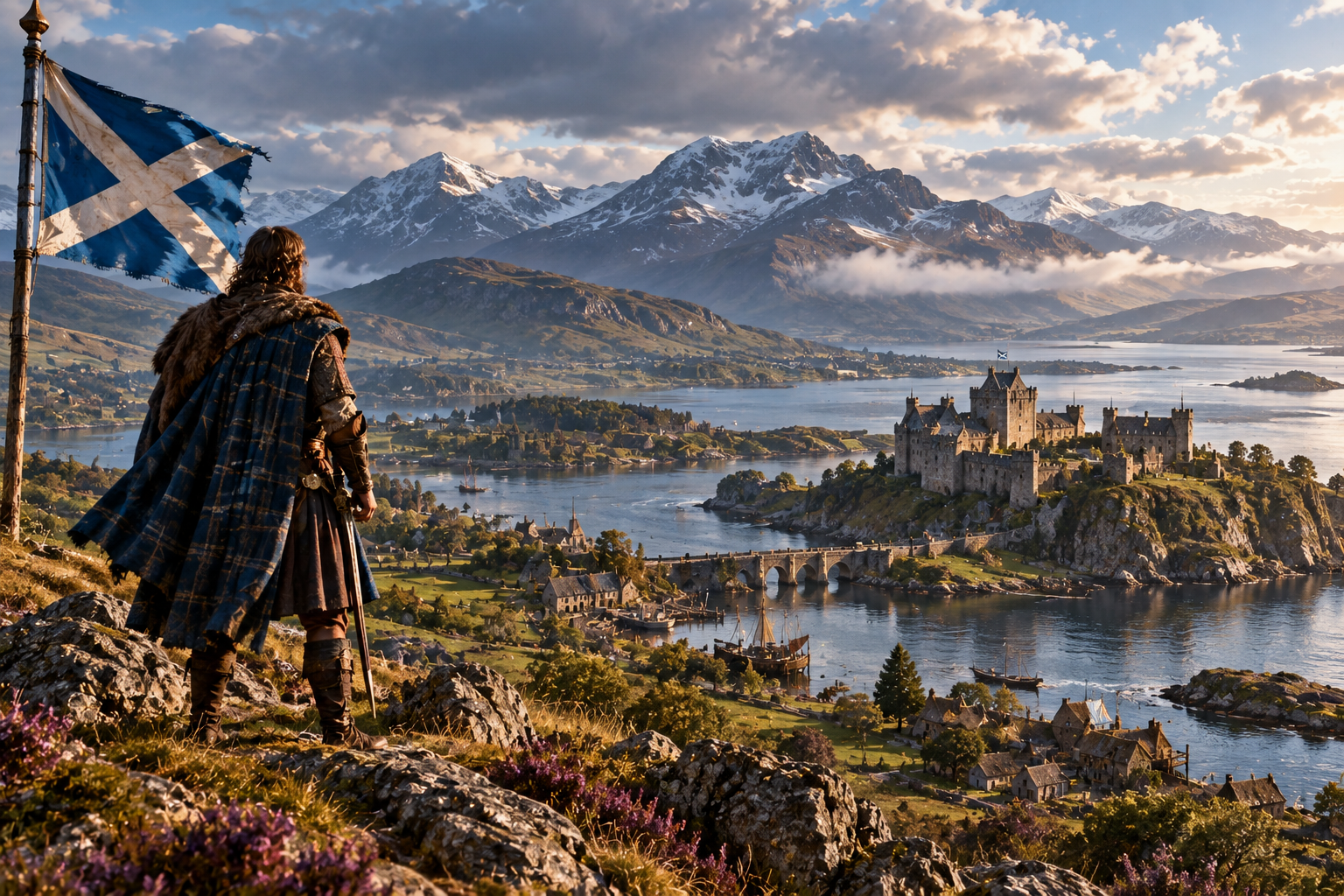
British Isles · Independent kingdom · Royal fortresses · Clan country · Atlantic sea-lanes
At a Glance
| Realm | Independent Kingdom of Scotland |
|---|---|
| Royal house | James II and Mary of Guelders |
| Principal royal centres | Edinburgh, Stirling, Linlithgow and the travelling royal court |
| Languages | Scots, Scottish Gaelic, English and courtly French; learned traditions preserve Latin as a scholarly language |
| Major powers | The Crown, Black Douglas interests, border lords, Highland kindreds and the Lordship of the Isles |
| Northern frontier | Orkney and Shetland remain under Norwegian sovereignty |
| Supernatural character | Loch spirits, dangerous fey, selkies, household beings, old stones and sea-roads into older realms |

Scotland is an independent kingdom whose royal authority is powerful but never effortless. The Crown commands castles, officers and parliament; great noble houses possess lands broad enough to challenge royal policy; Highland kindreds control mountain routes; the Lordship of the Isles looks west across its own sea kingdom; and the Borders answer every political weakness with raiding, feud and opportunity.
What Is Happening Right Now?
King James II is consolidating royal power after years in which magnates governed around a child king. His conflict with the Black Douglases has already become deadly: William, eighth Earl of Douglas, was killed at Stirling in 1452, and the surviving Douglas power remains large enough to threaten open war. Castles in Douglas country are being strengthened, alliances tested and loyalties priced.
Queen Mary of Guelders brings a strong continental connection to the court. Her marriage to James linked Scotland with Guelders and the Burgundian world, while weapons, craftsmen and court fashions move through the same North Sea routes as wool, hides, fish and diplomatic messages.
Farther west, the Lordship of the Isles is no ordinary provincial lordship. Its fleets, island strongholds and Gaelic networks give it the reach of a sea kingdom. In the south, the Borders remain a military frontier where Crown politics and local feud constantly overlap.
Run Scotland Tonight
The Douglas Messenger
A courier carrying letters between Douglas allies disappears on the road to the west. The Crown wants the letters. Douglas riders want the courier alive. A brownie in the abandoned farm where he hid will reveal the truth only to someone who observes the household’s old customs.
The Loch Horse
Two horses vanish beside a Highland loch. The third returns soaked and terrified with a human hand tangled in its bridle. Local families know the water has an owner and insist that the missing travellers were warned.
The Norwegian Ship
A vessel from Orkney reaches a Scottish harbour with sealed letters, a wounded noble and a cargo nobody is permitted to inspect. Scottish officers claim jurisdiction over the ship. Its captain answers that neither Orkney nor his cargo belongs to Scotland.
Royal Scotland
Edinburgh is the kingdom’s leading political and commercial centre, but the royal household remains mobile. Stirling controls the great route between Lowland and Highland Scotland and is inseparable from the current Douglas crisis. Royal business also moves through other castles and estates as the king travels.
The Scottish parliament is an established part of government rather than a modern invention. Great nobles, representatives of recognised sanctuaries and burgh commissioners meet with the Crown over law, taxation and the affairs of the kingdom. James II has already accepted limits on altering parliamentary acts, even while he works to reduce magnate power elsewhere.
Glasgow is growing as a western urban centre, and its new university draws scholars into a city whose river routes open toward the Clyde and Atlantic world.
Highlands, Isles and Northern Waters
The Scottish Highlands are not empty wilderness. Clans, cattle routes, hunting grounds, lochs and fortified settlements create a dense human landscape whose politics often depend on kinship and local force more than distant paperwork.
Westward, the Lordship of the Isles binds Hebridean islands and mainland territories through ships rather than roads. Sea power lets its lord move warriors, messages and tribute between places that look isolated on a land map.
Orkney is geographically tied to the northern Scottish world but politically remains a Norwegian earldom. Shetland is likewise still under Norway. Scottish merchants, nobles and sailors deal with the Northern Isles across a real international frontier.
Dungeon: The Black Douglas Underworks at Threave
Threave Castle stands on an island in the River Dee at the heart of Black Douglas power. The great tower is occupied, guarded and politically active. Its lower levels therefore make a stronger dungeon than an abandoned ruin: every passage below remains connected to a household preparing for possible war.
The Working Tower
Stores, weapons, food and household servants fill the lower floors. Messengers arrive by boat; armourers work; guards count provisions. A party cannot move through the castle without entering the Douglas political crisis.
The Artillery Wall
New defensive works are being raised around the tower to resist royal guns. Construction has exposed older foundations and a waterlogged passage running beneath the island’s edge. Engineers want it sealed before anyone outside the household learns it exists.
The River Vault
The passage enters a stone chamber older than the Douglas tower. The river seeps through its walls around iron rings set too low for boats. At high water, the chamber fills completely; at low water, a second doorway appears beneath the mud.
The Older Island
Beyond lies an ancient place of oath and execution where the river was once treated as witness. Anyone speaking a false oath inside the chamber leaves a reflection that continues speaking after the person stops. In a kingdom already divided by sworn loyalties, that power is worth more than treasure.
If the vault becomes known, the Douglas household may use it to test allies, the Crown may try to seize it and river spirits may object to mortal rulers turning an old sacred place into a political weapon. The dungeon cannot be separated from the crisis above.
Creatures of Scotland
Kelpies and Each-Uisge
Kelpies haunt rivers and lochs, while the far more dangerous each-uisge claim remote waters where travellers and livestock disappear. Similar shapes do not mean similar behaviour; Highland communities know which water can be approached and which should be avoided after dark.
Baobhan Sith
Baobhan sith hunt in lonely glens and remote halls, appearing beautiful until their victims are isolated. A winter gathering can become lethal long before anyone realises the strangers at the fire were never invited.
Brownies
Brownies attach themselves to households, farms and working places. They reward proper custom and quiet reciprocity, but insult or exploitation can turn a helpful presence into a persistent enemy inside one’s own home.
Selkies
Selkies move between shore communities and the sea, especially through the Hebrides and northern waters. Their loyalties follow family and promise more readily than mortal borders.
The Cailleach
The Cailleach belongs to the high, cold country where winter, stone and age possess their own authority. Her presence is read in weather and landscape long before she is seen.
People and Powers
James II is young, forceful and determined to prevent any magnate house from becoming a rival monarchy inside Scotland. Mary of Guelders is more than a dynastic bride: her connections to the Burgundian world give the Scottish court access to weapons, fashions and continental influence.
The Black Douglases remain the immediate mortal threat to royal consolidation. Their castles, lands and retainers stretch across the kingdom. In the west, the Lord of the Isles holds a different kind of power based on fleets, kinship and island lordship rather than dependence on Edinburgh.
Sawney Bean represents a darker pressure on the south-western coast: a living outlaw power beneath ordinary law, tied to tidal caves, disappearance and roads where travellers simply fail to arrive.
Historical and Mythological Context
James II reached his majority in 1449 and has spent the following years trying to break the power of magnates who dominated the kingdom during his childhood. His conflict with the Black Douglases turned violent at Stirling in 1452 with the killing of William, eighth Earl of Douglas. In 1454 the struggle remains unresolved and shapes politics from the Borders to Galloway.
Mary of Guelders married James in 1449 after arriving from the Burgundian world with a major international alliance and a rich dowry. The Scottish court is therefore connected directly to continental diplomacy and military technology rather than isolated at the edge of Europe.
The Scottish parliament is centuries old, with surviving records reaching back into the thirteenth century. In the north, political geography differs sharply from the modern map: Orkney and Shetland remain Norwegian in 1454 and will not pass to Scotland until later in the fifteenth century.
Scottish supernatural traditions are equally regional. Water horses belong to lochs and rivers; selkies to the sea; brownies to households; baobhan sith to isolated glens; ancient winter powers to high country. These beings share landscapes with castles and courts rather than existing in a separate mythic past.
Historic Environment Scotland — James II and the Black Douglases · Historic Environment Scotland — Mary of Guelders · National Records of Scotland — Parliament Records · Historic Environment Scotland — Threave Castle · Historic Environment Scotland — Jarlshof and the Northern Isles
Keep this reference growing
If this page helped with your reading or game, you can support its upkeep or explore the curated books.
Explore the Bookshop — epics, classics and stories behind imagined worlds.