
Derry — Colum Cille’s Sacred College on the Foyle
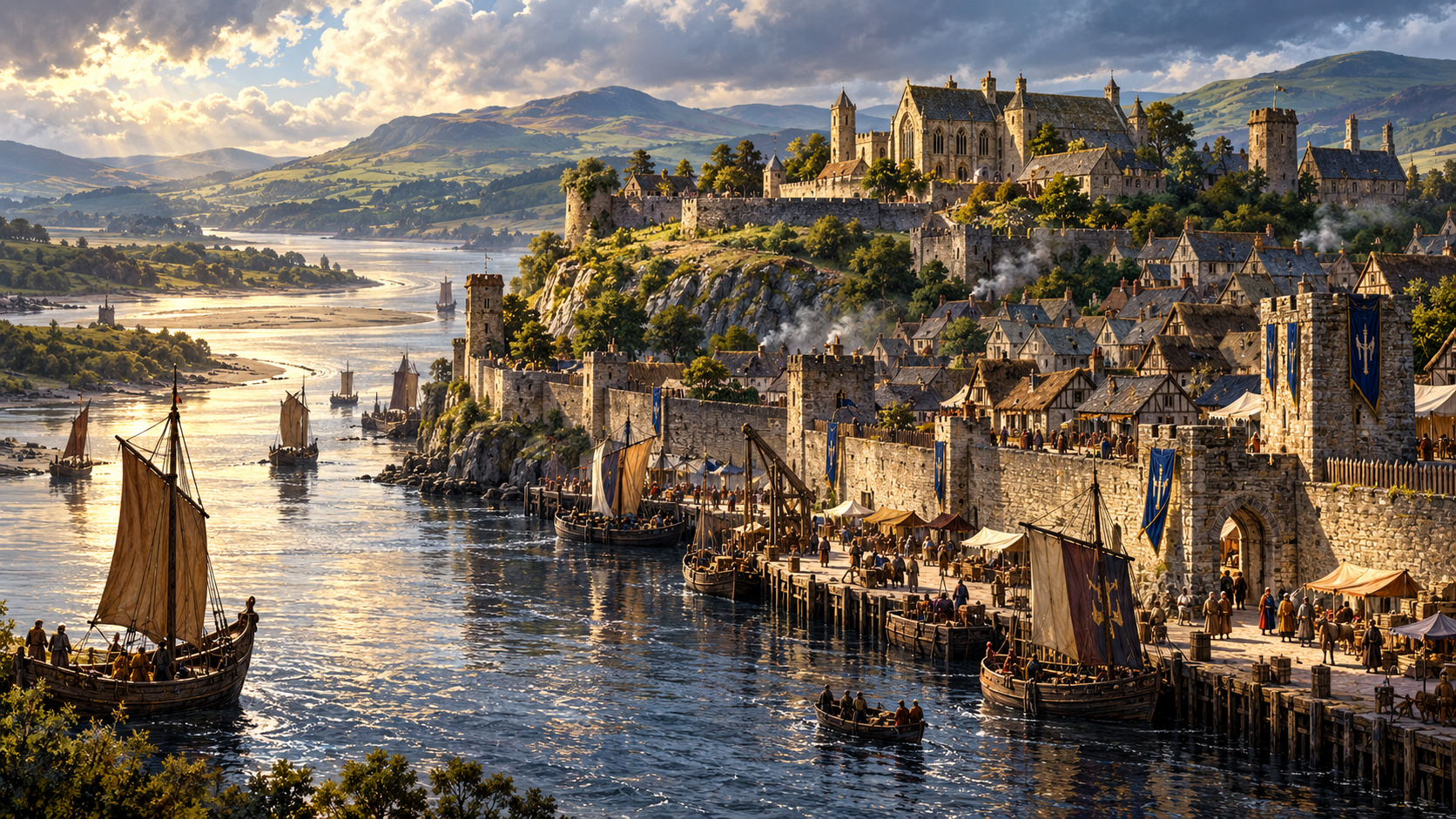
Ulster · Doire Cholmcille · Druidic college · River Foyle · Tír Conaill influence · Western sea roads
At a Glance
| Province | Ulster |
|---|---|
| Settlement | Sacred college and river settlement on the west bank of the Foyle; not yet the later plantation walled city |
| Sacred identity | Doire Cholmcille, principal northern college of the poet-seer Colum Cille |
| Sacred authority | A council of senior druids, filí, brehons, healers, astronomers and manuscript keepers |
| Secular pressure | O’Donnell influence from Tír Conaill, exercised locally through allied families including the O’Dohertys |
| Key places | The Great Hall, the Black House of Learning, Port na Long, the sacred oak enclosure, manuscript houses and the O’Doherty towerhouse |
| Best for | Druidic lore, prophecy, manuscript mysteries, dynastic sanctuary, river travel and O’Donnell politics |
| Immediate pressure | Tír Conaill’s succession war is pulling secular violence toward a place whose authority depends on remaining above faction |
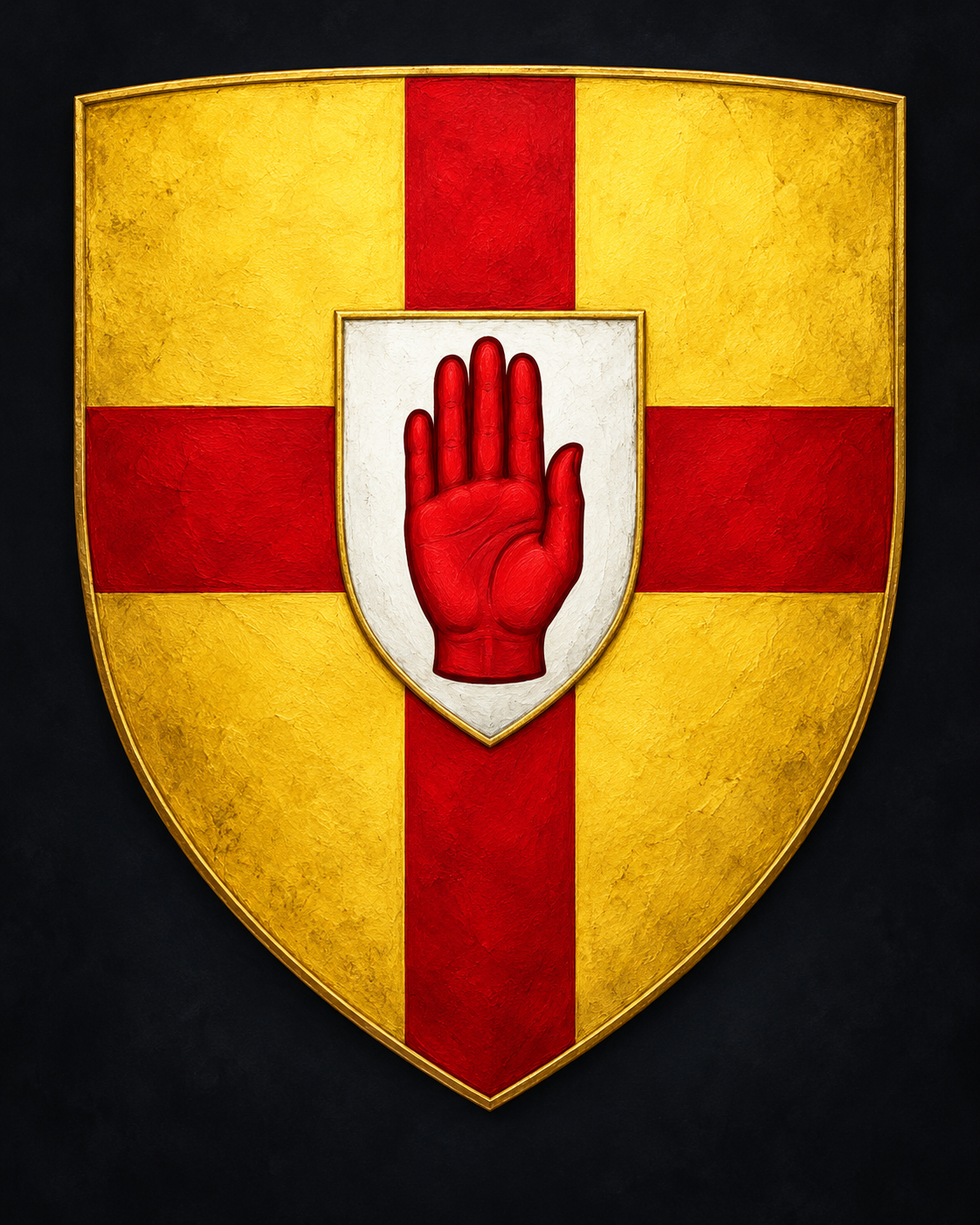
Derry is Doire Cholmcille: the oak grove and sacred college of Colum Cille. It is not yet a great walled city. Learned houses, ritual enclosures, guest halls, manuscript rooms and sacred trees cover the hill above the Foyle. Colum Cille is remembered as a poet-seer, navigator and founder whose teachings bind the north-west to Iona and the western isles. Kings value Derry because a blessing, judgement or poem delivered here can strengthen a dynasty—or destroy its honour.
What Is Happening Right Now?
The O’Donnell succession struggle in Tír Conaill has reached a violent turning point. Domhnall O’Donnell has been installed with O’Neill backing, while rival branches remain capable of retaliation. Both sides want Derry’s learned houses to recognise their genealogies and speak publicly for their legitimacy.
The senior council refuses to turn the college into a dynastic weapon. That neutrality is under pressure. Hostages, messengers and wounded retainers arrive daily asking for sanctuary, while each faction insists that helping the other is itself a political act.
The O’Doherty towerhouse represents O’Donnell secular power close to the sacred hill. Its garrison watches the river and protects the approaches, but custom forbids armed occupation of the central oak enclosure.
The Foyle is the fastest road in the region. Boats carry travellers, fish, letters and armed men between inland routes, Lough Foyle and the North Atlantic. A political crisis can reach Derry by water before warning riders arrive overland.
Run Derry Tonight
The Battle Poem
A fili composes a praise poem for one O’Donnell claimant. By dawn the same poem has rewritten itself to praise his rival, and both factions accuse the college of treachery.
The Cathach Copy
A manuscript keeper is found making an unauthorised copy of a battle-text associated with Colum Cille. He insists an O’Donnell lord ordered it and that the words can turn defeat into victory.
The Traveller at Port na Long
A curragh arrives carrying one living traveller and six dry cloaks. The survivor says the others stepped ashore beside him, but their footprints end at the water.
The O’Doherty Prisoner
A prisoner escapes the towerhouse and reaches the oak enclosure. The garrison demands his return. The keepers of the grove declare that anyone drawing blood inside it will carry the quarrel into their descendants.
The Oak That Bleeds Ink
An ancient oak begins leaking black liquid that works perfectly as manuscript ink. Every text written with it acquires one additional sentence overnight.
The Sacred College
Derry’s authority comes from learning rather than walls. Druids, filí, brehons, healers, star-readers and manuscript keepers live in a network of timber and stone buildings spread across the hill.
No single druid commands the college. Senior druids, filí, brehons and other learned figures share ritual authority and external diplomacy. A brehon may overrule a warrior on law; a fili may ruin a king through satire; a genealogist may prove that a celebrated claim rests on a false descent.
Students come from noble and learned families across the north-west. Some remain for years studying poetry, law, memory, natural philosophy and ritual. Others arrive only long enough to receive instruction before returning to a lord’s household.
Colum Cille
Colum Cille is remembered as a poet-seer, master of sacred speech and founder of a chain of learned communities linking Derry to Iona and the western isles. His departure from Ireland is interpreted as exile under geas rather than missionary history.
Stories say he could read the meaning of weather, settle disputes between kings, bless voyages and bind violence with words. His surviving teachings emphasise memory, hospitality, restraint in warfare and the terrible responsibility carried by poets who can shape reputation.
The college preserves Colum Cille as an ancestor of learning whose geasa, poems and judgements still matter.
The Great Hall and the Black House of Learning
The Great Hall is the principal ritual and assembly building. Kings and envoys are received there without being allowed to treat it as a royal court.
The Black House of Learning contains the oldest manuscripts and teaching rooms. Its name comes from the dark oak timbers and smoke-blackened interior rather than anything sinister.
Some texts are copied freely. Others are restricted by lineage, rank or geas. A manuscript can be legally owned yet forbidden to the owner if the college judges that reading it would violate an older obligation.
Port na Long and the Foyle
Port na Long—the port of the ships—is Derry’s river approach. Travellers climb from the landing toward the sacred hill, passing storehouses, fishermen, boatmen and guest compounds.
The Foyle links Derry to inland waterways and Lough Foyle. Curraghs and larger vessels connect the settlement to Donegal, the northern coast and the western Scottish world.
Local pilots are valuable because tide, fog and shifting channels can make a familiar route suddenly dangerous. Boatmen also know which landing places lie outside the view of the O’Doherty tower.
O’Donnell and O’Doherty Power
Derry lies inside the political orbit of Tír Conaill. O’Donnell kings seek endorsement from its genealogists and poets because sacred learning can convert military success into legitimate kingship.
The O’Dohertys provide local armed strength around the Foyle and Inishowen. Their relationship with the college is protective but not controlling. A captain who ignores druidic sanctuary risks turning every learned family in the region against his patron.
Places That Matter
The Great Hall
The principal assembly space for judgement, teaching and encounters between rulers and the learned orders.
The Black House of Learning
A restricted manuscript house containing genealogies, battle poems, star tables and dangerous ritual texts.
Port na Long
The river landing where travellers, goods and political news enter Derry.
The O’Doherty Towerhouse
A secular strongpoint representing the O’Donnell political world beside the sacred college rather than inside it.
The Oak Enclosure
The oldest trees on the hill form a sanctuary where weapons must be peace-bound. One oak is said to have grown from Colum Cille’s staff.
Magic of Doire Cholmcille
Derry’s magic concerns memory, exile, poetry and journeys. Dreams repeat events from the life of Colum Cille. A false genealogy may fade from the page. A satirical poem can leave visible blemishes on someone whose honour truly deserves the attack.
The link with Iona makes Derry a threshold between Ireland and the western sea roads. Travellers who follow the wrong boat through fog sometimes reach an island college belonging to another century.
Dungeon: The Manuscript Halls Beneath the Hill
Repairs beside the Black House reveal a stone stair descending beneath the sacred enclosure.
The Dry Library
Bundles of parchment remain untouched by damp. Every surviving text concerns exile, navigation or return.
The Exile Door
A carved threshold opens only for someone who has willingly left home and cannot return unchanged.
The Battle-Word Chamber
A stone lectern stands surrounded by impressions where armed rulers once knelt. Any poem placed upon it reveals the names of those whose deaths would make the victory possible.
The Oak Root Well
Living roots fill the lowest chamber around a spring. One enormous root stretches west beneath the river and cannot be cut by iron.
Far Darrig on the Donegal Road
The roads west of Derry into Tír Conaill are famous for encounters with the Fir Darrig, the red-clad practical jokers of Irish folklore. A lone traveller may hear a familiar voice from an empty ditch, find a milestone moved during the night or discover that a companion has been replaced by someone who knows every private joke but none of the prayers or passwords expected of them.
Pookas also use the old roads beyond the cultivated ground. The safest response to an impossible horse waiting at a crossroads is to continue on foot.
The learned houses at Derry keep records of such encounters because repeated fey activity often marks a route to an older place rather than random mischief.
Historical and Mythic Context
Derry preserves the real geography and political importance of the early sacred settlement while following the world’s native religious history. Colum Cille’s historical association with Derry, Iona and the northern dynasties is preserved as a druidic and poetic tradition rooted in the northern learned orders.
By the campaign present, O’Donnell and O’Doherty power surrounds the settlement, but the learned college remains institutionally distinct. The later plantation walls and civic city do not yet exist.
Historical geography of Derry and Colum Cille · Archaeology and early settlement of Derry
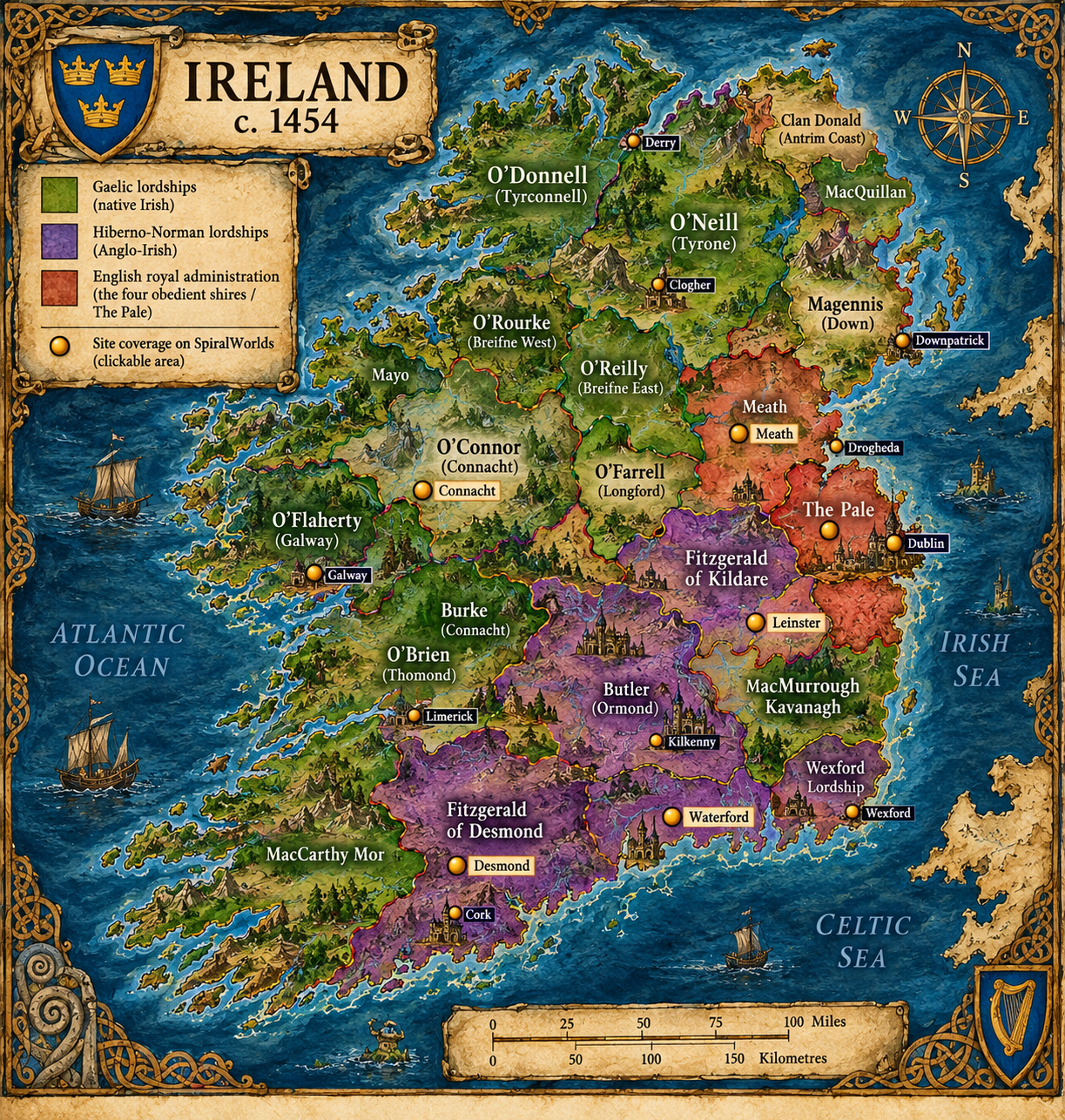
Map of the Northern Lordships
Keep this reference growing
If this page helped with your reading or game, you can support its upkeep or explore the curated books.
Explore the Bookshop — epics, classics and stories behind imagined worlds.