
Bristol — City and Port
England · Western port · Merchant city · Tidal harbour · Atlantic trade
At a Glance
| Realm | Kingdom of England |
|---|---|
| Status | County of itself, with its own mayor and sheriff |
| Mayor | Robert Sturmy, merchant and shipowner |
| Sheriff | William Howell until Michaelmas; Philip Mede succeeds him for 1454–55 |
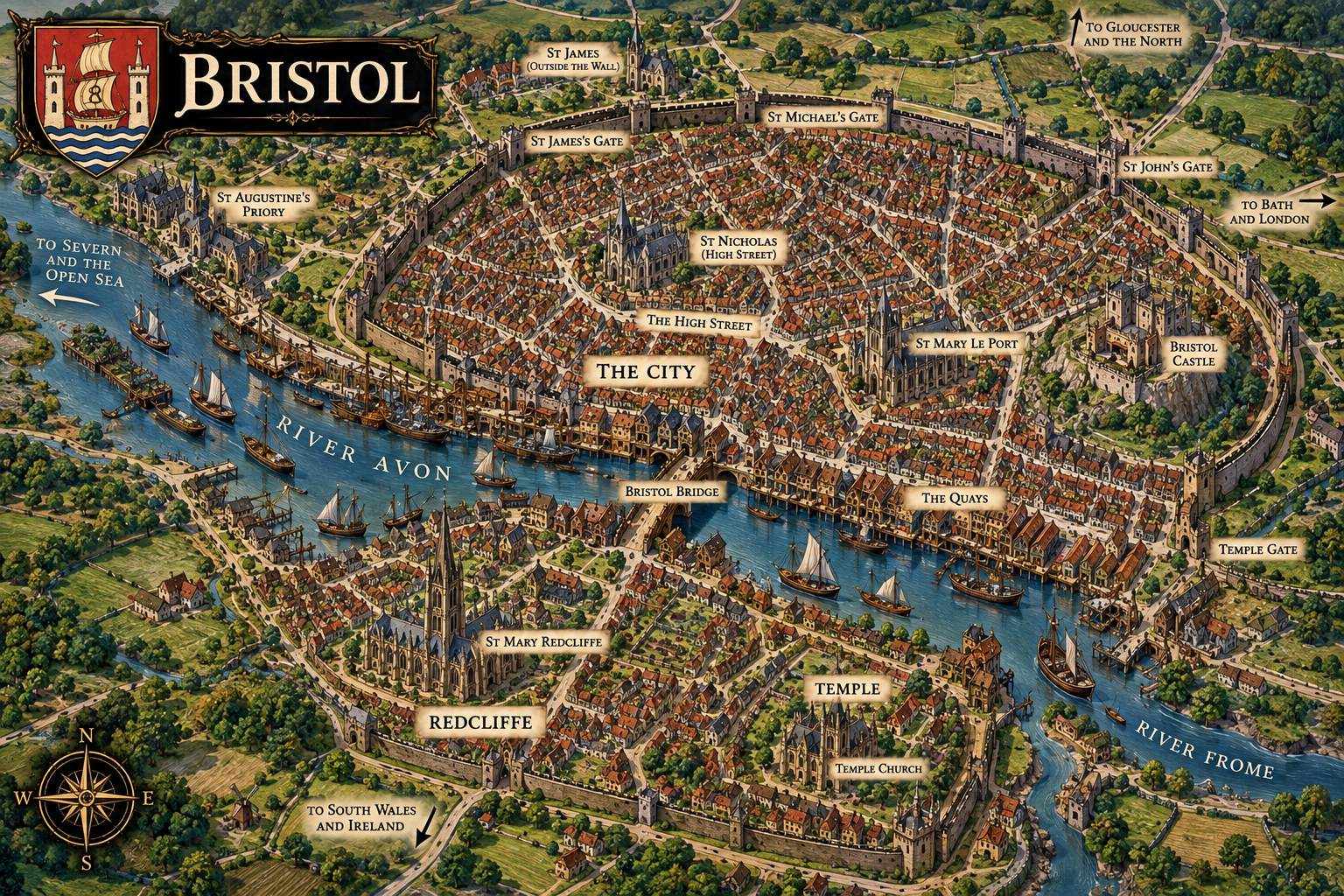
| Character | Walled merchant town, tidal harbour, castle, bridge, churches and crowded quays |
| Trade | Cloth, wine, fish, salt, oil, dyestuffs, hides, grain and imported luxuries |
| Best For | Urban intrigue, smuggling, harbour investigations, merchant rivalries, sea voyages, customs disputes and supernatural crime |
| Danger | Tides, fire, disease, armed sailors, corrupt factors, river monsters and things brought ashore in sealed cargo |

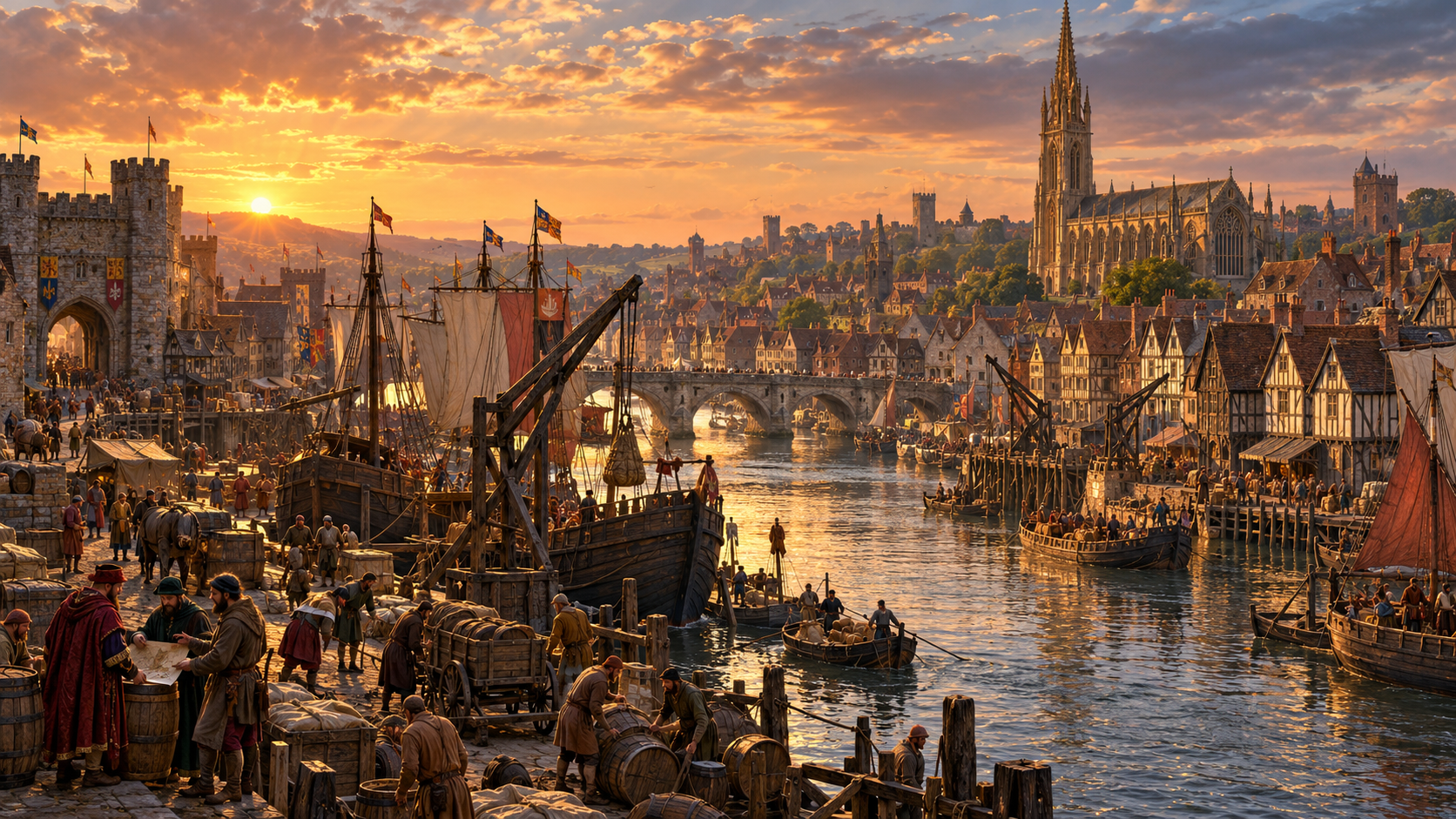
Bristol is England’s great western port: a self-governing county, a merchant stronghold and a tidal gateway to Ireland, Iberia, France and the northern seas. Ships crowd the Avon and Frome, customs officers watch the quays, merchant families dominate civic office, and every cargo creates opportunities for profit, fraud, espionage and supernatural trouble.
What Is Happening Right Now?
Bristol is not waiting for history to happen. Mayor Robert Sturmy is one of the town’s wealthiest and most ambitious merchants. He has traded to Ireland, Gascony, Spain and farther south, carried pilgrims to Compostela, and now presides over a community expected to contribute heavily to England’s maritime defence.
The Crown is demanding money and ships to help keep the sea. Bristol’s burden is substantial. Sturmy answers not only with taxation and negotiation but with a new vessel intended for war.
Timber, iron, sailcloth, cordage, carpenters, victuals, weapons, money and men are suddenly strategic resources. Prices rise. Contracts become political. A missing cargo of pitch is no longer simple theft if it delays the ship.
At the same time, the end of English rule in Gascony has disrupted old commercial habits. Bristol merchants cannot assume that wine, cloth and credit will move along the same routes they did before 1453.
Iberian trade is becoming more important. Ireland remains deeply connected to the port. Northern voyages seek fish and opportunity. Every shift creates winners, losers and people willing to make dangerous bargains.
Run Bristol Tonight
The Mayor’s Warship
Oak intended for Sturmy’s new warship disappears from a guarded yard. The timber is found downstream, neatly stacked on mud that should have been submerged.
Dockworkers blame smugglers. Sailors insist something in the Avon moved it against the tide.
The Customs Chest
A customs clerk vanishes with a locked chest containing tallies for an incoming wine cargo. Three merchants claim the books would clear them of fraud. A royal officer says the records prove exactly the opposite.
Whoever has the chest can ruin reputations before a court ever hears the case.
The Ship from Ireland
A vessel from Ireland arrives at dusk with its master dead and every member of the crew refusing to touch one sealed barrel.
The cargo papers are legitimate. The barrel is not listed.
The Pilgrim’s Debt
A survivor of an earlier pilgrimage voyage seeks Robert Sturmy’s protection, claiming a debt contracted overseas has followed him home.
The creditor is not human, but the written agreement is valid by every rule the signer understood at the time.
The Harbour Is the City’s Engine
Bristol’s harbour depends on the tides. Ships move through the Avon and into the city’s river system rather than entering a later enclosed floating harbour.
Masters who misjudge water, wind or mud can lose hours or a hull. Pilots, lightermen, quay workers and people who know the channels therefore possess real power.
The port is also a customs machine. Imports and exports are recorded, duties assessed, cargo measured and merchants identified.
That bureaucracy is useful at the table. A forged entry can hide contraband. A genuine entry can prove a ship was somewhere its owner denies. A clerk may be more dangerous to a smuggler than a patrol of armed men.
The waterfront is crowded and physical. Warehouses smell of wine, fish, hides and pitch. Cranes and tackles groan over the quays. Foreign sailors crowd inns. Animals and carts block narrow lanes. Arguments over damaged cargo can become violent before a serjeant arrives.
Trade, Money and Merchant Power
Bristol’s wealth is built on movement. Its merchants are deeply involved in overseas commerce, with particularly strong ties to Ireland and long experience in the wine and cloth trades.
Surviving fifteenth-century customs accounts begin in 1445 and reveal the port ship by ship, merchant by merchant and cargo by cargo.
The old Gascon wine relationship has been shaken by the political changes of 1453. That does not end the trade overnight; it makes routes, licences, credit and access less predictable.
Merchants increasingly look toward Iberia as well. Northern voyages remain valuable because fish, particularly preserved fish, feed inland towns and provide cargoes for wider exchange.
Merchant families are not merely wealthy townspeople. They sit in civic office, finance ships, employ factors abroad, lend money, support churches, negotiate with the Crown and sometimes command enough resources to influence policy directly.
Law, Government and Factions
Bristol has been a county of itself since the fourteenth century. Its mayor, sheriff, bailiffs, councillors and courts give the town unusual administrative weight.
Outsiders expecting ordinary county government can discover quickly that Bristol guards its privileges.
The Mayor and Common Council
Robert Sturmy represents the fusion of commerce and civic authority. The mayor must deal with royal demands, merchant disputes, industrial quarrels, foreign traders, harbour discipline and the defence of the town.
His office is powerful, but he cannot simply ignore the interests of Bristol’s merchant elite.
The Sheriff and Courts
The sheriff represents royal judicial authority inside the county of Bristol. Courts deal with debt, contracts, assault, property and commercial disputes.
For adventurers, this means violence inside the walls has consequences. A sword drawn on the quay can become a legal problem long after the fight ends.
Merchant Houses
Families associated with men such as Sturmy, William Canynges, the Medes, Shipwards and other established merchants compete through trade, marriage, patronage and office.
They are overlapping networks of family and commercial interest rather than permanent political parties.
Guilds, Crafts and Labour
Shipwrights, sailors, cloth workers, vintners, smiths, porters and other trades all have leverage because the harbour cannot function without them.
A wage dispute can delay a royal contract. A craft secret can be worth stealing.
For wider organisations, use the Guilds, Factions & Organisations hub.
Landmarks & Places to Know
Bristol Bridge
The bridge is a choke point between districts, markets and routes. Houses and commercial activity press close to the crossing.
Controlling movement across it during a riot, flood, fire or pursuit can decide an encounter.
St Mary Redcliffe
The great church at Redcliffe is already one of Bristol’s architectural statements of wealth.
Merchant patronage, chapels, burials and gifts make it a natural location for inheritance disputes, stolen relics and supernatural obligations tied to wealthy families.
Bristol Castle
The royal castle still exists and still matters, but it is no longer at its medieval peak. Repairs are recorded in the middle of the century, while later observers describe serious decay.
Use it as a partly worn royal fortress: chambers with prestige, neglected fabric, prisons, officials and sealed spaces that have outlived the purpose for which they were built.
Redcliffe and Temple
These suburbs grew with Bristol’s commerce and industry. Workshops, storehouses, churches, yards and labouring households make them ideal districts for investigations that begin with ordinary economic pressure and reveal something stranger underneath.
The Quays and Warehouses
This is where foreign cargo becomes Bristol property.
Wine disappears by the cask, cloth by the bale and information by the whispered sentence. Anything dangerous arriving from overseas is most likely to enter the campaign here.
Taverns, Inns & Lodgings
Old Market and West Street Inns
The eastern approach to Bristol is lined with inns and lodging houses serving traffic through Lawford’s Gate. Merchants, carriers, drovers and travellers from the London road can find stabling, meals and beds here before they ever reach the harbour. The farther a house stands from civic scrutiny, the more likely it is to shelter smugglers, fugitives and men paid not to remember faces.
Harbourside Taverns
Around the quays, alehouses serve sailors, stevedores, shipmasters, factors and foreign merchants. Some are respectable places for arranging cargo and hiring labour; others exist because crews with coin want drink immediately after coming ashore. Jobs involving a missing sailor, an unregistered crate or a ship leaving on the next tide often begin here.
Bridge and Redcliffe Lodgings
Travellers who need to stay close to the crossings, warehouses and southern road can find everything from merchant lodging to packed common rooms. These houses are useful for characters who need anonymity, access to dock labour or somewhere to watch traffic moving between the town and Redcliffe.
Notable Resident: Adam “The Leper”
Adam “The Leper” belongs in Bristol’s street-level network rather than as a name stranded in an old settlement list.
Beggars, outcasts, dock workers and people excluded from respectable households see things merchants and officials do not.
Adam can identify strangers, follow rumours through poorer districts and recognise when something has changed in the city before the authorities notice.
Magic, Monsters and the Tidal City
Bristol’s supernatural threats grow from the port rather than appearing randomly.
The tide carries things in and takes evidence away. Warehouses contain objects whose owners do not understand them. Sailors bring stories that sometimes turn out to describe very real creatures.
Sea Hags fit the outer approaches and isolated tidal ground where ships wait for water.
Fuath belong around foul water, damaged vessels and malign river encounters.
Black Shuck belongs on roads beyond the walls rather than in the crowded harbour itself.
Not every wreck is supernatural. Genuine navigational error, fraud and bad weather sit beside hauntings and monsters. Adventurers must investigate before deciding which kind of problem they face.
Services and What Adventurers Can Buy
Bristol is one of the best places in western England to outfit an expedition.
Ordinary weapons, armour, rope, canvas, barrels, preserved food, tools, horses, carts, navigation supplies and shipboard equipment are readily obtainable for those who can pay.
Specialist services include scribes, notaries, translators, money-changers, shipmasters, pilots, factors, armourers and clerics.
Rare magical goods are not sitting openly in a modern shop. They move through private sellers, church treasuries, wealthy households, foreign cargoes and people who know exactly which questions not to ask.
For broader settlement mechanics and services, use Fantasy Settlements.
Travel from Bristol
| Route | What It Means in Play |
|---|---|
| Ireland | One of Bristol’s most important commercial relationships; ships, merchants and news cross constantly. |
| Bordeaux and Gascony | An old wine route made politically uncertain after the loss of English Gascony. |
| Iberia | Growing commercial importance, pilgrimage routes and access to Atlantic shipping. |
| South Wales | Short sea crossing into marcher politics and ports across the Bristol Channel. |
| London | Royal government, finance and a rival commercial centre reached overland. |
Waterfront Taverns, Literary Bristol and Sea-Folk
At the Sign of the Spy-glass
Near the busier docks stands the Spy-glass, a low tavern marked by a brass telescope above the door. Its room is clean by waterfront standards, its floor sanded and its customers overwhelmingly sailors, pilots, factors and men looking for a berth.
The establishment is adapted from the Bristol of Robert Louis Stevenson’s Treasure Island. Here it is part of the living port: a place to hire a crewman, find a pilot, hear which captain is short of hands or discover which ship is carrying cargo it did not declare.
Merrow in the Avon
Merrow from the western waters occasionally come upriver with the tide. Most avoid the crowded quays, but harbour workers know the signs: wet footprints where no boat landed, shells arranged on mooring posts and nets cut cleanly without a blade.
A merrow bargain can secure a lost cargo, a drowned sailor or safe passage through bad water. Breaking one can make the river itself hostile.
The Harbour’s Unclaimed Dead
Not every body lost in the Avon reaches the sea. Some drowned sailors return to the quay where they last expected to be paid, heard first as wet footsteps behind warehouse doors. They are rarely violent unless someone is still profiting from the voyage that killed them.
Deeper History: How Bristol Became Bristol
Bristol’s wealth predates the current generation by centuries.
Medieval walls enclosed and regulated the town; Redcliffe and Temple developed outside the earliest core; the castle guarded the eastern side; and royal charters increased Bristol’s autonomy and commercial strength.
By the fourteenth century Bristol was among the wealthiest towns in England, and in 1373 it became a county of itself.
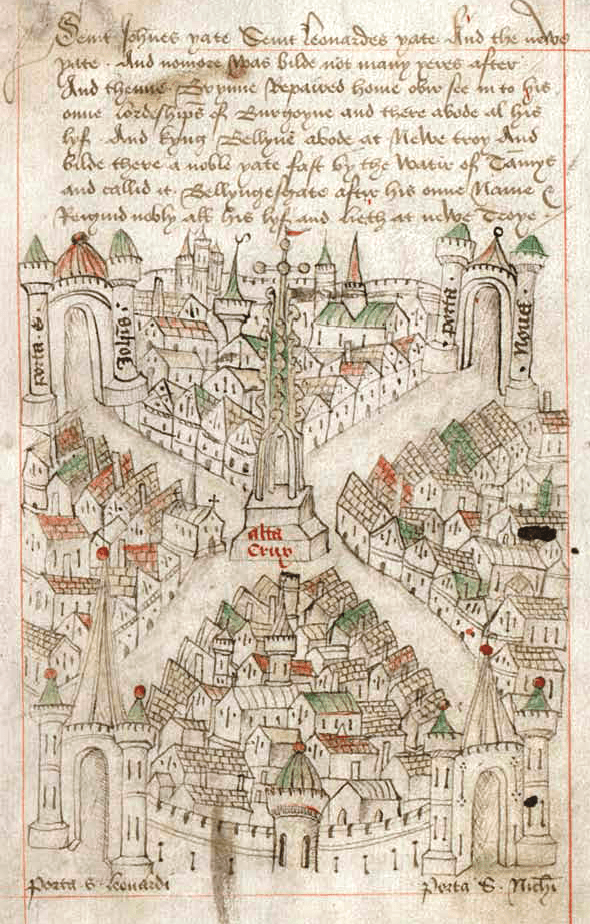
The city walls were as much about regulating commerce as defence. Gates controlled people and goods.
The castle’s connection with the monarchy remained important even as parts of the complex declined. St Mary Redcliffe’s fifteenth-century work demonstrates the resources available to a community of wealthy merchants and patrons.
Adventure Pressure
- Royal pressure: money, ships and men are being demanded for maritime defence.
- Commercial pressure: established routes are changing after the loss of Gascony.
- Civic pressure: merchant government must balance royal orders, town privileges and private fortunes.
- Harbour pressure: tides, cargo fraud, foreign crews and dangerous goods make every arrival a potential incident.
- Supernatural pressure: the Avon, outer estuary and warehouses create natural entry points for water beings, curses and imported magic.
Sources and Historical Grounding
The historical spine uses surviving customs records, civic lists and modern heritage research.
University of Bristol researchers have transcribed surviving Bristol customs accounts from 1445 onward, providing direct evidence for the port’s merchants, cargoes and shipping.
Bristol City Council records Robert Sturmy among the mayors of the mid-fifteenth century. Historic England documents the medieval city wall, Bristol Castle and St Mary Redcliffe.
University of Bristol — Fifteenth-Century Customs Accounts · Bristol City Council — Mayors of Bristol · Historic England — Bristol Castle · Historic England — St Mary Redcliffe
Continue Exploring
Kingdom of England · The British Isles · Ireland · Wales · British Isles NPCs · Celtic Creatures
Keep this reference growing
If this page helped with your reading or game, you can support its upkeep or explore the curated books.
Explore the Bookshop — epics, classics and stories behind imagined worlds.