
Ireland — The Pale, Gaelic Kingdoms and the Old Roads
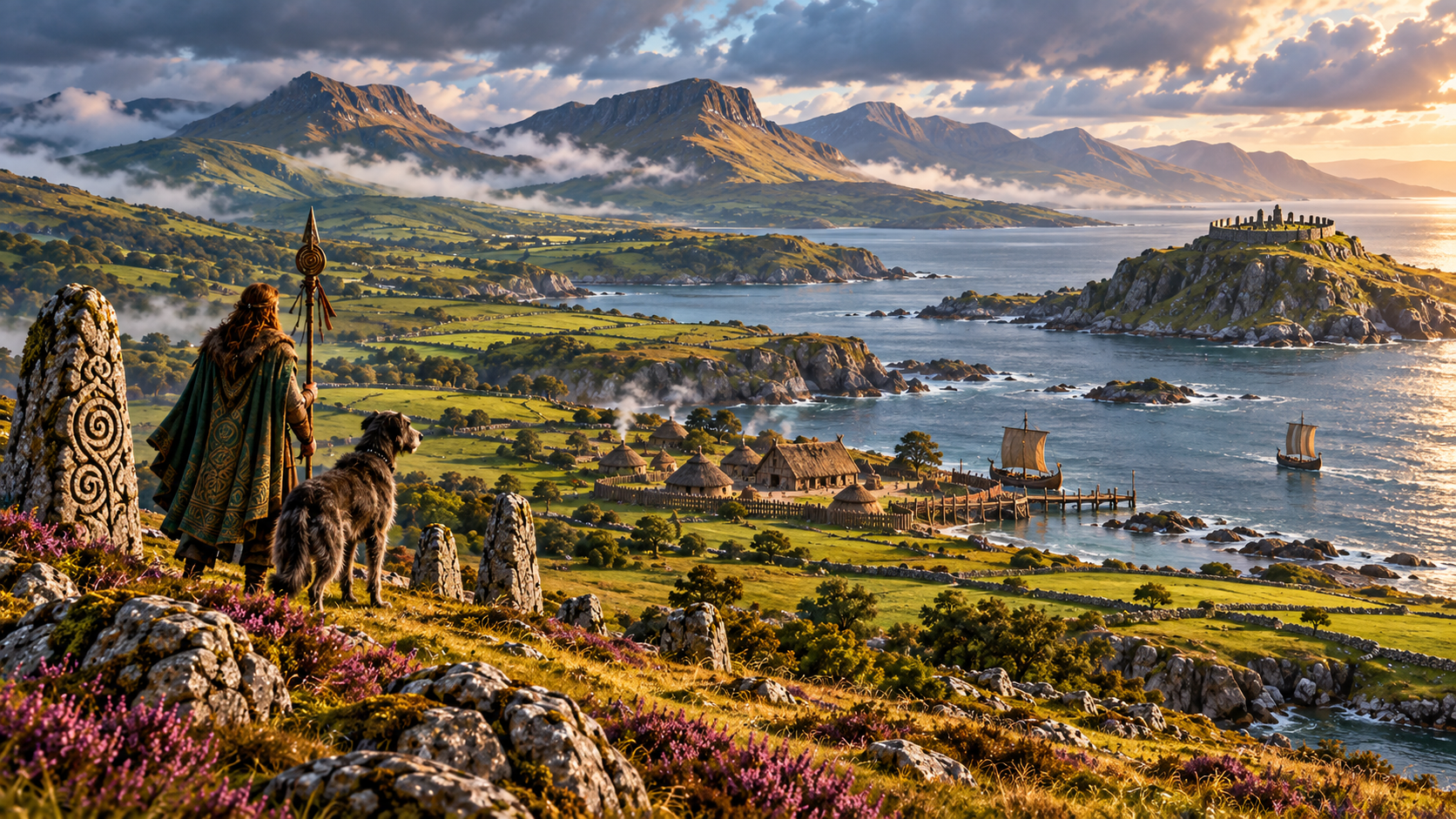
British Isles · Lordship and Gaelic realms · Great rivers · Ancient mounds · Otherworld roads
At a Glance
| Political reality | The English Lordship centred on Dublin and the Pale beside powerful Gaelic kingdoms and Hiberno-Norman lordships |
|---|---|
| Lord Lieutenant | Richard, Duke of York; government is exercised through deputies and justiciars in his absence |
| 1454 deputies | Sir Edward FitzEustace serves through most of the year; Thomas FitzGerald, Earl of Kildare, becomes justiciar after FitzEustace’s death in October |
| Principal centres | Dublin, Waterford, Kilkenny, Cork, Limerick, Galway and the great lordly courts of Leinster, Munster, Connacht and Ulster |
| Languages | Irish, English and Anglo-Norman French; learned and legal traditions also preserve Latin |
| Supernatural character | Sidereal roads, passage tombs, sovereignty powers, pookas, banshees, fomorians and dangerous sea crossings |
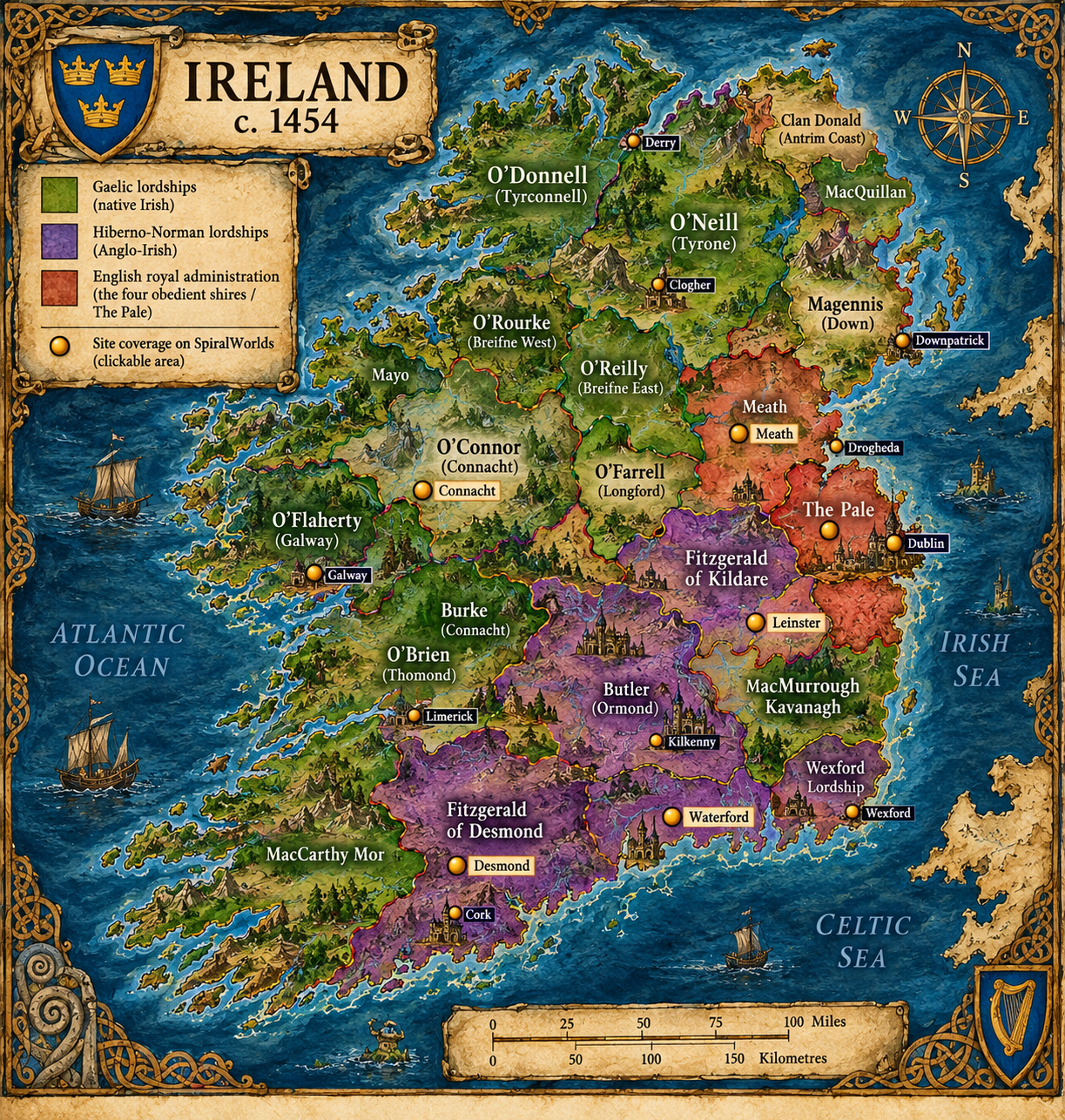
Ireland is not one obedient lordship. Dublin Castle speaks in the name of the English Crown, the Pale protects the core of that administration, great Hiberno-Norman houses govern broad territories in their own interest, and Gaelic kings and lords rule much of the island through dynastic power, clientage, cattle wealth and armed followings. Old roads cross all of these boundaries without asking permission.
Druids, Filí, Brehons and Bards
Ireland’s learned orders are not one priesthood. Sacred practice, law, poetry, history, healing and performance overlap, but no central sacred hierarchy sits above them. Status comes from learning, recognised grade, lineage, reputation and the authority of the local college or ruler who receives their judgement.
| Learned order | Role in play | Class route |
|---|---|---|
| Druids | Keep sacred places, interpret geasa, negotiate with gods and spirits, preserve ritual law and wield nature magic. | Druid |
| Filí | Elite poet-scholars who preserve genealogy, history and place-lore; compose formal praise and satire; advise rulers; and wield learned poetic magic. | Bard is the primary player-facing chassis; advanced filí can also take Poet or Chronicler paths. |
| Brehons | Professional jurists who preserve precedent, hear disputes, calculate honour-price and compensation, and decide how customary law applies. | Usually skill- and profession-led characters, often Bard, Druid, Scholar or similar learned builds. |
| Seanchaithe | Historians, genealogists and tradition-keepers. Many overlap with the filí. | Bard, Chronicler, Loremaster or Scribe are natural mechanical routes. |
| Physicians | Hereditary and college-trained healers dealing with wounds, herbs, disease and supernatural affliction. | Healer, herbalist, druidic or other specialist paths according to edition. |
| Bards and harpers | Performers, praise-singers, satirists, musicians and travelling carriers of news. Some remain professional entertainers; the most learned may progress into fili status. | Bard |
The recognised grades already used by Ireland’s learned tradition run from Fochloc through Mac Fuirmid, Dos, Cana, Cli and Ansruth to Ollamh. They mark mastery rather than ecclesiastical command. Druids, filí and suitably learned bards can hold these grades; an Ollamh receives extraordinary respect without automatically becoming the ruler of every lower-ranked druid or poet.
Druidic Hierarchy defines those grades mechanically for the older rules tradition. Druid: Ollave is an existing specialist option, although its legacy wording is being treated as an older rules interpretation rather than the universal social definition of an ollamh.
What Is Happening Right Now?
The government at Dublin is politically entangled with the struggle around Richard, Duke of York. York holds the Irish lieutenancy, but his power is normally exercised through deputies. Sir Edward FitzEustace serves through most of 1454; after his death in October, Thomas FitzGerald of Kildare is elected justiciar and then acts as York’s deputy. Office therefore matters, but so do the local forces that make any order enforceable.
The Pale around Dublin, Meath, Kildare and Louth is the most concentrated zone of English administration, yet its frontier is porous. Gaelic lords negotiate with Dublin, raid it, enter its politics and make agreements with its governors. The earls of Kildare, Desmond and Ormond command lordships powerful enough to behave like regional states.
Beyond administrative borders, sovereignty is older and stranger. A hill may belong to a Gaelic king, a nearby castle to a Hiberno-Norman lord and the road between them to a power that remembers the Tuatha Dé Danann. Political geography and mythic geography rarely match.
Run Ireland Tonight
The Deputy’s Seal
A messenger leaves Dublin carrying sealed instructions for a marcher lord and vanishes inside the Pale. Three different factions want the packet returned unopened. A pooka knows where the horse bolted but will answer only in riddles and wagers.
The Road Through the Mound
A winter storm opens a side passage near the Boyne. Travellers who shelter inside emerge on a road where the stars are wrong and hear riders approaching from both directions. Their guide insists the mound has not opened like this in his lifetime.
The Banshee at the Feast
A noble household preparing a marriage alliance hears a banshee before anyone has died. Both families take the omen seriously, but each believes it names the other house. The wedding cannot be cancelled without turning the omen into a political insult.
Dublin, the Pale and the Great Lordships
Dublin is the administrative heart of the Lordship. Its castle is fortress, prison, treasury and government centre, but authority weakens rapidly beyond the core districts that sustain it. The Pale is defended not because the rest of Ireland is empty, but because powerful neighbours surround it.
The FitzGeralds of Kildare dominate much of the eastern political world; their Desmond cousins control vast territories in Munster. Butler power reaches through Ormond and the south-east. Gaelic dynasties remain decisive in Ulster, Connacht, Leinster and the midlands. Alliances cross cultural lines constantly when land, marriage or survival makes cooperation useful.
There is therefore no clean frontier between English and Irish Ireland. A lord may use English legal forms, Irish fosterage, Gaelic troops and continental trade in the same year. A campaign that treats the island as two simple camps will misunderstand almost every important household.
Rivers, Roads and Sea Gates
The Shannon divides and connects the interior; the Barrow, Nore and Suir carry trade through the south-east; the Boyne ties Meath to one of the oldest ritual landscapes in Europe. Roads between lordly courts are valuable precisely because many run through contested territory.
Ports at Dublin, Waterford, Cork, Limerick and Galway look outward as much as inward. Ships connect Ireland to Britain, France, Iberia and the wider Atlantic. Manannán mac Lir is therefore not a remote sea-god to coastal people; his mists, roads and islands belong to the same waters that merchants cross for profit.
Dungeon: Beneath Dublin Castle
Dublin Castle is the most politically dangerous dungeon entrance on the island because the fortress above is fully occupied. Officials, prisoners, guards, clerks and messengers move through its courts every day. Any secret below the castle immediately becomes a matter of government.
The Medieval Undercrofts
Stores, prison spaces, treasury chambers and service passages occupy the lowest working levels. Old doors have been bricked up as the fortress changed, and some inventories refer to rooms nobody currently uses.
The Viking Ground
The castle was built over an earlier Viking settlement. Beneath later walls lie earthworks, drains, timber lines and forgotten river-edge spaces from the older town. A breached cellar can therefore open into a street that vanished centuries before the present fortress existed.
The Black Pool
Water still moves beneath the site toward the old dark pool that gave Dublin its name. A culvert widened by erosion reveals stonework older than the Viking defences. The passage floods with the tide, carrying objects and sometimes voices from farther below.
The Sovereignty Stone
At the deepest reachable chamber stands a worn stone on which no royal badge survives. Anyone who gives an order while touching it hears a second voice repeat the command in Irish, altered just enough to reveal what the speaker truly intends. In a castle full of officials, deputies and rival loyalties, the stone is more dangerous than gold.
If the underworks become known, government itself changes. Prisoners gain escape routes, smugglers gain access, rival magnates seek the stone and older powers object to Dublin Castle claiming authority over a place beneath its own foundations.
Brú na Bóinne and the Ancient East
North of Dublin, Brú na Bóinne is a landscape of immense passage tombs at Newgrange, Knowth and Dowth surrounded by dozens of lesser monuments. These are not generic barrows. Their chambers, carved stones and solar alignments belong to a ritual landscape thousands of years older than every kingdom now fighting over Meath.
The great mounds remain places of ancestry, kingship and Otherworld danger. A passage that opens on the wrong night can lead into a court where no mortal title is recognised. Treasure taken from such a chamber may prove a genealogy, awaken a claim or draw the attention of beings who remember the mound being built.
Creatures of Ireland
Pookas
Pookas haunt roads, hills and lonely crossings, changing shape and temperament as readily as direction. Some carry travellers to safety; others leave them miles away, robbed of time, certainty or pride.
Dullahan
Dullahan ride when death has acquired a road and a destination. Gates do not reliably stop them. The sound of wheels or hooves after midnight can empty a village road before anyone sees the rider.
Banshees
Banshees are tied to families and death-memory rather than random haunting. Their cries can turn an expected inheritance into a political crisis before the doomed person has even fallen.
Leprechauns
Leprechauns are solitary fey of craft, secrecy and hidden wealth. Attempts to force treasure from them usually produce bargains, misdirection and humiliation long before they produce gold.
Fomorians
Fomorians survive in remote strongholds, islands and places where sea and stone meet. Their older wars with the divine powers are not safely finished history when fomorian bloodlines and relics still endure.
Gods, Sovereignty and Living Heroes
The Dagda embodies abundance, authority and the dangerous generosity of a king whose gifts can bind as strongly as threats. The Morrígan moves through war, fate and sovereignty, appearing where rulers mistake possession of land for unquestioned right to rule it.
Lugh remains a power of skill, kingship and victory, while Manannán rules the uncertain roads of sea and mist. Their old rivalries with fomorian powers still give meaning to particular coasts, islands and battle sites.
Cú Chulainn is a living heroic presence in the north and beyond it: terrifying in battle, bound by geasa and remembered wherever Ulster’s honour is at stake. His existence makes ancient heroic law a present political fact rather than a dead tale.
Historical and Mythological Context
The English Lordship of Ireland began with the Anglo-Norman conquest, but in the fifteenth century its effective power is concentrated rather than island-wide. Dublin Castle remains the administrative centre; beyond the Pale, Crown governors depend on agreements, military expeditions and powerful regional families as much as direct rule.
In 1454 Richard, Duke of York, holds the lieutenancy. Sir Edward FitzEustace serves as deputy from May until his death in October; Thomas FitzGerald of Kildare is then elected justiciar and becomes York’s deputy. These offices sit inside a political world where Kildare, Desmond, Ormond and Gaelic dynasties all possess independent military weight.
Dublin Castle itself was built in the early thirteenth century on the site of an earlier Viking settlement and serves as fortress, prison, treasury and court. Brú na Bóinne is vastly older: Newgrange, Knowth and Dowth were built around 3200 BC and form one of Europe’s greatest concentrations of passage tombs and megalithic art.
Dictionary of Irish Biography — Thomas FitzGerald of Kildare · History Ireland — Irish Lords and English Rulers · Dublin Castle — History · World Heritage Ireland — Brú na Bóinne
Keep this reference growing
If this page helped with your reading or game, you can support its upkeep or explore the curated books.
Explore the Bookshop — epics, classics and stories behind imagined worlds.