
Dublin — Castle City at the Edge of the Pale
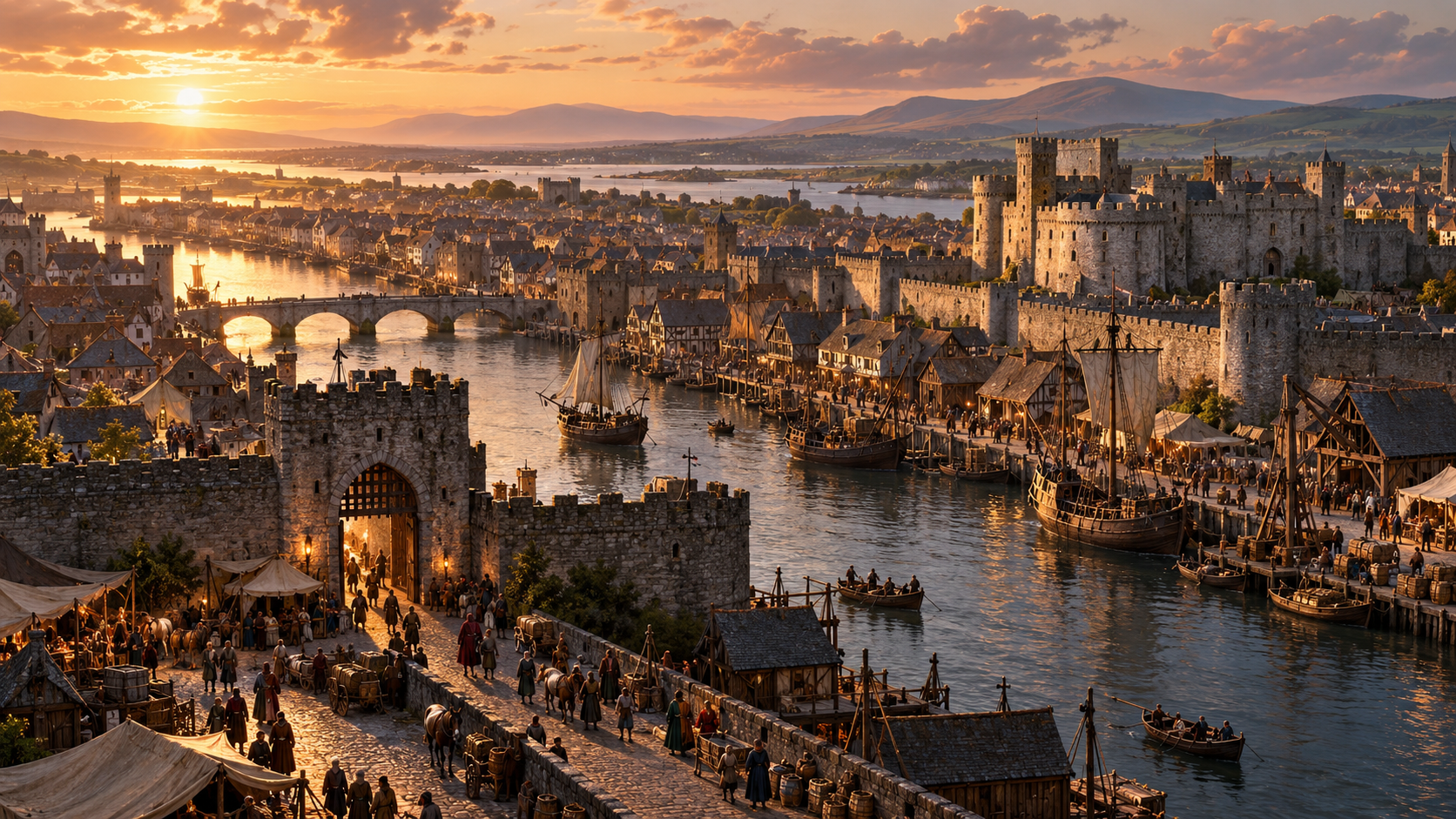
Ireland · Walled port · Castle government · Viking foundations · Frontier capital
At a Glance
| Realm | Lordship of Ireland |
|---|---|
| Political role | Administrative centre of English royal government in Ireland and the chief city of the Pale |
| Governor | Richard, Duke of York, holds the lieutenancy; deputies and justiciars conduct day-to-day government |
| Character | Walled port, castle city, market centre and frontier capital |
| Key places | Dublin Castle, the city walls, the Liffey quays, Fishamble Street, the Black Pool and the Pale roads |
| Best for | Political intrigue, urban pursuit, smuggling, castle expeditions, disputed jurisdiction and Viking underlayers |
| Supernatural pressure | Pookas, banshees, black water, ancestral claims and roads that cross from the Pale into older Ireland |

Dublin is a fortified port and administrative city built over older Norse ground at the meeting of the Liffey and the Poddle. Its walls, castle, markets and quays make it the strongest centre of English royal authority in Ireland, but the city stands close to the edge of that authority. Beyond the roads and estates of the Pale, Gaelic lords and great regional houses negotiate with Dublin on their own terms.
What Is Happening Right Now?
Richard, Duke of York, holds the lieutenancy of Ireland, but Dublin government is being exercised through deputies. Sir Edward FitzEustace serves through most of the year; after his death in October, Thomas FitzGerald of Kildare is elected justiciar and becomes York’s deputy. For merchants and petitioners, the practical question is therefore not merely who holds the highest title, but who can issue an order today and make it hold outside the walls tomorrow.
Dublin is prosperous enough to attract traders, lawyers, officials and ambitious noble households, yet its hinterland remains militarised. Roads into the Pale are patrolled, estates fortified and loyalties negotiated. The city can send commands into the countryside faster than it can guarantee obedience.
Older Dublin lies beneath every political dispute. Viking earthworks, buried walls and the diverted Poddle survive below the castle. The city has been rebuilt too many times for anyone to know every void beneath the streets.
Run Dublin Tonight
The Deputy’s Prisoner
A Gaelic envoy is arrested inside the city after arriving under a promised safe conduct. The castle says the document is forged. His retainers say the seal is genuine. Before anyone can settle the matter, the envoy disappears from a locked cell without opening the door.
The Black Pool Cargo
Smugglers recover a sealed bronze chest from a flooded passage near the old Dubh Linn. Every person who touches it dreams of the same shoreline, where a man in a grey cloak waits beside a boat.
The Gate That Should Be Closed
A postern in the city wall is found open after midnight. No guard admits unlocking it. Tracks lead out toward the Pale but return as hoofprints belonging to a different animal.
Dublin Castle and Royal Government
Dublin Castle is the administrative heart of the Lordship: fortress, residence, prison, treasury and meeting place for officials who act in the Crown’s name. Its great strength is concentration. A prisoner, sealed order, royal payment or diplomatic visitor can all be secured behind the same walls.
That concentration also creates vulnerability. Rival magnates seek influence over appointments. Messengers can be intercepted before leaving the city. A rumour from one castle chamber can reach the quays before an official proclamation is drafted.
The castle stands on ground first occupied by the earlier Viking settlement. Its moat uses the Poddle, and its defences meet the medieval city wall. Government therefore sits physically on top of Dublin’s older history.
Walls, Markets and the Liffey
The medieval city is walled, compact and crowded. Gates control entry, while illegal openings and neglected sections create opportunities for smugglers, fugitives and corrupt guards. Fishamble Street carries the memory of the city’s fish market; the quays connect merchants to Britain and continental ports.
The Liffey is both road and barrier. Cargo moves more easily by water than over bad roads, but tides, shoals and weather complicate every arrival. The Poddle is less grand but more intimate: diverted through the city and castle defences, it carries water beneath walls that officials prefer to think solid.
Dublin’s markets are supplied by the Pale and by trade across the Irish Sea. A feud in Kildare, a blocked road in Meath or a hostile fleet can change prices inside the city faster than the administration can respond.
Landmarks & Places to Know
The City Walls and Gates
Dublin’s walls define where authority is strongest. Gates funnel merchants, travellers, livestock and armed retainers into watched spaces, while lesser openings and neglected stretches invite smuggling, bribery and escape.
Fishamble Street and Winetavern Street
These crowded streets sit close to the commercial life of the medieval city. Food sellers, drink merchants, craftsmen and travellers compete for space, making the district ideal for buying supplies, finding gossip or locating someone who wishes to stay near the markets without approaching the castle.
The Liffey Crossing
The river is both road and barrier. The main crossing, quays and landing places concentrate traffic from the Irish Sea and the roads beyond the city, so a watcher posted here can learn who is arriving long before official messengers do.
Taverns, Inns & Lodgings
Winetavern Street Houses
Wine merchants, taverners and lodgers make this one of the natural places to drink and do business. Better rooms host merchants and officials; rougher rooms take sailors, servants, guards and strangers with coin.
Market Alehouses
Near Fishamble Street and the busier market lanes, small drink houses feed labourers and traders through the day. They are cheap, crowded and excellent places to learn about missing cargoes, sudden arrests, feuds and ships expected on the next tide.
Castle-Gate Lodgings
Visitors with legal or administrative business often pay more to remain close to Dublin Castle. The advantage is access; the disadvantage is scrutiny. Anyone watched by officials should sleep elsewhere.
The Pale Begins at the City Gates
The Pale is not a wall enclosing a safe English island inside Ireland. It is a defended zone of estates, roads, towns and lordships around Dublin whose security depends on local power. Gaelic neighbours, Anglo-Irish magnates and the Crown’s own officers make agreements across its supposed boundaries constantly.
For travellers, jurisdiction changes quickly. A warrant issued at Dublin Castle may be feared in one district, negotiated over in the next and ignored beyond it unless backed by armed men or a local alliance.
Dungeon: Beneath Dublin Castle
Dublin Castle’s underworks belong to a living fortress. Guards patrol above them, prisoners are held nearby, officials store records and valuables inside the same complex, and the city’s government depends on the walls remaining secure.
The Medieval Curtain
Behind stores and prison spaces survive parts of the original medieval curtain wall, postern passages and steps descending toward the old moat. Some routes remain known to engineers and guards. Others were blocked generations ago and have slipped out of official plans.
The Viking Embankment
Deeper excavations reveal the stone-faced earthwork of Viking Dublin. Timber impressions and old defensive lines run beneath the thirteenth-century fortress. A narrow gap follows the earlier embankment toward the site of the Black Pool.
The Poddle Passage
The River Poddle still flows beneath the castle grounds. A culvert opened by collapse exposes older masonry and a flooded chamber where the current turns in a direction no surface map explains. At low tide, carved stones emerge from the black water.
The King’s Door
Beyond the flooded chamber stands an oak door banded with green bronze. No hinge is visible on the Dublin side. Knocking once produces no answer; knocking twice brings a reply in Irish; knocking three times opens onto a road beneath a starless sky.
The danger is political as much as supernatural. A secret route beneath the castle can free prisoners, admit spies or bypass the city wall. Any official who discovers it must decide whether to seal the passage, control it or conceal its existence from his own superiors.
Creatures of Dublin and the Pale
Pookas
Pookas haunt the roads beyond the walls and the uncertain ground where the Pale gives way to older jurisdictions. They mislead riders, borrow shapes and turn a simple journey into a wager whose rules are discovered too late.
Banshees
Banshees follow family rather than city boundary. Their cries in Dublin are especially feared among noble households because an omen heard in a crowded street can become public knowledge before the doomed person’s kin understand it.
Dullahan
Dullahan ride roads that gates cannot reliably close. A city watch may bar a mortal pursuer, yet discover that the headless rider it hoped to exclude has already passed within.
Leprechauns
Leprechauns move through workshops, hidden yards and the edges of merchant wealth. They are solitary, secretive and far more difficult to rob than the stories told in taverns suggest.
Sea Roads and Older Powers
Dublin faces east across the Irish Sea, but its supernatural roads do not obey that direction. Manannán mac Lir governs mist, sea passage and islands beyond ordinary navigation. Sailors who dismiss him as a western power learn quickly that every coast can disappear under fog.
The Morrígan is felt whenever sovereignty, violence and the right to rule become inseparable. A castle may hold the king’s seal while a battlefield beyond the Pale decides whose claim the land accepts.
Cú Chulainn belongs most strongly to Ulster’s heroic world, but his fame reaches Dublin as living political memory. Warriors invoke him carelessly; poets do not.
Historical and Mythological Context
Dublin began as a Viking settlement around the Liffey and the Black Pool. After the Anglo-Norman conquest, King John ordered the construction of Dublin Castle in the early thirteenth century. The fortress was built over part of the older settlement and linked into the city defences, with the Poddle diverted to help form its moat.
Archaeology beneath the castle preserves both medieval masonry and Viking defences. Dublin City Council’s work on the medieval walls also records a city whose fortifications were altered, neglected, repaired and pierced by unofficial posterns as prosperity and danger changed over time.
In the fifteenth century the castle remains the seat of English administration in Ireland, but that administration does not control the whole island. Dublin’s significance lies precisely in that contrast: it is the strongest centre of Crown government and at the same time a frontier capital whose authority depends on roads, alliances and powerful local families.
Dublin Castle — History · Dublin Castle — Viking Excavation · Dublin City Council — Dublin Archaeology and Medieval Walls
Keep this reference growing
If this page helped with your reading or game, you can support its upkeep or explore the curated books.
Explore the Bookshop — epics, classics and stories behind imagined worlds.