
Scottish Highlands — Clans, Lochs and Old Powers
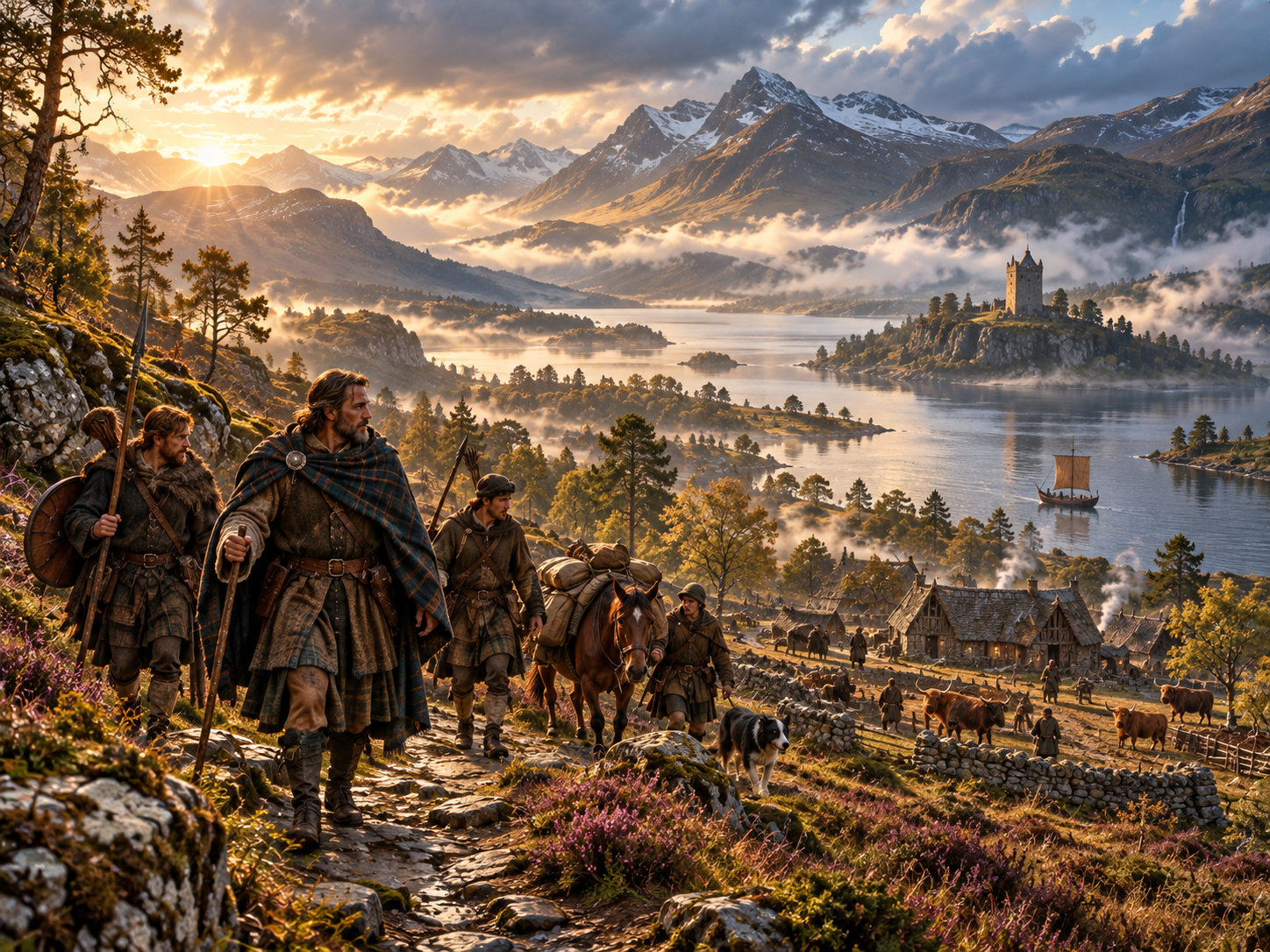
Scotland · Mountain region · Clan territories · Supernatural wilderness
The Highlands are not empty country beyond royal civilisation. They are inhabited territories of kin-groups, lords, religious houses, cattle routes, hunting grounds and supernatural powers whose claims can be older than the kingdom itself.
At a Glance
| Region | Northern and western uplands of the Kingdom of Scotland |
|---|---|
| Political reality | Human clan territories, local lordships, sacred college estates, royal interests, elven and fey domains, small dwarven enclaves and the expanding influence of the Lordship of the Isles |
| Inhabitants | Human clans and settlements, elves, Daoine Sidhe, Urisks, Brownies, rare Pech and scattered dwarven communities |
| Best for | Long journeys, clan diplomacy, territorial treaties, monster hunting, cattle raids, hidden valleys, sacred places and survival play |
| Movement | Mountain passes, loch routes, drove roads, coastal boats and local guides |
| Strong creature links | Each Uisge, Glaistig, Baobhan Sith, Cat Sith, Boobrie, Fachan, Cailleach, Caoineag, Far Liath, Selkie and Bean Nighe |
| Supernatural rule | Many non-human powers hold land by custom, treaty, inheritance or older law. Defeating one inhabitant does not erase the claim. |
What Is Happening Right Now?
James II is strengthening royal authority elsewhere in Scotland, but the Highlands cannot be governed simply by sending an officer with a seal. Local power rests on kinship, armed followings, control of routes and the ability to reward allies. The western Highlands are further complicated by the Lordship of the Isles, whose maritime network joins mainland and island politics.
Royal charters do not settle every Highland boundary. Some glens are occupied by human clans but crossed under treaty with elven neighbours; some woods and hollow hills belong to the Daoine Sidhe; and some passes, mines and old roads remain under dwarven or older claims that no Scottish clerk created and no Scottish king can casually extinguish.
Adventurers are most useful when they can travel where a formal army would cause a political crisis: carrying messages, negotiating ransom, arbitrating territorial disputes, hunting a creature, confirming whether a feud has supernatural causes or finding a missing heir before another clan does.
Peoples and Older Claims
Human communities remain the majority population: Gaelic clans, sacred settlements, cattle herders, fishers, island households, merchants and lordly followings.
Elves hold scattered territories in ancient woodland, secluded glens and valleys where mortal settlement has never wholly displaced older ownership. Some clans trade, intermarry or share seasonal grazing rights with them; others dispute the same ground.
Daoine Sidhe rule hollow hills, old roads and pockets of land that touch the Fey World. Their courts, households and retainers are political neighbours. A mortal lord may claim a valley on parchment while every local family knows which hill cannot be entered without permission.
Urisks inhabit rugged mountains, forests and streams, sometimes maintaining long relationships with nearby households. Brownies attach themselves to particular farms, halls and estates, becoming part of domestic life when treated according to custom.
Pech survive in small numbers around old hill works, stone places and remote uplands. Small dwarven enclaves also hold mines, workshops and mountain roads, especially where valuable stone and metal justify remaining close to dangerous passes.
These peoples do not form a single supernatural faction. Their treaties, feuds, kinships and territorial rights overlap human politics and one another.
Run the Highlands Tonight
The Green Lady’s Cattle
A herd vanishes from a glen without tracks. A local family blames raiders. The cattle are actually inside the territory of a Glaistig, and recovering them requires deciding whether the humans broke an old grazing agreement first.
The Loch That Hunts Back
Fishermen disappear from a remote loch. Witnesses describe a vast bird moving between water and mist. The signs point toward a Boobrie, but its attacks began only after men disturbed an island nesting place.
The Woman at the Ford
A noble party hears singing at a ford before one member falls ill. The warning may be connected to a coming death, a political ambush or both.
Creatures and Supernatural Territories
The Highlands should not use its creatures as interchangeable random encounters. Each belongs to a landscape, route or community.
Lochs and sea lochs: Each Uisge are among the most feared native water predators, while Boobries dominate isolated waters and islands. Selkies belong on the western and northern coasts, sea caves and remote islands rather than far inland.
Mountains and high passes: Fachan turn difficult ground into actively hostile territory. Far Liath belongs to the high Cairngorms and should be encountered as a mountain presence rather than a wandering roadside monster. Powers associated with the Cailleach dominate winter, exposed heights, deer country and places where weather itself feels deliberate.
Glens, forests and households: Glaistigs, Baobhan Sith, Cat Sith, Urisks and Brownies all occupy different social roles, from predators and territorial fey to neighbours and household spirits.
Fords, death and prophecy: Caoineag and Bean Nighe belong around clan deaths, battles, burns and lonely crossings. Their appearance is information as much as danger.
A creature may prey on one community, bargain with another and be protected by a third. The wider Celtic Creatures catalogue supplies further beings, but only those with a clear Highland place and purpose should be brought into a local adventure.
Clans, Law and Hospitality
A traveller’s name matters. So does who gave them hospitality, who guarantees their word and whether they cross land while armed. Feuds can persist for generations without requiring constant open warfare. Cattle, fosterage, marriage, hostage-taking and compensation can matter as much as battlefield victory.
Royal law exists, but enforcement depends on local power. A party that solves a problem while insulting the household that controls the next pass has not solved the campaign problem.
Travel
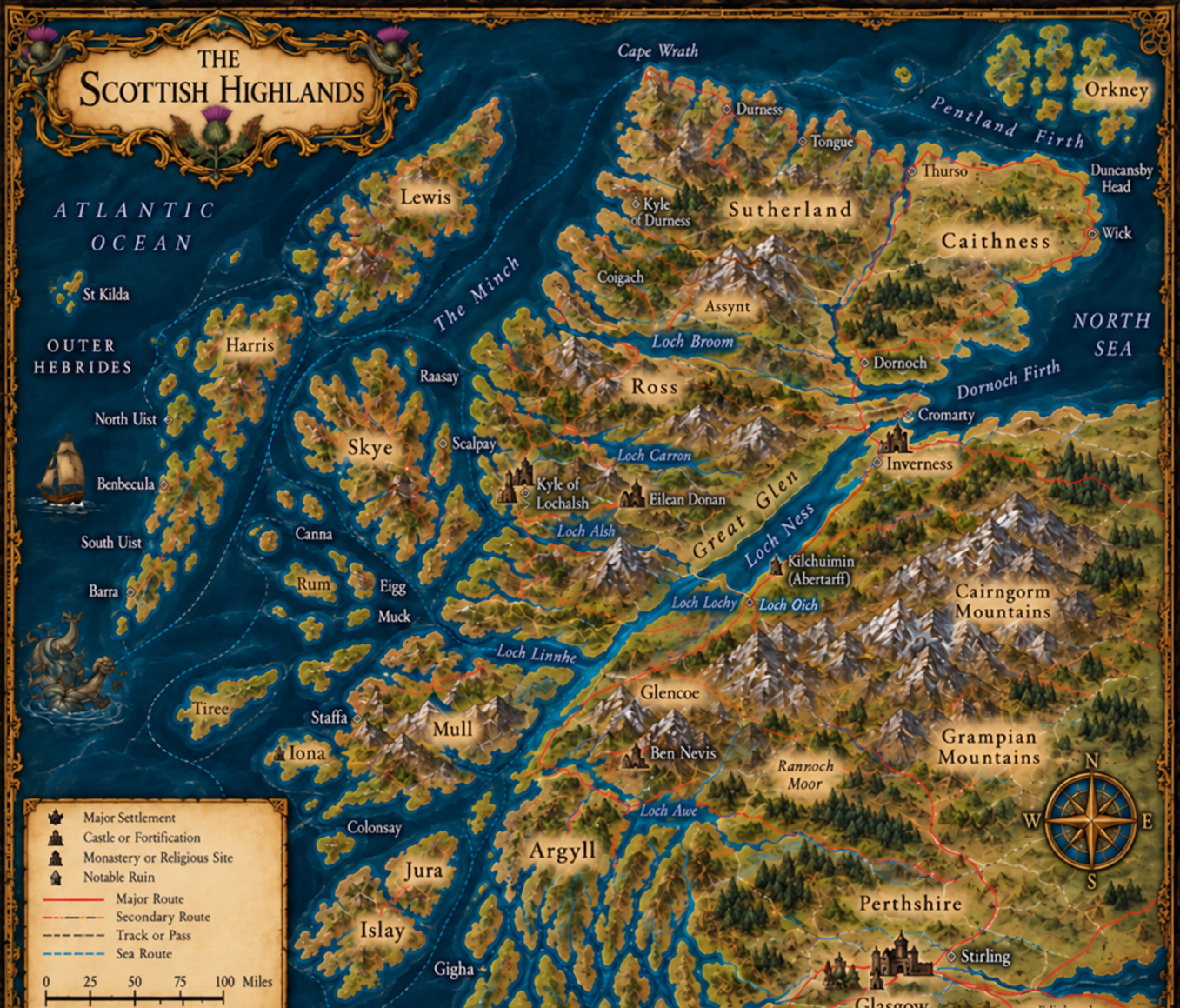
Distances that look short on a map can consume days. Weather, swollen burns, bad ground and closed passes reshape routes constantly. Boats often connect communities more efficiently than roads. Use guides, ferries, learned houses and cattle routes as strategic resources.
Southbound travel reaches Glasgow and central Scotland; westward travel enters the sea politics of the Lordship of the Isles.
Old Highland Roads and Other Folk
The Highlands are full of routes that belong to more than clans. Kelpies wait at dangerous water crossings, glaistigs watch cattle and lonely glens, and brownies still attach themselves to households that know how to treat them.
Selkies move between shore communities and the western sea. A missing boatman may have drowned, fled a feud or simply followed a selkie through a door in the tide.
Hospitality is therefore more than custom. Refusing shelter to the wrong stranger can insult a clan, a fey household or something older than both.
Historical and Mythological Context
The late-medieval Highlands were not a single political block. Power rested in overlapping Gaelic lordships, clan territories, island strongholds and royal claims. The history of Kisimul Castle shows how seafaring Gaelic lordship worked in practice, while Castle Sween preserves the changing control of Argyll and its later connection with the MacDonald Lords of the Isles. At Urquhart Castle, repeated seizures by the Lords of the Isles show how far their ambitions reached into the Great Glen and north-eastern Highlands.
The mythic landscape is equally rooted in recorded Highland tradition. The Cailleach is associated in Scottish Gaelic tradition with winter, mountains, deer, storms and the shaping of the land itself. University of Edinburgh folklore collections preserve Highland and island stories of the Each Uisge and the Bean Nighe, recorded in the nineteenth century from older oral traditions in Skye and the western islands.
Even Loch Ness carries an early supernatural tradition: Historic Environment Scotland notes Adomnán’s account of St Columba encountering a monster in the loch during his journey to the court of the Pictish king Bridei. These sources do not make every later folk tale a literal fifteenth-century record; they provide the historical and oral-traditional foundations from which the living supernatural Highlands are built.
Historical Foundation
The Highlands remain a late-medieval landscape of clan lordship, kinship, sacred college estates, cattle routes, islands and difficult communications, but human political geography sits beside older non-human occupation rather than replacing it. Elven glens, Daoine Sidhe hills, fey households, dwarven roads and ancient territorial customs are part of the living country.
The supernatural ecology draws from the site’s Celtic Creatures catalogue and is used geographically: loch beings in the waters, mountain powers on the heights, household spirits among settlements, and death-omens where clan conflict makes them matter.
Keep this reference growing
If this page helped with your reading or game, you can support its upkeep or explore the curated books.
Explore the Bookshop — epics, classics and stories behind imagined worlds.