
Stirling — Royal Fortress and the Douglas Crisis
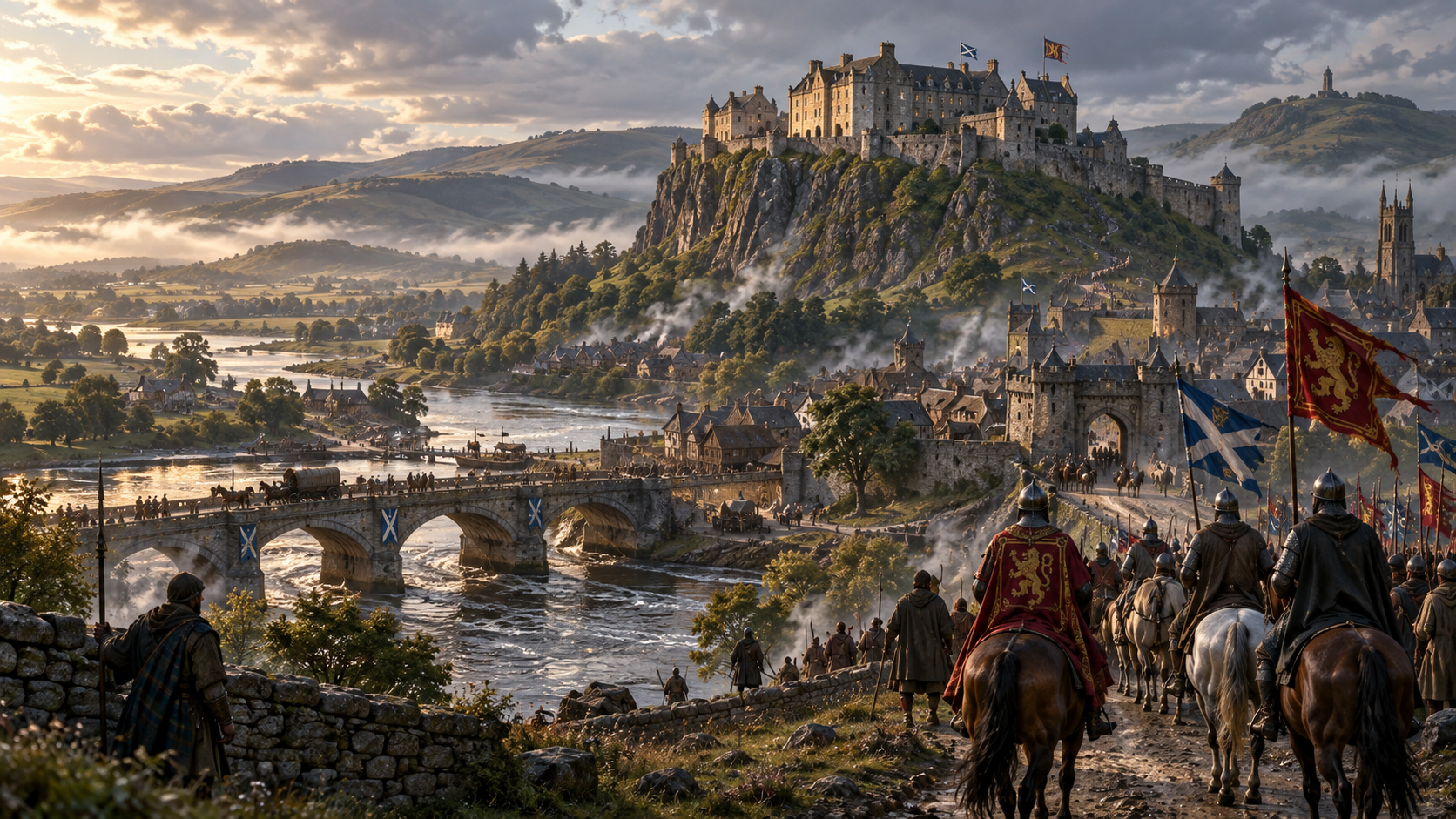
Scotland · Royal stronghold · Castle town · Political crisis
At a Glance
| Realm | Kingdom of Scotland |
|---|---|
| Character | Royal fortress, market town and strategic crossing |
| Current pressure | The Crown’s unresolved struggle with the Black Douglases |
| Best for | Court intrigue, escorts, espionage, arrests, factional violence and supernatural investigations |
| Nearby routes | Edinburgh, the Forth, Douglas country, the Highlands and the western roads |
| Supernatural layer | Haunted battle-ground, river spirits, fey roads and oaths that refuse to die |
Stirling stands where roads, river crossings and royal authority converge. The castle is one of the places from which James II can project power into central Scotland, but it is also the place where his struggle with the Black Douglases became personal and bloody.
What Is Happening Right Now?
Two years ago James II killed William, 8th Earl of Douglas, at Stirling Castle after the earl refused to abandon his alliances. The killing did not end the crisis. James, 9th Earl of Douglas now heads a family with great estates, armed clients and allies, while the king works to break that power before it can become a rival state inside Scotland.
In Stirling, rumours matter. A household servant can overhear a conversation that changes an alliance. A safe-conduct can be trusted by one faction and despised by another. A sealed letter may be worth more than a wagon of silver.
Run Stirling Tonight
The Safe-Conduct
A Douglas messenger enters Stirling carrying a royal safe-conduct and demands an audience. Someone intends to make certain he never reaches the castle gates. The party must decide whether the attack comes from royal agents, a rival Douglas faction, English intelligence or somebody exploiting the crisis for a private murder.
The Blood in the Garden
A servant claims the place where William Douglas died has begun replaying fragments of the murder after midnight. The apparition reveals details no living witness has admitted publicly—and several powerful people want the haunting silenced before the party can learn why.
The Forth Road
A royal shipment vanishes between the river and the castle. Tracks lead towards ordinary thieves, but the stolen cargo includes an oath-bound object claimed by an older power of the landscape.
Who Holds Power?
The Crown: James II, royal officers, castle servants and loyal magnates are trying to turn royal authority into something stronger than personal allegiance.
The Black Douglas affinity: kinsmen, retainers, tenants and allies do not vanish because one earl dies. Their influence reaches into households that publicly profess loyalty to the king.
Merchants and townspeople: they need roads, fairs and river traffic to remain open regardless of which noble claims the moral high ground.
Older powers: mortal politics have occupied Stirling for centuries; they have not erased the supernatural claims beneath fort, river and hill.
Travel, Law and Danger
Possession of a royal writ is useful here, but the identity of the bearer matters almost as much as the seal. Armed retainers are common. Strangers asking detailed questions about garrisons, noble households or the road south can attract attention quickly.
Beyond the settled roads, river crossings and wooded ground make excellent places for ambush, flight and pursuit. A journey towards Edinburgh is political travel; a journey west can become maritime politics through the Lordship of the Isles, while the northern roads lead towards the Scottish Highlands.
Places to Use at the Table
Stirling Castle
The castle dominates the crossing country from its volcanic crag. Treat it as a royal residence, administrative centre, prison, armoury and political stage rather than merely a fortress. The party may enter through official business, service to a household, an arrest, a summons or a problem nobody wants discussed outside the walls.
The River Crossing
The Forth shapes movement through central Scotland. Control of crossings determines who can move messages, livestock and valuable cargo efficiently between north and south. Ferrymen, boatmen and guards therefore hear rumours before they reach the castle.
The Castle Town
Below the fortress, inns, workshops, sacred houses, markets and households live in the shadow of the castle. A crisis inside the walls quickly becomes a commercial problem in the town when retainers arrive, roads close or rumours make merchants delay their journeys.
Old Stories Beneath Royal Stone
Stirling’s supernatural layer should feel older than the current crisis. The castle and its hill accumulate stories because generations of rulers, soldiers and travellers have passed through the same constrained ground. Ghosts need not repeat famous battles; they may be servants, prisoners, messengers or oath-breakers whose deaths were never important enough to enter a chronicle.
Medieval tradition also connected Stirling with Arthurian story. Use that association as a route into older Britain: a sealed chamber, broken table, disputed relic or knightly oath can turn a castle investigation into an Arthurian adventure.
The River Below the Castle
The Forth is a political road and a supernatural boundary. Kelpies haunt quieter crossings away from the busiest bridge approaches, taking the form of unusually calm horses when the river is high.
Castle servants also tell of footsteps in sealed chambers after executions or sudden deaths. These hauntings are rarely violent; they repeat the last route of the dead until somebody discovers what unfinished duty keeps them moving.
A messenger who vanishes between castle and river may therefore be the victim of politics, fey predation or a ghost leading the living toward evidence hidden in an older wall.
Historical Foundation
The campaign pressure is grounded in the documented conflict between James II and the Black Douglases. Historic Environment Scotland records that James killed William, 8th Earl of Douglas, at Stirling Castle on 22 February 1452 after the earl refused to break his alliances; the confrontation continued into open conflict.
Historic Environment Scotland — James II and the Black Douglases
Keep this reference growing
If this page helped with your reading or game, you can support its upkeep or explore the curated books.
Explore the Bookshop — epics, classics and stories behind imagined worlds.