
Witch — Patrons, Hexes, Familiars and Traditions
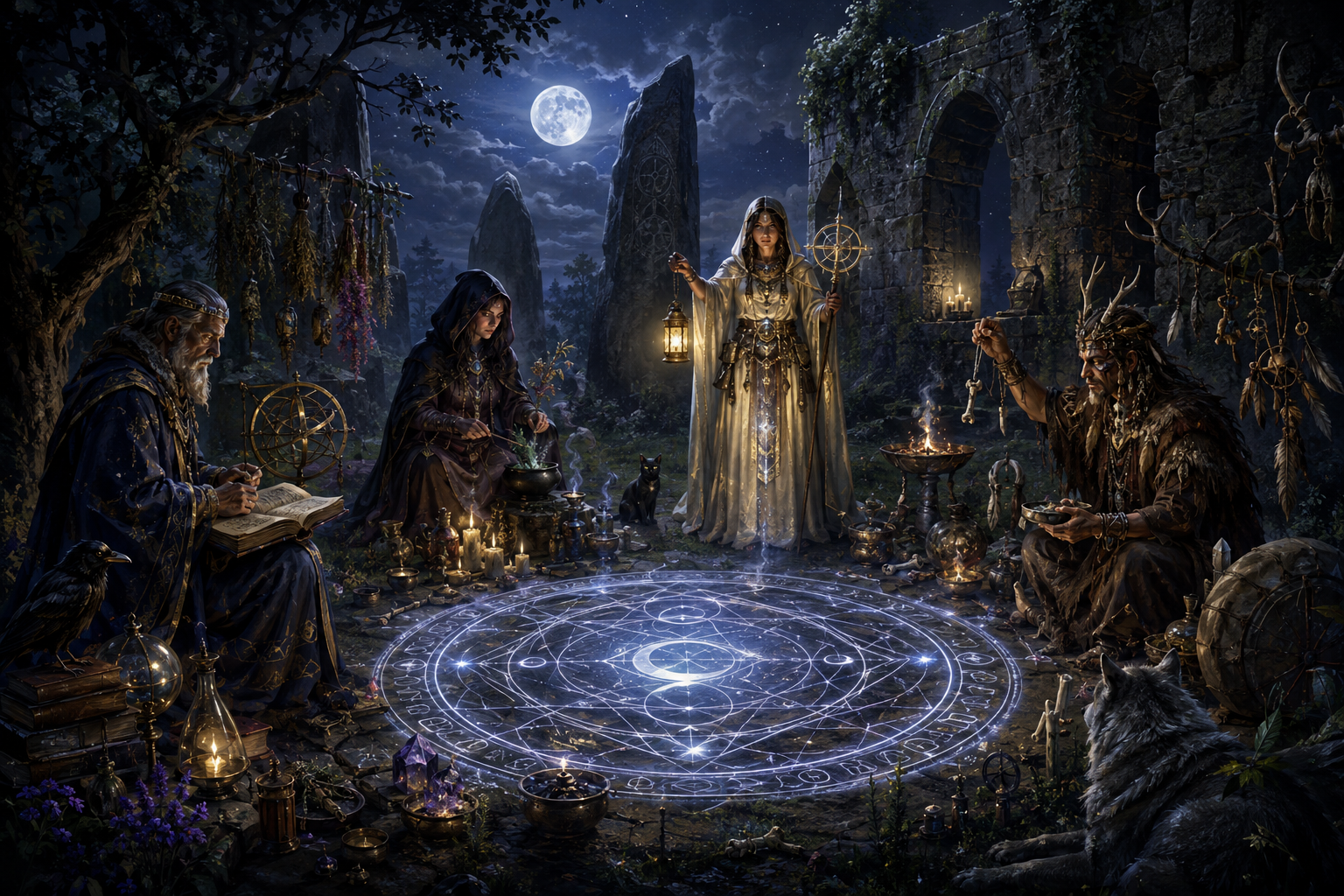
Patrons · Hexes · Familiars · Rituals · Covens · Witch Traditions · Occult Arts
You did not learn magic the way a wizard did. Something answered you. A Witch builds power through a patron, a familiar, a magical tradition and the personal practices that turn strange knowledge into spells, hexes and ritual magic.
Play a Witch if you want a spellcaster whose identity is shaped as much by who taught you, what you owe and how you practise magic as by the spells on your character sheet. One Witch may be a village healer with a crow familiar; another a court diviner bound to a fey patron; another a curse-worker whose coven meets only beneath a winter moon.
Why Play a Witch?
- You want a spellcaster with a strong identity. Patron, familiar, coven and tradition all give the character immediate hooks.
- You like control and clever magic. Witches excel at curses, divination, enchantment, support, ritual and battlefield manipulation.
- You want choices outside combat. Familiars, covens, patrons, occult knowledge and specialised Arts create things to do between fights as well as during them.
- You want your magic to belong to the world. A Witch’s powers connect directly to spirits, fey courts, ancestors, strange teachers, old traditions and dangerous supernatural bargains.
At a Glance
| What you are | A patron-linked spellcaster using hexes, familiars, ritual magic and a distinct Witch tradition. |
|---|---|
| What you do | Control enemies, weaken dangerous foes, uncover secrets, protect allies and solve problems with specialised magic. |
| Your key choices | Patron, familiar, tradition, coven or solitary practice, spells and — in the legacy rules — one or more magical Arts. |
| Best for players who enjoy | Character hooks, occult magic, unusual spellcasting, social obligations, investigation and magical problem-solving. |
| Primary ability | Intelligence in 5.5e / 2024 and Pathfinder 1e; Wisdom in the preserved legacy d20 Witch. |
Build Your Witch
A Witch comes together through four decisions. Make them in any order, but by the end you should know where your magic comes from, what it looks like and what it costs you to keep it.
- Choose your Patron. Who answered you? A deity, spirit, fey sovereign, ancestor, outsider or stranger power can all shape a Witch.
- Choose your Tradition. This is how you were taught: family craft, faerie practice, elemental philosophy, alchemy, song, coven lore or another magical lineage.
- Choose your Familiar. Decide what accompanies you and why. Is it a trusted companion, your patron’s messenger, the keeper of your spells or something you still do not entirely understand?
- Choose how your Witch solves problems. Select the spells, hexes and — where your ruleset uses them — Occult Arts that support the kind of Witch you want to play.
Witch Spells
Browse the Witch spell archive and individual spell pages.
Covens
Give your Witch allies, teachers, rivals and obligations.
Mystical Paths
Combine Witchcraft with another calling.
Create a Tradition
Build a new magical lineage for the campaign.
Witch Rules by Edition
5.5e / 2024 Witch
A complete 1st–20th-level Witch for 5.5e play. The class is a d6 Intelligence-based full caster whose identity comes from a patron, familiar, Hexcraft and a Witch Tradition.
Additional class: this is an original 5.5e-compatible Witch, not one of the core classes in SRD 5.2.1.
Quick Build
- Put your highest ability score in Intelligence; Constitution is a strong second choice.
- Choose a Patron’s Gift at 1st level.
- Choose three Hexes at 2nd level.
- Choose a Witch Tradition at 3rd level. The Classical Tradition is fully detailed below.
Core Witch Traits
| Primary Ability | Intelligence |
|---|---|
| Hit Point Die | d6 per Witch level |
| Saving Throws | Intelligence, Wisdom |
| Skills | Choose 2: Arcana, Deception, Insight, Investigation, Medicine, Nature, Religion or Survival |
| Weapons | Simple weapons |
| Tools | Herbalism Kit |
| Armour | None |
| Spellcasting Focus | Arcane Focus or Book of Shadows |
Starting Equipment and Multiclassing
Starting Equipment: choose (A) Dagger, Arcane Focus, Book of Shadows, Herbalism Kit, Scholar’s Pack and 5 GP; or (B) 55 GP.
Multiclass prerequisite: Intelligence 13. When you multiclass into Witch, you gain the Witch Hit Point Die and simple-weapon proficiency. Use the normal full-caster multiclass spell-slot rules.
Witch Features
PB means Proficiency Bonus. Prepared is the number of level 1+ Witch spells you prepare through Spellcasting, before bonus spells from your patron, familiar or tradition.
| Level | PB | Features | Hex Die | Hexes | Cantrips | Prepared |
|---|---|---|---|---|---|---|
| 1 | +2 | Spellcasting, Patron’s Gift, Witch’s Familiar | — | — | 3 | 4 |
| 2 | +2 | Hexcraft | d6 | 3 | 3 | 5 |
| 3 | +2 | Witch Tradition | d6 | 3 | 3 | 6 |
| 4 | +2 | Ability Score Improvement | d6 | 3 | 4 | 7 |
| 5 | +3 | Whispered Preparation | d8 | 3 | 4 | 9 |
| 6 | +3 | Tradition Feature | d8 | 3 | 4 | 10 |
| 7 | +3 | Hex Recovery | d8 | 4 | 4 | 11 |
| 8 | +3 | Ability Score Improvement | d8 | 4 | 4 | 12 |
| 9 | +4 | Consult Patron | d8 | 4 | 4 | 14 |
| 10 | +4 | Tradition Feature | d8 | 4 | 5 | 15 |
| 11 | +4 | — | d10 | 4 | 5 | 16 |
| 12 | +4 | Ability Score Improvement | d10 | 4 | 5 | 16 |
| 13 | +5 | Familiar Conduit | d10 | 5 | 5 | 17 |
| 14 | +5 | Tradition Feature | d10 | 5 | 5 | 17 |
| 15 | +5 | Relentless Hex | d10 | 5 | 5 | 18 |
| 16 | +5 | Ability Score Improvement | d10 | 5 | 5 | 18 |
| 17 | +6 | — | d12 | 6 | 5 | 19 |
| 18 | +6 | Perfected Hex | d12 | 6 | 5 | 20 |
| 19 | +6 | Epic Boon | d12 | 6 | 5 | 21 |
| 20 | +6 | Patron Incarnate | d12 | 6 | 5 | 22 |
Spell Slots by Witch Level
| Level | 1st | 2nd | 3rd | 4th | 5th | 6th | 7th | 8th | 9th |
|---|---|---|---|---|---|---|---|---|---|
| 1 | 2 | — | — | — | — | — | — | — | — |
| 2 | 3 | — | — | — | — | — | — | — | — |
| 3 | 4 | 2 | — | — | — | — | — | — | — |
| 4 | 4 | 3 | — | — | — | — | — | — | — |
| 5 | 4 | 3 | 2 | — | — | — | — | — | — |
| 6 | 4 | 3 | 3 | — | — | — | — | — | — |
| 7 | 4 | 3 | 3 | 1 | — | — | — | — | — |
| 8 | 4 | 3 | 3 | 2 | — | — | — | — | — |
| 9 | 4 | 3 | 3 | 3 | 1 | — | — | — | — |
| 10 | 4 | 3 | 3 | 3 | 2 | — | — | — | — |
| 11 | 4 | 3 | 3 | 3 | 2 | 1 | — | — | — |
| 12 | 4 | 3 | 3 | 3 | 2 | 1 | — | — | — |
| 13 | 4 | 3 | 3 | 3 | 2 | 1 | 1 | — | — |
| 14 | 4 | 3 | 3 | 3 | 2 | 1 | 1 | — | — |
| 15 | 4 | 3 | 3 | 3 | 2 | 1 | 1 | 1 | — |
| 16 | 4 | 3 | 3 | 3 | 2 | 1 | 1 | 1 | — |
| 17 | 4 | 3 | 3 | 3 | 2 | 1 | 1 | 1 | 1 |
| 18 | 4 | 3 | 3 | 3 | 3 | 1 | 1 | 1 | 1 |
| 19 | 4 | 3 | 3 | 3 | 3 | 2 | 1 | 1 | 1 |
| 20 | 4 | 3 | 3 | 3 | 3 | 2 | 2 | 1 | 1 |
Level 1: Spellcasting
You cast Witch spells using Intelligence. At 1st level you know three Witch cantrips and prepare four level 1 Witch spells. Whenever you gain a Witch level, you can replace one cantrip you know with another Witch cantrip. You learn another cantrip at 4th and 10th level.
After a Long Rest, prepare the number of level 1+ Witch spells shown in the table. Every prepared spell must be of a level for which you have spell slots. Spells granted by your Patron’s Gift, Familiar or Tradition do not count against this number.
Spell save DC: 8 + Intelligence modifier + Proficiency Bonus.
Spell attack modifier: Intelligence modifier + Proficiency Bonus.
You can cast a prepared Witch spell as a Ritual if it has the Ritual tag. An Arcane Focus or Book of Shadows can serve as your Spellcasting Focus.
Level 1: Patron’s Gift
Choose one gift. Its cantrip is a Witch cantrip for you and does not count against your cantrips known. Its level 1 spell is always prepared and does not count against your prepared spells.
| Gift | Bonus Cantrip | Always Prepared |
|---|---|---|
| Omen | Guidance | Bane |
| Hearth | Spare the Dying | Cure Wounds |
| Veil | Minor Illusion | Disguise Self |
| Wild | Druidcraft | Entangle |
| Whisper | Message | Comprehend Languages |
If you already know the bonus cantrip, choose another Witch cantrip instead. The gift describes how your patron first touches your magic; it does not dictate the patron’s identity, temperament or alignment.
Level 1: Witch’s Familiar
You always have Find Familiar prepared, and it does not count against your prepared spells. You can cast it as a Ritual. Once per Long Rest, when you cast Find Familiar, you can ignore its Material component.
Level 2: Hexcraft
You learn three supernatural Hexes. You can use Hexcraft a number of times equal to your Proficiency Bonus, regaining all expended uses after a Long Rest. You can use only one Hex per turn. Some Hexes use the Hex Die shown in the class table.
Whenever you gain a Witch level, you can replace one Hex you know with another. Your Hex save DC is your Witch spell save DC.
Hex Options
Evil Eye. When a creature you can see within 60 feet makes an attack roll or ability check, use your Reaction after the d20 is rolled but before the outcome is known. Expend one Hexcraft use and subtract one roll of your Hex Die from the roll.
Fortune Charm. When a creature you can see within 60 feet makes an attack roll, ability check or saving throw, use your Reaction after the d20 is rolled but before the outcome is known. Expend one Hexcraft use and add one roll of your Hex Die to the roll.
Mending Charm. As a Bonus Action, choose yourself or a creature you can see within 30 feet and expend one Hexcraft use. The target regains Hit Points equal to two rolls of your Hex Die + your Intelligence modifier. A creature can’t benefit from this Hex again until it finishes a Short or Long Rest.
Withering Word. As a Bonus Action, choose a creature you can see within 60 feet and expend one Hexcraft use. It makes a Constitution saving throw. On a failure, it takes Necrotic damage equal to two rolls of your Hex Die + your Intelligence modifier and can’t regain Hit Points until the start of your next turn. On a success, it takes half damage and suffers no healing restriction.
Binding Hex. As a Bonus Action, choose a creature you can see within 60 feet and expend one Hexcraft use. It makes a Wisdom saving throw. On a failure, its Speed is halved and it can’t take Reactions until the start of your next turn.
Dread Hex. As a Bonus Action, choose a creature you can see within 60 feet and expend one Hexcraft use. It makes a Wisdom saving throw. On a failure, it has the Frightened condition with respect to you until the start of your next turn.
Slumber Hex. As a Magic action, choose a creature you can see within 60 feet and expend one Hexcraft use. It makes a Wisdom saving throw. On a failure, it has the Incapacitated condition and its Speed becomes 0 until the end of its next turn. The effect ends early if it takes damage or another creature uses an action to rouse it.
Witch’s Ward. When you or a creature you can see within 30 feet is hit by an attack, use your Reaction and expend one Hexcraft use. Roll your Hex Die and add the result to the target’s AC against that attack, potentially causing the attack to miss.
Level 3: Witch Tradition
Choose a Witch Tradition. Every 5.5e Tradition grants features at Witch levels 3, 6, 10 and 14. Classical is printed in full in this tab; the other complete conversions are on their Tradition pages.
5.5e Witch Traditions
- Amazon — martial coven, defence and patron-charged battle magic.
- Chovihani — family roads, concealed travel, disguise and the Evil Eye.
- Classical — regional old ways, practical lore and protective charms.
- Craft of the Wise — patron aspects, counsel and embodied archetypes.
- Eclectic — borrowed spells, flexible Hexcraft and cross-tradition study.
- Faerie — fey movement, glamour and otherworldly transformation.
- Family — inherited lore, kinship sight and household guardians.
- Lorelei — Witchsong, travel, performance and enchantment.
- Malefic — curses, ruin and destructive patronage.
- Tantric — healing, discipline and body-spirit resilience.
- Tempestarii — earth, fire, air or water specialisation.
- Venefica — alchemy, field draughts and magical brewing.
- Voudounista — spirit craft, wards and enchantment.
Level 4: Ability Score Improvement
Gain the Ability Score Improvement feat or another feat for which you qualify. You gain this feature again at Witch levels 8, 12 and 16.
Level 5: Whispered Preparation
When you finish a Short Rest while your familiar is within 30 feet, you can replace one prepared level 1+ Witch spell with another Witch spell of a level for which you have spell slots.
Level 7: Hex Recovery
Whenever you finish a Short Rest, regain one expended Hexcraft use, up to your normal maximum.
Level 9: Consult Patron
You can cast Commune without expending a spell slot or Material components, treating your patron as the entity contacted. Once you cast it this way, you can’t do so again until you finish a Long Rest.
Level 13: Familiar Conduit
When you cast a Witch spell with a range other than Self, you can cause it to originate from your familiar’s space if the familiar is within 60 feet and can take its Reaction. You must still be able to see the target or point of origin. You can do this a number of times equal to your Proficiency Bonus, regaining all uses after a Long Rest.
Level 15: Relentless Hex
When you roll Initiative and have no Hexcraft uses remaining, regain two uses.
Level 18: Perfected Hex
Once per Long Rest, when a creature succeeds on a saving throw against one of your Hexes, you can force it to reroll the saving throw and use the lower result. This feature can’t override Legendary Resistance or a similar feature that replaces a failed saving throw with a success.
Level 19: Epic Boon
Gain an Epic Boon feat for which you qualify, or another feat allowed by the campaign.
Level 20: Patron Incarnate
As a Bonus Action, allow your patron’s power to move through you for 1 minute. Once on each of your turns during that minute, you can use one Hex you know without expending a Hexcraft use, and you have Advantage on Constitution saving throws made to maintain Concentration on Witch spells. Once used, this feature returns after a Long Rest.
Witch Tradition — Classical
Classical Witches preserve regional rites, household protections, seasonal customs and relationships with local spirits.
Level 3: Old Ways Spells
These spells are always prepared for you and do not count against your prepared spells.
| Witch Level | Always-Prepared Spells |
|---|---|
| 3 | Animal Friendship, Detect Magic, Aid, Augury |
| 5 | Plant Growth, Remove Curse |
| 7 | Divination, Hallucinatory Terrain |
| 9 | Commune with Nature, Greater Restoration |
Level 3: Practical Lore
Choose Arcana, Medicine, Nature, Religion or Survival. Gain proficiency in that skill. If you already have proficiency, gain Expertise instead.
Level 6: Protective Charm
When you or a creature you can see within 30 feet takes damage, use your Reaction and expend one Hexcraft use to reduce that damage by two rolls of your Hex Die + your Intelligence modifier.
Level 10: The Old Road
As a Bonus Action, expend one Hexcraft use to teleport up to 30 feet to an unoccupied space you can see. You can bring one willing creature within 5 feet of you, which appears in an unoccupied space within 5 feet of your destination.
Level 14: Keeper of the Old Ways
Your Protective Charm now reduces damage by three rolls of your Hex Die + your Intelligence modifier.
After each Long Rest, choose one level 5 or lower spell with the Ritual tag from the Cleric, Druid or Wizard spell list. Until your next Long Rest, it counts as a Witch spell for you and is always prepared.
5.5e Witch Spell List
Cantrips: Chill Touch, Druidcraft, Guidance, Mage Hand, Mending, Message, Minor Illusion, Poison Spray, Prestidigitation, Resistance, Spare the Dying, Thaumaturgy, Toll the Dead, True Strike.
Level 1: Animal Friendship, Bane, Charm Person, Comprehend Languages, Cure Wounds, Detect Magic, Disguise Self, Entangle, Faerie Fire, False Life, Find Familiar, Fog Cloud, Healing Word, Hex, Hideous Laughter, Identify, Illusory Script, Mage Armor, Protection from Evil and Good, Sleep, Speak with Animals, Unseen Servant, Witch Bolt.
Level 2: Aid, Augury, Blindness/Deafness, Calm Emotions, Darkness, Darkvision, Detect Thoughts, Enhance Ability, Enlarge/Reduce, Hold Person, Invisibility, Lesser Restoration, Locate Animals or Plants, Locate Object, Mind Spike, Mirror Image, Misty Step, Moonbeam, Pass without Trace, Protection from Poison, Ray of Enfeeblement, See Invisibility, Silence, Spider Climb, Suggestion.
Level 3: Bestow Curse, Clairvoyance, Counterspell, Dispel Magic, Fear, Fly, Gaseous Form, Glyph of Warding, Hypnotic Pattern, Magic Circle, Major Image, Plant Growth, Remove Curse, Sending, Speak with Dead, Summon Fey, Summon Undead, Tongues, Vampiric Touch.
Level 4: Arcane Eye, Banishment, Blight, Charm Monster, Confusion, Death Ward, Dimension Door, Divination, Greater Invisibility, Hallucinatory Terrain, Polymorph, Summon Aberration.
Level 5: Animate Objects, Awaken, Commune, Contact Other Plane, Dominate Person, Dream, Geas, Greater Restoration, Hold Monster, Insect Plague, Legend Lore, Scrying, Telepathic Bond, Wall of Stone.
Level 6: Circle of Death, Create Undead, Eyebite, Flesh to Stone, Mass Suggestion, Planar Ally, Programmed Illusion, True Seeing.
Level 7: Etherealness, Finger of Death, Forcecage, Mirage Arcane, Plane Shift, Project Image, Symbol.
Level 8: Antipathy/Sympathy, Befuddlement, Clone, Dominate Monster, Mind Blank, Power Word Stun.
Level 9: Astral Projection, Foresight, Gate, Imprisonment, Power Word Kill, Shapechange, True Polymorph, Weird.
5.5e Rules Boundary
This Witch uses 2024-style spellcasting and advancement. Do not import the d4 Hit Die, base-attack progression, legacy Dabble rules or Pathfinder hex progression into this version. The legacy rules remain preserved in their own tab and section below.
Rules reference: the class is an original 5.5e-compatible design benchmarked against System Reference Document 5.2.1. SRD 5.2.1 is published by Wizards of the Coast LLC under CC BY 4.0.
Pathfinder 1e Witch — Complete Conversion
This is the Pathfinder 1e conversion of the site’s Witch class. It uses the Pathfinder Witch’s d6, Intelligence-based prepared casting, familiar, patron and hex chassis, then converts Traditions, Occult Powers and Dabble Arts into Pathfinder-compatible options rather than leaving them as 3.x rules.
Rules boundary: this is a site conversion for Pathfinder 1e. It is compatible with Pathfinder’s Witch rules but is not a verbatim reproduction of the published Paizo class. The conversion preserves the site’s Witch identity without giving a full caster extra powers for free.
Quick Build
- Make Intelligence your highest ability score. It governs spellcasting and hex save DCs.
- Choose a Patron. Your patron supplies bonus spells through your familiar as you advance.
- Choose a Witch Tradition. It determines your Occult Powers at 7th, 13th and 19th level.
- Choose a Dabble Art. It expands the kinds of magic your Witch can learn without granting free extra actions or spell slots.
- Choose your first Hex. Hexes are the class’s main repeatable supernatural abilities.
Class Basics
| Alignment | Any |
|---|---|
| Hit Die | d6 |
| Primary Ability | Intelligence |
| Base Attack Bonus | 1/2 level |
| Good Save | Will |
| Poor Saves | Fortitude and Reflex |
| Skill Ranks | 2 + Intelligence modifier per level |
| Weapons | Simple weapons |
| Armour | None; armour can interfere with arcane spellcasting as normal |
Class Skills
Craft (Int), Fly (Dex), Heal (Wis), Intimidate (Cha), Knowledge (arcana) (Int), Knowledge (history) (Int), Knowledge (nature) (Int), Knowledge (planes) (Int), Profession (Wis), Spellcraft (Int), Use Magic Device (Cha), and Knowledge (witchcraft) (Int) where that skill is used in the campaign.
Pathfinder Witch Progression
| Level | BAB | Fort | Ref | Will | Special |
|---|---|---|---|---|---|
| 1 | +0 | +0 | +0 | +2 | Cantrips, Hex, Witch’s Familiar, Patron, Tradition, Dabble Art |
| 2 | +1 | +0 | +0 | +3 | Hex, Patron Spell |
| 3 | +1 | +1 | +1 | +3 | — |
| 4 | +2 | +1 | +1 | +4 | Hex, Patron Spell |
| 5 | +2 | +1 | +1 | +4 | — |
| 6 | +3 | +2 | +2 | +5 | Hex, Patron Spell |
| 7 | +3 | +2 | +2 | +5 | Minor Occult Power |
| 8 | +4 | +2 | +2 | +6 | Patron Spell; 8th-level Hex replaced by Minor Occult Power |
| 9 | +4 | +3 | +3 | +6 | — |
| 10 | +5 | +3 | +3 | +7 | Hex, Major Hex, Patron Spell, Dabble Art |
| 11 | +5 | +3 | +3 | +7 | — |
| 12 | +6/+1 | +4 | +4 | +8 | Hex, Patron Spell |
| 13 | +6/+1 | +4 | +4 | +8 | Medial Occult Power |
| 14 | +7/+2 | +4 | +4 | +9 | Patron Spell; 14th-level Hex replaced by Medial Occult Power |
| 15 | +7/+2 | +5 | +5 | +9 | — |
| 16 | +8/+3 | +5 | +5 | +10 | Hex, Patron Spell |
| 17 | +8/+3 | +5 | +5 | +10 | — |
| 18 | +9/+4 | +6 | +6 | +11 | Hex, Grand Hex, Patron Spell |
| 19 | +9/+4 | +6 | +6 | +11 | Greater Occult Power |
| 20 | +10/+5 | +6 | +6 | +12 | Dabble Art; 20th-level Hex replaced by Greater Occult Power |
Spells per Day
| Level | 0 | 1st | 2nd | 3rd | 4th | 5th | 6th | 7th | 8th | 9th |
|---|---|---|---|---|---|---|---|---|---|---|
| 1 | 3 | 1 | — | — | — | — | — | — | — | — |
| 2 | 4 | 2 | — | — | — | — | — | — | — | — |
| 3 | 4 | 2 | 1 | — | — | — | — | — | — | — |
| 4 | 4 | 3 | 2 | — | — | — | — | — | — | — |
| 5 | 4 | 3 | 2 | 1 | — | — | — | — | — | — |
| 6 | 4 | 3 | 3 | 2 | — | — | — | — | — | — |
| 7 | 4 | 4 | 3 | 2 | 1 | — | — | — | — | — |
| 8 | 4 | 4 | 3 | 3 | 2 | — | — | — | — | — |
| 9 | 4 | 4 | 4 | 3 | 2 | 1 | — | — | — | — |
| 10 | 4 | 4 | 4 | 3 | 3 | 2 | — | — | — | — |
| 11 | 4 | 4 | 4 | 4 | 3 | 2 | 1 | — | — | — |
| 12 | 4 | 4 | 4 | 4 | 3 | 3 | 2 | — | — | — |
| 13 | 4 | 4 | 4 | 4 | 4 | 3 | 2 | 1 | — | — |
| 14 | 4 | 4 | 4 | 4 | 4 | 3 | 3 | 2 | — | — |
| 15 | 4 | 4 | 4 | 4 | 4 | 4 | 3 | 2 | 1 | — |
| 16 | 4 | 4 | 4 | 4 | 4 | 4 | 3 | 3 | 2 | — |
| 17 | 4 | 4 | 4 | 4 | 4 | 4 | 4 | 3 | 2 | 1 |
| 18 | 4 | 4 | 4 | 4 | 4 | 4 | 4 | 3 | 3 | 2 |
| 19 | 4 | 4 | 4 | 4 | 4 | 4 | 4 | 4 | 3 | 3 |
| 20 | 4 | 4 | 4 | 4 | 4 | 4 | 4 | 4 | 4 | 4 |
Spellcasting
The Pathfinder Witch is a prepared arcane caster using Intelligence. To cast a spell, Intelligence must equal at least 10 + the spell’s level. A Witch spell’s saving throw DC is 10 + spell level + Intelligence modifier.
After 8 hours of rest, spend 1 hour communing with the familiar to prepare spells. The familiar stores the Witch’s known spells. At 1st level it stores all Witch cantrips, three 1st-level Witch spells chosen by the player, plus a number of additional 1st-level Witch spells equal to the Witch’s Intelligence modifier. Each time the Witch gains a level, add two Witch spells of levels the Witch can cast to the familiar.
Prepared cantrips are not expended when cast.
Patron
Choose a patron at 1st level. The patron is the power, spirit or supernatural intelligence behind the Witch’s magic. Beginning at 2nd level and every two Witch levels thereafter, the patron grants one bonus spell appropriate to its theme. That spell is added automatically to the familiar and can be prepared normally.
Witch’s Familiar
The familiar is both companion and living spell repository. Use the Pathfinder familiar rules, treating Witch level as the effective wizard level for familiar abilities. The familiar stores Witch spells and is required for normal daily preparation.
If the familiar dies or is lost, the Witch can replace it with an 8-hour ritual performed after at least 1 day. The replacement familiar begins with the spells appropriate to the Witch’s level and patron, as determined by the Games Master and the campaign’s normal Pathfinder familiar rules.
Hexes
At 1st level, 2nd level and every even Witch level thereafter, the Witch normally gains a hex. A hex is a supernatural Witch ability rather than a spell. Unless a hex says otherwise, using it is a standard action that does not provoke attacks of opportunity.
Hex save DC: 10 + 1/2 Witch level + Intelligence modifier.
Beginning at 10th level, any new hex can instead be a Major Hex. Beginning at 18th level, any new hex can instead be a Grand Hex.
Under this conversion, the standard hex gained at 8th, 14th and 20th level is exchanged for the Tradition’s Minor, Medial and Greater Occult Power respectively. That keeps the converted class in the Pathfinder Witch’s normal power budget.
Converted Legacy Hex Options
These options preserve several recognisable abilities from the legacy Witch without adding them on top of the normal hex progression.
Bewitch (Hex, minimum 6th level). As a standard action, choose one humanoid within 30 feet. It must succeed at a Will save against your hex DC or be affected as charm person for 1 minute per Witch level. A creature that succeeds on the save is immune to your Bewitch for 24 hours.
Trackless Step (Hex, minimum 6th level). You leave no trail in natural surroundings and cannot be tracked there unless you choose to leave a trail.
Brewer’s Craft (Hex). Gain Brew Potion as a bonus feat. If you already possess Brew Potion, gain a +2 competence bonus on Craft (alchemy) checks made to create potions or alchemical preparations.
Coven Bond (Major Hex, minimum 14th level). When seven allied Witches are gathered so that no two are more than 30 feet apart, each gains a +1 morale bonus to the saving throw DC of Witch spells and hexes. At thirteen allied Witches, this becomes +2. A creature can benefit from only one Coven Bond at a time.
Ageless (Grand Hex). You no longer take ability-score penalties from ageing and cannot be magically aged. Age-based bonuses still accrue and you still die when your natural lifespan ends.
Witch Tradition
At 1st level, choose one of the site’s Witch Traditions. The Tradition does not grant free bonus abilities at 1st level; instead it determines the three Occult Powers that enter the Pathfinder progression.
- 7th level — Minor Occult Power. Gain the tradition’s Minor power. This replaces the hex you would otherwise gain at 8th level.
- 13th level — Medial Occult Power. Gain the tradition’s Medial power. This replaces the hex you would otherwise gain at 14th level.
- 19th level — Greater Occult Power. Gain the tradition’s Greater power. This replaces the hex you would otherwise gain at 20th level.
When converting an older Tradition power, use the following Pathfinder equivalents:
| Legacy reference | Pathfinder conversion |
|---|---|
| Wilderness Lore | Survival |
| Alchemy skill | Craft (alchemy) |
| Scry skill | Use Spellcraft or an appropriate divination spell/check |
| Reaction roll | Diplomacy, Intimidate or Sense Motive as appropriate |
| Ability DC with no formula | 10 + 1/2 Witch level + Intelligence modifier |
| Spell-like effect | Use Witch level as caster level and Intelligence for its DC |
Dabble — Pathfinder Conversion
Choose one Dabble Art at 1st level, a second at 10th level and a third at 20th level.
A Dabble Art does two things:
- Expanded Witch magic: the spells listed by that Art are treated as Witch spells for you. They are not automatically known; they can be learned by your familiar normally when you gain levels, from another familiar, from a scroll or by another legal Pathfinder method.
- Art Power: if the Art lists a special power, that power becomes an optional Hex, Major Hex or Grand Hex chosen at the Games Master’s discretion according to its strength. You must spend a normal hex selection to gain it.
The old Art alignment restrictions are optional legacy prerequisites. A Pathfinder campaign may instead replace them with patron, coven, conduct or training requirements.
Dabble Arts
Astrology · Black Magic · Brimstone · Candles · Cat Magic · Cauldrons · Crystals · Curses · Demonology · Dreams · Fairy Magic · Folk Magic · Gaze Magic · Incantations · Mirrors · Mist Magic · Moon Magic · Numerology · Pentacles · Prophecy · Secrets · Seduction · Serpent Magic · Songs · Spider Magic · Spiritism · Swamp Magic · Toadstools · Weather Magic · White Magic · Winter Magic.
Adding Spells to the Familiar
When the Witch gains a level, add two spells from the Pathfinder Witch spell list that the Witch can cast. A familiar can also learn from another Witch familiar or from a suitable scroll using Pathfinder’s normal Spellcraft-based process. Patron spells are added automatically when gained.
Pathfinder Spell List
This conversion uses the Pathfinder 1e Witch spell list, not the legacy d20 Witch Spell List elsewhere on the site. Individual spells can still link to the site’s spell pages where the mechanics match, but spell eligibility and spell level come from the Pathfinder list.
Pathfinder 1e Witch spell list — Archives of Nethys
Conversion Summary
- Keep: d6 Hit Die, Intelligence casting, familiar, patron spells, Pathfinder hex DCs, Major Hexes and Grand Hexes.
- Convert: Traditions become Occult Powers at 7th/13th/19th, paid for by the following hex selections.
- Convert: Dabble Arts expand the Witch spell list and make their powers available as hex choices instead of free abilities.
- Do not import: the legacy d4 Hit Die, Wisdom casting, base-attack table, Coven spell slots or 3.x skill list.
Published Pathfinder reference
The published Pathfinder Witch uses a d6 Hit Die, Intelligence-based prepared arcane casting, 1/2 base attack progression, good Will saves, a familiar that stores spells, patron bonus spells, hexes from 1st level, Major Hexes from 10th and Grand Hexes from 18th. The conversion above keeps that chassis while adapting the site’s own Tradition and Dabble systems.
Legacy d20 / D&D 3.x Witch
Use this version if your campaign is running the original d20 Witch. It is a full 1st–20th-level spellcasting class built around Wisdom, a familiar, a patron, Occult Powers and the Dabble system of magical Arts.
Quick Build
- Put your highest score in Wisdom. It controls spell level, bonus spells and spell saving throw DCs.
- Decide what kind of Witch you are becoming. Choose a patron and tradition before selecting the details of your spell list.
- Give Intelligence or Charisma your next-best score. Intelligence helps skills and occult knowledge; Charisma supports social magic and several Witch abilities.
- Choose your first Art carefully. Dabble is one of the features that most strongly changes how two legacy Witches play.
- Treat your familiar as part of the character. Name it, decide how it behaves and work out what your patron’s relationship with it looks like.
Legacy Witch at a Glance
| Hit Die | d4 |
|---|---|
| Primary Ability | Wisdom |
| Secondary Abilities | Intelligence and Charisma |
| Best Save | Will |
| Core features | Dabble, Familiar, Bewitch, Hex, Occult Powers, Coven and Ageless |
| Spellcasting | Full spell progression using the legacy Witch spell list |
Edition boundary
This is the preserved Liber Mysterium-based d20 Witch. Do not mix its d4 Hit Die, save progression, Dabble rules or class features into Pathfinder 1e or 5.5e unless the Games Master is deliberately converting them.
Class Statistics
Ability Scores
Wisdom is your spellcasting ability. You need Wisdom 10 + spell level to cast a Witch spell, and high Wisdom gives bonus spells.
- Spell save DC: 10 + spell level + your Wisdom modifier.
- Intelligence: useful for skill points, magical knowledge and several Witch skills.
- Charisma: useful for social magic, influence and several tradition abilities.
Legacy alignment rule: Any alignment, but the original class requires the Witch to remain within one step of the patron’s alignment. Treat this as an edition-specific patron rule rather than a statement that alignment determines personality.
Class Skills
Choose skills that support the Witch you are actually building. The full legacy list is:
- Occult knowledge: Alchemy, Knowledge (Arcana), Knowledge (Demonology), Knowledge (Nature), Knowledge (Religion), Knowledge (Witchcraft), Spellcraft and Scry.
- Practical craft: Craft, Heal, Profession (Fortune Teller), Profession (Herbalist), Profession (Midwifery) and Survival / Wilderness Lore.
- Social and intuitive: Bluff, Seduction, Sense Motive and Meditative Trance.
- Other legacy skills: Concentration, Tantra and Yoga.
Skill Points at 1st Level: (2 + Intelligence modifier) × 4.
Each Additional Level: 2 + Intelligence modifier.
| The Witch | |||||
| Level | Base Attack Bonus | Fort Save | Ref Save | Will Save | Special |
| 1 | 0 | +0 | +0 | +2 | Create Talisman, Dabble, Familiar, Vulnerability |
| 2 | +1 | +0 | +0 | +3 | Summon Familiar |
| 3 | +1 | +1 | +1 | +3 | Brew Potion |
| 4 | +2 | +1 | +1 | +4 | Bonus Feat |
| 5 | +2 | +1 | +1 | +4 | Trackless Step |
| 6 | +3 | +2 | +2 | +5 | Bewitch |
| 7 | +3 | +2 | +2 | +5 | Occult Power |
| 8 | +4 | +2 | +2 | +6 | Hex |
| 9 | +4 | +3 | +3 | +6 | |
| 10 | +5 | +3 | +3 | +7 | Dabble |
| 11 | +5 | +3 | +3 | +7 | |
| 12 | +6/+1 | +4 | +4 | +8 | Bewitch |
| 13 | +6/+1 | +4 | +4 | +8 | Occult Power |
| 14 | +7/+2 | +4 | +4 | +9 | Coven |
| 15 | +7/+2 | +5 | +5 | +9 | Hex |
| 16 | +8/+3 | +5 | +5 | +10 | Bonus Feat |
| 17 | +8/+3 | +5 | +5 | +10 | |
| 18 | +9/+4 | +6 | +6 | +11 | Bewitch |
| 19 | +9/+4 | +6 | +6 | +11 | Occult Power |
| 20 | +10/+5 | +6 | +6 | +12 | Dabble, Ageless |
| Witch Spells per Level | ||||||||||
| Spells Per Day | ||||||||||
| Level | 0 | 1 | 2 | 3 | 4 | 5 | 6 | 7 | 8 | 9 |
| 1 | 3 | 1 | – | – | – | – | – | – | – | – |
| 2 | 4 | 1+1 | – | – | – | – | – | – | – | – |
| 3 | 4 | 2+1 | 1 | – | – | – | – | – | – | – |
| 4 | 5 | 2+1 | 1+1 | – | – | – | – | – | – | – |
| 5 | 5 | 3+1 | 2+1 | 1 | – | – | – | – | – | – |
| 6 | 5 | 3+1 | 2+1 | 1+1 | – | – | – | – | – | – |
| 7 | 6 | 3+1 | 3+1 | 2+1 | 1 | – | – | – | – | – |
| 8 | 6 | 4+1 | 3+1 | 2+1 | 1+1 | – | – | – | – | – |
| 9 | 6 | 4+1 | 3+1 | 3+1 | 2+1 | 1 | – | – | – | – |
| 10 | 6 | 4+1 | 4+1 | 3+1 | 2+1 | 1+1 | – | – | – | – |
| 11 | 6 | 4+1 | 4+1 | 3+1 | 3+1 | 2+1 | 1 | – | – | – |
| 12 | 6 | 5+1 | 4+1 | 4+1 | 3+1 | 2+1 | 1+1 | – | – | – |
| 13 | 6 | 5+1 | 4+1 | 4+1 | 3+1 | 3+1 | 2+1 | 1 | – | – |
| 14 | 6 | 5+1 | 5+1 | 4+1 | 4+1 | 3+1 | 2+1 | 1+1 | – | – |
| 15 | 6 | 5+1 | 5+1 | 4+1 | 4+1 | 3+1 | 3+1 | 2+1 | 1 | – |
| 16 | 6 | 5+1 | 5+1 | 5+1 | 4+1 | 4+1 | 3+1 | 2+1 | 1+1 | – |
| 17 | 6 | 5+1 | 5+1 | 5+1 | 4+1 | 4+1 | 3+1 | 3+1 | 2+1 | 1 |
| 18 | 6 | 5+1 | 5+1 | 5+1 | 5+1 | 4+1 | 4+1 | 3+1 | 2+1 | 1+1 |
| 19 | 6 | 5+1 | 5+1 | 5+1 | 5+1 | 4+1 | 4+1 | 3+1 | 3+1 | 2+1 |
| 20 | 6 | 5+1 | 5+1 | 5+1 | 5+1 | 5+1 | 4+1 | 4+1 | 3+1 | 3+1 |
| The number after the plus sign (+) is the number of Coven spells the Witch receives. |
The Witch in the World
A Witch is defined less by appearance than by relationship: who taught the character, what patron or power stands behind the magic, which traditions shape the practice, and what the Witch is prepared to do with that knowledge.
How Did You Become a Witch?
- The Call: a patron, spirit or supernatural power reached out directly.
- Family teaching: Witchcraft has been handed down through a household for generations.
- A coven found you: an existing tradition recognised talent and offered training.
- You found the magic first: a grimoire, ruined shrine, strange familiar or accidental ritual opened a door you could not close again.
- You chose it: study, ambition or desperation led you deliberately toward Witchcraft.
Adventuring as a Witch
Witches adventure for the same reasons as anyone else, but the class gives those motives supernatural hooks. You might search for a lost spell, fulfil a patron’s request, rescue a missing coven member, investigate a disturbance your familiar can sense, recover a family relic or simply leave home before someone else decides what your magic should become.
At the table, look for opportunities to use the Witch outside combat. Ask questions, prepare rituals, bargain with strange beings, investigate curses, use the familiar as a scout and let your tradition shape how the character approaches ordinary problems.
Patrons
A patron is the supernatural relationship behind a Witch’s power. It may be a deity, spirit, fey ruler, ancestor, outsider, elemental intelligence or another being capable of teaching or empowering magic. The relationship might be devotional, contractual, familial, friendly, coercive or deliberately mysterious.
Good patron questions: What does it want? Why did it choose you? What does it refuse to explain? What favour could it ask for at the worst possible moment?
Traditions and Covens
A Tradition is how a Witch practises magic; a Coven is a group of people connected by teaching, obligation or shared ritual. A Witch can belong to a tradition without belonging to a coven, and two members of the same coven do not have to be identical characters.
Choose the tradition that best supports the character you want to play:
- Amazon — martial covens, oaths and sacred defence.
- Chovihani — halfling family and caravan magic.
- Classical — regional old ways, seasonal rites and local patrons.
- Craft of the Wise — patron aspects, ritual identity and old coven lore.
- Eclectic — build a personal practice from several magical influences.
- Faerie — fey allies, enchanted places and otherworldly bargains.
- Family — inherited craft, kinship, ancestors and household secrets.
- Lorelei — song, travel, memory and enchantment.
- Malefic — destructive patrons, curses and dangerous choices.
- Tantric — body, breath, healing and disciplined spiritual practice.
- Tempestarii — earth, fire, air or water as a magical philosophy.
- Venefica — potions, alchemy, herbs and prepared magic.
- Voudounista — spirits, charms, wards and enchantment.
Compare all Witch Traditions → · Covencraft →
How the World Treats You
There is no universal reaction to Witches. One community may rely on a village Witch for healing and divination; another may licence covens; a noble court may employ a Witch openly while distrusting a particular patron or practice. Suspicion should come from local history, law and behaviour rather than from the class label alone.
Likewise, relationships with clerics, druids, paladins, wizards, sorcerers and other classes are decided by the characters involved. A Witch and Cleric can share a patron, disagree over doctrine, become close allies or hate one another for reasons that have nothing to do with class.
Multiclassing
Use the multiclass rules of your edition. Your Witch levels do not have to come first, and taking another class does not erase your patron, familiar or tradition. Decide what changed in the character’s life and let that explain the new training.
Explore Witch Multiclass Paths →
Related legacy Witch paths
Class Features
All of the following are class features of the witch.
Weapon and Armour Proficiency
Witches are proficient with all simple weapons. The legacy class does not rely on armour; its strength is spellcasting, preparation and supernatural class features.
Spellcasting
At each Witch level, add two new arcane Witch spells to the character’s spellbook or Book of Shadows. Witches can also learn spells from another Witch’s spellbook in the same way a wizard copies wizard spells.
Learning across classes: a Witch attempting to learn a wizard spell takes a –5 penalty. A wizard attempting to learn a Witch spell takes –5, plus a further –1 per Witch spell level. Each rank in Knowledge (Witchcraft) reduces that penalty by 1.
A Witch can prepare only spells recorded in the spellbook. Scribing a Witch spell requires paper and ink but no additional legacy scribing cost. Spell preparation is ritualised, usually taking place in the morning or the previous night.
Every legacy Witch spell uses either a material component or a focus. If a spell does not list one, use a common object associated with the Witch’s patron or tradition as the focus.
The witch can cast arcane spells as per the table below. Also, witches gain the ability to cast some divine spells. These divine spells are known as Coven spells and are determined by the coven that the witch belongs to. The divine spells that a witch may cast are also described below.
Legacy terminology: the original rules call cantrips Charms, Leys or Hexes according to alignment. You can retain those labels as coven terminology without treating alignment as personality.
Chaotic, Evil, Good, and Lawful spells: A witch cannot cast spells of an alignment opposed to her own or her Patron. This is similar to the cleric’s limitation. Witches also have spells that are unique to their own class
Coven Spells
From 2nd level, the Witch gains one additional spell slot at each spell level, shown by the +1 entries in the spell table. These Coven spells are chosen through the coven or patron and function like domain spells, but they do not grant a cleric domain’s special power.
A witch’s Coven or Patron determines what she may choose for her Coven spells.
For example, a Faerie Witch (a witch specializing in the magical nature of forests) may choose Coven spells from among those granted by the Plant, Animal or Travel Domains. Coven spells are considered divine. Unlike the witches· normal spells, these spells are cast in the same way a cleric casts domain spells.
Familiar
A Witch may attract a familiar such as a cat, toad, owl or another creature allowed by the campaign. The legacy ritual takes one day and consumes 100 gp of magical materials. Some Arts can determine or restrict the familiar chosen.
Player tip: name the familiar and decide how it communicates, what it wants and whether it serves the Witch, the patron or both.
The witch can enhance Familiar with the Blood Art and Sorcerous feats.
Summon Familiar [2nd level]: use the familiar-summoning rules of the legacy sorcerer or wizard.
Bonus Feats
The Witch gains one bonus feat at 1st level, then another at 4th, 10th and 16th level. Later bonus feats may be Item Creation, Metamagic or Witch feats for which the character meets the prerequisites. Other classes can learn some Witch feats when the Games Master allows it.
Occult Powers
At 7th, 13th and 19th level, the Witch gains an Occult Power from the chosen Tradition. This is one of the main reasons the traditions play differently from one another.
Dabble — Occult Arts [1st, 10th and 20th level]
Choose an Art to represent a specialised branch of Witchcraft. The choice can come from a patron, coven, teacher, homeland, unusual experience or simple personal affinity. Each Art grants its listed Power and adds its listed spells to the Witch’s available spell options.
Player tip: choose an Art because you want its theme to appear during play, not only because its spell list is efficient.
The known arcane Arts include:
- Dabble Astrology
- Dabble Black Magic
- Dabble Brimstone
- Dabble Candles
- Dabble Cat Magic
- Dabble Cauldrons:
- Dabble Crystals:
- Dabble Curses:
- Dabble Demonology:
- Dabble Dreams:
- Dabble Fairy Magic:
- Dabble Folk Magic:
- Dabble Gaze Magic:
- Dabble Incantations:
- Dabble Mirrors:
- Dabble Mist Magic:
- Dabble Moon Magic:
- Dabble Numerology:
- Dabble Pentacles:
- Dabble Prophecy:
- Dabble Secrets:
- Dabble Seduction:
- Dabble Serpent Magic:
- Dabble Songs:
- Dabble Spider Magic:
- Dabble Spiritism:
- Dabble Swamp Magic:
- Dabble Toadstools:
- Dabble Weather Magic:
- Dabble White Magic:
- Dabble Winter Magic:
A Witch can Dabble in a maximum number of Arts equal to the character’s Charisma modifier – 1. If an Art grants a Witch spell already known, choose another Witch spell of the same level instead.
Legacy prerequisite: the original Arts use alignment restrictions. If your campaign keeps those restrictions, losing the required alignment suspends that Art’s Power and granted spells until the requirement is met again. A campaign using alignment as guidance can replace that restriction with patron, conduct or tradition requirements.
The witch can enhance Dabble with the Art Focus, Blood Art, Dabble, and Extra Witch Ability feats.
Vulnerability [1st level]
Every legacy Witch carries a supernatural weakness. Choose one with the Games Master, or roll if the campaign wants the original uncertainty. The weakness should create complications without defining the character’s appearance, ancestry or religion.
- Cold Iron: cold-iron weapons threaten the Witch as though the wielder had Improved Critical. If the wielder already has Improved Critical, increase the threat range by only 1. A critical hit forces a Fortitude save with DC equal to the damage dealt or the Witch is nauseated for 1 round. Cold-iron damage can be healed only by magic.
- Fire: fire spells and effects deal +1 damage per die to the Witch. Fire damage suffered through this vulnerability can be healed only by magic.
- Uncanny Mark: a supernatural sign, aura, shadow, voice or other tell makes the Witch unsettling when it becomes noticeable. The Witch does not add a positive Charisma bonus to Diplomacy, Disguise, Gather Information or Handle Animal checks while the mark is exposed, and instead takes a penalty equal to half that bonus, rounded up. Animals instinctively react with hostility.
- Pact: a powerful patron, dragon, outsider, spirit or other being teaches the Witch at a price. Before gaining access to a new spell level, the Witch must accept a bargain, task or sacrifice suited to the patron and the campaign. Under the original rules, failing that obligation imposes a –10% penalty to earned experience until a later Witch level is gained and the next bargain is fulfilled.
- Consecrated Water: water ritually empowered by a force directly hostile to the Witch’s patron deals 2d4 damage on a splash. Damage from this weakness can be healed only by magic. The Games Master decides which consecrations count when the vulnerability is chosen.
- Silver: silver weapons threaten the Witch as though the wielder had Improved Critical. If the wielder already has Improved Critical, increase the threat range by only 1. A critical hit forces a Fortitude save with DC equal to the damage dealt or the Witch is nauseated for 1 round. Silver damage can be healed only by magic.
The witch can enhance Vulnerability with the Hag Claws feat.
Brew Potion [3rd level]
The Witch gains Brew Potion as a bonus feat.
Trackless Step [5th level]
The Witch leaves no trail in natural surroundings and cannot be tracked there by ordinary means. This is an extraordinary ability.
Bewitch [6th, 12th and 18th level]
With carefully chosen words and supernatural influence, the Witch can affect another creature as charm person. Delivering Bewitch as a touch attack increases the save DC by +2. The ability can be used once per day for every six Witch levels.
The witch can enhance Bewitch with the Charm a Crowd, Cupid’s Brew, Extra Witch Ability, Greater Charm, Subschool Focus, and Touch Focus feats.
Hex [8th and 15th level]
The Witch can curse a creature within 30 feet as though using a ranged version of bestow curse. Delivering the Hex as a touch attack increases the save DC by +2. The ability can be used once per day for every seven Witch levels.
The witch can enhance Hex with the Extra Witch Ability, Greater Curse, and Touch Focus feats.
Coven [14th level]
A Witch of sufficient power and reputation attracts other Witches seeking instruction, protection or shared practice. For the purpose of attracting Witch followers, treat the character as having the Leadership feat. If the Witch already has Leadership, increase the effective level by +2 for attracting Witch followers.
Power in numbers: when at least seven allied Witches remain within a 30-foot-radius group, each gains a +1 morale bonus to the save DC of Witch spells. At thirteen Witches, the bonus becomes +2. This is an extraordinary ability.
Ageless [20th level]
The Witch no longer suffers ability penalties from ageing and cannot be magically aged. Age-related bonuses still accrue, and the character still dies of old age when the natural lifespan ends. This is an extraordinary ability.
- Witch Spell Lists
- Covencraft
- Covens and Game Play
- Witch’s Name
- Witch’s Mark
- Duties of the Coven
- Officers
Ex-Witches
If a Witch deliberately breaks with the patron under the legacy rules, Coven spells and patron-dependent class abilities are suspended and the character cannot gain further Witch levels until the relationship is repaired or replaced. This may require a quest, bargain, reconciliation rite or other act agreed with the Games Master; a specific spell is not automatically required.
Legacy Starting Package
Use this as a quick starting point for a 1st-level legacy d20 Witch of any ancestry. Apply ancestry speed and traits normally.
| Armour | None |
|---|---|
| Weapons | Dagger (1d4, 19–20/×2) and quarterstaff (1d6, ×2) |
| Patron | Choose one appropriate to the character, tradition and campaign. |
| Suggested skills | Spellcraft, Knowledge (Witchcraft), Heal, Knowledge (Demonology) and Craft. |
| Suggested feats | Astromancy and Create Talisman. |
| Gear | Backpack, waterskin, one day of trail rations, bedroll, sack, flint and steel, spell-component pouch and Book of Shadows. |
Skill ranks: spend 1st-level skill points using the class rules above. The old package suggested 4 ranks each in Spellcraft, Knowledge (Witchcraft), Heal, Knowledge (Demonology) and Craft where enough points were available.
Original starting-wealth note
The preserved package listed starting gold equal to Charisma score for the human package and 2d6 for several alternate-ancestry packages. Use the campaign’s normal starting-wealth rule unless the Games Master deliberately keeps that legacy variant.
Epic Level Witch
When a witch reaches 21st level she is considered to be an epic character. Epic characters are dealt with in Core Rulebook II, v.3.5. Briefly, the following applies
to witches beyond 20th level.
- Class-related base save bonuses and base attack bonus don’t increase after 20th level. Thus, these class tables have no columns for base save bonuses or base attack bonus. Instead, use Table: Epic Save and Epic Attack Bonuses (Core Rulebook II, v.3.5) to determine the character’s epic bonus on saving throws and attacks.
- A character continues to gain Hit Dice and skill points as normal beyond 20th level.
- Generally speaking, any class feature that uses the character’s class level as part of a mathematical formula continues to increase using the character’s
class level in the formula. - Any prestige class feature that calculates a save DC using the class level should add only half the character’s class levels above 10th.
- The powers of familiars, special mounts, and fiendish servants continue to increase as their masters gain levels, if they are based on a formula that includes the caster’s level.
- Any class features that increase or accumulate as part of a repeated pattern also continue to increase or accumulate after 20th level at the same rate. An exception to this rule is any bonus feat progression granted as a class feature. If a character gets bonus feats as part of a class feature these do not increase with epic levels. Instead, these classes get a new bonus feat progression (described in each class summary below).
- A character doesn’t gain any new class features beyond 20th level. Class features with a progression that slows or stops before 20th level and features that have a limited list of options do not improve as a character attains epic level. Likewise, class features that are gained only at a single level do not improve.
The epic witch is a raw force of nature and the divine. Channeling the powers of her Patron, she is both respected and feared.
Hit Die: d4.
Skill Points at Each Additional Level: 4 + Intelligence modifier.
Spells: The witch’s caster level is equal to her class level. The witch’s number of spells per day does not increase after 20th level. Each time the witch attains a new level, she learns two new spells of any level or levels that she can cast (according to her new level).
Familiar: The epic witch’s familiar continues to increase in power. Every two levels higher than 20th the familiar’s natural armour bonus and Intelligence each increase by +1. The familiar’s Spell Resistance is equal to the master’s level + 5. At 21st level and again every ten levels higher than 21st, the familiar gains the benefit of the Familiar Spell epic feat for a spell of its master’s choice.
Bonus Feats: The epic witch gains a bonus feat every three levels higher than 20th. The witch also gains access to Epic feats.
Occult Powers: The epic witch does not gain any new occult powers but occult powers based on the witch’s level continue to grow.
What Makes a Witch Different?
A wizard treats magic primarily as learned technique. A cleric acts through sacred service. A warlock is defined by pact magic in editions that use the class. The Witch is defined by the combination of patron, tradition, familiar, ritual and personal magical practice. Two Witches can use the same class rules and still feel completely different at the table.
Before Your First Session
Answer these questions and you already have the bones of a playable Witch:
- Who answered you? Name the patron, spirit, ancestor or other power behind your magic.
- Who taught you? A coven, relative, solitary mentor, familiar or patron can all fill that role.
- What do you owe? Give the Witch one obligation that can create an adventure rather than merely restrict the character.
- What does your magic look like? Smoke, whispered names, knotted cord, moonlight, chalk circles, herbs, mirrors, song or something stranger.
- What frightens you about your own magic? A good Witch has at least one power, patron demand or family secret that is not entirely comfortable.
Playing the Witch
Do not wait for combat to use the class. Ask the familiar what it noticed. Consult the patron before entering a dangerous place. Use divination before the party chooses a road. Prepare a charm for the fighter. Trade a favour with a local spirit. A Witch should feel useful whenever knowledge, preparation or supernatural relationships matter.
Legacy d20 source
Substantial d20 material on this page and its child pages originates with Liber Mysterium: The Netbook of Witches and Warlocks by Timothy S. Brannan and the Netbook of Witches and Warlocks team, with material credited on the original page to Shadowfoot of the Wizards Community forums. It is retained as edition-specific rules material rather than mixed silently into later editions.
Keep this reference growing
If this page helped with your reading or game, you can support its upkeep or explore the curated books.
Explore the Bookshop — epics, classics and stories behind imagined worlds.