
Character Classes • Divine Spellcaster
The Cleric: A Divine Vanguard
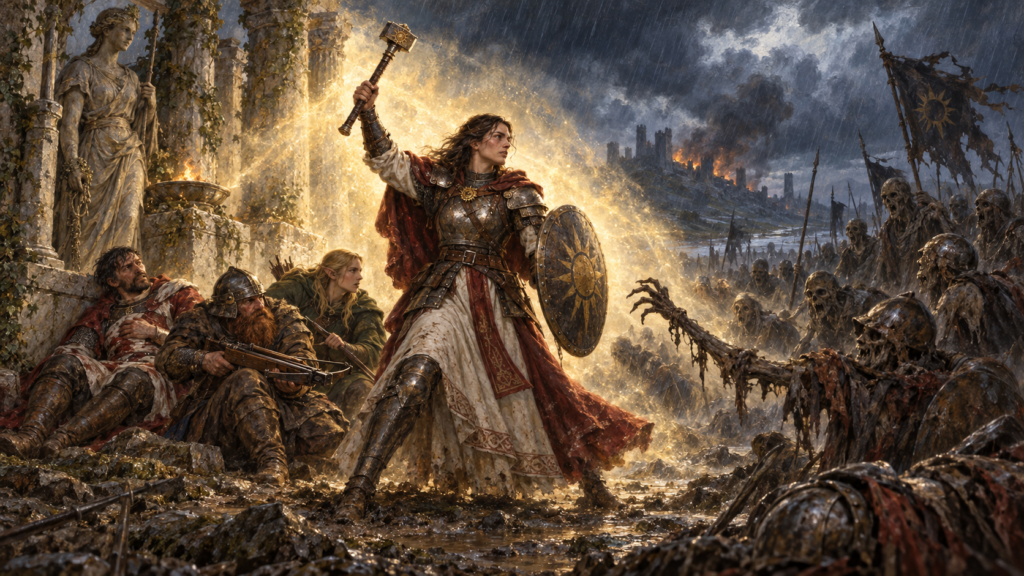
A cleric carries a god’s power into places a temple cannot reach. They heal the wounded, break curses, confront the restless dead, and decide what their faith demands when mercy and duty pull in different directions.
Cleric at a Glance
| Role | Divine spellcaster; healing, protection, judgment, and battlefield control |
|---|---|
| Primary ability | Wisdom; Constitution supports survival and concentration |
| Hit Die | d8 in all four editions below |
| Defining choice | A deity and sacred calling; one subclass in fifth edition, two domains in PF1e and 3.5e |
| Core tension | The needs of a community, the commands of a god, and the cost of keeping faith |
| Start here | Choose your edition • Create a cleric • Find a domain |
Cleric Class Rules
Choose the edition used at your table. Progression, spell preparation, armour training, domains, and the treatment of undead follow that edition’s rules. The Life Domain is included as a complete fifth-edition example; other domains are linked below.
5.5e Cleric — 2024 Rules
Core class and Life Domain: SRD 5.2.1. Subclass choice begins at level 3.
Core Traits and Starting Equipment
Hit points: 8 + Constitution modifier at level 1; 1d8 (or 5) + Constitution modifier for each later Cleric level. Saving throws: Wisdom and Charisma. Skills: choose two from History, Insight, Medicine, Persuasion, and Religion. Weapons: simple weapons. Armour: light and medium armour, and shields. Divine Order can add heavy armour and martial weapons.
Equipment: choose (A) a chain shirt, shield, mace, holy symbol, priest’s pack, and 7 GP; or (B) 110 GP. Add the equipment provided by your background.
| Level | PB | Features | Channel uses | Cantrips | Prepared spells | 1 | 2 | 3 | 4 | 5 | 6 | 7 | 8 | 9 |
|---|---|---|---|---|---|---|---|---|---|---|---|---|---|---|
| 1 | +2 | Spellcasting; Divine Order | — | 3 | 4 | 2 | — | — | — | — | — | — | — | — |
| 2 | +2 | Channel Divinity | 2 | 3 | 5 | 3 | — | — | — | — | — | — | — | — |
| 3 | +2 | Cleric subclass | 2 | 3 | 6 | 4 | 2 | — | — | — | — | — | — | — |
| 4 | +2 | Ability Score Improvement | 2 | 4 | 7 | 4 | 3 | — | — | — | — | — | — | — |
| 5 | +3 | Sear Undead | 2 | 4 | 9 | 4 | 3 | 2 | — | — | — | — | — | — |
| 6 | +3 | Subclass feature | 3 | 4 | 10 | 4 | 3 | 3 | — | — | — | — | — | — |
| 7 | +3 | Blessed Strikes | 3 | 4 | 11 | 4 | 3 | 3 | 1 | — | — | — | — | — |
| 8 | +3 | Ability Score Improvement | 3 | 4 | 12 | 4 | 3 | 3 | 2 | — | — | — | — | — |
| 9 | +4 | — | 3 | 4 | 14 | 4 | 3 | 3 | 3 | 1 | — | — | — | — |
| 10 | +4 | Divine Intervention | 3 | 5 | 15 | 4 | 3 | 3 | 3 | 2 | — | — | — | — |
| 11 | +4 | — | 3 | 5 | 16 | 4 | 3 | 3 | 3 | 2 | 1 | — | — | — |
| 12 | +4 | Ability Score Improvement | 3 | 5 | 16 | 4 | 3 | 3 | 3 | 2 | 1 | — | — | — |
| 13 | +5 | — | 3 | 5 | 17 | 4 | 3 | 3 | 3 | 2 | 1 | 1 | — | — |
| 14 | +5 | Improved Blessed Strikes | 3 | 5 | 17 | 4 | 3 | 3 | 3 | 2 | 1 | 1 | — | — |
| 15 | +5 | — | 3 | 5 | 18 | 4 | 3 | 3 | 3 | 2 | 1 | 1 | 1 | — |
| 16 | +5 | Ability Score Improvement | 3 | 5 | 18 | 4 | 3 | 3 | 3 | 2 | 1 | 1 | 1 | — |
| 17 | +6 | Subclass feature | 3 | 5 | 19 | 4 | 3 | 3 | 3 | 2 | 1 | 1 | 1 | 1 |
| 18 | +6 | — | 4 | 5 | 20 | 4 | 3 | 3 | 3 | 3 | 1 | 1 | 1 | 1 |
| 19 | +6 | Epic Boon | 4 | 5 | 21 | 4 | 3 | 3 | 3 | 3 | 2 | 1 | 1 | 1 |
| 20 | +6 | Greater Divine Intervention | 4 | 5 | 22 | 4 | 3 | 3 | 3 | 3 | 2 | 2 | 1 | 1 |
Table key: PB = proficiency bonus. Spell-slot columns are spell levels 1–9. Prepared spells exclude cantrips and spells always prepared by another Cleric feature. Thaumaturge adds one cantrip beyond the table.
Level 1: Spellcasting
You know three Cleric cantrips. Guidance, Sacred Flame, and Thaumaturgy are useful starting choices. At each Cleric level, you may replace one cantrip with another from the Cleric list. Learn another at levels 4 and 10.
Prepare four level 1 Cleric spells at level 1; thereafter use the Prepared Spells column. Choose spells of levels for which you have slots. You can change any prepared spells when you finish a Long Rest. Always-prepared spells from other Cleric features count as Cleric spells and do not use this allowance. Casting a prepared spell spends a slot of its level or higher; the spell remains prepared. All expended spell slots return after a Long Rest.
Spell save DC: 8 + PB + Wisdom modifier. Spell attack modifier: PB + Wisdom modifier. A holy symbol is your spellcasting focus. A prepared spell with the Ritual tag can be cast as a ritual under the general spellcasting rules. A ritual adds 10 minutes to casting and does not expend a slot.
Level 1: Divine Order
- Protector: gain martial weapon proficiency and heavy armour training.
- Thaumaturge: learn one additional Cleric cantrip. Add your Wisdom modifier (minimum +1) to Intelligence checks using Arcana or Religion.
Level 2: Channel Divinity
Each use creates one Cleric Channel Divinity effect. You start with two uses, gain a third at level 6 and a fourth at level 18. A Short Rest restores one expended use; a Long Rest restores all. Saving throws use your Cleric spell save DC.
- Divine Spark: as a Magic action, point your holy symbol at another creature you can see within 30 feet. Roll 1d8 + Wisdom modifier; either restore that many hit points or deal your choice of radiant or necrotic damage. For damage, the creature makes a Constitution save, taking half on a success. The dice increase to 2d8 at level 7, 3d8 at level 13, and 4d8 at level 18.
- Turn Undead: as a Magic action, present your holy symbol. Each undead you choose within 30 feet makes a Wisdom save. On failure, it is Frightened and Incapacitated for 1 minute and tries to move as far from you as it can on its turns. The effect ends for that creature if it takes damage, if you become Incapacitated, or if you die.
Level 3: Cleric Subclass
Choose a Cleric subclass. Gain its features at the stated levels: the Life Domain below grants features at 3, 6, and 17. Use the appropriate edition of a domain; older subclass features require the relevant compatibility rules.
Levels 4, 8, 12, and 16: Ability Score Improvement
Gain the Ability Score Improvement feat or another feat for which you qualify. The Ability Score Improvement feat raises one ability by 2 or two abilities by 1, to a maximum of 20.
Level 5: Sear Undead
When you use Turn Undead, you may roll a number of d8s equal to your Wisdom modifier (minimum 1d8). Each undead that fails the save takes radiant damage equal to the total. This damage does not end the turn effect.
Level 7: Blessed Strikes
Choose one benefit. If an older Cleric subclass also grants Divine Strike or Potent Spellcasting, use only the option selected here.
- Divine Strike: once on each of your turns, when you hit a creature with an attack roll using a weapon, deal an extra 1d8 radiant or necrotic damage (your choice).
- Potent Spellcasting: add your Wisdom modifier to the damage you deal with any Cleric cantrip.
Level 10: Divine Intervention
As a Magic action, choose a Cleric spell of level 5 or lower that does not require a Reaction to cast. Cast it as part of that action without a spell slot or material components. You regain this feature after a Long Rest.
Level 14: Improved Blessed Strikes
- Divine Strike: the extra damage becomes 2d8.
- Potent Spellcasting: when a Cleric cantrip you cast damages a creature, you can give yourself or another creature within 60 feet temporary hit points equal to twice your Wisdom modifier.
Level 19: Epic Boon
Gain an Epic Boon feat or another feat for which you qualify. Boon of Fate is the SRD recommendation.
Level 20: Greater Divine Intervention
You may select Wish with Divine Intervention. If you do, you cannot use Divine Intervention again until you finish 2d4 Long Rests. Apply Wish’s own rules, including the stress associated with uses beyond duplicating a spell.
Life Domain — 2024
A Life Cleric can serve a deity of healing, agriculture, endurance, or community. This domain begins at level 3 and does not independently grant heavy armour.
| Cleric level | Spells |
|---|---|
| 3 | Aid, Bless, Cure Wounds, Lesser Restoration |
| 5 | Mass Healing Word, Revivify |
| 7 | Aura of Life, Death Ward |
| 9 | Greater Restoration, Mass Cure Wounds |
- Level 3 — Disciple of Life: when a spell cast with a spell slot restores hit points to a creature, that creature regains extra hit points on the turn you cast it equal to 2 + the slot’s level.
- Level 3 — Preserve Life: as a Magic action, present your holy symbol and spend one Channel Divinity use. Divide a healing pool equal to five times your Cleric level among Bloodied creatures within 30 feet, including yourself if desired. Each recipient can be healed only up to half its hit point maximum. Bloodied means at half maximum hit points or fewer.
- Level 6 — Blessed Healer: immediately after you cast a spell with a slot that restores hit points to one or more creatures other than yourself, regain hit points equal to 2 + the slot’s level.
- Level 17 — Supreme Healing: when a spell or Channel Divinity would roll dice to restore hit points, use the maximum result for each healing die.
Multiclassing: Wisdom 13 is required to enter or leave Cleric through multiclassing. Entering Cleric grants its Hit Point Die, light and medium armour training, shields, and level 1 features; it does not grant the class’s starting saving throw or skill proficiencies. Use the multiclass spell-slot rules and prepare Cleric spells according to your Cleric level.
2024 Cleric rules, spell list, and Life Domain — SRD 5.2.1, pp. 36–40
5e Cleric — 2014 Rules
Core class and Life Domain: SRD 5.1. Divine Domain is chosen at level 1.
Hit Points and Proficiencies
Hit points: 8 + Constitution modifier at level 1; 1d8 (or 5) + Constitution modifier for each later Cleric level. Saving throws: Wisdom and Charisma. Skills: choose two from History, Insight, Medicine, Persuasion, and Religion. Weapons: simple weapons. Armour: light and medium armour, and shields. Tools: none. A domain may add proficiencies.
Starting equipment: a mace or a warhammer if proficient; scale mail, leather armour, or chain mail if proficient; a light crossbow with 20 bolts or any simple weapon; a priest’s pack or explorer’s pack; a shield and holy symbol. Add your background equipment.
| Level | PB | Features | Channel uses | Cantrips | 1 | 2 | 3 | 4 | 5 | 6 | 7 | 8 | 9 |
|---|---|---|---|---|---|---|---|---|---|---|---|---|---|
| 1 | +2 | Spellcasting; Divine Domain | — | 3 | 2 | — | — | — | — | — | — | — | — |
| 2 | +2 | Channel Divinity; domain feature | 1 | 3 | 3 | — | — | — | — | — | — | — | — |
| 3 | +2 | — | 1 | 3 | 4 | 2 | — | — | — | — | — | — | — |
| 4 | +2 | Ability Score Improvement | 1 | 4 | 4 | 3 | — | — | — | — | — | — | — |
| 5 | +3 | Destroy Undead (CR ½) | 1 | 4 | 4 | 3 | 2 | — | — | — | — | — | — |
| 6 | +3 | Domain feature | 2 | 4 | 4 | 3 | 3 | — | — | — | — | — | — |
| 7 | +3 | — | 2 | 4 | 4 | 3 | 3 | 1 | — | — | — | — | — |
| 8 | +3 | Ability Score Improvement; domain feature; Destroy Undead (CR 1) | 2 | 4 | 4 | 3 | 3 | 2 | — | — | — | — | — |
| 9 | +4 | — | 2 | 4 | 4 | 3 | 3 | 3 | 1 | — | — | — | — |
| 10 | +4 | Divine Intervention | 2 | 5 | 4 | 3 | 3 | 3 | 2 | — | — | — | — |
| 11 | +4 | Destroy Undead (CR 2) | 2 | 5 | 4 | 3 | 3 | 3 | 2 | 1 | — | — | — |
| 12 | +4 | Ability Score Improvement | 2 | 5 | 4 | 3 | 3 | 3 | 2 | 1 | — | — | — |
| 13 | +5 | — | 2 | 5 | 4 | 3 | 3 | 3 | 2 | 1 | 1 | — | — |
| 14 | +5 | Destroy Undead (CR 3) | 2 | 5 | 4 | 3 | 3 | 3 | 2 | 1 | 1 | — | — |
| 15 | +5 | — | 2 | 5 | 4 | 3 | 3 | 3 | 2 | 1 | 1 | 1 | — |
| 16 | +5 | Ability Score Improvement | 2 | 5 | 4 | 3 | 3 | 3 | 2 | 1 | 1 | 1 | — |
| 17 | +6 | Domain feature; Destroy Undead (CR 4) | 2 | 5 | 4 | 3 | 3 | 3 | 2 | 1 | 1 | 1 | 1 |
| 18 | +6 | Channel Divinity (3/rest) | 3 | 5 | 4 | 3 | 3 | 3 | 3 | 1 | 1 | 1 | 1 |
| 19 | +6 | Ability Score Improvement | 3 | 5 | 4 | 3 | 3 | 3 | 3 | 2 | 1 | 1 | 1 |
| 20 | +6 | Divine Intervention improvement | 3 | 5 | 4 | 3 | 3 | 3 | 3 | 2 | 2 | 1 | 1 |
Table key: PB = proficiency bonus. Channel uses are regained in full after a short or long rest. Spell-slot columns cover spell levels 1–9.
Level 1: Spellcasting
Know three Cleric cantrips, increasing to four at level 4 and five at level 10. The core 2014 class does not grant routine cantrip replacement on gaining a level.
Prepare a number of Cleric spells equal to your Wisdom modifier + Cleric level (minimum one), choosing spells of levels for which you have spell slots. Domain spells are always prepared and do not count against this number. You may change your prepared list after a long rest; preparing a new list takes at least 1 minute of prayer and meditation per spell level for each spell on it. Casting a prepared spell expends a slot of its level or higher without removing it from your prepared list. Regain all spell slots after a long rest.
Spell save DC: 8 + PB + Wisdom modifier. Spell attack modifier: PB + Wisdom modifier. Use a holy symbol as a focus. You may cast a prepared Cleric spell with the ritual tag as a ritual, adding 10 minutes to casting and expending no slot.
Level 1: Divine Domain
Choose one domain associated with your deity. It grants initial features and domain spells at level 1, an additional Channel Divinity option at level 2, and further features at levels 6, 8, and 17. Always-prepared domain spells count as Cleric spells even if absent from the general Cleric list.
Level 2: Channel Divinity
Each use creates either Turn Undead or an effect provided by your domain. You have one use between rests, increasing to two at level 6 and three at level 18. A short or long rest restores all expended uses. Effects requiring saves use your Cleric spell save DC.
Turn Undead: as an action, present your holy symbol and speak a prayer. Every undead within 30 feet that can see or hear you makes a Wisdom save. Failure turns it for 1 minute or until it takes any damage. It spends its turns trying to move as far away as possible, cannot willingly move within 30 feet of you, and cannot take reactions. Its action is limited to Dash or escaping an effect preventing movement; if it has nowhere to move, it may Dodge.
Levels 4, 8, 12, 16, and 19: Ability Score Improvement
Raise one ability score by 2 or two by 1, to a maximum of 20. If the table uses the optional feat rules, you may choose a feat instead.
Level 5: Destroy Undead
An undead that fails its save against Turn Undead is instantly destroyed if its challenge rating is at or below your threshold.
| Cleric level | Maximum undead CR |
|---|---|
| 5 | ½ |
| 8 | 1 |
| 11 | 2 |
| 14 | 3 |
| 17 | 4 |
Level 10: Divine Intervention
As an action, describe the aid you seek and roll percentile dice. The deity intervenes if the result is equal to or below your Cleric level. The DM chooses the intervention; a Cleric spell or domain spell is an appropriate effect. After a successful intervention, this feature is unavailable for 7 days. If the roll fails, it is available after your next long rest. At level 20, intervention succeeds automatically.
Life Domain — 2014
| Cleric level | Spells |
|---|---|
| 1 | Bless, Cure Wounds |
| 3 | Lesser Restoration, Spiritual Weapon |
| 5 | Beacon of Hope, Revivify |
| 7 | Death Ward, Guardian of Faith |
| 9 | Mass Cure Wounds, Raise Dead |
- Level 1 — Bonus Proficiency: heavy armour.
- Level 1 — Disciple of Life: when you use a spell of level 1 or higher to restore hit points to a creature, restore additional hit points equal to 2 + the spell’s level.
- Level 2 — Preserve Life: as an action, present your holy symbol and spend Channel Divinity. Divide a healing pool of five times your Cleric level among creatures within 30 feet. Each creature can be healed only up to half its hit point maximum. Undead and constructs cannot receive this healing.
- Level 6 — Blessed Healer: when you cast a level 1 or higher spell that restores hit points to a creature other than yourself, regain hit points equal to 2 + the spell’s level.
- Level 8 — Divine Strike: once on each of your turns when you hit a creature with a weapon attack, add 1d8 radiant damage; increase this to 2d8 at level 14.
- Level 17 — Supreme Healing: use the maximum result of each die when a spell restores hit points. The core 2014 feature applies to spells.
Multiclassing: Wisdom 13 is required to enter or leave Cleric. Entering the class grants light armour, medium armour, and shields, plus its level 1 features, but not its starting saving throw or skill proficiencies. Combine spellcasting levels for slots under the multiclass rules while preparing Cleric spells according to your Cleric level.
Pathfinder 1e Cleric
Core Rulebook class. This Cleric uses Channel Energy and two domains.
Class Basics
Hit Die: d8. Alignment: within one step of your deity on either the law–chaos or good–evil axis. Starting wealth: 4d6 × 10 gp (average 140 gp). Skills per level: 2 + Intelligence modifier (minimum 1). Proficiencies: simple weapons, your deity’s favoured weapon, light and medium armour, and shields except tower shields.
Class skills: Appraise (Int), Craft (Int), Diplomacy (Cha), Heal (Wis), Knowledge—arcana, history, nobility, planes, religion (Int), Linguistics (Int), Profession (Wis), Sense Motive (Wis), and Spellcraft (Int). Domains may add class skills. Concentration is a caster-level check in PF1e, rather than a skill.
| Level | BAB | Fort | Ref | Will | Features | 0 | 1 | 2 | 3 | 4 | 5 | 6 | 7 | 8 | 9 |
|---|---|---|---|---|---|---|---|---|---|---|---|---|---|---|---|
| 1st | +0 | +2 | +0 | +2 | Aura, channel energy 1d6, domains, orisons | 3 | 1+1 | — | — | — | — | — | — | — | — |
| 2nd | +1 | +3 | +0 | +3 | — | 4 | 2+1 | — | — | — | — | — | — | — | — |
| 3rd | +2 | +3 | +1 | +3 | Channel energy 2d6 | 4 | 2+1 | 1+1 | — | — | — | — | — | — | — |
| 4th | +3 | +4 | +1 | +4 | — | 4 | 3+1 | 2+1 | — | — | — | — | — | — | — |
| 5th | +3 | +4 | +1 | +4 | Channel energy 3d6 | 4 | 3+1 | 2+1 | 1+1 | — | — | — | — | — | — |
| 6th | +4 | +5 | +2 | +5 | — | 4 | 3+1 | 3+1 | 2+1 | — | — | — | — | — | — |
| 7th | +5 | +5 | +2 | +5 | Channel energy 4d6 | 4 | 4+1 | 3+1 | 2+1 | 1+1 | — | — | — | — | — |
| 8th | +6/+1 | +6 | +2 | +6 | — | 4 | 4+1 | 3+1 | 3+1 | 2+1 | — | — | — | — | — |
| 9th | +6/+1 | +6 | +3 | +6 | Channel energy 5d6 | 4 | 4+1 | 4+1 | 3+1 | 2+1 | 1+1 | — | — | — | — |
| 10th | +7/+2 | +7 | +3 | +7 | — | 4 | 4+1 | 4+1 | 3+1 | 3+1 | 2+1 | — | — | — | — |
| 11th | +8/+3 | +7 | +3 | +7 | Channel energy 6d6 | 4 | 4+1 | 4+1 | 4+1 | 3+1 | 2+1 | 1+1 | — | — | — |
| 12th | +9/+4 | +8 | +4 | +8 | — | 4 | 4+1 | 4+1 | 4+1 | 3+1 | 3+1 | 2+1 | — | — | — |
| 13th | +9/+4 | +8 | +4 | +8 | Channel energy 7d6 | 4 | 4+1 | 4+1 | 4+1 | 4+1 | 3+1 | 2+1 | 1+1 | — | — |
| 14th | +10/+5 | +9 | +4 | +9 | — | 4 | 4+1 | 4+1 | 4+1 | 4+1 | 3+1 | 3+1 | 2+1 | — | — |
| 15th | +11/+6/+1 | +9 | +5 | +9 | Channel energy 8d6 | 4 | 4+1 | 4+1 | 4+1 | 4+1 | 4+1 | 3+1 | 2+1 | 1+1 | — |
| 16th | +12/+7/+2 | +10 | +5 | +10 | — | 4 | 4+1 | 4+1 | 4+1 | 4+1 | 4+1 | 3+1 | 3+1 | 2+1 | — |
| 17th | +12/+7/+2 | +10 | +5 | +10 | Channel energy 9d6 | 4 | 4+1 | 4+1 | 4+1 | 4+1 | 4+1 | 4+1 | 3+1 | 2+1 | 1+1 |
| 18th | +13/+8/+3 | +11 | +6 | +11 | — | 4 | 4+1 | 4+1 | 4+1 | 4+1 | 4+1 | 4+1 | 3+1 | 3+1 | 2+1 |
| 19th | +14/+9/+4 | +11 | +6 | +11 | Channel energy 10d6 | 4 | 4+1 | 4+1 | 4+1 | 4+1 | 4+1 | 4+1 | 4+1 | 3+1 | 3+1 |
| 20th | +15/+10/+5 | +12 | +6 | +12 | — | 4 | 4+1 | 4+1 | 4+1 | 4+1 | 4+1 | 4+1 | 4+1 | 4+1 | 4+1 |
Table key: BAB = base attack bonus. Fort, Ref, and Will are base saves. “+1” is one domain-only spell slot at that spell level, shared between your two domains. Add bonus spells for a high Wisdom score separately. Column 0 gives prepared orisons, which are reusable.
Aura (Ex)
A Cleric serving a chaotic, evil, good, or lawful deity radiates a powerful aura of the corresponding alignment, as described by detection spells.
Divine Spellcasting
Choose and prepare spells from the Cleric list. To prepare or cast a spell, Wisdom must be at least 10 + spell level. Save DC: 10 + spell level + Wisdom modifier. The table gives your base daily allotment; high Wisdom adds bonus spells. Choose a daily time for 1 hour of prayer or meditation to regain and prepare spells. You may select any Cleric spell of a level you can cast, subject to alignment restrictions.
Orisons: prepare three level 0 spells at level 1 and four from level 2 onward. An orison is not expended when cast. Concentration: roll d20 + caster level + Wisdom modifier when circumstances demand a concentration check; the situation determines its DC.
Channel Energy (Su)
A good Cleric, or a Cleric of a good deity, channels positive energy; an evil Cleric, or a Cleric of an evil deity, channels negative energy. A neutral Cleric of a neutral deity, or one without a specific deity, chooses positive or negative at character creation. This choice is permanent and determines spontaneous cure or inflict casting.
As a standard action that does not provoke attacks of opportunity, present your holy symbol and release a 30-foot-radius burst centred on yourself. Choose one effect: positive energy heals living creatures or damages undead; negative energy damages living creatures or heals undead. It affects all creatures of the selected type in the burst; you may choose whether to include yourself. It does not both heal one type and damage another in the same use.
Roll 1d6 at level 1, adding 1d6 every two Cleric levels thereafter, to a maximum of 10d6 at level 19. Targets taking damage make a Will save for half: DC 10 + half your Cleric level (round down) + Charisma modifier. Healing cannot exceed maximum hit points. Uses per day equal 3 + Charisma modifier. Core Channel Energy deals hit point damage or healing; feats may give it turning or commanding effects.
Deity, Domains, and Domain Spells
Choose two domains belonging to your deity. An alignment domain—Chaos, Evil, Good, or Law—requires your own matching alignment. With GM approval, a Cleric of a divine ideal may choose two domains representing that ideal. Gain the level-appropriate powers of both domains; a domain power takes a standard action unless stated otherwise.
Each spell level you can cast from level 1 onward grants one domain slot. Prepare either domain’s spell of that level in it. A domain spell absent from the general Cleric list can be prepared only in that domain slot. You cannot convert domain spells through spontaneous casting. Use PF1e domain powers and spell lists from the Pathfinder domain reference and the domain directory.
Spontaneous Casting
A good Cleric, or neutral Cleric of a good deity, may give up a prepared spell other than an orison or domain spell to cast a cure spell of the same level or lower. An evil Cleric, or neutral Cleric of an evil deity, instead converts to inflict spells. A Cleric who is neutral and has a neutral deity chooses cure or inflict permanently, matching the chosen energy type. “Cure” and “inflict” mean spells with those words in their names.
Alignment Spells, Languages, and Ex-Clerics
You cannot cast a spell whose alignment descriptor opposes your own alignment or your deity’s. Celestial, Abyssal, and Infernal are available as bonus languages in addition to those granted by your ancestry. Grossly violating your deity’s code removes spells and class features, retaining armour, shield, and simple weapon proficiencies. Further Cleric advancement in that faith requires atonement.
PF1e Cleric source and optional archetypes, favoured class bonuses, and alternate capstones • PF1e Cleric spell list
D&D 3.5e Cleric
Core SRD class. This Cleric uses two domains and turn or rebuke undead.
Class Basics
Hit Die: d8. Alignment: within one step of your deity on either the law–chaos or good–evil axis, but not both. A Cleric may be true neutral only if the deity is also true neutral. Skill points: (2 + Intelligence modifier) × 4 at level 1; 2 + Intelligence modifier at each later level, with a minimum of 1 before the first-level multiplier.
Proficiencies: all simple weapons; light, medium, and heavy armour; shields except tower shields. The War domain grants Weapon Focus with the deity’s weapon and Martial Weapon Proficiency with it if applicable. A deity’s favoured weapon is not otherwise an automatic class proficiency.
Class skills: Concentration (Con), Craft (Int), Diplomacy (Cha), Heal (Wis), Knowledge—arcana, history, religion, the planes (Int), Profession (Wis), and Spellcraft (Int).
- Animal or Plant domain adds Knowledge (nature).
- Knowledge domain adds all Knowledge skills.
- Travel domain adds Survival.
- Trickery domain adds Bluff, Disguise, and Hide.
| Level | BAB | Fort | Ref | Will | Features | 0 | 1 | 2 | 3 | 4 | 5 | 6 | 7 | 8 | 9 |
|---|---|---|---|---|---|---|---|---|---|---|---|---|---|---|---|
| 1st | +0 | +2 | +0 | +2 | Aura; spells; domains; turn or rebuke undead | 3 | 1+1 | — | — | — | — | — | — | — | — |
| 2nd | +1 | +3 | +0 | +3 | — | 4 | 2+1 | — | — | — | — | — | — | — | — |
| 3rd | +2 | +3 | +1 | +3 | — | 4 | 2+1 | 1+1 | — | — | — | — | — | — | — |
| 4th | +3 | +4 | +1 | +4 | — | 5 | 3+1 | 2+1 | — | — | — | — | — | — | — |
| 5th | +3 | +4 | +1 | +4 | — | 5 | 3+1 | 2+1 | 1+1 | — | — | — | — | — | — |
| 6th | +4 | +5 | +2 | +5 | — | 5 | 3+1 | 3+1 | 2+1 | — | — | — | — | — | — |
| 7th | +5 | +5 | +2 | +5 | — | 6 | 4+1 | 3+1 | 2+1 | 1+1 | — | — | — | — | — |
| 8th | +6/+1 | +6 | +2 | +6 | — | 6 | 4+1 | 3+1 | 3+1 | 2+1 | — | — | — | — | — |
| 9th | +6/+1 | +6 | +3 | +6 | — | 6 | 4+1 | 4+1 | 3+1 | 2+1 | 1+1 | — | — | — | — |
| 10th | +7/+2 | +7 | +3 | +7 | — | 6 | 4+1 | 4+1 | 3+1 | 3+1 | 2+1 | — | — | — | — |
| 11th | +8/+3 | +7 | +3 | +7 | — | 6 | 5+1 | 4+1 | 4+1 | 3+1 | 2+1 | 1+1 | — | — | — |
| 12th | +9/+4 | +8 | +4 | +8 | — | 6 | 5+1 | 4+1 | 4+1 | 3+1 | 3+1 | 2+1 | — | — | — |
| 13th | +9/+4 | +8 | +4 | +8 | — | 6 | 5+1 | 5+1 | 4+1 | 4+1 | 3+1 | 2+1 | 1+1 | — | — |
| 14th | +10/+5 | +9 | +4 | +9 | — | 6 | 5+1 | 5+1 | 4+1 | 4+1 | 3+1 | 3+1 | 2+1 | — | — |
| 15th | +11/+6/+1 | +9 | +5 | +9 | — | 6 | 5+1 | 5+1 | 5+1 | 4+1 | 4+1 | 3+1 | 2+1 | 1+1 | — |
| 16th | +12/+7/+2 | +10 | +5 | +10 | — | 6 | 5+1 | 5+1 | 5+1 | 4+1 | 4+1 | 3+1 | 3+1 | 2+1 | — |
| 17th | +12/+7/+2 | +10 | +5 | +10 | — | 6 | 5+1 | 5+1 | 5+1 | 5+1 | 4+1 | 4+1 | 3+1 | 2+1 | 1+1 |
| 18th | +13/+8/+3 | +11 | +6 | +11 | — | 6 | 5+1 | 5+1 | 5+1 | 5+1 | 4+1 | 4+1 | 3+1 | 3+1 | 2+1 |
| 19th | +14/+9/+4 | +11 | +6 | +11 | — | 6 | 5+1 | 5+1 | 5+1 | 5+1 | 5+1 | 4+1 | 4+1 | 3+1 | 3+1 |
| 20th | +15/+10/+5 | +12 | +6 | +12 | — | 6 | 5+1 | 5+1 | 5+1 | 5+1 | 5+1 | 4+1 | 4+1 | 4+1 | 4+1 |
Table key: BAB = base attack bonus. Saves are base bonuses. “+1” is a domain slot shared by your two domains, in addition to Wisdom bonus spells. Level 0 spells are expended when cast in 3.5e.
Aura (Ex)
A Cleric of a chaotic, evil, good, or lawful deity has a powerful matching alignment aura. A Cleric without a deity who chooses Chaos, Evil, Good, or Law has the corresponding aura.
Divine Spellcasting
Prepare divine spells from the Cleric list in advance. Wisdom must be at least 10 + the spell’s level to prepare or cast it. Spell save DC: 10 + spell level + Wisdom modifier. Add high-Wisdom bonus spells to the table’s daily allotment. Set aside 1 hour at your chosen daily time for prayer or contemplation to regain spells; resting by itself does not replenish them. You can prepare any Cleric spell of a level you can cast, within alignment restrictions.
Deity, Domains, and Domain Spells
Choose two domains offered by your deity, gaining both granted powers. Chaos, Evil, Good, and Law domains require your own corresponding alignment. A Cleric without a particular deity chooses two domains representing their spiritual inclinations, subject to the same alignment restrictions.
At every spell level from 1 upward that you can cast, prepare one of your two domains’ spells in your single domain slot. A domain spell absent from the Cleric list can be prepared only in that slot. Use the 3.5e version of each power and spell list in the domain directory or 3.5e domain reference.
Spontaneous Casting
A good Cleric, or neutral Cleric of a good deity, can give up a prepared non-domain spell to cast a cure spell of the same level or lower. An evil Cleric, or neutral Cleric of an evil deity, converts to inflict spells instead. A Cleric who is neither good nor evil and has a deity that is neither good nor evil chooses cure or inflict permanently. This determines whether they turn or rebuke undead. A cure or inflict spell has the corresponding word in its name.
Turn or Rebuke Undead (Su)
Use this ability 3 + Charisma modifier times per day. Good Clerics and neutral Clerics of good deities turn or destroy undead; evil Clerics and neutral Clerics of evil deities rebuke or command them. A neutral Cleric of a neutral deity makes a permanent choice, matching spontaneous casting. Having at least 5 ranks in Knowledge (religion) adds +2 to turning checks against undead.
- Present your symbol: a standard action that does not provoke attacks of opportunity. Affect undead within 60 feet, nearest first. You need line of effect; total cover prevents turning. Line of sight is not required.
- Turning check: roll d20 + Charisma modifier, plus applicable bonuses. The result gives the maximum individual Hit Dice you can affect, using the table below.
- Turning damage: roll 2d6 + Cleric level + Charisma modifier. This is the total number of undead Hit Dice affected, not hit point damage. Undead too powerful for your check are unaffected; you may skip already-turned undead.
| Check result | Maximum individual undead HD |
|---|---|
| 0 or lower | Cleric level − 4 |
| 1–3 | Cleric level − 3 |
| 4–6 | Cleric level − 2 |
| 7–9 | Cleric level − 1 |
| 10–12 | Cleric level |
| 13–15 | Cleric level + 1 |
| 16–18 | Cleric level + 2 |
| 19–21 | Cleric level + 3 |
| 22 or higher | Cleric level + 4 |
Turned: flee for 10 rounds, or cower if unable to flee. Approaching within 10 feet ends the effect; merely remaining within 10 feet does not. Attacks by others, and your ranged attacks from at least 10 feet away, do not break turning. If your Cleric level is at least twice the undead’s HD, destroy it instead of turning it.
Rebuked: cower in awe for 10 rounds; attacks against them gain +2. An undead that would have been destroyed is instead commanded. You can command total undead HD up to your Cleric level; giving mental orders takes a standard action. You may relinquish control to command new undead.
Dispelling turning: a negative-energy Cleric may make a turning check at least as high as the original check to end turning, affecting total HD determined by turning damage. Bolstering: instead use the check’s maximum-HD result as the undead’s effective HD against turning, if higher than its actual HD, for 10 rounds. An undead Cleric may bolster itself. Under these edition rules, positive-energy turning is a good act and negative-energy rebuking is an evil act.
Alignment Spells, Languages, and Ex-Clerics
You cannot cast spells with an alignment descriptor opposed to your alignment or your deity’s. Bonus language choices include Celestial, Abyssal, and Infernal alongside your ancestry’s languages. Grossly violating your deity’s code removes all spells and class features except armour, shield, and simple weapon proficiencies. You cannot gain further Cleric levels in that faith until you atone.
3.5e Cleric source • Full turning and rebuking reference • 3.5e Cleric spell list
Creating and Playing a Cleric
Choose the Faith Before the Armour
Choose the power you serve, the people you answer to, and one duty you will keep even when it becomes inconvenient. A temple healer, an itinerant shrine keeper, a keeper of funerary rites, and an armoured champion can all be Clerics. Ordinary priesthood and the Cleric class need not coincide: many priests have no adventuring magic, while a chosen wanderer may hold no temple office.
- Choose your edition: use one rules panel consistently.
- Choose a deity and calling: browse the gods and pantheons, then read the deity’s domains, sacred duties, and relationships. In PF1e and 3.5e, check alignment and select two valid domains; in fifth edition, select the appropriate subclass at its starting level.
- Set abilities: prioritise Wisdom. Constitution helps you remain standing and maintain concentration. Strength supports heavier armour and melee weapons; Dexterity suits lighter equipment. In PF1e and 3.5e, Charisma also matters for channeling or turning.
- Choose a background: decide how you learned ritual, whom you served, and why you left. Use your edition’s actual background or skill rules.
- Check equipment: choose armour and weapons you can use proficiently. A cultural weapon name or sacred symbol does not grant proficiency, a magic item, or a mechanical bonus.
- Prepare for the party: carry useful protection, restoration, and exploration magic alongside healing. Record domain spells, channel uses, material components, and concentration limits separately.
A Useful First Spell Selection
In fifth edition, Guidance, Sacred Flame, and Thaumaturgy cover aid, an attack option, and ritual presence. At level 1, Bless supports the party’s attacks and saves; Cure Wounds or Healing Word supplies healing; Guiding Bolt supplies ranged pressure; Shield of Faith can protect an exposed ally. A 2024 Cleric can prepare four ordinary spells at level 1; a 2014 Cleric uses Wisdom modifier + level. Use the Cleric spell list and read your edition’s spell text: casting times, healing dice, components, and concentration requirements can differ.
In PF1e and 3.5e, remember that an ordinary prepared spell is committed to its slot until cast or converted. A domain slot has its own restrictions. Plan daily preparation around what you expect to encounter, leaving restoration and travel problems room beside combat spells.
At the Table
- Before danger: ask about hazards, prepare counters, and determine who carries costly components for revival or restoration.
- In battle: protect concentration, use terrain, and weigh whether preventing damage will help more than repairing it. Keep an answer for a fallen companion, but do not assume every turn must be spent healing.
- Against undead: check the edition. A 2024 turn can incapacitate chosen undead; a 2014 turn affects those that see or hear you; PF1e Channel Energy can damage a whole burst; 3.5e turning uses individual and total HD limits.
- Outside battle: use divination, diplomacy, ritual knowledge, curse removal, and funerary duties to make the faith part of the party’s decisions.
- Between adventures: decide who needs your service and what resources a temple actually controls. A religious title does not automatically grant political authority, wealth, followers, or access to every sanctuary.
Faith, Disagreement, and the Party
Give your Cleric a clear doctrine and room to make choices. A healer may refuse to abandon an enemy’s wounded; a judge may insist on evidence before punishment; a servant of the dead may oppose careless resurrection. Agree with the group how these convictions create decisions everyone can play through. Apply loss-of-power and atonement rules where the chosen edition actually specifies them; do not silently add older-edition restrictions to fifth edition.
Clerics in the World
The gods have distinct interests, and their priesthoods give those interests a place in daily life. A cure offered in a harvest shrine, an oath witnessed at a war god’s altar, and a burial conducted beside a river all establish different relationships between worshipper, community, and divine power. A Cleric’s daily work can be as concrete as maintaining a sanctuary, teaching rites, tending a sick household, guarding a pilgrimage road, or seeing that the dead receive their due.
Clerics at Work
The Cleric’s faith belongs to the places through which the party travels. A devotee of Apollo can centre their calling on prophecy and healing; a servant of Anubis on funerary rites and the care of the dead. In Tenochtitlan, Huītzilōpōchtli’s priesthood binds worship to war, sacrifice, and the city’s survival. These are different obligations, even when the characters share a class. A sacred duty might send a Cleric beyond the temple to seek an answer, protect a burial, or defend the people who rely on the god’s favour.
Calling and Training
Some Clerics learn within temples, where repeated service teaches liturgy, medicine, law, and the care of sacred objects. Others inherit local ritual knowledge, study under a travelling teacher, or answer a revelation outside established institutions. Choose whether your authority rests on ordination, communal trust, demonstrated miracles, or a personal calling that others still dispute.
Temples, Courts, and Communities
A city sanctuary can possess stores, lands, archives, and obligations to rulers. A village shrine may depend on seasonal offerings and the labour of a few households. Neither makes every Cleric a commander. Establish who appoints clergy, who funds the rites, who can seek sanctuary, and who is responsible when divine help does not arrive. These answers explain why a priest leaves for an adventure and what waits when they return.
Rival Faiths and Shared Duties
Devotion to one god does not require denying all others. A sea voyage, marriage, harvest, and burial can call for different rites. Rival temples may compete over patronage or the meaning of an omen while still cooperating during famine or invasion. The important disagreement is concrete: whose law governs the oath, who guards the grave, or what price is acceptable for victory.
Cleric, Paladin, and Druid
The Cleric’s defining strength is divine spellcasting shaped by faith and domain. A Paladin centres their adventuring role on an oath and martial commitment. A Druid centres their calling on the natural world. A sanctuary can contain all three, each with different class rules and duties.
Traditions of Service
Temple guardians, diviners, funerary specialists, monastics, and healers all carry divine duties. Their clothing, ritual tools, weapons, and obligations differ, but each must decide what faithful service demands beyond the sanctuary.
Cleric Traditions and Sacred Callings
Use these as character concepts. Equipment must follow your edition’s proficiency and starting-wealth rules. The domain and background names are themes; select an available subclass, domain, or background rather than gaining extra abilities from this list.
Armoured Temple Guardian
- Inspiration: Guardian of a European temple or pilgrimage route
- Background themes: Acolyte, Soldier, Noble
- Primary arms: Longsword, Warhammer, Mace
- Secondary arms: Heavy Crossbow, Dagger
- Armour ideas: Chain Mail, Splint, Plate; Shield
- Equipment ideas: Holy symbol emblazoned on shield or worn as an amulet; religious texts; prayer beads
- Domain themes: War, Light
- Sacred associations: Mars (Roman god of war), Tyr (Norse god of justice), Athena (Greek goddess of wisdom and warfare)
Sōhei (Japanese Warrior Monk)
- Inspiration: Japan; inspired by Buddhist warrior monks of feudal Japan
- Background themes: Acolyte, Hermit, Soldier
- Primary arms: Naginata (use glaive stats), Katana (use longsword stats)
- Secondary arms: Shortbow, Handaxe
- Armour ideas: Padded or Leather Armor; often no armor to allow for mobility
- Equipment ideas: Prayer beads, temple robes, incense
- Domain themes: Tempest, Peace
- Sacred associations: Hachiman (Shinto god of war), Bishamonten (Buddhist god of warriors)
Oracle (Ancient Greek Seer)
- Inspiration: Greece; inspired by the Pythia and other Delphic prophets
- Background themes: Sage, Hermit, Acolyte
- Primary arms: Quarterstaff, Dagger
- Secondary arms: Sling
- Armour ideas: None; ceremonial robes and sandals
- Equipment ideas: Laurel wreath, incense burner, divination tools
- Domain themes: Knowledge, Light
- Sacred associations: Apollo (Greek god of prophecy), Themis (Greek goddess of divine law)
Babalawo (Yoruba Diviner)
- Inspiration: Yoruba regions of West Africa; inspired by Ifá priests of Yoruba culture
- Background themes: Sage, Hermit, Acolyte
- Primary arms: Staff, Javelin
- Secondary arms: Dagger
- Armour ideas: None; ceremonial robes
- Equipment ideas: Divination tray (opon Ifá), cowrie shells, sacred texts
- Domain themes: Grave, Knowledge
- Sacred associations: Orunmila (Yoruba deity of wisdom and divination), Esu (Yoruba trickster deity and messenger)
Bhikkhu (Buddhist Monk)
- Inspiration: South and Southeast Asia; inspired by Theravāda Buddhist monastics
- Background themes: Hermit, Acolyte, Sage
- Primary arms: Quarterstaff
- Secondary arms: Sling
- Armour ideas: None; traditional monastic robes
- Equipment ideas: Dharma wheel pendant, alms bowl, meditation beads
- Domain themes: Peace, Twilight
- Sacred associations: A monastic ideal of compassion and discipline; Avalokiteśvara is a devotional inspiration. Use a non-deity Cleric only where the edition and DM permit it
Sangoma (Southern African Healer)
- Inspiration: Southern Africa; inspired by Zulu and Xhosa traditional healers
- Background themes: Folk Hero, Hermit, Acolyte
- Primary arms: Spear, Club
- Secondary arms: Dagger
- Armour ideas: Hide Armor; traditional garments
- Equipment ideas: Ancestral totem (bone necklace), herbalism kit, drums
- Domain themes: Life, Grave
- Sacred associations: Unkulunkulu (Zulu creator deity), Nomkhubulwane (Zulu goddess of rain and fertility)
Zulu healer variation: a knobkerrie (club), spear, throwing knives, beaded garments, ancestral divination bones, herbal mixtures, and a drum. Ancestors can be central to the character’s obligations.
Völva (Norse Seeress)
- Inspiration: Scandinavia; inspired by seeresses practicing seiðr in Viking Age
- Background themes: Hermit, Sage, Acolyte
- Primary arms: Spear, Staff
- Secondary arms: Handaxe
- Armour ideas: Padded or Leather Armor; fur-lined cloaks
- Equipment ideas: Runestone, seiðr staff, ritual garments
- Domain themes: Twilight, Nature
- Sacred associations: Freyja (Norse goddess associated with seiðr), Odin (Norse god of wisdom and magic)
Māori Tohunga
- Inspiration: Aotearoa; inspired by Māori spiritual experts
- Background themes: Sage, Hermit, Acolyte
- Primary arms: Taiaha (use quarterstaff stats), Mere (club)
- Secondary arms: Sling
- Armour ideas: None; traditional flax garments (woven flax cloaks)
- Equipment ideas: Carved hei‑tiki pendant (holy symbol), woodcarving tools, herbal remedies
- Domain themes: Nature, Life
- Sacred associations: Ranginui (Sky Father), Papatūānuku (Earth Mother), Tāne Mahuta (god of forests and birds)
Aztec Warrior Priest
- Inspiration: Central Mexico; inspired by priests leading rituals and war parties in the Aztec Empire
- Background themes: Acolyte, Soldier, Sage
- Primary arms: Macuahuitl (use longsword stats), Spear
- Secondary arms: Dagger
- Armour ideas: Quilted cotton armour (use the agreed edition’s armour equivalent); leather armour
- Equipment ideas: Feathered headdress badge (holy symbol), obsidian sacrificial knife, ceremonial incense
- Domain themes: War, Light
- Sacred associations: Huitzilopochtli (god of sun and war), Tezcatlipoca (god of the night sky and memory), Quetzalcoatl (god of wind and learning)
Indian Martial Devotee
- Inspiration: An Indian temple defender devoted to a god of duty or battle.
- Background themes: Soldier, Acolyte, Folk Hero
- Primary arms: Talwar (scimitar), Dagger
- Secondary arms: Spear, Sling
- Armour ideas: Chain Shirt, Half Plate; Turban or cloth head covering (no inherent armour bonus)
- Equipment ideas: Deity-marked steel bracelet or pendant, calligrapher’s supplies, scripture scrolls
- Domain themes: Order, War
- Sacred associations: Choose a deity already present in the campaign; War or Order is a possible theme
Shinto Kannushi
- Inspiration: Japan; inspired by Shinto priests serving at shrines
- Background themes: Acolyte, Sage, Hermit
- Primary arms: Gohei (ritual wand; use club stats), Naginata (use glaive stats)
- Secondary arms: Shortbow
- Armour ideas: None; traditional robes (hakama and haori)
- Equipment ideas: Shimenawa (sacred rope), ofuda (paper talismans), ritual bells
- Domain themes: Light Domain, Nature Domain
- Sacred associations: Amaterasu (sun goddess), Inari Ōkami (god of prosperity and agriculture), Hachiman (god of war and archery)
Non-Human Clerics
The same calling can be expressed through many peoples. Forge keepers, hearth guardians, forest healers, and elemental devotees bring different customs to divine service. Choose your ancestry’s rules separately; these callings grant no additional traits.
Dwarf Cleric
- Background themes: Guild Artisan, Acolyte, Hermit
- Primary arms: Warhammer, Battleaxe
- Secondary arms: Light Hammer, Handaxe
- Armour ideas: Chain Mail, Scale Mail (runic-etched), Plate; Shield
- Equipment ideas: Holy symbol (hammer or anvil) on shield or helm; Smith’s tools; Miner’s pick; Lantern & torches
- Domain themes: Forge Domain, War Domain
- Sacred associations: Völundr (Norse master smith), Thor (Norse god of thunder)
- Lore: These clerics embody the enduring spirit of ancient mountain forges, keeping alive the traditions of craftsmanship and divine protection. They serve as living relics of a time when gods shaped the world with tools of iron and fire, dedicating their divine powers to both creation and defense.
Elf Cleric
- Background themes: Outlander, Sage, Acolyte
- Primary arms: Longbow, Longsword
- Secondary arms: Quarterstaff, Shortbow
- Armour ideas: Elven Chain (chain shirt), Studded Leather
- Equipment ideas: Wooden holy symbol (oak leaf or antler); Herbalism kit; Harp or flute
- Domain themes: Nature Domain, Light Domain
- Sacred associations: Cernunnos (Celtic horned god), Brigid (Celtic goddess of healing)
- Lore: Elf clerics blend nature’s vitality with divine grace. Often emerging from deep forest sanctuaries, they uphold the balance of the wild and wield healing magic as old as the groves. Their faith intertwines with the seasons and the secret rhythms of life.
Halfling Cleric
- Background themes: Folk Hero, Acolyte, Guild Artisan
- Primary arms: Sling, Shortsword
- Secondary arms: Light Hammer, Dagger
- Armour ideas: Padded Armor, Leather Armor
- Equipment ideas: Hearth-emblem pendant; Cooking kit; Lucky charm; Gardening toolkit
- Domain themes: Life Domain, Trickery Domain
- Sacred associations: Hestia (Greek hearth goddess), Ēostre (Germanic spring goddess)
- Lore: These gentle-hearted yet fiercely devoted clerics are defenders of home and hearth. Their magic preserves family, tradition, and the joys of simple living. Though small in stature, they carry immense compassion and cunning.
Gnome Cleric
- Background themes: Sage, Guild Artisan, Hermit
- Primary arms: Dagger, Light Crossbow
- Secondary arms: Club
- Armour ideas: Studded Leather, Chain Shirt (decorated)
- Equipment ideas: Holy symbol integrated into Tinker’s tools; Tinker’s tools; Alchemist’s supplies; Journal
- Domain themes: Knowledge Domain, Trickery Domain
- Sacred associations: Hermes (Greek messenger & crafts), Mercury (Roman god of merchants & craftsmen)
- Lore: Gnome clerics are eccentric seekers of knowledge and magical innovation. Their prayers are whispered through gears and beakers, and they often balance curiosity with reverence. They turn divine inspiration into clever invention.
Half-Orc Cleric
- Background themes: Soldier, Outlander, Acolyte
- Primary arms: Greataxe, Morningstar
- Secondary arms: Heavy Mace, Javelin
- Armour ideas: Chain Mail, Scale Mail; Shield
- Equipment ideas: Armor-etched holy symbol; Climbing gear; Hunting trap; Warhorn
- Domain themes: War Domain, Tempest Domain
- Sacred associations: Ares (Greek god of war), Tyr (Norse god of heroic glory)
- Lore: These clerics channel the divine rage and honor of ancient warlords. They bring divine fury to the battlefield, often as champions of justice or vengeance. Torn between discipline and impulse, they are the iron fists of their deities.
Dragonborn Cleric
- Background themes: Sage, Hermit, Acolyte
- Primary arms: Spear, Warhammer
- Secondary arms: Halberd
- Armour ideas: Scale Mail (dragon-scale motif), Breastplate
- Equipment ideas: Dragon-claw holy symbol; Incense & censer; Ceremonial robes; Scroll case
- Domain themes: War Domain, Light Domain
- Sacred associations: Shenlong (Chinese dragon deity), Tlaloc (Aztec rain god)
- Lore: These clerics are emissaries of ancient draconic wisdom, often seen as heralds of celestial will. Their divine power is awe-inspiring, combining breath, battle, and radiant light in service to mighty dragon-gods.
Tiefling Cleric
- Background themes: Charlatan, Sage, Acolyte
- Primary arms: Dagger, Rapier
- Secondary arms: Whip
- Armour ideas: Studded Leather, Chain Shirt (dark-toned)
- Equipment ideas: Infernal-styled holy symbol; Disguise kit; Poisoner’s kit; Manacles
- Domain themes: Trickery Domain, Knowledge Domain
- Sacred associations: Set (Egyptian god of chaos), Loki (Norse trickster god)
- Lore: Tiefling clerics walk the razor’s edge between redemption and temptation. They wield deception as divinity and uncover secrets with uncanny insight. Their faith is subversive, challenging the status quo with sly elegance.
Aasimar Cleric
- Background themes: Acolyte, Sage, Noble
- Primary arms: Mace, Longsword
- Secondary arms: Light Crossbow
- Armour ideas: Chain Mail, Splint Armor with radiant filigree; Shield
- Equipment ideas: Celestial holy symbol; Healer’s kit; Prayer book; Vial of holy water
- Domain themes: Life Domain, Light Domain
- Sacred associations: Ra (Egyptian sun god), Apollo (Greek god of light & healing)
- Lore: These divine beings radiate benevolence and purpose. They are beacons of healing and truth, upholding celestial decrees with grace. Whether defending the innocent or cleansing corruption, their presence is luminous and reassuring.
Genasi Cleric
- Background themes: Hermit, Outlander, Acolyte
- Primary arms: Elemental staff, Trident
- Secondary arms: Dagger
- Armour ideas: Fire: Scale Mail; Air: Leather; Water: Breastplate; Earth: Hide
- Equipment ideas: Elemental-symbol token; Vial of elemental essence; Traveler’s kit; Map of elemental nodes
- Domain themes: Tempest Domain, Nature Domain
- Sacred associations: Poseidon (Greek sea god), Geb (Egyptian earth god), Shu (Egyptian air god), Sekhmet (Egyptian fire goddess)
- Lore: Genasi clerics are the living embodiment of nature’s primal forces. Their power flows from the heart of the world, channeled through elemental devotion. As avatars of their domains, they often travel between sacred sites preserving balance.
Kenku Cleric
- Background themes: Urchin, Sage, Acolyte
- Primary arms: Shortsword, Dagger
- Secondary arms: Sling
- Armour ideas: Leather Armor, Padded Armor
- Equipment ideas: Feather-carved holy symbol; Thieves’ tools; Mimicry script; Disguise kit
- Domain themes: Trickery Domain, Knowledge Domain
- Sacred associations: Raijin (Shinto storm god), Ame-no-Uzume (Shinto dawn goddess)
- Lore: Trickster-priests of forgotten shrines, Kenku clerics are masters of mimicry and stealth. They speak with borrowed voices and move in shadows, dispensing divine insight in riddles and echoes. Their rituals are performances that invoke ancient winds.
Firbolg Cleric
- Background themes: Hermit, Acolyte, Outlander
- Primary arms: Quarterstaff, Greatclub
- Secondary arms: Sling
- Armour ideas: Hide Armor, Chain Shirt
- Equipment ideas: Wooden holy symbol; Herbalism kit; Animal-call whistle; Deity’s ritual token
- Domain themes: Nature Domain, Life Domain
- Sacred associations: Brigid (Celtic goddess of fire & life), Nodens (Celtic god of healing)
- Lore: Firbolg clerics are quiet stewards of ancient groves. Towering yet tender, they offer healing, wisdom, and protection. Their prayers are whispered on the wind and carried by wildlife, strengthening the harmony of the natural world.
Lizardfolk Cleric
- Background themes: Outlander, Hermit, Acolyte
- Primary arms: Spear, Javelin
- Secondary arms: Club, Blowgun
- Armour ideas: Scale Mail (lamellar), Hide Armor
- Equipment ideas: Reptilian-scale holy symbol; Hunting trap; Tribal drum; Explorer’s Pack
- Domain themes: Nature Domain, Grave Domain
- Sacred associations: Quetzalcoatl (Aztec feathered serpent), Chalchiuhtlicue (Aztec water goddess)
- Lore: These primal clerics venerate the cycles of life, death, and transformation. Their rituals are soaked in symbolism and often guided by river spirits and serpentine ancestors. They preserve knowledge in song, scale, and sacred tattoo.
Cleric Domains
A domain states which aspect of divine power your Cleric expresses. Fifth-edition domains are subclasses; PF1e and 3.5e domains are paired sources of powers and domain spells. A matching name does not make their mechanics interchangeable.
Browse the full Cleric Domain Directory →
| Calling | Useful domain themes | A question for the character |
|---|---|---|
| Healer and protector | Life, Healing, Protection | Whose suffering are you obliged to relieve? |
| Temple champion | War, Strength, Glory | Which victory would dishonour your god? |
| Judge and oath witness | Law, Order, Truth | What evidence do you require before judgment? |
| Diviner and keeper of knowledge | Knowledge, Oracle, Rune | Which truths must be taught, and which guarded? |
| Guardian of the dead | Death, Grave, Repose | What separates an honoured death from a violated grave? |
| Keeper of land and season | Nature, Plant, Animal, Earth | Who depends on the sanctuary you protect? |
| Storm and sea devotee | Tempest, Weather, Water | When is the storm a warning rather than an enemy? |
| Trickster’s servant | Trickery, Luck, Travel | When can a deception serve a sacred duty? |
Follow the directory to a domain’s page, then choose its edition-specific rules and confirm that the deity offers it. Themes here guide character creation; they do not add a domain to a deity’s published list.
Divine Animal Companion
Optional PF1e material: this third-party alternative comes from The Book of Divine Magic (4 Winds Fantasy Gaming, 2009). It is not part of the core Cleric class and requires the table to use that option.
Divine Animal Companion (Ex)
Choose this option only at Cleric level 1. Give up the initial granted power from one of your two domains to gain a divine animal companion favoured by your deity. Later powers from that domain are retained: for example, exchanging the Earth domain’s Acid Dart does not remove its level 6 Acid Resistance. Initially the companion uses the statistics of a normal creature of its type. Its improvements follow the table below, rather than the Druid animal-companion progression.
| Cleric level | Benefit |
|---|---|
| 1 | Link (Ex): sense and communicate basic information with the companion within 1 mile. The detail possible depends on its Intelligence. |
| 4 | Natural Armour Bonus (Ex): +1. |
| 6 | Devotion (Ex): +4 morale bonus on Will saves against enchantment spells and effects. |
| 10 | Ability Score Increase (Ex): +1 to any one ability score. |
| 12 | Natural armour bonus increases to +2. |
| 15 | Totem Animal Apotheosis (Su): gain the Totem Animal template below. |
| 20 | Natural armour bonus increases to +3. |
If the companion dies, acquire a replacement after 30 days or on gaining one Cleric level, whichever comes first. If the deity favours several animal types, the replacement may be a different favoured type.
Totem Animal Template — CR +1
A true totem animal has been touched by divine power; an ordinary sacred animal does not automatically gain this template.
- Senses: darkvision 60 feet.
- Spell resistance: new CR + 5.
- Ability scores: +4 Intelligence and +4 Charisma.
- Speech: Common and one other language, usually Elven or Sylvan. A creature that can already speak gains one additional language.
- Defences: cold and fire resistance, and damage reduction, depend on Hit Dice.
| Hit Dice | Cold and fire resistance | Damage reduction |
|---|---|---|
| 1–4 | 5 | — |
| 5–10 | 10 | 5/cold iron |
| 11+ | 15 | 10/cold iron |
The favoured creatures below are campaign associations. Vermin, magical beasts, and larger divine messengers require the option’s selection rules and the GM’s ruling; a symbol in a sacred-animal list does not itself make that creature available as a starting companion.
The Book of Divine Magic. Copyright 2009, 4 Winds Fantasy Gaming; authors Connie J. Thomson and Robert W. Thomson, with Katheryn Bauer and Sean O’Connor. Totem Animal template reference.
Deities and Sacred Animals
Sacred animals appear in divine symbols, temple rites, and the service of a god’s messengers. More powerful messenger forms remain distinct from normal animals.
Mesopotamian associations
| Divine figure | Sacred animal or messenger |
|---|---|
| Anu | Bull |
| Astarte | Camel |
| Druaga | Snake |
| Enlil | Hawk |
| Ereshkigal | Jackal |
| Inanna | Lion |
| Lahamu and Lahmu | Bull |
| Lahar | The peacock, a symbol of beauty and flamboyance |
| Moloch | Bull |
Pharaonic associations
| Divine figure | Sacred animal or messenger |
|---|---|
| Amun-Ra | The ram |
| Anubis | Dog, Jackal |
| Apep | Snakes |
| Apshai | The scarab beetle. |
| Bast | All Felines |
| Bes | Thrush (songbird) |
| Geb | Goose |
| Hathor | Hippopotamus |
| Horus | Falcon |
| Imhotep | Dove |
| Isis | Vulture, Kite (bird) |
| Khonsu | Desert Tortoise, Falcon |
| Mut | Vulture |
| Nephthys | Kite (bird) |
| Nut | Cow |
| Osiris | Bull or Cow |
| Ptah | Bull |
| Ra | Falcon |
| Serket | Scorpion |
| Set | Asp, Boar, Crocodile, Desert Oryx, Hippopotamus |
| Shu | Ostrich |
| Sobek | Crocodile |
| Tefnut | Lion |
| Thoth | Baboon, Ibis |
| Wepwawet | Jackal, Wolf |
Hellenic associations
| Divine figure | Sacred animal or messenger |
|---|---|
| Apollo | Songbirds |
| Areion | Dolphin |
| Ares | Dog, Vultures. |
| Artemis | Stags, Foxes and Bears |
| Asclepius | Serpent |
| Athena | Owls, Owl Celestial, Owl Giant |
| Dionysus | Lions (Anarchic and normal), Panthers (Anarchic and normal), |
| Hecate | Dogs, Hell Hounds |
| Hera | Fiendish Giant Cranes, Peacocks, |
| Pan | Goat |
| Poseidon | cretan bulls, dolphins, hippocampi, pegasi, porpoises, |
| Zeus | Eagles (Behemoth, Legendary, Paragon) |
Celtic associations
| Divine figure | Sacred animal or messenger |
|---|---|
| Áine | Red Horses |
| Arawn | Dog (Hound) |
| Brigid | Swan, Snake, Cow and Wolf. |
| Ceridwen | White sow (pig), Toad, Hawk and Crow. |
| Cernunnos | Stag, Dog (Hound) |
| Danu | Eagle, buzzard, owl and wren. |
| Domnu | Salmon, Seal and Heron. |
| Epona | Horse |
| Flidais | Cow |
| Manannan mac Lir | Dolphin, Whale |
| Math fab Mathonwy | Toad, Raven. |
| Morrigan | Crow, Bull, Wolf |
| Rhiannon | White mares (horses), song birds and doves. |
Character Concepts
The following linked character templates come from The Quintessential Cleric, by Sam Witt (Mongoose Publishing, 2002). Choose one at character creation if the table uses that supplement, applying its stated bonus and penalty together. These templates provide a roleplaying foundation; they are not fifth-edition backgrounds or additional core class features. For another edition, use the story with the DM’s agreement and keep mechanical benefits within that edition’s rules.
- Abandoned Child
- Anchorite
- Divine Revolutionary
- Godslave
- Judge
- Missionary
- Pariah
- Proselyte
- Reformed Criminal
- Twice Born
- Vengeful Survivor
- Visionary
Keep the chosen concept active in play: who raised the abandoned child, what the judge owes the accused, whom the revolutionary hopes to free, or what the survivor cannot forgive. Adjust the story to the campaign rather than applying several templates for extra benefits.
Continue Your Cleric
- Cleric Domain Directory — powers, spells, and divine associations.
- Cleric Spells — check each entry’s edition against the rules above.
- Character Classes — compare other adventuring callings.
Rules Sources and Credits
The four class panels use their own edition’s rules. Cultural callings and non-human concepts are character inspiration. The companion option and linked character templates are separately identified supplements.
This work includes material from the System Reference Document 5.2.1 (“SRD 5.2.1”) by Wizards of the Coast LLC, available at https://www.dndbeyond.com/srd. The SRD 5.2.1 is licensed under the Creative Commons Attribution 4.0 International License, available at https://creativecommons.org/licenses/by/4.0/legalcode.
This work includes material taken from the System Reference Document 5.1 (“SRD 5.1”) by Wizards of the Coast LLC and available at the SRD 5.1. The SRD 5.1 is licensed under the Creative Commons Attribution 4.0 International License.
PF1e: Pathfinder Roleplaying Game Core Rulebook, Paizo Publishing, 2009, Cleric pp. 38–41; Archives of Nethys. D&D 3.5e: Cleric SRD and turning rules.
Keep this reference growing
If this page helped with your reading or game, you can support its upkeep or explore the curated books.
Explore the Bookshop — epics, classics and stories behind imagined worlds.