
Enchantment · Social Magic
Charm Person
Charm Person changes a relationship rather than taking control of a mind. The target becomes unusually well-disposed toward the caster, making conversation, persuasion and ordinary cooperation easier while leaving personality, loyalties and judgement intact.
The spell is strongest when the caster asks for something a friendly person might realistically provide: directions, an introduction, shelter, ordinary information, patience or a chance to talk before weapons are drawn. It is much weaker when treated as obedience magic.
Quick Reference
At a Glance
| 5.5e / 2024 | Level 1 Enchantment · Bard, Druid, Sorcerer, Warlock, Wizard · Wisdom save · Friendly on failure |
|---|---|
| 5e / 2014 | 1st-level Enchantment · Bard, Druid, Sorcerer, Warlock, Wizard · Wisdom save · friendly acquaintance |
| Pathfinder 1e | Enchantment (charm) [mind-affecting] · Bard 1, Sorcerer/Wizard 1 plus later class lists · Will negates |
| D&D 3.5e | Enchantment (Charm) [Mind-Affecting] · Bard 1, Sorcerer/Wizard 1 · Will negates |
Rules
Spell Rules by Edition
Charm Person — 5.5e / 2024
| Level | 1st-level Enchantment |
|---|---|
| Classes | Bard, Druid, Sorcerer, Warlock, Wizard |
| Casting Time | Action |
| Range | 30 feet |
| Components | V, S |
| Duration | 1 hour |
| Target | One Humanoid you can see within range |
| Saving Throw | Wisdom |
The target has Advantage on its saving throw if you or your allies are fighting it. On a failure, it has the Charmed condition until the spell ends or until you or your allies damage it.
The Charmed creature is Friendly to you. That makes influence easier; it does not turn the target into an automaton.
When the spell ends, the target knows it was Charmed by you.
Higher-Level Slot: target one additional creature for each slot level above 1st.
Charm Person — 5e / 2014
| Level | 1st-level Enchantment |
|---|---|
| Classes | Bard, Druid, Sorcerer, Warlock, Wizard |
| Casting Time | 1 action |
| Range | 30 feet |
| Components | V, S |
| Duration | 1 hour |
| Target | One humanoid you can see within range |
| Saving Throw | Wisdom |
The target has Advantage on the saving throw if you or your companions are fighting it. On a failure, it is Charmed by you until the spell ends or until you or your companions do anything harmful to it.
The creature regards you as a friendly acquaintance. It still makes its own decisions.
When the spell ends, the creature knows it was Charmed by you.
Higher Levels: one additional creature for each slot level above 1st; all chosen creatures must be within 30 feet of one another when targeted.
Charm Person — Pathfinder 1e
| School | Enchantment (charm) [mind-affecting] |
|---|---|
| Core Levels | Bard 1, Sorcerer/Wizard 1 |
| Later PF1e Lists | Arcanist 1, Mesmerist 1, Occultist 1, Psychic 1, Shaman 1, Skald 1, Witch 1 |
| Casting Time | 1 standard action |
| Range | Close (25 ft. + 5 ft./2 levels) |
| Components | V, S |
| Target | One humanoid creature |
| Duration | 1 hour/level |
| Saving Throw | Will negates |
| Spell Resistance | Yes |
The target regards you as a trusted friend and ally and treats its attitude toward you as friendly. If it is currently threatened or attacked by you or your allies, it receives a +5 bonus on its save.
The spell does not grant direct control. Convincing the target to do something it would not ordinarily do requires an opposed Charisma check, and you cannot retry the same failed request.
The target never obeys suicidal or obviously harmful orders, though it may be persuaded that a dangerous task is worth doing. Any act by you or your apparent allies that threatens it breaks the spell. Communicate orders in a language it understands or through effective pantomime.
Charm Person — D&D 3.5e
| School | Enchantment (Charm) [Mind-Affecting] |
|---|---|
| Level | Bard 1, Sorcerer/Wizard 1 |
| Casting Time | 1 standard action |
| Range | Close (25 ft. + 5 ft./2 levels) |
| Components | V, S |
| Target | One humanoid creature |
| Duration | 1 hour/level |
| Saving Throw | Will negates |
| Spell Resistance | Yes |
The target regards you as a trusted friend and ally. A creature already threatened or attacked by you or your allies gains +5 on the saving throw.
Requests the target would not ordinarily accept require an opposed Charisma check; a failed request cannot be retried. It refuses suicidal or obviously harmful instructions, though it may be persuaded to undertake danger. Threatening acts by you or your apparent allies break the charm. Communicate orders in a language it understands or through effective pantomime.
Edition Changes
What Changed?
- 2024 ends the charm when you or your allies damage the target.
- 2014 uses the broader phrase “anything harmful,” so non-damaging harmful acts can also end it.
- 2024 uses the Friendly attitude rules explicitly; 2014 says the creature regards you as a friendly acquaintance.
- PF1e/3.5e last 1 hour per level and use the +5 threatened/attacked save bonus plus opposed Charisma checks for unusual requests.
- Legacy versions can break from threatening acts by you or your apparent allies, not merely damage.
Play
Using Charm Person in Play
Gain an Audience
Guards, clerks, servants, guild officers and stewards often control access rather than policy. A friendly target may be willing to explain procedure, provide directions or arrange an introduction.
Defuse a Confrontation
The spell is most useful before a dispute becomes a fight. It can make negotiation possible; it does not erase the target’s reasons for being cautious.
Gather Information
A friendly person is more likely to gossip or explain local customs. Friendship does not force truth or automatically make every secret safe to reveal.
Buy Time
Keeping a suspicious person talking can be enough for companions to complete negotiations, find another route or prepare an escape.
Ask for Ordinary Help
Shelter, food, directions, a modest favour, an introduction or permission to wait indoors are exactly the kinds of requests magical friendship can plausibly support.
Rulings
Common Rulings
Does Charm Person control the target?
No. The creature retains its personality, memories, allegiances and judgement.
Can a charmed creature betray an ally?
Not automatically. Friendship with the caster does not erase the target’s other relationships.
Can the caster demand valuables?
A friendly creature might make an ordinary gift or loan where that fits the relationship. The spell does not automatically make someone surrender treasured possessions or ruin themselves financially.
Does the target remember?
Yes. Charm Person does not erase memory. Modern versions additionally say the creature knows it was charmed when the spell ends.
Does the target have to tell the truth?
No. A friendly creature can still lie, omit information or protect something it regards as private.
How is this different from Suggestion or Dominate Person?
Charm Person changes disposition. Suggestion places magical force behind a course of action, while Dominate Person provides much stronger control.
Consequences
After the Charm Ends
The spell does not undo what happened while it was active. A guard may have admitted someone who should never have entered. A merchant may have revealed more than intended. A courtier may have arranged an introduction that now looks disastrous.
Those actions can create resentment, embarrassment, retaliation, disputed agreements or criminal accusations once magical influence is suspected.
World Use
Charm Person in Courts and Guilds
Enchantment is a practical problem of government, trade, scholarship and war. Courts, guild halls, merchant houses and military commands depend on people trusting introductions, permissions, testimony and orders.
An abrupt change of attitude in a magistrate, guildmaster, captain or envoy can therefore raise suspicion. Sensitive decisions may require witnesses, countersigns or confirmation by several officials. Important agreements may be disputed if magical coercion is demonstrated.
Charming a tavern keeper or gate porter may bring local punishment or personal revenge. Enchanting a magistrate, envoy or military commander can become a far more serious offence because one manufactured friendship may redirect public authority.
Historical Context
Charms, Words and Manufactured Trust
The word charm belongs to a much older magical vocabulary than the roleplaying spell. Medieval Europeans used spoken and written formulae intended to protect, heal, avert danger or influence circumstances.
Written charms could also be carried as rings, pendants or slips of text. In a magical campaign world, this makes enchantment part of a wider culture of words, signs and objects believed capable of changing relationships or fortune.
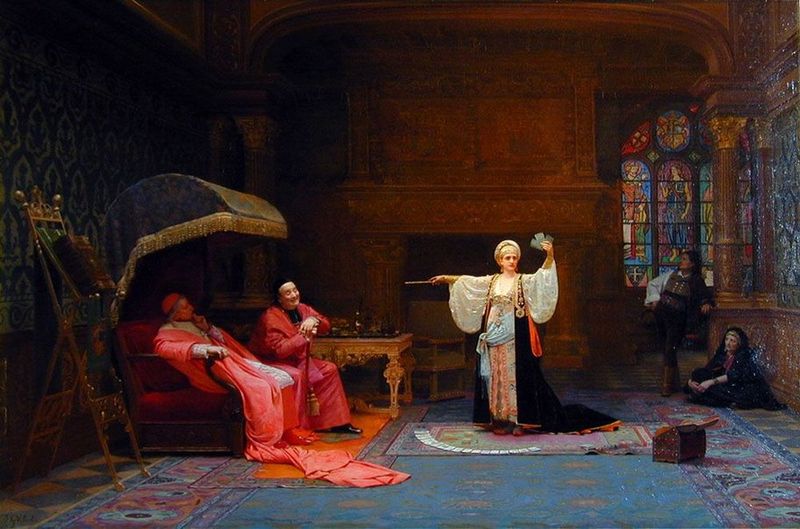
The fortune-teller image above is much later than 1454, but it captures the same dramatic idea: confidence, attention and trust can be manufactured without visible force.
Related Magic
Related Spells
- Suggestion — pushes a target toward a specific course of action.
- Command — compels a brief action rather than creating friendship.
- Dominate Person — far stronger mental control.
- Modify Memory — changes recollection rather than disposition.
- Zone of Truth — concerns truthful speech rather than friendliness.
- Calm Emotions — suppresses powerful emotion and can defuse confrontation.
- Bard Spells
Sources & Licensing
Rules Sources and Licensing
The 2014 rules summary adapts the System Reference Document 5.1 by Wizards of the Coast LLC, under Creative Commons Attribution 4.0 International. The edition summaries use paraphrased wording and separate commentary.
The 2024 and 2014 panels follow the corresponding public D&D spell entries. Pathfinder 1e and D&D 3.5e use their open rules versions. Their different break conditions, duration models and social procedures are intentionally kept separate.
Keep this reference growing
If this page helped with your reading or game, you can support its upkeep or explore the curated books.
Explore the Bookshop — epics, classics and stories behind imagined worlds.